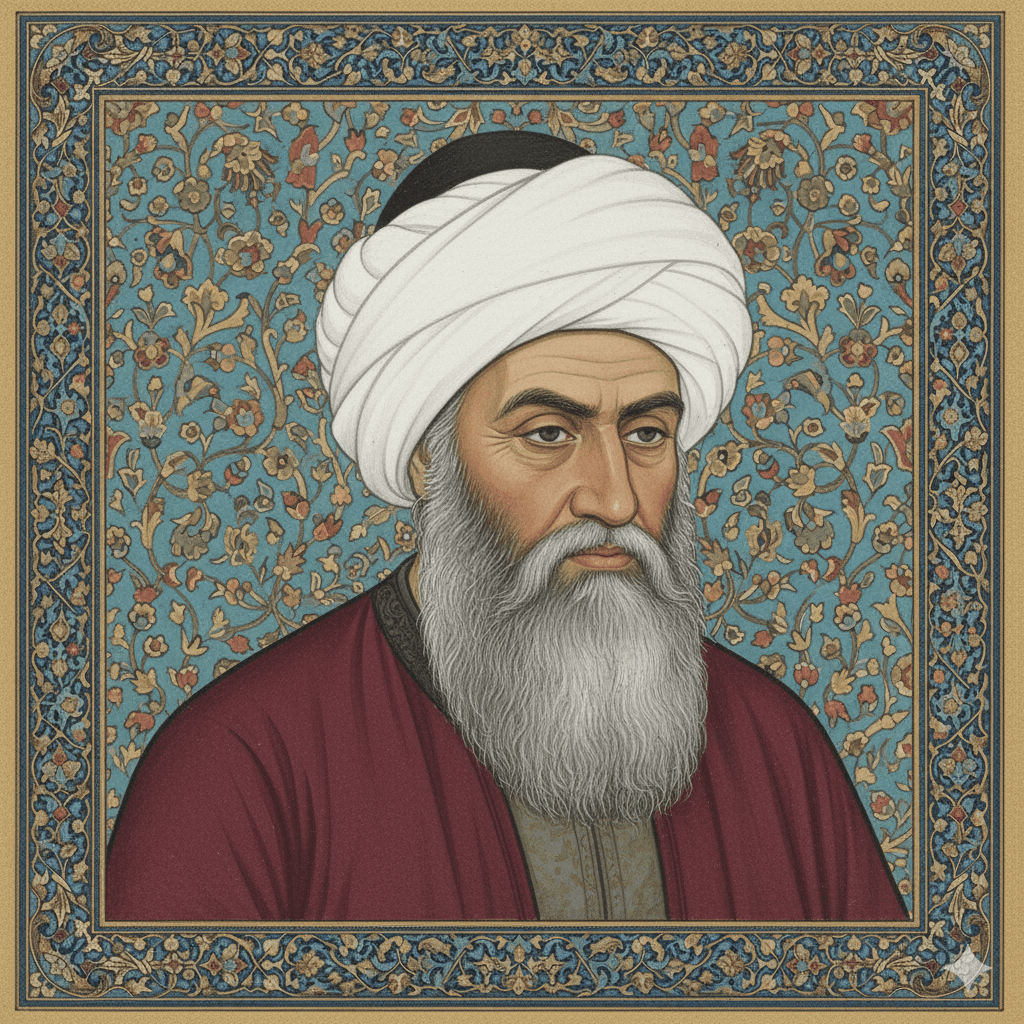


Yusuf Has Hâcib: In Pursuit of the Blessed Knowledge
Once, in the city of Balasagun—one of the wise cities of Central Asia—lived a sage who wrote a book to help people find truth and live justly. His name was Yusuf Has Hâcib. Though centuries have passed, his ideas still illuminate humanity today! Let us embark on the journey of discovery.
🏡Birth and Place of Origin
Yusuf Has Hâcib was born in the early 11th century in the city of Balasagun, located within the borders of present-day Kyrgyzstan. At that time, Balasagun was one of the major cultural and scientific centers of the Karakhanid State. The city was rich in learning and the arts, and it was this environment that nurtured Yusuf Has Hâcib’s curiosity for knowledge.

City of Balasagun in the 11th century, representative (image generated by artificial intelligence).
👨🏻👩🏻👦🏻Family and Education
Although little is known about Yusuf Has Hâcib’s family, it is well established that he received an excellent education. From an early age, he learned Arabic and Persian, and developed expertise in literature, mathematics, philosophy, and religion. He loved books and used his knowledge to benefit others.
✍️What Did He Do?
Yusuf Has Hâcib was not merely a poet; he was also a sage, thinker, and statesman. He devoted his life to writing works that would serve as guides for people to achieve happiness in both this world and the hereafter. Through his writings, he explored themes of justice, truth, wisdom, and virtuous living.

Yusuf Has Hâcib writing his work, representative (image generated by artificial intelligence).
👑How Did He Earn the Title “Has Hâcib”?
When Yusuf Has Hâcib presented his major work, Kutadgu Bilig, to the Karakhanid ruler Tabghach Bugra Khan, the ruler was deeply impressed. In recognition of this masterpiece, he awarded Yusuf the title “Has Hâcib,” which means “the most trusted and wise official of the court.” Thus, Yusuf Has Hâcib became a respected sage at the royal court and secured his name in history.

Yusuf Has Hâcib presenting his work to the ruler, representative (image generated by artificial intelligence).
📖His Works and Poetic Legacy
Yusuf Has Hâcib’s only known work is:
Kutadgu Bilig (“Blessed Knowledge” or “Knowledge That Brings Happiness”).
This work is both a poetic anthology and a book of moral instruction. Written in the aruz meter and in Karakhanid Turkish, it teaches people how to lead a just, virtuous, and happy life. It also instructs rulers on how to govern their states with justice. In his poetry, Yusuf Has Hâcib emphasized wisdom, ethics, and love for humanity.

Page from the copy of Kutadgu Bilig exhibited at the Cairo Museum (Turkish Education Encyclopedia).
🌍The Significance of Kutadgu Bilig and Its Contribution to the Present
Kutadgu Bilig is not only a landmark of Turkish literature but also a vital work in the history of world thought. In this book, topics ranging from state governance to individual morality are systematically addressed.
Even today, scholars draw lessons from his ideas on justice, truth, and wisdom. Yusuf Has Hâcib demonstrated the power of the Turkish language and became one of the foundational pillars of Turkish culture.