+2 More

Location | Doğanyurt Village Türkiye Aydın Çine | ||||||||
|---|---|---|---|---|---|---|---|---|---|
Region(s) | Ancient Caria | ||||||||
Founded | Before 3rd century BCE | ||||||||
Historical Period(s) | Hellenistic Byzantine Roman | ||||||||
Excavations | First excavations 1905–1906; regular excavations since 1999 | ||||||||
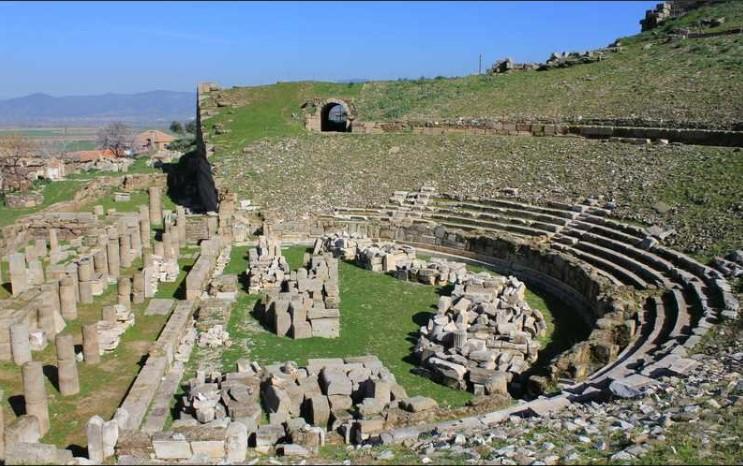
Alabanda is an ancient settlement located in the ancient region of Caria, within the borders of Çine district in Aydın Province, modern-day Türkiye. The ancient city is situated within the boundaries of Doğanyurt village, which belongs to Çine, specifically on Araphisar, a neighborhood of this village. The city spans the slopes of two hills that are extensions of Karadağ, spreading towards the Çine Plain. Known for its archaeological remains and historical records, Alabanda was an important settlement during the Hellenistic, Roman, and Byzantine periods.
.JPG&w=1280&q=75)
Alabanda Ancient City (Türkiye Culture Portal)
The name Alabanda is derived from the Carian words “ala” (horse) and “banda” (race). The Byzantine historian Stephanos states that the city received this name after King Kar’s son, Alabandos, won a horse race. The Roman orator and writer Cicero, on the other hand, claims that the name comes from the Carian god Alabandos. Around the late 3rd century BCE, the city was renamed Khrysor Antiokhia by the Seleucid king. An inscription from Delphi mentions that, at the request of Antiochus III, the Amphictyonic League granted the city immunity and that the city was dedicated to Zeus Khrysaoeos and Apollo Isotimos.
Alabanda is not mentioned during Alexander the Great’s Anatolian campaign, but information about the city begins to appear in historical records after the late 3rd century BCE. It is known that in 190 BCE, King Philip V of Macedonia destroyed the city before the Battle of Magnesia. After the war, under the Treaty of Apamea in 188 BCE, the city became part of the Caria region, which was assigned to Rhodes; however, Rhodes established only limited control there. In 167 BCE, Alabanda sided with Mylasa against Rhodes, demonstrating a stance toward independence. The Roman historian Livy records that in 170 BCE, the people of Alabanda sent envoys to Rome presenting a golden crown and gifts.
The city began minting its first coins in the 3rd century BCE, when it was known as Antiokheia Khrysaoreus. These coins featured the figure of Pegasus (the winged horse), which is believed to be linked to the city’s mythological founding story. In 70 BCE, when Rome solidified its control over Anatolia, Alabanda was incorporated into the Roman system as the 21st city of the province of Asia. In 48 BCE, with Ephesus declared the provincial capital, Alabanda became a regional center, overseeing cities such as Miletus, Priene, Tralles, and Nysa.
During the 1st and 2nd centuries BCE, the city maintained good relations with Rome. In 22 CE, Emperor Tiberius once again awarded Alabanda the right to immunity. The geographer Strabo mentions the wealth and luxury of the people of Alabanda and particularly notes that the girls in the city were skilled at playing the harp.
.JPG&w=1280&q=75)
Alabanda Ancient City (Türkiye Culture Portal)
In the 4th century CE, Alabanda became part of the Byzantine Empire and later served as a bishopric under the Metropolis of Aphrodisias. The city came under Turkish rule in the 11th century. Although it changed hands during the Crusades, from 1280 onwards it remained under Turkish control.
The first archaeological excavations at Alabanda were carried out in 1905–1906 by Halil Ethem Bey. During these excavations, the foundations of two temples were uncovered. In addition to the bouleuterion, one of the city’s most notable structures, various architectural remains such as a theater, aqueduct, and necropolis have survived to the present day. Especially in the eastern section, numerous sarcophagi indicate the location of the necropolis in this area. Scientific excavations at the ancient city have been ongoing since 1999 under the supervision of the Aydın Museum Directorate, affiliated with the Ministry of Culture and Tourism.
.JPG&w=1280&q=75)
Alabanda Ancient City (Türkiye Culture Portal)
Alabanda Ancient City is located about 4 kilometers west of the Çine River (ancient Marsyas), built on the slopes of two hills. Today, the site is accessible via an asphalt road and lies along a route leading to Alinda. A road passing through the center of the ancient settlement facilitates easy access to the area and allows visitors to reach the city’s ruins.
T.C. Aydın Valiliği İl Kültür ve Turizm Müdürlüğü. “Alabanda (Araphisar).” T.C. Kültür ve Turizm Bakanlığı. Accessed June 25, 2025. https://aydin.ktb.gov.tr/TR-64417/alabanda-araphisar.html.
Türkiye Cumhuriyeti Kültür ve Turizm Bakanlığı. “Alabanda Ören Yeri.” Müze.gov.tr. Accessed June 25, 2025. https://muze.gov.tr/muze-detay?SectionId=ALA01&DistId=MRK.
Türkiye Kültür Portalı. “Alabanda Antik Kenti - Aydın.” T.C. Kültür ve Turizm Bakanlığı. Accessed June 25, 2025. https://www.kulturportali.gov.tr/turkiye/aydin/gezilecekyer/alabanda--araphisar--.

Location | Doğanyurt Village Türkiye Aydın Çine | ||||||||
|---|---|---|---|---|---|---|---|---|---|
Region(s) | Ancient Caria | ||||||||
Founded | Before 3rd century BCE | ||||||||
Historical Period(s) | Hellenistic Byzantine Roman | ||||||||
Excavations | First excavations 1905–1906; regular excavations since 1999 | ||||||||
No Discussion Added Yet
Start discussion for "Alabanda Ancient City" article
Name and Origin
History
Byzantine Period and Afterwards
Archaeological Findings and Structures
Geographic Location and Access
This article was created with the support of artificial intelligence.