

+2 More

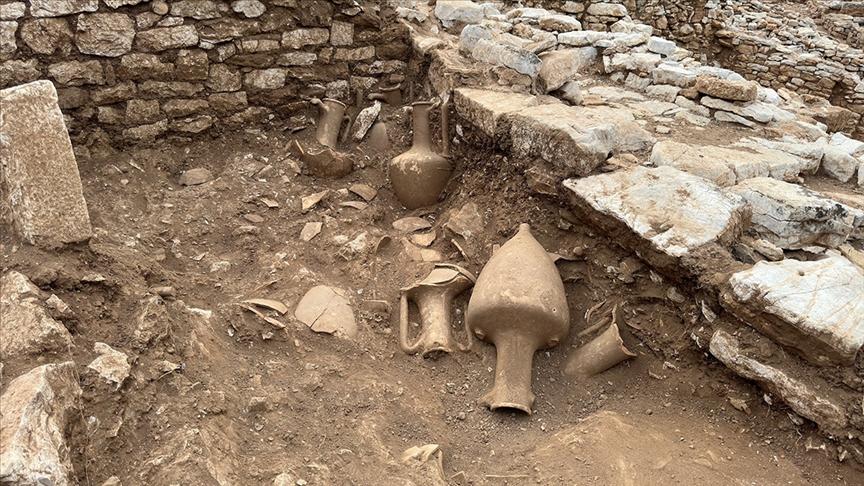
Amphorae found in the Ancient City of Amos. (Anadolu Agency)
Location | Turuç Türkiye Muğla Marmaris | ||||||||
|---|---|---|---|---|---|---|---|---|---|
Foundation | 6th century BCE | ||||||||
Administration | Attica-Delos Maritime League, Rhodos, Rome | ||||||||
Architectural Structures | City Walls, Theater, Temple, Necropolis | ||||||||
The Ancient City of Amos is located within the borders of Turunç Neighborhood, Marmaris District, Muğla Province, Türkiye. The ancient city is situated on Asarcık Hill, also known as Hisar Burnu. Amos is approximately 20 km from Marmaris and is positioned on a peninsula extending eastward. Surrounded by natural bays to the north and south, this region has held strategic and economic significance throughout history.
The city can be reached by a one-hour walk from Turunç or a half-hour walk from Kumlubük. The bays surrounding Amos served as small-scale harbors in ancient times, allowing the city to participate in maritime trade.

Amphorae found in the Ancient City of Amos. - Anadolu Agency
Amos is known as one of the ancient settlements of Karia Khersonesos (Bozburun Peninsula). Archaeological findings indicate that the city has been inhabited since the 6th century BCE. The earliest historical record of Amos dates back to the 5th century BCE, appearing in the Athenian Tribute Lists under the name “Amioi”. During this period, the city was recorded as a member of the Attica-Delos Maritime League, paying an annual tax to the alliance.
In 408 BCE, when the cities of Lindos, Ialysos, and Kamiros united to form the Rhodian state, Amos and the surrounding settlements became part of this new political structure. Thus, Amos was incorporated into Rhodos’ Peraia and was administratively controlled by Lindos. The city's close economic and political ties with Rhodos throughout the Hellenistic period are confirmed by lease contracts and archaeological findings. Especially, agreements related to agricultural production and land leases provide insights into Amos’ economic activities.
In 227 BCE, a major earthquake in Rhodos also affected Amos and its surroundings. However, the city quickly recovered and continued its existence. In 201 BCE, Amos experienced a short-term occupation by Macedonian King Philip V, but in 197 BCE, Rhodos regained control after its victory. With the increasing dominance of Rome in the region, Amos remained under Rhodian rule until the 2nd century CE, after which it, like other cities in the area, came under Roman administration.
Amos was built as a fortified hill settlement typical of the Hellenistic period. The city walls, towers, and gates reflect a strong defense system. The most remarkable structures in Amos include the theater and a small temple.
The economy of Amos was primarily based on agricultural production. Epigraphic documents reveal that the city leased out its agricultural lands. Amos established strong commercial ties with Rhodos and Knidos, particularly playing a key role in amphora trade.
Archaeological surface surveys conducted in 2019 uncovered ceramic remains that confirm Amos was an inhabited settlement since the Archaic period and had an extensive trade network during the Hellenistic period. The discovery of Rhodian and Knidian amphorae in Amos demonstrates the city's role in Mediterranean trade.
As an important settlement of Karia Khersonesos, Amos held strategic significance throughout history. The city was integrated into Rhodos’ Peraia during the Hellenistic period and stood out for its economic activities. Archaeological evidence suggests that Amos' settlement history dates back to the 6th century BCE and that it thrived during the Hellenistic period. The theater, temple, city walls, and necropolis all indicate that Amos was a well-developed settlement throughout antiquity.
Gürbüzer, Mehmet. "Amos’ta Yeni Araştırmalar ve Bulgular." Cedrus: The Journal of MCRI IX (2021): 219-249.
Kesen, Sabri. "Amos Antik Kenti'nde 10 Amfora Bulundu." Anadolu Ajansı. News Date: 17.01.2024. Access Date: 13.03.2025. https://www.aa.com.tr/tr/kultur/amos-antik-kentinde-10-amfora-bulundu/3111690
T.C. Kültür ve Turizm Bakanlığı. Muğla İl Kültür ve Turizm Müdürlüğü. "Nereye Gidilir?" Access Date: 13.03.2025. https://mugla.ktb.gov.tr/TR-296583/nereye-gidilir.html
T.C. Kültür ve Turizm Bakanlığı. Muğla İl Kültür ve Turizm Müdürlüğü. "Turunç" Access Date: 13.03.2025. https://mugla.ktb.gov.tr/TR-270734/turunc.html
Yaman, Asil. "Amos Arkeolojik Yüzey Araştırmalarında Ele Geçen Seramikler." OLBA XXX. Mersin Üniversitesi Kilikia Arkeolojisini Araştırma Merkezi Yayınları. Mersin (2022): 113-128.

Amphorae found in the Ancient City of Amos. (Anadolu Agency)
Location | Turuç Türkiye Muğla Marmaris | ||||||||
|---|---|---|---|---|---|---|---|---|---|
Foundation | 6th century BCE | ||||||||
Administration | Attica-Delos Maritime League, Rhodos, Rome | ||||||||
Architectural Structures | City Walls, Theater, Temple, Necropolis | ||||||||
Historical Development and Significance
Architectural Structures and Urban Planning
City Walls
Theater
Temple (Sanctuary of Apollo Samnaios)
Necropolis
Economic and Trade Relations
This article was created with the support of artificial intelligence.