

+4 More

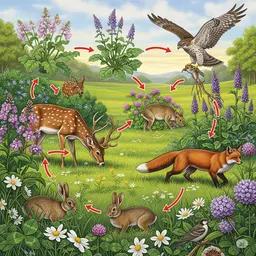
Energy Flow (Generated with AI)
Primary Energy Source | The Sun | ||||||||
|---|---|---|---|---|---|---|---|---|---|
Direction of Flow | Unidirectional: From producer → consumer → decomposer | ||||||||
Energy Transfer Efficiency | Approximately 10% (Known as the Lindeman Law in ecology) | ||||||||
Main Component(s) | Producers (Autotrophs): Convert solar energy into chemical energy. Consumers (Heterotrophs): Obtain energy by consuming producers or other consumers. Decomposers (Saprotrophs): Break down dead organisms and recycle nutrients back into the system. | ||||||||
Visualization Models | Energy Pyramid: Illustrates the amount of energy at each trophic level. Food Web: Represents the complex feeding relationships within an ecosystem. | ||||||||
Accumulation at Higher Levels | Biological Accumulation (Bioaccumulation): The gradual buildup of toxic substances (e.g., DDT, mercury, radionuclides) through trophic levels, leading to higher concentrations in top predators. | ||||||||
Energy flow is the process by which energy is transferred among organisms in an ecosystem through feeding relationships. Essential for the continuity of ecosystems, this process represents the unidirectional movement of energy from producers to consumers and finally to decomposers. Through this flow, organisms obtain the energy required to sustain their vital activities.
The primary energy source in any ecosystem is the Sun. Solar energy is captured and used by organisms, and part of it is released into the environment as heat, which cannot re-enter the energy cycle. For this reason, energy flow is considered unidirectional. The balance and stability of this process depend closely on the roles of producers, consumers, and decomposers within the ecosystem.
In almost all ecosystems, the Sun serves as the primary source of energy. Solar radiation is converted into chemical energy by photosynthetic organisms, known as producers. This transformation process is called photosynthesis. Producers—such as green plants, algae, and some bacteria—use inorganic substances like water and carbon dioxide to synthesize organic compounds with the aid of sunlight. The chemical bonds within these organic molecules store energy, forming the first link of the food chain. The energy stored by producers is transferred to other organisms through feeding interactions, marking the starting point of energy flow within the ecosystem.
Organisms in an ecosystem are classified based on how they obtain food and energy. These groups form the trophic levels, or stages of energy transfer.
Organisms that can produce their own food. They synthesize organic matter from inorganic materials, storing energy in the process.
Organisms that obtain the energy they need by consuming other organisms. They cannot produce their own food and are divided into several subgroups:
Organisms that feed on dead organisms and organic waste (such as feces or fallen leaves). Bacteria and fungi are key members of this group. Decomposers convert organic matter into inorganic compounds, ensuring nutrient recycling and enabling producers to reuse these materials. As they interact with all trophic levels, decomposers are vital for ecosystem continuity.
A linear sequence showing how energy is transferred from one organism to another. Each link consumes the previous one as food.
Examples:
In nature, most organisms feed on multiple species and are prey to several others, forming complex feeding networks. A food web consists of interconnected food chains, offering a more realistic representation of energy transfer and species interactions within an ecosystem.
A keystone species is one whose impact on ecosystem structure and stability is disproportionately large relative to its population size. Removing such a species can trigger cascading effects, disrupting the balance of the food web. For example, the removal of sea stars from an ecosystem may cause uncontrolled growth of mussel populations, displacing other species.
The energy pyramid is a conceptual model used to illustrate the flow of energy and distribution of biomass within ecosystems. It represents the amount of energy, biomass, or number of organisms at each trophic level.
The decrease in energy at higher trophic levels occurs because a significant portion of energy is lost as heat or used in metabolic activities such as movement, respiration, reproduction, and thermoregulation. Typically, only about 10% of the energy from one level is transferred to the next — a principle known as the “10% Rule” or Lindeman’s Law. For example, if producers contain 1000 kcal, primary consumers receive about 100 kcal, and secondary consumers only about 10 kcal. This progressive loss limits the length of food chains and determines how many organisms each level can support.
These patterns illustrate the fundamental ecological principles governing energy distribution and ecosystem organization.
Bioaccumulation refers to the buildup of persistent toxic substances (e.g., DDT, mercury, cyanide, radioactive isotopes) within the tissues of living organisms through the food chain. These substances are stored in fatty tissues and are difficult to eliminate. Unlike energy, which decreases at higher levels, the concentration of toxins increases with each trophic step — a process known as biomagnification. As a result, top predators and humans face higher health risks due to elevated toxin accumulation.
Akpınar, Adem, Murat İhsan Kömürcü, Murat Kankal, İsmail Hakkı Özölçer, and Kamil Kaygusuz. “Energy Situation and Renewables in Turkey and Environmental Effects of Energy Use.” Renewable and Sustainable Energy Reviews 12, no. 8 (2008): 2013–2039. https://doi.org/10.1016/j.rser.2007.04.011
Cebrian, Just. “Energy Flows in Ecosystems.” Science 349 (2015): 1053–1054. Accessed July 26, 2025. https://doi.org/10.1126/science.aad0684
Education National Geographic. “Energy Flow Through Ecosystem.” National Geographic Education. Accessed July 26, 2025. https://education.nationalgeographic.org/resource/resource-library-energy-flow-through-ecosystem
Education National Geographic. “Food Chain.” National Geographic Education. Accessed July 26, 2025. https://education.nationalgeographic.org/resource/food-chain/
Morris, Sherri J., and Christopher B. Blackwood. “The Ecology of the Soil Biota and Their Function.” In Soil Microbiology, Ecology and Biochemistry, edited by Eldor A. Paul, 273–309. 4th ed. Academic Press, 2015. https://doi.org/10.1016/B978-0-12-415955-6.00010-4
Odum, Eugene P. “Energy Flow in Ecosystems: A Historical Review.” American Zoologist 8, no. 1 (February 1968): 11–18. Oxford University Press Accessed July 26, 2025. https://www.jstor.org/stable/3881528
Zhang, J., and L. Guo. “Scaling Behaviors of Weighted Food Webs as Energy Transportation Networks.” arXiv (2010). https://doi.org/10.1016/j.jtbi.2010.03.024

Energy Flow (Generated with AI)
Primary Energy Source | The Sun | ||||||||
|---|---|---|---|---|---|---|---|---|---|
Direction of Flow | Unidirectional: From producer → consumer → decomposer | ||||||||
Energy Transfer Efficiency | Approximately 10% (Known as the Lindeman Law in ecology) | ||||||||
Main Component(s) | Producers (Autotrophs): Convert solar energy into chemical energy. Consumers (Heterotrophs): Obtain energy by consuming producers or other consumers. Decomposers (Saprotrophs): Break down dead organisms and recycle nutrients back into the system. | ||||||||
Visualization Models | Energy Pyramid: Illustrates the amount of energy at each trophic level. Food Web: Represents the complex feeding relationships within an ecosystem. | ||||||||
Accumulation at Higher Levels | Biological Accumulation (Bioaccumulation): The gradual buildup of toxic substances (e.g., DDT, mercury, radionuclides) through trophic levels, leading to higher concentrations in top predators. | ||||||||
Primary Energy Source of the Ecosystem
Feeding Relationships and Trophic Levels
Producers (Autotrophs)
Consumers (Heterotrophs)
Decomposers (Saprotrophs)
Food Chain and Food Web
Food Chain
Food Web
Keystone Species
Energy Pyramid
Changes Observed in Energy Pyramids
Biological Accumulation (Bioaccumulation)
This article was created with the support of artificial intelligence.