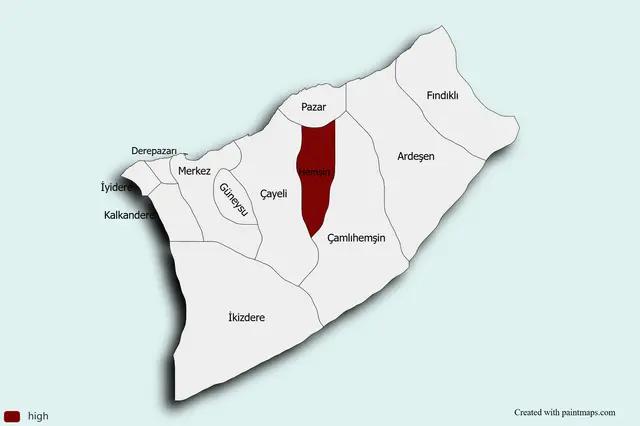
Hemşin (District)
Province(s) | Rize | ||||||||
|---|---|---|---|---|---|---|---|---|---|
Area(s) | Black Sea | ||||||||
Climate(s) | Black Sea climate | ||||||||
Altitude | 315m | ||||||||
Population | 2,422 (2024) | ||||||||
Economy | Small livestock farming Beekeeping Tea cultivation | ||||||||
Tourism Spots | Nature hiking trails plateaus traditional Hemşin houses | ||||||||
Mayor(s) | Halim Kazım Bekar | ||||||||
District Governor | Fatma Bayalan | ||||||||
Local Products | Kale wraps Muhlama Hemşin honey | ||||||||
Hemşin , a district of Rize province , is one of the districts of the Eastern Black Sea region with a unique cultural identity. in the northern foothills of the Kaçkar Mountains , which run parallel to the Black Sea coast, the district boasts a mountainous and rugged geography. Located approximately 20 kilometers inland, the Hemşin region is notable for its characteristic natural landscape, rich flora, and high plateaus. Stretching east- west from Anzer to the villages of Hemşin in Georgia's Adjara region, this region has been shaped by diverse cultural influences throughout history and continues its economic and cultural vitality today through local activities such as farming, beekeeping, and traditional handicrafts .
Although the historical past of the Hemşin region cannot be directly documented , it is reported that it was known as "Dambur" in mythological times and that its center was located around the present-day village of Hala . Information from the pre-conquest period is largely based on the notes of travelers and clerics, and this information is often contradictory. According to the most common account, the Amad-Uni (Hamadani) tribe, originating from Hamedan , migrated to the region in 620 AD under the leadership of Hamam . This event was mentioned in the chronicles of Armenian historians such as Mamikonian, Asoghik, and Ghewond . In reference to Hamam, the leader of the migration, the region was called "Hamam-Şen" (the place where Hamam makes life joyful); this expression eventually evolved into "Hemşin." However , some researchers argue that the name "Hemşin" derives from the Persian words "hem" ( unity , togetherness) and "nişin" (settlement).
It is reported that Kipchak and Cuman Turks were settled in the Hemşin region in the mid-1400s, as in the entire Eastern Black Sea region. These peoples, after adopting Christianity under Byzantine influence, turned to the Gregorian sect. Over time, they reconverted to Islam under the influence of the Akkoyunlu Turkmens in the region. With the Ottoman conquest of the Greek Empire in 1461 , the Hemşin region came under Ottoman rule. Land registry records dated 1481 indicate that Hemşin had the status of a fief, headed by a zaim named Karaca Nişi. In 1515, the region was under the administration of Serasker Ali Koruk ; in 1518, it was allocated as a " has " to
Another census from the reign of Suleiman the Magnificent indicates that Hemşin was divided into four sub-districts: Hemşin, Eksanos, Kuşova, and Mihmanos. It shows that there were 1,105 households in 30 villages and two neighborhoods, and 57 mills in operation. The name Mihmanos appears in records for the first time during this period, and it appears that the central sub-district of Hemşin was known by this name. An undated register number 122 in the archives of the General Directorate of Land Registry and Cadastre states that Hemşin was registered as a district of Sanjak , with 1,307 households in 31 villages and two neighborhoods.
According to 1681 Avarız taxation records, Hemşin was affiliated with the Gönye liva and consisted of 25 villages and 25 neighborhoods. With the spread of the ayanlık system in the 18th century, local powers rose to prominence in Hemşin; imperial edicts dated 1788 and 1789 requested soldiers for the Ottoman army from Siçanoğlu Hüseyin Ağa . Documents from 1827-28 indicate that a request for 1,000 soldiers was made from Hemşin and distributed among various ayans.
According to the 1876 yearbook, Hemşin had 43 villages; only nine of these are within the current borders of Hemşin. In 1886, the Senoz region was separated from Hemşin and attached to Mapavri (Çayeli). In 1916, when plans were made to change place names, the idea of renaming Hemşin "Kadı District" was considered, but this plan was not implemented due to the Russian occupation. Hemşin was reattached to Pazar as a sub-district in 1924 and regained district status in 1990.
Hemşin is located in the inland area of Rize Province in Türkiye's Eastern Black Sea Region . Situated on the northern slopes of the Kaçkar Mountains, which run parallel to the Black Sea coastline, the district boasts a unique geographical structure stretching from the coast to the mountain peaks along an approximately 20-kilometer inland . The Hemşin Valley, which forms the region's backbone, acts as a natural gateway between the coastline and the high mountain ranges. Traveling north to south along this gateway, one passes through the villages of Hemşin approximately 20 kilometers from the coast, clearly experiencing the region's boundaries . Locals refer to the coastline beyond these boundaries as "Lazlık" (Lazlık), and the mountainous areas further inland as "Hemşinlik."
The western border of the Hemşin region, which extends east-west, begins with the Anzer region and continues through the Cimil, Senoz, Salvizan, Büyükdere, Yukarı Hemşin, and Hopa Hemşin regions, extending eastward to the three Hemşin villages of the Autonomous Republic of settlements such as Saleçur, Hoderçur, Hevek, and Barhal . Due to the region's steep, rugged, and high altitude, land use is limited. This topography has significantly shaped the settlement pattern and agricultural activities.
Hemşin's climate is typical of the Eastern Black Sea region. The region receives regular rainfall throughout the year, resulting in high humidity . The district's mountainous terrain creates microclimatic variations, which foster the development of diverse have fostered a rich diversity of vegetation and natural flora, making Hemşin a suitable environment for activities such as beekeeping, transhumance, and organic farming .
The Hemşin district's economic structure is predominantly based on agriculture, animal husbandry, beekeeping, and small- scale handicrafts. While the district's mountainous and rugged topography limits large-scale agricultural production, its microclimatic advantages have led to specialization in the cultivation of certain crops. Tea is the most prominent agricultural product, and tea cultivation is concentrated in the villages of Akyamaç, Bilen, Çamlıtepe, Hilal , Kantarlı, Levent , Nurluca, and Yaltkaya, as well as in the central neighborhoods . In addition to tea , corn, beans, kale, and potatoes are also grown for household consumption. In Kantarlı village, eggs are produced using ecological methods.

Hemşin Stream ( Republic of Türkiye Hemşin District Governorship )
Livestock farming in the district is generally carried out as a family operation. Large-scale livestock farming is uncommon due to the scattered nature of the settlements. Since approximately one-third of the district's land is covered by plateaus, plateau farming increases significantly during the summer months, particularly with the arrival of livestock from surrounding districts. cattle breeds are widely raised in Hemşin; dairy products are primarily used for home consumption as yogurt, cheese, and butter , while surplus produce is sold to local markets. The district's headcount during the summer months is reported to reach around 2,000.
Beekeeping plays a significant role in Hemşin's traditional and sustainable economy. The district boasts approximately 3,000 hives, both natural and natural, and thanks to its rich flora, the honey produced is of high quality and is popular in surrounding provinces and districts. Indeed, Hemşin honey has gained international recognition, winning first prize at a food fair in Italy. This demonstrates the qualitative value of the honey produced in the district and the economic potential of beekeeping.

Hemşin Honey ( Republic of Türkiye Hemşin District Governorship )
Hemşin's current population, according to 2024 data, is 2,422. Of this population, 1,252 are male and 1,170 are female. When considering the gender ratio, males constitute 51.69% of the total population, while females constitute 48.31%. While the slight male predominance in the district's population is striking, this is also linked to Hemşin's economic and social structure.
Hemşin, which has historically had a highly dynamic demographic structure, continues to exist not only with its settled population but also with communities of Hemşin origin living in large cities. As a result of ongoing migration movements throughout the 20th century, a significant portion of the Hemşin population migrated outside Rize, particularly to major cities such as Istanbul, , and Izmir. Some estimates from the 1960s and 1980s suggest that the total population of Hemşin origin may have been between 50,000 and 70,000 people. According to the 1990 census, approximately 73% of the Hemşin district's population lived in villages. However, this ratio has reversed today, with a significant increase in the number of Hemşin residing in cities.
Located at the foothills of the Kaçkar Mountains, Hemşin offers significant potential for nature tourism with its high-altitude plateaus, deep valleys, and rich flora. The plateau culture, particularly active in the summer months, offers a favorable environment for activities such as hiking, photography, and ecotourism . The low pressure from construction has largely preserved the district's traditional architecture and rural character, making it attractive to visitors seeking an authentic
From a cultural heritage perspective, one of the most distinctive elements of Hemşin is its clothing culture. The Hemşin scarf and Hemşin socks stand out as symbols of identity, beyond their functionality in the region's women's clothing. The traditional scarf is worn as a long , thin wrapped around the head, while hand-knitted socks, with their colorful patterns and symbolic motifs, represent a cultural memory. These products are not just clothing items; they are also examples of craftsmanship passed down from generation to generation. Scarf weaving was once a domestic production process, gradually being replaced by outsourced production. Today , scarves, in their traditional style, still play a part in the daily and ceremonial lives of the region's women.

Hemşin Scarf and Hemşin Socks ( Republic of Tükiye Hemşin District Governorship )
An important part of Hemşin's cultural fabric is its local music. Folk songs unique to the region revolve around themes of nature, exile , highland life, and emotional themes. Songs like "Hemşin'in Yaylaları" (Hemşin's Highlands) , "Gel Çıkalım Konağa" (Gel Çıkalım Konağa), and "Hayde Gidelum Hayde" (Come on, let's go) hold a significant place both in the local musical repertoire and in Black Sea music in general. These folk songs are considered among the areas where oral culture is kept alive and are frequently performed at weddings, highland festivals, and social gatherings.
Hemşin cuisine, on the other hand, is characterized by its simple yet satisfying flavor, shaped by the region's natural resources. As a center for tea production, the district's tea culture is an integral part of daily life. Local agricultural products such as corn, beans , kale, and potatoes also form the basis of the cuisine. Dairy products such as is prominent; its distinctive aroma, derived from the highland flora, carries both nutritional and economic value .
Ersoy, Erhan. ''Economy and gender-based division of labor in Hemşin region.'' Hacettepe University Faculty of Letters Journal no. 26, 1 (1999): 129-143.
Hemsin Municipality. “Geography.” Hemsin Municipality Official Website. Accessed April 17, 2025. https://www.hemsin.bel.tr/sayfa/cografyasi.html
Hemsin Municipality. “Economy.” Hemsin Municipality Official Website. Accessed April 17, 2025. https://www.hemsin.bel.tr/sayfa/ekonomi.html
Hemsin District Governorship. “ The Formation of Hemsin as a District and Its History. ” Hemsin District Governorship Official Website. Accessed April 17, 2025. http://www.hemsin.gov.tr/hemsin-in-ile-olusu-ve-tarihesi
Hemsin District Governorship. “ Hemshin Honey. ” Hemsin District Governorship Official Website. Accessed 17 April 2025. http://www.hemsin.gov.tr/hemsin-bali-
Hemsin District Governorship. “ Organic Tea. ” Hemsin District Governorship Official Website. Accessed April 17, 2025. http://www.hemsin.gov.tr/organik-cay
Hemsin District Governorship. “ Hemsin Scarf and Hemsin Socks. ” Hemsin District Governorship Official Website. Accessed 17 April 2025. http://www.hemsin.gov.tr/hemsin-pusisi
Paintmaps. “Turkey Provinces Map – Highlighting Hemşin, Rize.” Erişim tarihi: 15 Nisan 2025. https://paintmaps.com.
Population. ''Hemşin Population - Rize.'' Population Website. Accessed 17 April 2025. https://www.nufusu.com/ilce/hemsin_rize-nufusu
Republic of Turkey Ministry of Culture and Tourism. “Hemşin.” Republic of Turkey Rize Provincial Directorate of Culture and Tourism. Accessed 17 April 2025. https://rize.ktb.gov.tr/TR-55299/hemsin.html

Hemşin (District)
Province(s) | Rize | ||||||||
|---|---|---|---|---|---|---|---|---|---|
Area(s) | Black Sea | ||||||||
Climate(s) | Black Sea climate | ||||||||
Altitude | 315m | ||||||||
Population | 2,422 (2024) | ||||||||
Economy | Small livestock farming Beekeeping Tea cultivation | ||||||||
Tourism Spots | Nature hiking trails plateaus traditional Hemşin houses | ||||||||
Mayor(s) | Halim Kazım Bekar | ||||||||
District Governor | Fatma Bayalan | ||||||||
Local Products | Kale wraps Muhlama Hemşin honey | ||||||||
History
Geography and Climate
Economy
Demographic Structure
Tourism, Culture and Cuisine
This article was created with the support of artificial intelligence.