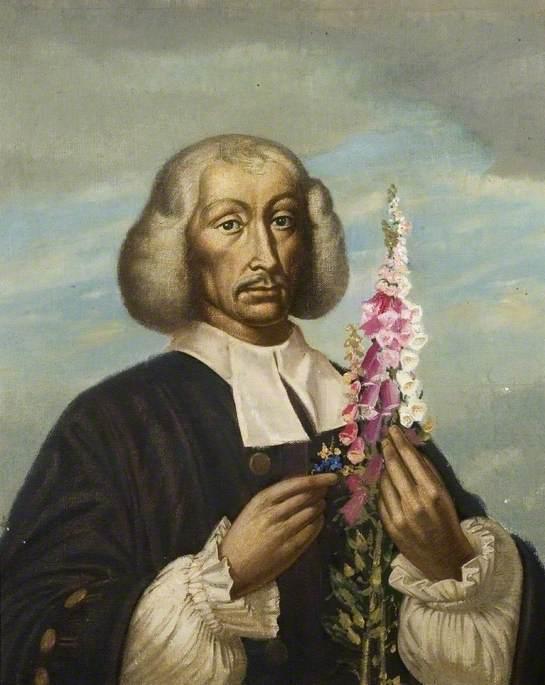

Date of Birth | 1627-11-29 | ||||||||
|---|---|---|---|---|---|---|---|---|---|
Place of Birth | Black Notley, Essex, England | ||||||||
Parents | Roger Ray and Elizabeth Ray | ||||||||
Education | University of Cambridge Braintree Grammar School | ||||||||
Fields of Study | Natural Theology Zoology Botany | ||||||||
Scientific Travels | Wales Scotland England | ||||||||
Publications | Historia Insectorum (1710) Travels and Observations England The Wisdom of God (1691) Historia Plantarum (1686–1704) Historia Piscium (1686) Methodus Plantarum (1682) Ornithologia (1676) Catalogus Plantarum (1660) | ||||||||
Date of Death | 1705-01-17 | ||||||||
John Ray (1627–1705) was a naturalist renowned for his observations in botany and was referred to in his time as the “Father of Natural History.” Thanks to the language education he received at the University of Cambridge, he wrote his works in Latin, making them influential throughout Europe.
John Ray was born on November 29, 1627, in the village of Black Notley, Essex, England. His father was a blacksmith named Roger Ray, and his mother was Elizabeth Ray. He began his education at the grammar school in Braintree, where he developed skills in Latin, penmanship, and memorization. In 1644, he was admitted to Catherine Hall (later transferred to Trinity College) at the University of Cambridge. There, he studied classical languages (Latin) and completed his bachelor’s degree in 1647–48 and his master’s degree in 1651. He taught Greek, mathematics, and the humanities at various times.
In 1649, Ray was elected as a fellow at Trinity College. However, with the enactment of the “Act of Uniformity” in 1662—which was seen as a restriction of freedom of expression—he resigned from his university position, as he refused to take the oath required by the act. As a result, he lost both his church office and academic position.
Ray is considered one of the first naturalists to systematically record his observations of plants and animals. His Catalogus Plantarum circa Cantabrigiam nascentium, published in 1660, was his first major work and included observations in both botany and entomology. In the following years, he published works such as Methodus Plantarum (1682) and the three-volume Historia Plantarum (1686, 1688, 1704).
He also made important contributions to entomology. His descriptions of insect developmental stages, parasites, and behaviors were compiled in Historia Insectorum (1710). He made observations on the structure of honeycombs, ant behavior, and the foam produced by spittlebugs.
During the 1650s and 1660s, Ray conducted natural observations in Northern England, Wales, Scotland, and on the continent of Europe. Some of these journeys were made with his student and patron Francis Willughby. The two decided to divide their work, with Ray focusing on plants and Willughby on animals. After Willughby’s death, Ray completed and published his work. Ornithologia (1676) and Historia Piscium (1686) are products of this collaboration.
One of Ray’s most widely read and influential works was The Wisdom of God Manifested in the Works of Creation (1691). In this work, he presented nature as a reflection of God’s order and wisdom. Ray stated that he approached nature not only with scientific curiosity but also with a sense of religious duty.
From 1679 onward, Ray lived in Black Notley, dedicating his final years to writing and observing nature. He had four daughters with his wife, Margaret Oakley. His daughters also assisted him with his entomological studies. Ray died on January 17, 1705, in his birthplace of Black Notley.
Berry, R. J. “John Ray, Father of Natural Historians.” The John Ray Initiative. Latest access: 26 Haziran 2025.
https://jri.org.uk/wp-content/uploads/2019/10/ray_natural_historian.pdf
“John Ray (1628-1705) ” University of California Museum of Paleontology. Latest access: 12 Temmuz 2025. https://ucmp.berkeley.edu/history/ray.html#:~:text=John%20Ray&text=One%20of%20the%20most%20eminent,Black%20Notley%2C%20Essex%2C%20England.
Art UK “John Ray (1627-1705)”. artuk.org Latest access: 17 Temmuz 2025. https://artuk.org/discover/people/ray-john-22759

Date of Birth | 1627-11-29 | ||||||||
|---|---|---|---|---|---|---|---|---|---|
Place of Birth | Black Notley, Essex, England | ||||||||
Parents | Roger Ray and Elizabeth Ray | ||||||||
Education | University of Cambridge Braintree Grammar School | ||||||||
Fields of Study | Natural Theology Zoology Botany | ||||||||
Scientific Travels | Wales Scotland England | ||||||||
Publications | Historia Insectorum (1710) Travels and Observations England The Wisdom of God (1691) Historia Plantarum (1686–1704) Historia Piscium (1686) Methodus Plantarum (1682) Ornithologia (1676) Catalogus Plantarum (1660) | ||||||||
Date of Death | 1705-01-17 | ||||||||
Early Life and Education
Academic Career and Religious Stance
Scientific Work
Travels and Collaborations
Natural Theology and Intellectual Outlook
Later Years and Death
This article was created with the support of artificial intelligence.