


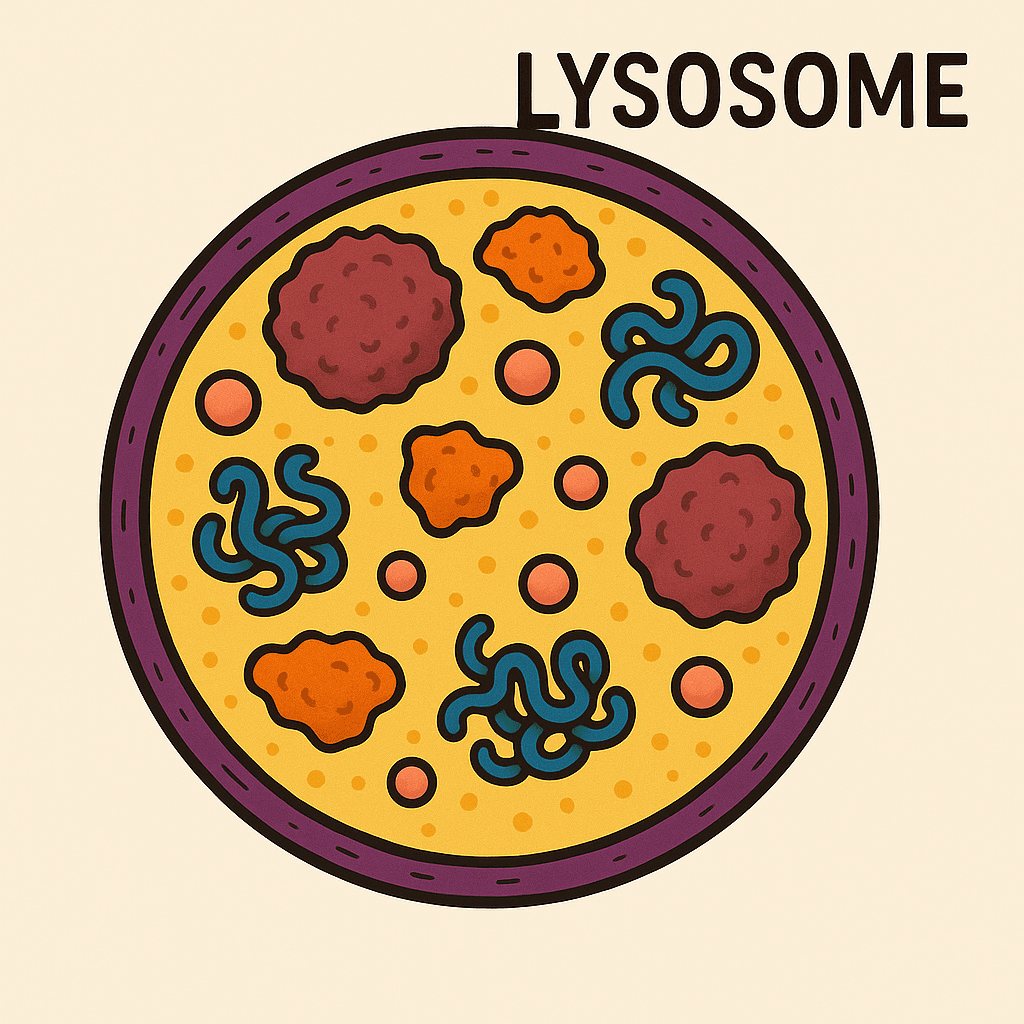
Lysosome Organelle
Structure(s) | Acidic with a pH around 4.5 to 5. Contain apx. 60 different digestive enzymes. Surrounded by a single lipid bilayer membrane. | ||||||||
|---|---|---|---|---|---|---|---|---|---|
Function(s) | Cellular renewal and membrane repair. Regulation of cellular signaling and metabolism. Intracellular defense through degradation of harmful microorganisms. Digestion and recycling of intracellular waste (autophagy). | ||||||||
Lysosomes are small, membrane-bound organelles found in eukaryotic (nucleated) cells. These organelles contain approximately 60 different digestive enzymes that break down large molecules such as proteins, lipids, and carbohydrates. The internal environment of the lysosome is highly acidic (approximately pH 4.5–5) to facilitate the activity of these enzymes.
The integrity of the lysosomal membrane is crucial to prevent the enzymes from damaging the surrounding cell. The inner surface of the membrane is coated with specialized proteins to protect it from the digestive enzymes. Lysosomes act as fundamental centers for cellular cleanup and recycling in eukaryotic cells. They are involved not only in digestion but also play crucial roles in cellular signaling, energy homeostasis, and defense mechanisms.
Lysosomes are enclosed by a single lipid bilayer membrane, which contains various digestive enzymes within its lumen. These enzymes include proteases (which degrade proteins), nucleases (which break down DNA and RNA), lipases (which hydrolyze lipids), and glycosidases (which digest carbohydrates). Due to the acidic nature required for optimal enzyme activity, the internal pH of lysosomes is maintained at a low level, typically around 4.5 to 5. Proton pumps (H⁺-transporting proteins) embedded in the lysosomal membrane are responsible for sustaining this acidic environment.

Lysosome (Generated by Artifical Intelligencce)
Lysosomes are formed via the endosomal pathway, which processes materials internalized by the cell. The Golgi apparatus packages digestive enzymes into vesicles that fuse with early endosomes. These mature endosomes subsequently transform into lysosomes. The transcription factor TFEB regulates this process by activating lysosomal gene expression in response to the cell’s metabolic and nutritional status. TFEB thereby promotes lysosome biogenesis and contributes to cellular renewal processes such as autophagy.
Traditionally considered primarily as digestive organelles, lysosomes are now recognized as key players in intracellular signaling. The mTORC1 protein complex, which regulates cell growth and metabolism, localizes to the lysosomal membrane where it becomes activated. This complex integrates signals related to the cell’s energy availability, amino acid levels, and environmental stressors to determine whether the cell should grow or enter a quiescent state.
Autophagy is a cellular process that removes damaged or obsolete components through self-digestion. In this process, autophagosomes envelop the cellular debris and subsequently fuse with lysosomes, forming autolysosomes. Within these structures, lysosomal enzymes degrade the contents into reusable molecular building blocks. Autophagy is especially critical under conditions such as nutrient deprivation, stress, and aging, serving as a vital mechanism to maintain cellular health.
Damage to the lysosomal membrane poses a significant threat to cellular integrity because the contained enzymes can indiscriminately degrade intracellular components. In such cases, cells recognize and remove damaged lysosomes via lysophagy, a selective form of autophagy. Moreover, lysosomes actively participate in repairing minor disruptions in the plasma membrane, a function particularly important in mechanically stressed cells such as muscle fibers.
Lysosomes also contribute to immune defense by degrading pathogens such as bacteria and viruses that enter the cell. Additionally, they clear cellular debris from dead cells, thereby preserving tissue homeostasis. By recycling intracellular components in response to cellular energy demands, lysosomes optimize resource utilization within the cell.
Impairments in lysosomal function can lead to various serious health conditions. Lysosomal storage disorders (LSDs), including Gaucher, Tay-Sachs, and Pompe diseases, arise from deficiencies in specific lysosomal enzymes, resulting in the accumulation of undigested substrates. Furthermore, lysosomal dysfunction has been implicated in neurodegenerative diseases such as Alzheimer’s and Parkinson’s disease. In cancer cells, altered autophagy and lysosomal activities have been observed, with lysosomes serving as potential targets for therapeutic interventions.
Aksoy, Zeynep Büşra, and Ege Soydemir. “Lysosomal Activity.” Current Journal of Gastroenterology (2016): 345–352. https://guncel.tgv.org.tr/journal/68/pdf/100492.pdf.
Ankara University. “MDF Week 1.” Open Course Materials, 2025. https://acikders.ankara.edu.tr/pluginfile.php/209273/mod_resource/content/0/MDF%20%201.%20HAFTA.pdf.
Ballabio, Andrea, and Juan S. Bonifacino. “Lysosomes as Dynamic Regulators of Cell and Organismal Homeostasis.” Nature Reviews Molecular Cell Biology 21, no. 2 (2020): 101–118. https://www.nature.com/articles/s41580-019-0185-4.pdf.
Bi, Jianlei, Yincong Sun, Meihua Guo, Xiaoxin Sun, Jie Sun, Rujiao Jiang, Ning Wang, and Gena Huang. “Lysosomes: Guardians and Healers Within Cells – Multifaceted Perspective and Outlook from Injury Repair to Disease Treatment.” Cancer Cell International 25, no. 1 (2025): Article 45. https://cancerci.biomedcentral.com/articles/10.1186/s12935-025-03771-5.
Ferrari, Veronica, Barbara Tedesco, Marta Cozzi, Marta Chierichetti, Elena Casarotto, Paola Pramaggiore, Laura Cornaggia, et al. “Lysosome Quality Control in Health and Neurodegenerative Diseases.” Cellular & Molecular Biology Letters 29, no. 1 (2024): Article 35. https://cmbl.biomedcentral.com/articles/10.1186/s11658-024-00633-2.
Yang, Chonglin, and Xiaochen Wang. “Lysosome Biogenesis: Regulation and Functions.” Journal of Cell Biology 220, no. 6 (2021): e202102001. https://rupress.org/jcb/article/220/6/e202102001/212053/Lysosome-biogenesis-Regulation-and.
Zhang, Ziqi, Pengfei Yue, Tianqi Lu, Yang Wang, Yuquan Wei, and Xiawei Wei. “Role of Lysosomes in Physiological Activities, Diseases, and Therapy.” Journal of Hematology & Oncology 14, no. 1 (2021): Article 79. https://jhoonline.biomedcentral.com/articles/10.1186/s13045-021-01087-1.

Lysosome Organelle
Structure(s) | Acidic with a pH around 4.5 to 5. Contain apx. 60 different digestive enzymes. Surrounded by a single lipid bilayer membrane. | ||||||||
|---|---|---|---|---|---|---|---|---|---|
Function(s) | Cellular renewal and membrane repair. Regulation of cellular signaling and metabolism. Intracellular defense through degradation of harmful microorganisms. Digestion and recycling of intracellular waste (autophagy). | ||||||||
Structure and Components of Lysosomes
Lysosome Biogenesis: Formation and Regulation
Role in Cellular Communication
Functions in Autophagy and Cellular Renewal
Lysosomal Membrane Damage and Repair
Physiological and Immune Functions
Lysosome-Related Diseases
This article was created with the support of artificial intelligence.