


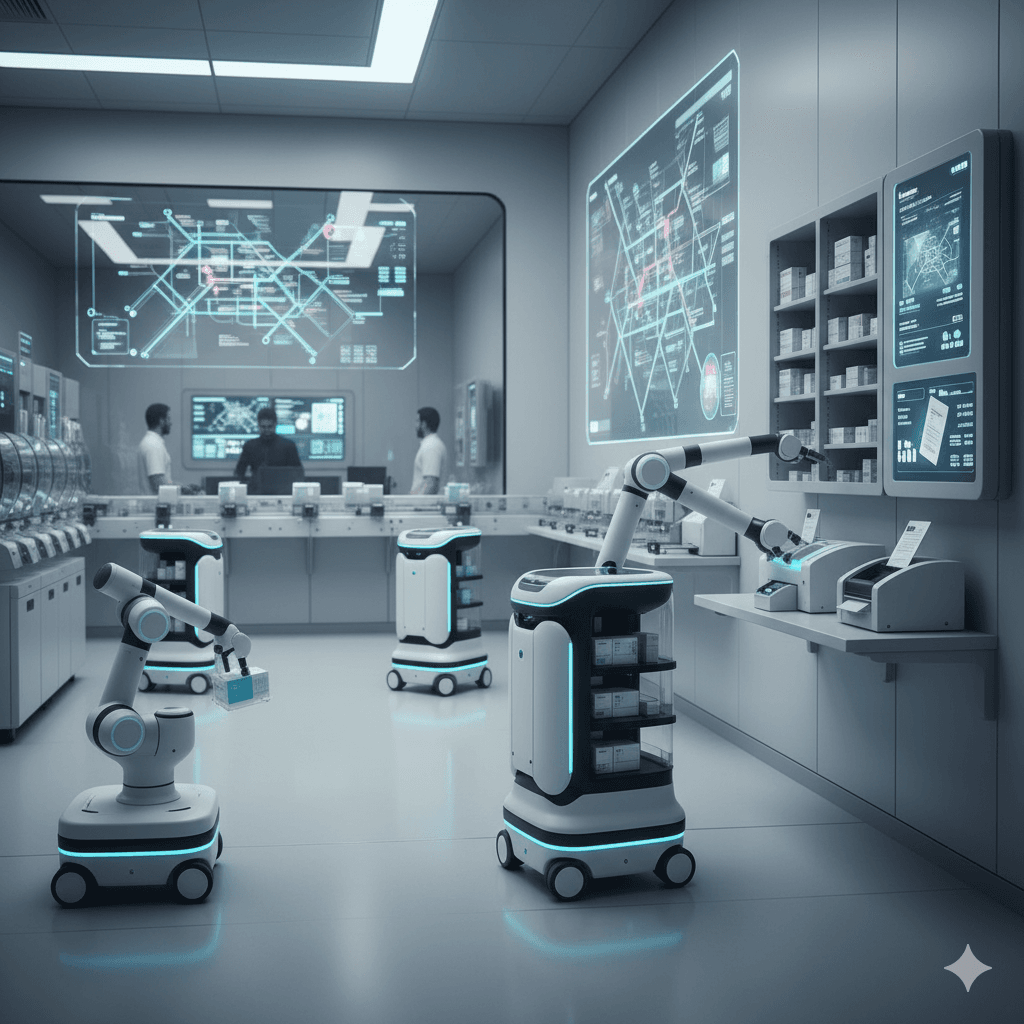
Medication Dispensing Robots (Generated with AI)
Field | Healthcare Automation | ||||||||
|---|---|---|---|---|---|---|---|---|---|
Core Functions | Automated medication preparation and unit-dose packaging Barcode/RFID verification for correct drug, dose, and patient Integration with Hospital Information Management Systems (HIMS) | ||||||||
Applications | Hospitals · Pharmacies · ICUs · Quarantine zones | ||||||||
Medication dispensing robots are advanced mechatronic systems that automate the pharmaceutical supply chain in healthcare. These systems take part in the preparation, packaging, storage, and delivery of medications to patients, offering significant advantages in terms of both accuracy and speed. Used especially in large hospitals, pharmacies, and healthcare institutions, these robots are developed to reduce human error in medication management, strengthen patient safety, optimize inventory control, and allow clinical staff to redirect their time toward direct patient care.
The workflow of medication dispensing robots is structured around full automation, data integrity, and precise motion control. The process typically begins with a medication order transmitted via HIMS and approved by clinical staff. The robotic system receives this order, automatically retrieves the relevant medications assigned to a specific patient from the storage unit, and initiates the dispensing process.
Among advanced systems, unit-dose medication management robots such as Swisslog PillPick carry out the preparation and distribution process in multiple stages. Using dedicated “Blister Cutter” modules, the robot separates tablets into single-dose units by cutting the blister without removing the tablet from its original cavity. These unit doses are then packaged and assigned unique barcodes, ensuring traceability throughout the entire life cycle of a medication and greatly reducing dose mix-ups and medication errors.
Maintaining hygiene standards is a core objective. Because the process is carried out without direct human contact, the risk of contamination is minimized. Packaged unit doses are placed by robotic arms into automated storage units known as DrugNest, where they are organized by type, dose, and frequency of use.
Medical robots are advanced technological systems developed to perform different functions in healthcare, ranging from surgery and rehabilitation to laboratory analysis and medication management. Within this field, medication dispensing systems are a key subcategory enabling automation of treatment workflows.
These integrated automation systems handle every stage of medication management — packaging, barcoding, storage, and patient-specific dose preparation — within a single closed system. Swisslog PillPick is among the most advanced models, designed for hospitals with high patient volumes.
These robots transport medications, meals, sterile materials, and other supplies within hospitals. With autonomous navigation, they can move independently through hallways and elevators, open doors, and avoid obstacles. Some include UV-C disinfection systems and remote communication features for sterile, contact-free operation.
Compact systems such as the LOCTITE D Series are used in laboratory or pharmacy environments for high-precision dosing and mixing. With three-axis motion capability, precise dose control, and plug-and-play operation, they are well-suited for small-scale or personalized pharmaceutical tasks.
These components together make medication dispensing robots a digital bridge between hospital logistics, pharmacy management, and patient safety.
Automated recognition, selection, and dosing mechanisms drastically reduce medication errors such as wrong drug, wrong dose, or wrong patient. Each medication unit is uniquely identified with a barcode or RFID tag, enabling verification at every stage.
By taking over repetitive and time-consuming tasks, robots allow pharmacists and nurses to focus more on patient care. Parallel automation of selection, verification, packaging, and delivery greatly increases efficiency and reduces preparation time, especially in emergency and intensive care units.
Robots continuously monitor stock levels via integrated management systems. Returned unopened medications are scanned, verified, and safely reintegrated, preventing waste and ensuring real-time updates in billing and inventory records.
Designed to maintain sterile conditions, these robots minimize human contact and contamination risks. UV-C sterilization and HEPA filtration systems ensure medications remain sterile throughout transport and storage.
Medication dispensing robots receive approved medication orders directly through the Hospital Information Management System (HIMS), eliminating manual entry and reducing human error. Each action — from retrieval to packaging — is logged digitally, providing complete traceability.
Robots send information about dispensed, returned, and stocked medications back to HIMS, ensuring synchronized records across billing, inventory, and patient data systems.
The barcodes produced by these robots are compatible with Bedside Verification Systems, allowing nurses to scan both the patient wristband and the medication before administration, ensuring the “right patient, right dose, right time” standard.
This approach ensures that every step from prescription to administration is digitally traceable and automatically verified, forming the backbone of smart medication management in modern hospitals.
Medication dispensing robots are not merely automation tools but integrated healthcare technologies that enhance patient safety, operational efficiency, and hygiene while reducing costs and waste. Through seamless integration with digital hospital systems, they serve as a cornerstone of the intelligent, data-driven healthcare infrastructure of the future.
Basile, Karen, Monserrat Martínez, Julia D. Lucaci, Claudia Goldblatt, and Idal Beer. “Enhancing Operational Efficiency and Service Delivery through a Robotic Dispensing System: A Case Study from a Retail Pharmacy in Brazil.” Pharmacy 12, no. 5 (2024): 130. Accessed October 18, 2025. https://doi.org/10.3390/pharmacy12050130.
Batson, S., A. Herranz, N. Rohrbach, M. Canobbio, S. A. Mitchell, and P. Bonnabry. “Automation of In-Hospital Pharmacy Dispensing: A Systematic Review.” European Journal of Hospital Pharmacy 28, no. 2 (March 2021): 58–64. Accessed October 18, 2025. https://doi.org/10.1136/ejhpharm-2019-002081.
Meknassi Salime, G., N. Bhirich, A. Cherif Chefchaouni, O. El Hamdaoui, S. El Baraka, and Y. Elalaoui. “Assessment of Automation Models in Hospital Pharmacy: Systematic Review of Technologies, Practices, and Clinical Impacts.” Hospital Pharmacy (February 27, 2025): 00185787251315622. Accessed October 18, 2025. https://doi.org/10.1177/00185787251315622.
Orsini, Federico Filippo, Daniele Bellavia, Fabrizio Schettini, and Emanuela Foglia. “The Impact of Automation and Digitalization in Hospital Medication Management: Economic Analysis in the European Countries.” Healthcare 13, no. 13 (2025): 1604. Accessed October 18, 2025. https://doi.org/10.3390/healthcare13131604.
Shermock, Steven B., Kristen M. Shermock, and Linda L. Schepel. “Closed-Loop Medication Management With an Electronic Health Record System in U.S. and Finnish Hospitals.” International Journal of Environmental Research and Public Health 20, no. 17 (August 30, 2023): 6680. Accessed October 18, 2025. https://doi.org/10.3390/ijerph20176680.
Takase, T., N. Masumoto, N. Shibatani, et al. “Evaluating the Safety and Efficiency of Robotic Dispensing Systems.” Journal of Pharmaceutical Health Care and Sciences 8 (2022): 24. Accessed October 18, 2025. https://doi.org/10.1186/s40780-022-00255-w.

Medication Dispensing Robots (Generated with AI)
Field | Healthcare Automation | ||||||||
|---|---|---|---|---|---|---|---|---|---|
Core Functions | Automated medication preparation and unit-dose packaging Barcode/RFID verification for correct drug, dose, and patient Integration with Hospital Information Management Systems (HIMS) | ||||||||
Applications | Hospitals · Pharmacies · ICUs · Quarantine zones | ||||||||
No Discussion Added Yet
Start discussion for "Medication Dispensing Robots" article
Working Principle and Technology
Types of Medication Dispensing Robots and System Components
Core Components
Use Cases and Advantages
System Integration
This article was created with the support of artificial intelligence.