+1 More

During flight, an aircraft can rotate around three principal axes that intersect at the center of gravity and are perpendicular to each other. One of these, the roll axis, extends longitudinally from the nose to the tail of the aircraft. The rotation of the aircraft around this axis is called rolling motion and is characterized by the upward and downward movement of the wings in opposite directions.
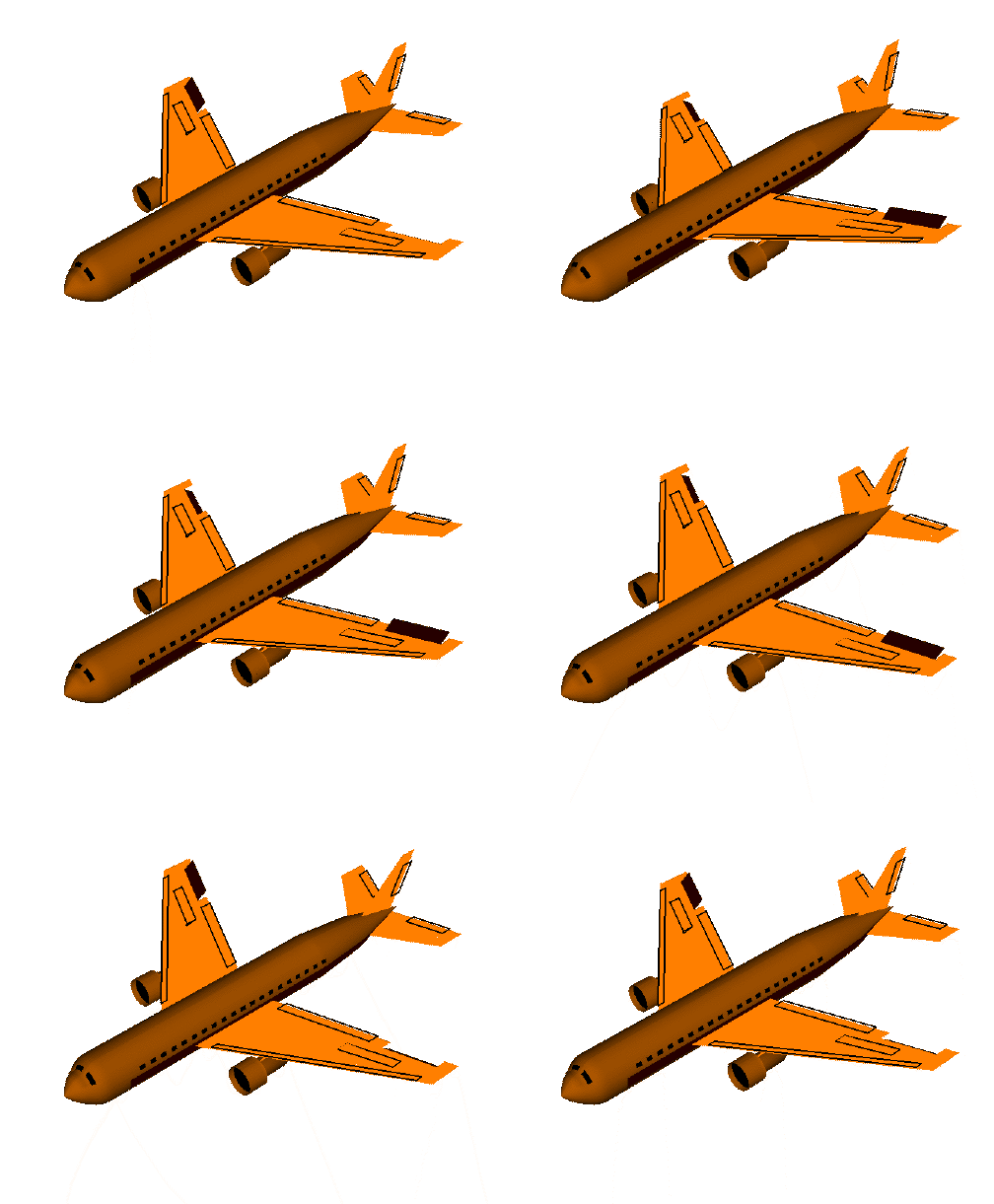
Rolling motion is typically achieved by the deflection of ailerons. Ailerons are hinged control surfaces located on the trailing edges of both wings and are designed to move in opposite directions. For example, when the aileron on the right wing deflects upward, the one on the left deflects downward. This configuration reduces lift on the right wing while increasing it on the left wing. The resulting lift differential between the wings causes the aircraft to roll about its center of gravity.
The rolling motion induced by the ailerons allows the aircraft to change its bank angle, enabling it to perform turns. In addition to this basic principle, alternative roll control mechanisms also exist. For instance, the Wright brothers used a method called wing warping in their early flights. In this method, the outer parts of the wings were twisted relative to the inner sections, altering the local angle of attack and thereby producing differential lift. This lift imbalance generated rolling motion in the same way as modern control surfaces.
In modern passenger aircraft, spoilers are often used in addition to ailerons to control rolling motion. Spoilers are panels located on the upper surface of the wing between the leading and trailing edges. When deployed upward, they disrupt airflow over the wing, reducing lift in that section. Because the lift on the opposite wing remains unchanged, the resulting imbalance causes the aircraft to roll.
Spoilers are preferred in some cases due to their quicker response and lower control force requirements. However, since they decrease total lift, they can affect overall aircraft performance.
By observing the position of the moving surface on the wing, one can determine which control surface is active: if it is located at the trailing edge, it is an aileron; if it is positioned more centrally on the wing surface, it is a spoiler.
Aircraft Control (SoftwarePole)
NASA Glenn Research Center. “Roll: Motion of the Aircraft.” NASA Virtual Aero Website. Accessed July 19, 2025. https://www.grc.nasa.gov/www/k-12/VirtualAero/BottleRocket/airplane/roll.html
Pilot Training System. “Yaw Axis – Flight Training Video.” YouTube. July 8, 2015. https://www.youtube.com/watch?v=pQ24NtnaLl8
İTÜ. Aerodinamik Kuvvet ve Momentler. Accessed July 19, 2025. https://web.itu.edu.tr/~yukselen/Uck351/02-%20Aerodinamik%20kuvvet%20ve%20momentler.pdf

No Discussion Added Yet
Start discussion for "Roll Motion (Aviation)" article
Formation of Rolling Motion
This article was created with the support of artificial intelligence.