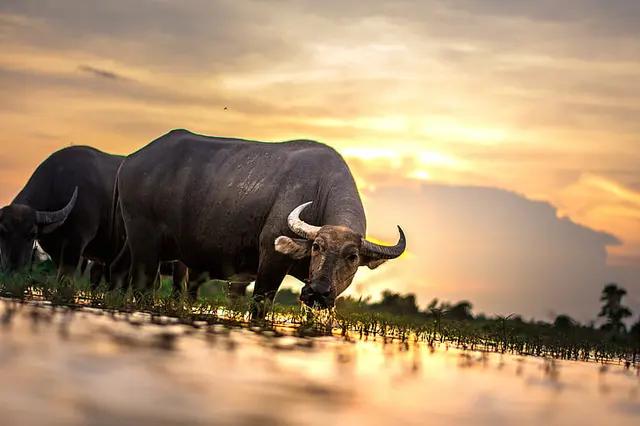
Scientific Name(s) | Bubalus mindorensis | ||||||||
|---|---|---|---|---|---|---|---|---|---|
Kingdom(s) | Animal | ||||||||
Phylum | Chordates | ||||||||
Class | Mammalia | ||||||||
Family | Bovidae | ||||||||
Conservation Status | Critically Endangered (CR) | ||||||||
The tamaraw (Bubalus mindorensis) is a critically endangered species of cattle in the family Bovidae, endemic only to the island of Mindoro in the Philippines.
Bubalus mindorensis belongs to the Chordata branch of the Animalia kingdom, the Mammalia class, the Cetartiodactyla order and the Bovidae family.
It has the appearance of a typical member of the Bovidae family, but is characterized by a smaller and stockier body structure than the Asian water buffalo (Bubalus bubalis).
Its average shoulder height is around 100 to 105 centimetres, and its body mass ranges from 200 to 300 kilograms. It has a compact, heavily built body and short, stocky limbs.
Adults are dark brown to grayish and have more hair than other buffalo species. A distinguishing morphological feature is the white markings on the hooves and inside of the lower front legs, similar to those of the Anoa. Most individuals also have a double gray-white stripe extending from the inner corner of the eye to the horns.
Both gender have short, black horns. These horns grow close together on the crown of the head in a V-shape, unlike the C-shaped horns of the Asian water buffalo. The horns can reach 35.5 to 51.0 centimeters in length. While there is no significant difference in size between the gender, males have been reported to have thicker necks.
The tamaraw is endemic to the Philippine island of Mindoro, which is its natural habitat. Prehistoric records have also been found on Luzon. In the past, it was widespread from sea level to the island's higher elevations above 1,800 meters, inhabiting open grasslands, forest clearings, dense bamboo forests, swampy river valleys, and low- to mid-altitude forests. Today, the species' range has diminished to less than 10,000 hectares, and it is most commonly found in isolated and mountainous areas above 200 meters, in secondary forests, and mixed forest/grassland.
Three known surviving subpopulations are located in the western (Occidental) part of Mindoro: Mount Iglit-Baco National Park, Aruyan-Malati Tamaraw Reserve, and Mount Calavite Wildlife Reserve.
Tamaraw are herbivores, primarily feeding on grasses in open grasslands. They also consume young bamboo shoots. During rest periods, they retreat to tall grasses or dense forests.
While tamaraw lead a solitary lifestyle, similar to other bovid species, they may come together temporarily during mating seasons.
The Tamaraw are solitary animals. Females are seen with their young, and males and females may occasionally congregate temporarily throughout the year. Historically active during the day, they have become nocturnal due to human disturbance. However, thanks to the relative protection afforded by the "core area" within Mount Iglit-Baco National Park, they are once again exhibiting diurnal behavior and can be seen in groups.
The Tamaraw was listed as Critically Endangered (CR) in a 2016 assessment . The population trend is declining. The majority of its population, over 95%, is estimated to be in a single subpopulation in Mount Iglit-Baco National Park. The minimum total population, according to the most recent count, is estimated at approximately 430 individuals, of which 50% to 70% are mature individuals (approximately 220-300 mature individuals).【1】 A decline of over 25% in mature individuals is expected over the next three generations (approximately 30 years).
The main threat to the Tamaraw in the 20th century was habitat loss due to agriculture by settlers and indigenous people. The main current threat is that remaining Tamaraw populations have no options to disperse and increase their range due to human pressure and the lack of intact natural corridors.
The tamaraw is listed on Appendix I of the Convention on International Trade in Endangered Species of Wild Fauna and Flora (CITES) and is fully protected under Philippine law. The largest subpopulation is found in Mount Iglit-Baco National Park. Although a small captive population exists in the country, a captive breeding program has been unsuccessful. Needed conservation actions include continued population surveys, effective habitat management, better integration of indigenous communities into habitat management plans, and securing and expanding the range of existing populations. New initiatives include designating the Aruyan-Malati region as "Critical Habitat" and implementing a Protected Area Management Plan for Mount Iglit-Baco National Park.
Boyles, R., Schutz, E. & de Leon, J. “Bubalus mindorensis.” IUCN Red List of Threatened Species. Accessed October 25, 2025. https://www.iucnredlist.org/species/3127/50737640
Gesch, Peter. “Bubalus mindorensis – Tamaraw.” Animal Diversity Web. Accessed October 25, 2025. https://animaldiversity.org/accounts/Bubalus_mindorensis/
PickPik. “Water buffalos outside of the house, Thailand countryside people JPG.” PickPik. Accessed October 25, 2025. https://www.pickpik.com/water-buffalos-buffalo-outside-of-the-house-thailand-countryside-people-59973
[1]
Boyles, R., Schutz, E., and de Leon, J, “ Bubalus mindorensis .” IUCN Red List of Threatened Species, last accessed 25 October 2025, https://www.iucnredlist.org/species/3127/50737640

Scientific Name(s) | Bubalus mindorensis | ||||||||
|---|---|---|---|---|---|---|---|---|---|
Kingdom(s) | Animal | ||||||||
Phylum | Chordates | ||||||||
Class | Mammalia | ||||||||
Family | Bovidae | ||||||||
Conservation Status | Critically Endangered (CR) | ||||||||
No Discussion Added Yet
Start discussion for "Tamaraw (Bubalus mindorensis)" article
Taxonomy
Morphological Features
Geographic Distribution and Habitat
Diet
Reproduction
Ecology and Behavior
Protection Status
This article was created with the support of artificial intelligence.