
+1 More

Author(s) | Imam al-Ghazali | ||||||||
|---|---|---|---|---|---|---|---|---|---|
Publisher(s) | Çelik Publishing House | ||||||||
Year of Publication | 2016 | ||||||||
Page Count | 248 | ||||||||
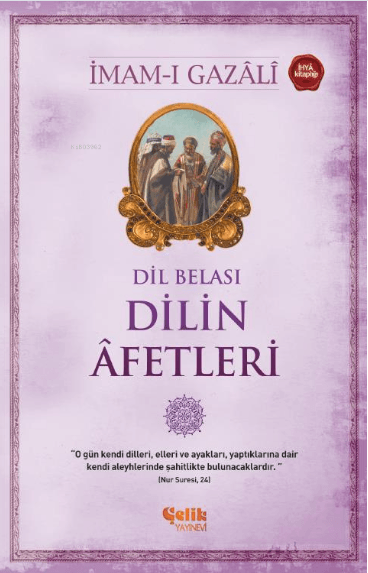
The Bane of the Tongue is a work that examines the dangers human beings may encounter in using the tongue and their moral, religious, and social consequences. Al-Ghazali emphasizes that improper use of language may lead a person toward sin and harm. The book provides detailed discussions of issues such as gossip, lying, slander, excessive talk, and idle speech, explaining each on the basis of Islamic sources. It also presents practical guidance on how to avoid these dangers, supported by Qur’anic verses and hadiths.
The text explores the individual and societal effects of speech in depth. Drawing on the Qur’an, hadiths, and the sayings of classical Islamic scholars, it demonstrates the ethical responsibility inherent in the use of language and its moral implications in human life.
The work reflects the classical Sufi discourse. While maintaining a spiritually rich tone, it also contains simplified examples that relate to daily life. Al-Ghazali’s writing is characterized by a didactic and instructive style. Throughout the book, the author employs admonitory expressions and integrates Qur’anic and hadith quotations to provide religious and intellectual grounding. In certain sections, a literary flow reinforces the spiritual content of the work.
The central theme of the book is the positive and negative effects of speech on human beings, its potential to guide toward virtue or to lead astray. Al-Ghazali presents the tongue as both a blessing and a dangerous instrument when misused. The book underscores that controlling speech is an essential component of ethical maturity and spiritual refinement, as unrestrained language can result in both moral decay and social discord.
The Bane of the Tongue - Al-Ghazālī- Audio Book - 1st Episode (Kaf)
The work is not a fictional narrative and therefore does not contain traditional characters. Its main subject is the human being, analyzed through the ethical and spiritual dimensions of language. The “tongue” is treated as a central moral concept that shapes behavior and social interaction. The author directly addresses the reader, explaining the potential moral pitfalls of speech and the ways to avoid them.
The Bane of the Tongue represents a systematic exposition of the classical Sufi understanding that mastering one’s speech is a key element of spiritual maturity. Al-Ghazali argues that language misuse can lead not only to individual sin but also to collective moral decay and social unrest.
In modern contexts, the book remains significant in two primary ways. In academia, it serves as a core reference in courses on Sufism, ethics, and Islamic thought. In contemporary communication and media ethics, its insights are increasingly discussed regarding misinformation, defamation, and hate speech, phenomena that mirror the dangers described by Al-Ghazali. With the rise of social media, issues such as online slander, false news, and verbal hostility have become practical examples of the “afflictions” the author warned against.【1】
Aydın, Garip. “İmam Gazzâlî’nin Kimyâ-yı Sa‘âdet Adlı Eserinde Kullandığı Hadislerin Manevî Destek Açısından Değerlendirilmesi.” Diyanet İlmî Dergi 59, no. 3 (July–September 2023): 1001–1040. https://doi.org/10.61304/did.1345671
Çelik Yayınevi. Dil Belâsı: Dilin Âfetleri – İmam-ı Gazâlî. İstanbul: Çelik Yayınevi. Accessed October 6, 2025. https://www.celikyayinevi.com.tr/urun/dilin-afetleri-dil-belasi-imam-i-gazali-9786059844765
Gazâlî, İmam. Dil Belası: Dilin Âfetleri. İstanbul: Çelik Yayınevi, 2016.
Kaf. “Dil Belası - İmam Gazali - Sesli Kitap - 1. Bölüm.” YouTube video. Accessed October 6, 2025. https://www.youtube.com/watch?v=P4f-r73yi_w
Özervarlı, M. Sait. “Gazzâlî.” Türkiye Diyanet Vakfı İslâm Ansiklopedisi, vol. 13 (1996): 425–448. İstanbul: TDV Yayınları. Accessed October 6, 2025. https://islamansiklopedisi.org.tr/gazzali
[1]
Garip Aydın. “İmam Gazzâlî’nin Kimyâ-yı Sa‘âdet Adlı Eserinde Kullandığı Hadislerin Manevî Destek Açısından Değerlendirilmesi.” Diyanet İlmî Dergi 59, no. 3 (July–September 2023): 1001–1040.

Author(s) | Imam al-Ghazali | ||||||||
|---|---|---|---|---|---|---|---|---|---|
Publisher(s) | Çelik Publishing House | ||||||||
Year of Publication | 2016 | ||||||||
Page Count | 248 | ||||||||
No Discussion Added Yet
Start discussion for "The Bane of the Tongue (Book)" article
Language and Style
Theme
Focus and Subject
Contemporary Relevance
This article was created with the support of artificial intelligence.