


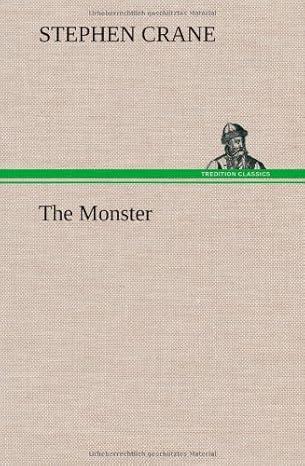
The Monster
Yazar | Stephen Crane | ||||||||
|---|---|---|---|---|---|---|---|---|---|
Yayınevi | Harper and Brothers Publishers | ||||||||
Basım Tarihi | 1899 | ||||||||
“The Monster” is a novella written by American author Stephen Crane, first published in 1898. It stands as one of the last narrative works published during Crane’s lifetime and reflects the influences of both realism and naturalism.
The work was first published in 1898. As a short novel, The Monster belongs to the mature period of Crane’s literary career and was among the final fictional texts published before his death. It was later included in the collection titled The Monster and Other Stories. Throughout the 20th century, the novella has been the subject of academic and literary evaluations, particularly in the context of themes such as racial structure in American society, ethical norms, and social exclusion.
At the heart of the story is Henry Johnson, an African American man who works for the town doctor and is respected within the community. During a fire, Henry saves a young boy but suffers severe facial burns in the process. The disfigurement leads the townspeople to label him a “monster.” The community's reaction to his altered appearance reveals the social dimension of the story. When Dr. Trescott chooses to continue caring for Henry, he too faces societal ostracism.
The novella explores the position of a Black individual within a small town and the transformation of public perception, shedding light on the racial prejudices of late 19th-century America.
The moral attitudes of the townspeople, their lack of empathy, and their defensive mechanisms toward difference are critically examined.
The fear triggered by physical deformity is explored about societal acceptance and the significance placed on outward appearance.
The story employs third-person narration, with the narrator assuming an observational and impartial stance. Events are often presented from the community’s perspective. As a novella, the text revolves around a single central incident and develops thematic depth through a limited number of characters. Crane utilizes a plain and realistic prose style, and his atmospheric descriptions are marked by a dark and intense tone.
The Monster is regarded as a representative example of American realism and naturalism. It has been analyzed through contemporary literary theories and cultural studies, particularly concerning themes such as race, identity, social marginalization, and moral values. In modern academic discourse, the novella is increasingly referenced as a foundational text in discussions of human rights, social inequality, and individual-society dynamics.
Since its first publication in 1898, The Monster has been included in various collections and standalone editions. From the second half of the 20th century onward, scholarly and critical editions have been produced. Today, it is regularly featured in American literature textbooks and major anthologies as one of Stephen Crane’s significant works.
Crane, Stephen. The Monster and Other Stories. New York: Harper & Brothers, 1899.

The Monster
Yazar | Stephen Crane | ||||||||
|---|---|---|---|---|---|---|---|---|---|
Yayınevi | Harper and Brothers Publishers | ||||||||
Basım Tarihi | 1899 | ||||||||
Publication Information and Publishing History
Plot Summary
Themes
Racism and Social Exclusion
Ethics and Social Norms
Human Nature and Fear
Narrative and Stylistic Features
Literary Significance and Scholarly Evaluation
Editions and Publication Status
This article was created with the support of artificial intelligence.