+1 More

Category | Multi-Purpose Training and Transport Aircraft | ||||||||
|---|---|---|---|---|---|---|---|---|---|
Origin(s) | Türkiye (THK Etimesgut Aircraft Factory) | ||||||||
Engine(s) | 2 x Walter Minor 6-III inline piston engines | ||||||||
First Flight(s) | 1946 | ||||||||
Crew | 2 persons | ||||||||
Passenger Capacity | 2 stretchers or 4–5 passengers | ||||||||
Maximum Speed | 265 km/h | ||||||||
Range(s) | 650 km | ||||||||
The THK-5 is a twin-engine, multi-purpose aircraft designed and produced at the Turkish Aeronautical Association's (THK) Etimesgut Aircraft Factory in the 1940s. Its development goal was to provide a platform for both pilot and navigator training, as well as to fulfill ambulance and light transport duties. It is considered an important example of domestic production efforts in Turkish aviation history.

TC-THK-5 (samolotypolskie)
The design work for the THK-5 was completed in 1944 by a team led by Polish engineer Jerzy Płoszajski, under the challenging conditions of World War II. Following the production process that began in 1945, the first prototype of the aircraft conducted its maiden flight in 1946. The design featured a simple and robust structure, consistent with the technological capabilities of the era.
THK-5 (tolgaozbekcom)
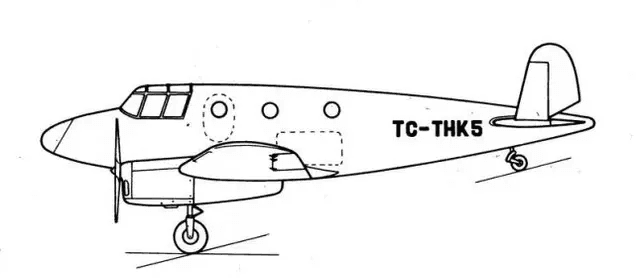
The aircraft consists of a twin-engine, low-wing monoplane. The wings have a wooden structure, covered with laminated plywood and fabric. The fuselage was built with a combination of both welded steel tube and wooden framework. While the aircraft's main landing gear was semi-retractable, the tail wheel was fixed. The capacity to carry two stretchers or four to five passengers inside the cabin reflects the aircraft's multi-role design philosophy.

TC-THK-5A (samolotypolskie)
The THK-5 was suitable for the conditions of the time in terms of performance and could be easily modified for different missions.
The THK-5 was primarily used for training and light transport duties. Its development and use, especially as a civil ambulance aircraft, demonstrated the Turkish Aeronautical Association's (THK) contributions to civil aviation at the time. The aircraft was also exported to Denmark. This export is notable for being the first and only aircraft export in Turkish aviation history. The aircraft sold to Denmark flew with the local registration number OY-THK and was used for various purposes, including aerial photography and cargo transport, in addition to ambulance missions.

TC-THK-5A (samolotypolskie)
The THK-5 was later developed into a modernized version known as the THK-5A. This version used more powerful engines and an improved fuselage. The design of the THK-5 also served as the basis for the MKEK-5 project, which was later integrated into the Turkish machinery industry. Although only a limited number were produced, including two prototypes and two production aircraft, the THK-5 symbolizes Türkiye's efforts in aviation during the World War II years as it sought to meet the needs of both the defense industry and civil aviation.
Haluk Bayraktar (Haluk Bayraktar/X)
Haluk Bayraktar. "THK - Türk Hava Kurumu." X. Accessed: October 19, 2025. https://x.com/haluk/status/1397241534832066560/photo/1
Pektaş, İlhami. "1944-1946 YILLARINDA ÜRETİLEN TÜRK MALI THK-5 UÇAKLARI." İlhami Pektaş. Accessed: October 19, 2025. https://www.ilhamipektas.com/1944-1946-tillarinda-uretilen-turk-mali-thk-5-ucaklari
Samolotypolskie. "THK-5 (THK-10, MKEK-5), 1945." Samolotypolskie. Accessed: October 19, 2025. http://www.samolotypolskie.pl/samoloty/2986/87/THK-5-THK-102
Türk Hava Kurumu. "Türk Tayyare Cemiyeti (T.Ta.C.)." THK. Accessed: October 19, 2025. https://www.thk.org.tr/turk_tayyare_cemiyeti
Yavuz, İsmail. THK-5 / THK-5A. Makine Mühendisleri Odası (MMO). Accessed: October 19, 2025. https://www.mmo.org.tr/sites/default/files/784b70742141814_ek.pdf
tolgaozbek.com. " 71 yıl önce Danimarka'ya satılan ambulans uçağın gerçek hikayesi." YouTube. Accessed: October 19, 2025. https://www.youtube.com/watch?v=kgxF2Cw6_u4&t=402s
Özer, Doğan. II. DÜNYA SAVAŞI YILLARINDA TÜRK HAVA KURUMU ETİMESGUT UÇAK FABRİKASI (1939-1945). Dergi Park. Accessed: October 19, 2025. https://dergipark.org.tr/tr/download/article-file/553815

Category | Multi-Purpose Training and Transport Aircraft | ||||||||
|---|---|---|---|---|---|---|---|---|---|
Origin(s) | Türkiye (THK Etimesgut Aircraft Factory) | ||||||||
Engine(s) | 2 x Walter Minor 6-III inline piston engines | ||||||||
First Flight(s) | 1946 | ||||||||
Crew | 2 persons | ||||||||
Passenger Capacity | 2 stretchers or 4–5 passengers | ||||||||
Maximum Speed | 265 km/h | ||||||||
Range(s) | 650 km | ||||||||
Design and Development Process
Structural Features
Technical Specifications and Areas of Use
Procjects and Legacy
This article was created with the support of artificial intelligence.