

Constellation | Triangulum | ||||||||
|---|---|---|---|---|---|---|---|---|---|
Absolute Magnitude | -19.38 | ||||||||
Apparent Mass | 50 Billion M☉ (solar masses) | ||||||||
Stars | 40 Billion | ||||||||
Distance from Earth | 2.723.000 Light-years | ||||||||
edit
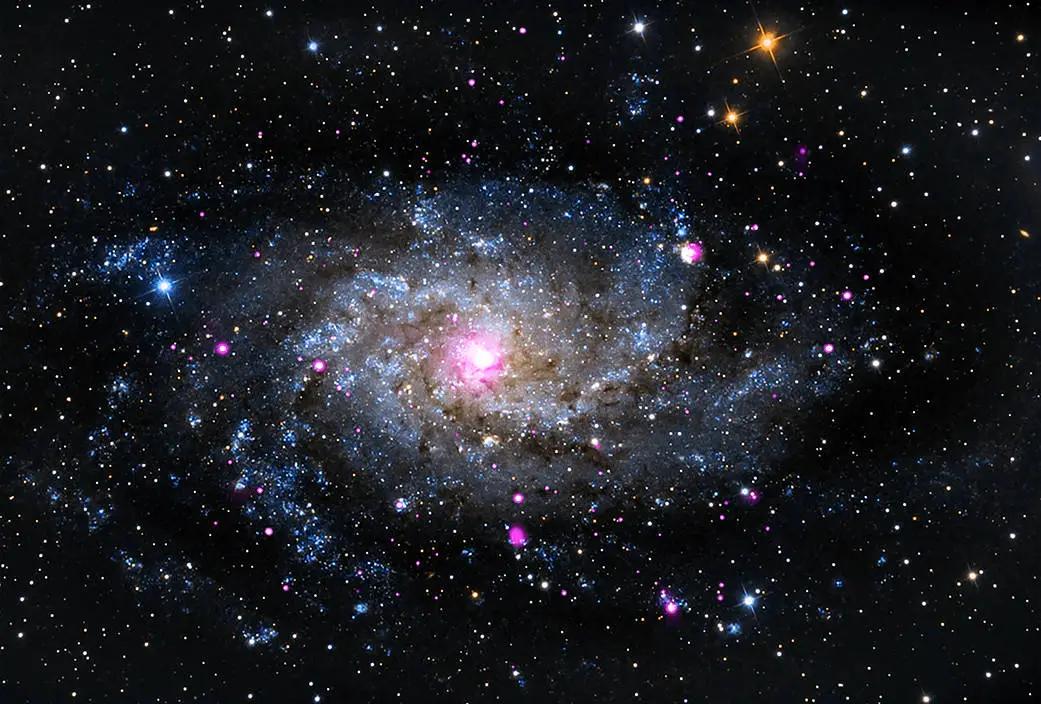
Triangulum Galaxy (Messier 33 or NGC 598) is the third-largest galaxy in the Local Group after the Milky Way and Andromeda. It is generally accepted that the galaxy was first discovered in 1654 by Giovanni Battista Hodierna and was later cataloged by Charles Messier in the 18th century as M33. M33 is relatively easy to observe, making it a significant research target for both amateur and professional astronomers.

Triangulum Galaxy. (NASA)
M33 is the largest galaxy in the Local Group after the Milky Way and Andromeda (M31). It has a spiral structure and belongs to the class of unbarred spiral galaxies.
The Triangulum Galaxy has open spiral arms that host active star formation regions along their length. Especially the galaxy’s H II regions stand out in observations due to the brightness emitted by ionized hydrogen gases.
The most prominent star formation region, NGC 604, is not only the largest H II region in M33 but also in the entire Local Group. This region contains more than 1,500 young, hot, and massive stars.
It is thought that M33 does not contain an active supermassive black hole at its center, or if it does, it has a very low mass. This feature distinguishes it from giant galaxies like Andromeda. The central star cluster is relatively less dense and exhibits low brightness.
The total mass of the galaxy is estimated to be around 5 × 10¹⁰ solar masses. Rotation curves show that dark matter dominates in the outer regions of the galaxy. This makes M33 an important case study for analyzing the distribution of dark matter.
The Triangulum Galaxy is located relatively close to the Andromeda Galaxy within the Local Group. It is believed that these two galaxies have had dynamic interactions in the past and may have formed a satellite system. In this context, M33 is a key object for understanding galaxy formation and evolution within the Local Group.

M33 Star Map. (NASA)
Due to its relative proximity, open spiral structure, and richness in star-forming regions, M33 provides a suitable target for a variety of astronomical studies, especially in areas such as:
Moreover, the galaxy’s low metal content offers conditions similar to those in early-universe galaxies, functioning as a kind of time machine.
The Triangulum Galaxy is a unique research resource for both professional and amateur astronomers due to its observational accessibility, structural simplicity, and scientific significance.
Through multi-wavelength observations conducted to better understand the dynamics of star formation and galactic evolution, our knowledge of the M33 galaxy continues to grow.
Its position in the Local Group and possible interaction with Andromeda places it in a special role within models of galactic evolution.
Bonanos, A. Z., K. Z. Stanek, R. P. Kudritzki, L. Macri, D. D. Sasselov, J. Kaluzny, D. Bersier, F. Bresolin, T. Matheson, B. J. Mochejska, N. Przybilla, A. H. Szentgyorgyi, J. Tonry, and G. Torres. "The First DIRECT Distance to a Detached Eclipsing Binary in M33." Astrophysics and Space Science (2006): 207. https://doi.org/10.1007/s10509-006-9112-1. Accessed July 9, 2025.
Karachentsev, I. D., V. E. Karachentseva, W. K. Hutchmeier, and D. I. Makarov. "A Catalog of Neighboring Galaxies." Astronomical Journal 127 (2004): 2031–2068. https://doi.org/10.1086/382905. Accessed July 9, 2025.
Karachentsev, I. D., and O. G. Kashibadze. "Masses of the Local Group and of the M81 Group Estimated from Distortions in the Local Velocity Field." Astrophysics 49, no. 1 (2006): 3–18. https://doi.org/10.1007/s10511-006-0002-6. Accessed July 9, 2025.
Corbelli, E., and P. Salucci. "The Extended Rotation Curve and the Dark Matter Halo of M33." Astrophysics and Space Science 342, no. 1 (2006): 263–267. https://link.springer.com/article/10.1007/s10509-006-9112-1. Accessed July 9, 2025.
Corbelli, Edvige. "Dark Matter and Visible Baryons in M33." The Astrophysical Journal 584, no. 1 (2003): 243–252. https://iopscience.iop.org/article/10.1086/382905. Accessed July 9, 2025.
SEDS. “Revised NGC Data for NGC 598.” Students for the Exploration and Development of Space. http://spider.seds.org/ngc/revngcic.cgi?NGC598. Accessed July 9, 2025.
Spitzer Science Center. “NASA Spitzer Telescope Reveals Pinwheel Galaxy's Hidden Wonders.” https://www.spitzer.caltech.edu/. Accessed July 9, 2025.
NASA. “Messier 33 (The Triangulum Galaxy).” NASA Science. https://science.nasa.gov/mission/hubble/science/explore-the-night-sky/hubble-messier-catalog/messier-33/. Accessed July 9, 2025.
NASA. “Triangulum Galaxy.” NASA. Last modified January 9, 2023. https://www.nasa.gov/image-article/triangulum-galaxy/. Accessed July 9, 2025.
NASA. “Messier 33.” NASA Science – Hubble Space Telescope. https://science.nasa.gov/mission/hubble/science/explore-the-night-sky/hubble-messier-catalog/messier-33/. Accessed July 9, 2025.

Constellation | Triangulum | ||||||||
|---|---|---|---|---|---|---|---|---|---|
Absolute Magnitude | -19.38 | ||||||||
Apparent Mass | 50 Billion M☉ (solar masses) | ||||||||
Stars | 40 Billion | ||||||||
Distance from Earth | 2.723.000 Light-years | ||||||||
General Features
Structural Features
Spiral Arms and Star Formation Regions
Nuclear Region and Core
Kinematics and Mass
Relationship with the Milky Way and Position in the Local Group
Observational Studies and Scientific Importance
This article was created with the support of artificial intelligence.