+2 More

Location | Ulukale Village Çemişgezek Tunceli Türkiye | ||||||||
|---|---|---|---|---|---|---|---|---|---|
Construction | 1793–1794 Commissioned as a waqf by Yusuf Pasha | ||||||||
Material(s) | Rubble and cut stone | ||||||||
Plan | Four bays (nef) Barrel-vaulted Two sections (sahn) | ||||||||
Minaret | Stone base, Polygonal shaft, Single balcony | ||||||||
Ulukale Mosque is a village mosque located in Ulukale Village, within the Çemişgezek district of Tunceli Province, Türkiye. Constructed in the late 18th century, the mosque is notable for its stone architecture. Built as a charitable foundation (waqf) by Yusuf Pasha, it stands out for its period-specific architectural features, its placement within the local topography, and its simple interior layout. With its original plan and later additions, the structure represents a typical example of rural mosque architecture.

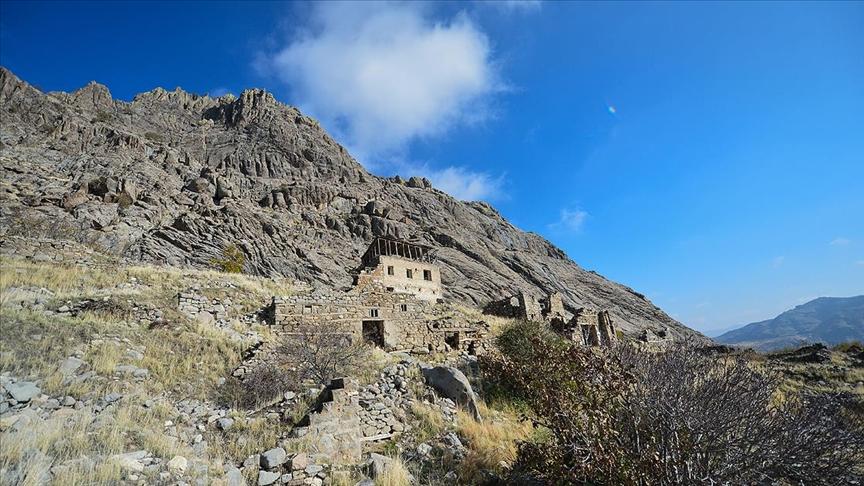
Ulukale Mosque (Anadolu Ajansı)
Ulukale Mosque was built in the year 1208 AH / 1793–1794 AD. According to historical sources, it was commissioned as a charitable foundation (waqf) by Yusuf Pasha, who once served as the governor of Diyarbakır. A last congregation area (son cemaat yeri) was added to the mosque in the 19th century. Over time, the village of Ulukale relocated, leaving the mosque within an abandoned former settlement area.
Ulukale Mosque was constructed using rubble and cut stone and is situated on sloped terrain. The main prayer hall is supported by three thick piers, which are connected to the eastern and western walls by arches. The structure is organized into four bays laterally and two sections in the direction of the mihrab. The prayer space is covered with barrel vaults, while the area near the mihrab is topped with a domed drum. Due to the central piers, both the entrance door and the mihrab are slightly shifted to the east of the building’s central axis.
The mosque's minaret, located to the northeast, is a later addition and is not attached to the main structure. It has a stone base and a polygonal shaft, with a single, plain balcony (şerefe). The minaret maintains the rural architectural character of the mosque while adding vertical emphasis to the composition, creating a balanced interplay between horizontal and vertical elements.

Ulukale Mosque(Türkiye Kültür Portalı)
Due to its location on sloping terrain, window openings were placed on the mosque’s western wall, while the single window on the eastern wall was positioned higher. This layout was designed to optimize the use of natural light within the interior. Both the mosque’s plain exterior and its simple interior layout reflect a minimalist approach, free from decorative embellishments.
The mosque is situated in the old settlement area of the historic Ulukale Village, which was once the village center prior to relocation. Today, alongside the mosque, remnants of adobe structures, a fountain, a mill, and a bathhouse can be found in the surrounding area. The old settlement of Ulukale has become a site of interest for photographers and history enthusiasts alike.
Anadolu Agency. “Tunceli’s Ulukale Village Takes Visitors on a Historical Journey.” Anadolu Agency, June 12, 2021. Accessed June 26, 2025. https://www.aa.com.tr/tr/yasam/tuncelinin-ulukale-koyu-ziyaretcilerini-tarihi-yolculuga-cikariyor/2102940.
Republic of Türkiye Tunceli Provincial Directorate of Culture and Tourism. “Mosques and Tombs.” Tunceli Ministry of Culture and Tourism. Accessed June 26, 2025. https://tunceli.ktb.gov.tr/TR-57264/cami-ve-turbeler.html.
Türkiye Culture Portal. “Ulukale Mosque.” Culture Portal. Accessed June 26, 2025. https://www.kulturportali.gov.tr/turkiye/tunceli/gezilecekyer/ulukale-camii.

Location | Ulukale Village Çemişgezek Tunceli Türkiye | ||||||||
|---|---|---|---|---|---|---|---|---|---|
Construction | 1793–1794 Commissioned as a waqf by Yusuf Pasha | ||||||||
Material(s) | Rubble and cut stone | ||||||||
Plan | Four bays (nef) Barrel-vaulted Two sections (sahn) | ||||||||
Minaret | Stone base, Polygonal shaft, Single balcony | ||||||||
History
Architectural Features and Minaret
Lighting and Spatial Arrangement
Context and Present Condition
This article was created with the support of artificial intelligence.