

The Venus Flytrap (Dionaea muscipula) is one of the most well-known species among carnivorous plants. Although it possesses the ability to produce its own food through photosynthesis, it supplements its nutritional needs by capturing and digesting insects in environments where essential minerals such as nitrogen and phosphorus are scarce. Therefore, it employs a complex feeding strategy that displays both autotrophic and heterotrophic characteristics.
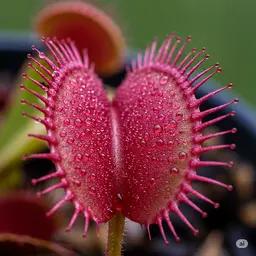
The leaves of the Venus Flytrap consist of two lobes, each edged with tooth-like projections. These lobes can rapidly snap shut in a manner that prevents the prey from escaping. On the inner surface of each lobe, there are three to four sensitive hairs (trichomes) that convert mechanical stimuli from prey contact into electrical signals, triggering the closure of the trap. This mechanism allows the plant to conserve energy by ensuring that only live and nutritionally valuable prey are captured.

Venus Flytrap (Generated by Artificial Intelligence)
The tiny, sensitive hairs (trichomes) located on the leaves of the Venus Flytrap function as mechanoreceptors that detect physical contact from prey. When stimulated, these hairs trigger electrical signals (action potentials) within the plant. Specifically, two hairs must be touched in quick succession to activate the trap mechanism, causing the lobes of the leaf to snap shut. This precise and selective triggering system enhances the plant’s energy efficiency by ensuring the trap closes only in response to live and nutritionally valuable prey, minimizing false alarms and unnecessary closures. The closure process occurs within milliseconds, and this rapid movement is critical to the plant’s success in capturing prey.
Once the trap closes, it secures the prey inside. If the prey continues to move, these movements are interpreted by the plant as additional stimuli, which then initiate the secretion of digestive enzymes. These secretions include various hydrolytic enzymes, primarily proteases, which break down the prey's proteins, lipids, and other macromolecules into smaller, absorbable components at the molecular level. This chemical digestion process generally takes between 5 and 12 days. During this time, the trap remains tightly closed to prevent escape. After digestion is complete, the trap reopens and expels the indigestible remains of the prey. This process allows the plant to conserve energy and focus on prey that offers high nutritional value.
The nutrients released during digestion, especially elements like nitrogen and phosphorus essential for the plant’s physiological functions, are absorbed through specialized cells on the surface of the leaf using active and passive transport mechanisms. This absorption process integrates the digested proteins and organic compounds into the plant’s metabolism. These nutrients are used in vital processes such as cell division, energy production, and photosynthesis. Access to nitrogen and phosphorus is crucial for the Venus Flytrap’s survival in its naturally nutrient-poor habitats, making this adaptation a fundamental component of the species’ ecological success.
The Venus Flytrap blooms in spring and summer, producing flowers that are typically white and borne on long stalks. Pollination usually occurs via wind and insects. In addition to sexual reproduction through seed formation, the plant also reproduces vegetatively. Vegetative reproduction involves the development of new individuals from leaves or roots, contributing to the plant’s spread within its habitat.
The Venus Flytrap is endemic to a very limited region of the United States, found only in North and South Carolina. Its natural habitats are typically described as acidic, nutrient-poor, moist bogs, wetlands rich in sphagnum moss, and humid forested areas. These environments are critical for the species' life cycle and ecological requirements.
The soil in these habitats is usually sandy and rich in organic matter, yet very low in essential nutrients like nitrogen and phosphorus. These nutrient deficiencies are key factors that have driven the evolutionary adaptation of Dionaea muscipula to carnivory as a means to supplement its diet with nutrients derived from insects. Additionally, the constant moisture levels in these habitats are essential for the effective functioning of the plant’s trap mechanism and for maintaining healthy photosynthesis.
The Venus Flytrap demonstrates a high degree of sensitivity to seasonal changes and environmental conditions within its natural habitat. Destruction of these habitats and environmental stressors such as climate change significantly reduce the plant’s chances of survival.
Habitat destruction, illegal harvesting, and climate change pose significant threats to the natural populations of the Venus Flytrap. The species is protected under the Convention on International Trade in Endangered Species of Wild Fauna and Flora (CITES). Conservation programs are focused on preserving its habitats and mitigating human impact.
Fabricant, Alexander, George Z. Iwata, Sebastian Scherzer, Lou Bougas, Kilian Rolfs, Anna Jodko-Władzińska, Johannes Voigt, Rainer Hedrich, ve Dmitry Budker. Action Potentials Induce Biomagnetic Fields in Venus Flytrap Plants. bioRxv, 2020. Erişim 27 Mayıs 2025. https://www.biorxiv.org/content/10.1101/2020.08.12.247924v2
Guo, Qiguang, Erfu Dai, Xinyang Han, Shaoyang Xie, Edmund Chao, ve Zhen Chen. Fast Nastic Motion of Plants and Bio-Inspired Structures. arXiv, 2015. Erişim 27 Mayıs 2025. https://arxiv.org/abs/1508.05435
Hedrich, Rainer, Anne Böhm, André Scherzer, Ines Fromm, Sönke Bauer, Shabih A. Zaheer, Ingo Mueller, ve diğerleri. "The Venus Flytrap Dionaea muscipula Counts Prey-Induced Action Potentials to Induce Sodium Uptake." Current Biology 26, no. 3 (2016): 286–295. Erişim 27 Mayıs 2025. https://www.sciencedirect.com/science/article/pii/S0960982215015018
Pixabay. “Venüs sinek kapanı, Doğa, Sinek kapanı görseli JPG.” Pixabay. Accessed 28 May 2025. https://pixabay.com/tr/photos/ven%C3%BCs-sinek-kapan%C4%B1-sinek-kapan%C4%B1-3684935/
Poppinga, Simon, ve Marc Joyeux. Different Mechanics of Snap-Trapping in the Two Closely Related Carnivorous Plants Dionaea muscipula and Aldrovanda vesiculosa. APS, 2011. Erişim 27 Mayıs 2025. https://journals.aps.org/pre/abstract/10.1103/PhysRevE.84.041928

No Discussion Added Yet
Start discussion for "Venus Flytrap (Dionaea muscipula)" article
Leaf Structure and Trap Mechanism
Electrical Stimulation and Trap Closure Process
Digestion and Nutrient Absorption
Digestion Process
Nutrient Absorption
Flowering and Reproduction
Ecology and Conservation Status
Natural Habitat
Threats and Conservation Status
This article was created with the support of artificial intelligence.