KURE Kids Header Line
badge icon

Bu içerik çocuklar için Türkçe olarak yazılmış olup yapay zeka ile otomatik olarak İngilizceye çevrilmiştir.

Venus

Son Güncellenme: 01.12.2025


What if we explore Venus—the planet that looks like a bright star in the sky? This mysterious planet, similar in size to Earth, hides scorching surfaces like ovens, acidic clouds, and astonishing secrets! Let’s take a closer look together at Venus’s enigmatic world!

What Is Venus?

Venus is the second planet from the Sun and one of the brightest objects in the night sky. Sometimes it shines just before sunrise or just after sunset, earning it the nickname “Morning Star” or “Evening Star.” So bright is this planet that it is often mistaken for a star.


Venus is very similar to Earth in size and structural features, which is why scientists call it “Earth’s twin.” But this twin leads a very different life! Venus’s surface is extremely hot due to its dense atmosphere, which traps heat. As a result, the average surface temperature reaches about 460°C—hotter than your oven when baking cookies!


Venus. (NASA)

What Is the Weather Like on Venus?

Venus’s atmosphere is extremely dense. It is mostly composed of carbon dioxide gas and contains clouds of sulfuric acid. This is why the sky on Venus is never blue—it is always covered by a thick, yellowish layer of clouds. Moreover, sulfuric acid droplets fall like rain on its surface, but they evaporate before reaching the ground!

Is There Life on Venus?

The conditions on Venus are not suitable for life as we know it. Extreme heat, a dense atmosphere, and an acidic environment make it inhospitable for living organisms. However, scientists speculate that traces of life might exist in the upper layers of Venus’s atmosphere. Further research on this topic is expected in the future.

Does Venus Rotate Backward?

Yes! Venus orbits the Sun in the same direction as the other planets, but it rotates on its axis in the opposite direction. This means that on Venus, the Sun rises in the west and sets in the east! Additionally, because its rotation is so slow, a single day on Venus is longer than its entire year!


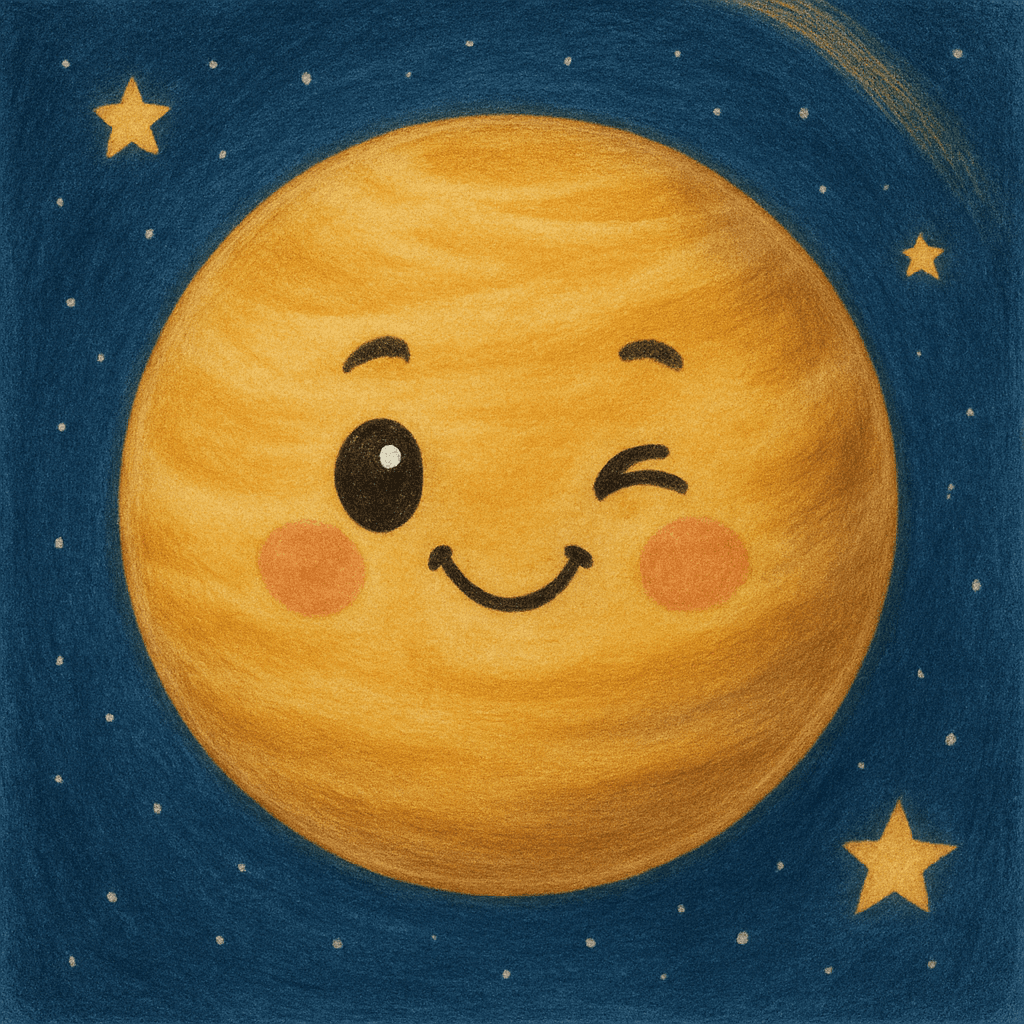
Venus (Generated by Artificial Intelligence.)

Bunlara Göz Atmayı Unutma!
Bilim ve Teknoloji
cat img
Tarih ve Kültür
cat img
Sanat ve Edebiyat
cat img
image
En Çok Okunan
Yanmayan El Deneyi
arrow
image
En Yeni Eklenen
Robotlar Nasıl Karar Verir?
arrow
ilham-notu-bg
MERAKLI ÇOCUKLARA İLHAM NOTU!

Venus shows us that appearances can be deceptive! Although it resembles Earth, it is not a suitable place for life. But this also demonstrates how diverse and fascinating space is. When you look up at the sky, imagine not only the stars but also the planets. Perhaps one day you will be the space explorer who discovers Venus! Remember, great discoveries always begin with small curiosity!

KURE Kids Kure Card Pin Icon
KURE Kids Kure Card Book Icon
venüş.png

Venus

Average Surface Temperature

Approximately 460°C

Satellite

No

Distance from the Sun

Approximately 108 million km

Surface Structure

Mountains; volcanoes and lava plains

Orbital Period Around the Sun

225 Earth days (Venusian year)

Rotation Period Around İts Own Axis

243 Earth days (Venusian day)

Atmosphere

Thick; contains carbon dioxide and sulfuric acid

Bunu Kim Yazdı?
Kids Writing
YazarRabia Aras1 Aralık 2025
bottom-bg-effect-bottom
bottom-bg-effect-top

Venus is the second planet from the Sun and one of the brightest objects in the sky. It is known for its similarity to Earth but is not suitable for life due to its thick atmosphere and high temperatures. A day on Venus lasts longer than its year and it rotates in the opposite direction. With its brightness, high temperature and dense atmosphere, Venus is one of the most impressive planets in space.

Kaynakça

NASA. “Venus from Mariner 10 (PIA23791).” *NASA Science*. Accessed August 5, 2025. https://assets.science.nasa.gov/dynamicimage/assets/science/cds/general/images/2024/03/venus-mariner-10-pia23791-fig2-16x9-1.jpg.

TUA - Türkiye Uzay Ajansı. “Venüs.” TUA Blog. Accessed August 5, 2025. https://tua.gov.tr/tr/blog/gunes-sistemi/venus

TÜBİTAK Bilim Genç. "Venüs." *Bilim Genç*. Accessed August 5, 2025. https://bilimgenc.tubitak.gov.tr/venus

ilham-notu-bg
ilham-notu-bg
ilham-notu-bg
HEYY!
Bunları Biliyor
Muydun?
Lamb
Lamb