




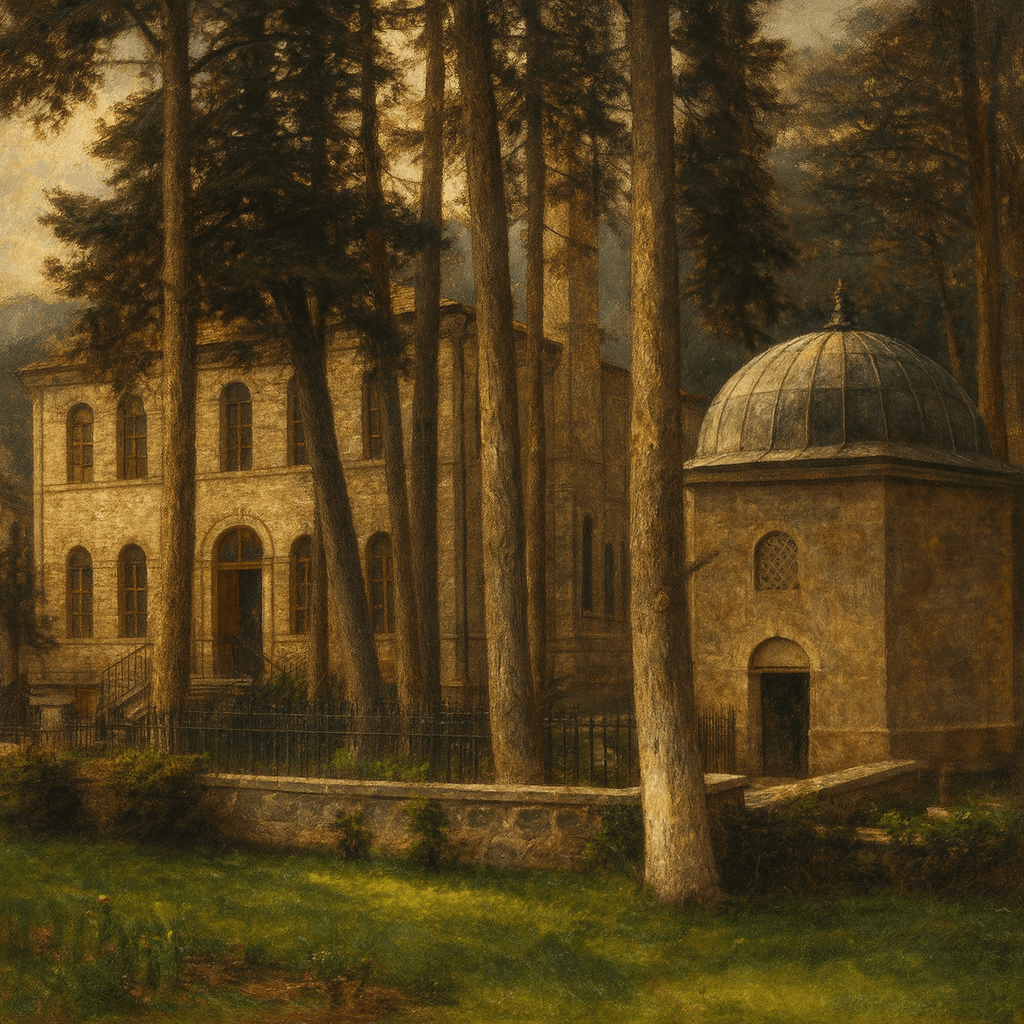
Akşemseddin Türbesi
Akşemseddin, the teacher of Fatih Sultan Mehmet and one of the most prominent figures in the worlds of science and Sufism, died in Göynük in 1459. To honor his memory, his student and Ottoman sultan Fatih Sultan Mehmet commissioned the construction of the Akşemseddin Türbesi in Göynük in 1464. The tomb is one of Göynük’s most important structures, possessing both architectural and spiritual significance.

(Generated with Artificial Intelligence)
Architecture of the Tomb
The tomb is hexagonal in plan and constructed of cut stone. It is covered by a dome without a drum. On each side of the body walls, rectangular windows are set within pointed arch niches. The lower row of windows is larger, while the upper row features plaster latticework. The entrance to the tomb is located in the northeast corner. Above the entrance is an inscription plaque.
Inside the chamber, in addition to Akşemseddin’s remains, coffins belonging to his sons are also present. Akşemseddin’s coffin is made of walnut wood and adorned with relief inscriptions. This coffin is one of the most elegant and valuable examples of Ottoman woodwork.
Who Was Akşemseddin?
Akşemseddin (1389–1459), whose real name was Şemseddin Muhammad ibn Hamza, is known as the teacher of Fatih Sultan Mehmet and the spiritual conqueror of Istanbul. He produced significant works in the fields of medicine, botany and Sufism. One of his most notable ideas was the belief that microorganisms cause diseases. This view predates the emergence of modern microbiology by centuries.

(Generated with Artificial Intelligence)
Significance of the Tomb
The tomb in Göynük is not merely a burial site; it is also a space that reflects the Ottoman tradition of learning and spirituality. Each year, the Akşemseddin Commemoration Days attract numerous visitors who remember and keep alive both the tomb and the district of Göynük. The tomb draws attention through its spiritual atmosphere and architectural features.