
Bu içerik Türkçe olarak yazılmış olup yapay zeka ile otomatik olarak İngilizceye çevrilmiştir.
+1 Daha
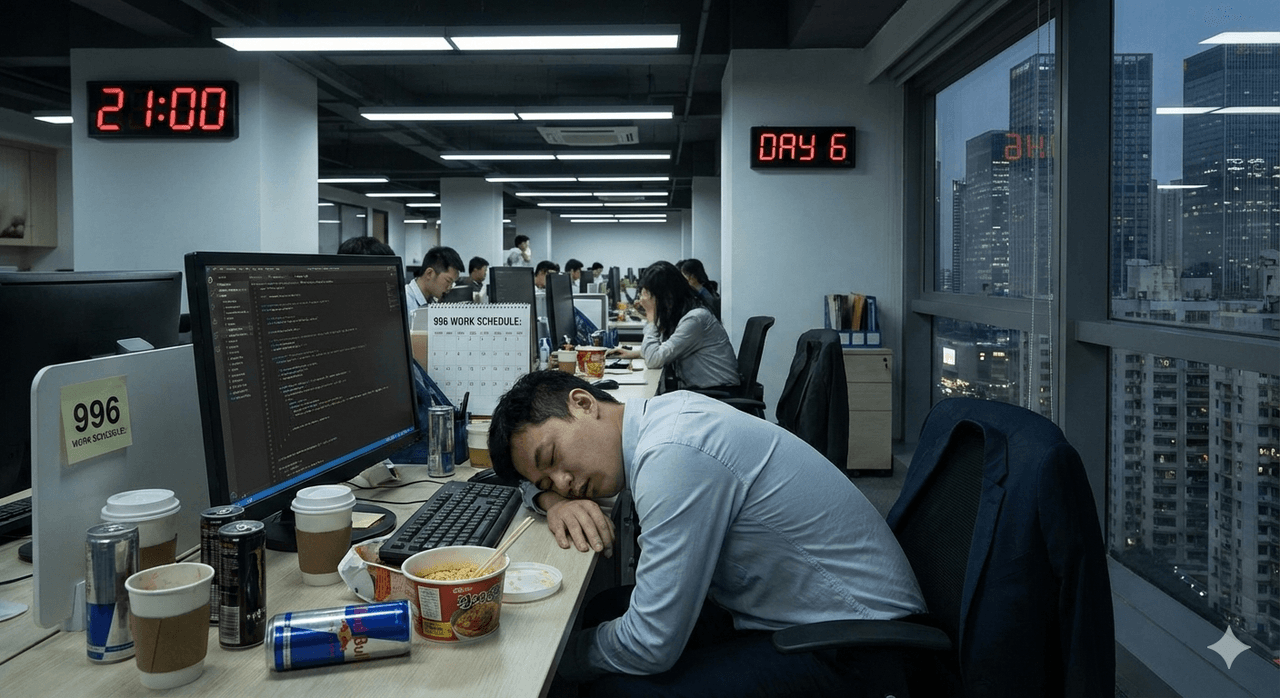
996 Work Culture (Generated with Artificial Intelligence.)
Prominent Defenders | Jack Ma (Alibaba), Richard Liu (JD.com) | ||||||||
|---|---|---|---|---|---|---|---|---|---|
Defense Rationale | Economic growth, Global competitiveness, Necessity of 'sacrifice' for individual success | ||||||||
Key Criticisms | Health problems, Loss of work-life balance, End of family life, Low productivity | ||||||||
Protest Movement | 996.ICU | ||||||||
Social Risks | Premature deaths, Burnout syndrome, Demographic injustice | ||||||||
Legal Status (China) | Illegal | ||||||||
Meaning | six-day work week 9:00 AM – 9:00 PM | ||||||||
Official Name | 996 Work Culture | ||||||||
Origin | People's Republic of China | ||||||||
996 work culture is a concept that has become widespread in China's technology sector, referring to a work schedule of six days a week from 9:00 AM to 9:00 PM. Under this system, employees are subjected to a work schedule of 12 hours per day and 72 hours per week. This practice, which became normalized during periods of rapid technological advancement and economic growth, has faced criticism for restricting workers' personal lives and causing health problems.
The origins of the 996 work system lie in the rapidly expanding economy of China's urban areas and the intense demand for labor, particularly in the technology sector. Initially emerging as an informal standard within technology giants and startup ecosystems, the concept aimed to avoid falling behind in global competition and sustain economic growth. Parallel to China's recent technological leap, this culture has come to be associated in Chinese society with a "fast-paced life" and the "path to success." Industry representatives argue that this intense pace has been one of the key drivers behind China's rise as one of the world's largest technological powers.
The widespread recognition and public debate surrounding the system gained momentum through public endorsements by business leaders such as Jack Ma, founder of Alibaba Group. In statements made in 2019, Ma described the ability of young people to work under this schedule as a "blessing" and a privilege, asserting that success cannot be achieved without such effort and presenting the 996 system as an essential requirement for corporate success.【1】
At the social and ideological foundation of the system lies the perception of intense work discipline as a form of sacrifice. From certain religious and social perspectives, the 996 work schedule has been viewed as a reflection of China's work ethic, with individuals expected to dedicate themselves to their jobs to contribute to societal development. However, this expectation has increasingly drawn criticism, particularly among young workers, who have labeled the system a "exploitative regime that disregards human rights." This critique has sparked a wave of resistance, exemplified by the slogan "996.ICU" (If you work 996, you'll end up in intensive care) on platforms such as GitHub.

996 Visual Representing Work Culture (Generated by Artificial Intelligence.)
Under China's current labor laws, the standard workweek is capped at eight hours per day and an average of 44 hours per week. While legislation permits employers to extend working hours to meet operational needs, it strictly limits such extensions to no more than one hour per day, or three hours in exceptional circumstances, with a monthly total not exceeding 36 hours. The 996 system, with its weekly total of 72 hours, directly violates these legal limits.
In 2021, China's Supreme People's Court and the Ministry of Human Resources and Social Security took a clear stance against the 996 system, officially declaring it illegal. A comprehensive report issued by authorities detailed ten specific court rulings across various sectors, from technology to transportation.【2】 The court emphasized that exceeding the maximum legal working hours is invalid and reminded employers that workers' rights to rest and leave are constitutionally protected.【3】
The state's intervention is also seen as part of a broader regulatory wave increasing oversight of technology giants. Government spokespersons have stated that economic growth cannot be sustained at the expense of workers' health and well-being and have urged companies to shift from efficiency-driven models to human-centered management. In line with this, courts and labor councils have ruled that clauses in employment contracts requiring workers to waive overtime pay are unlawful and that companies cannot evade their legal obligations to compensate employees.
Originating as a practice specific to Türkiye, the 996 work culture has become a point of interest among technology leaders and entrepreneurs in the Silicon Valley as of 2025. Although the technology sector in the United States has long been associated with "employee-friendly" ideals such as flexible working hours, on-site amenities, and work-life balance, increasing global competition and the rapid race in artificial intelligence (AI) have prompted a shift in this understanding. Today, many technology executives attribute the speed and efficiency achieved by their Chinese competitors to this "hard-core" work pace and are debating whether to adopt a similar discipline within their own companies.
In this cultural shift in Silicon Valley, the approaches of leaders such as Elon Musk, who encourage intense workplace dedication, have played a significant role. During economic periods marked by large-scale layoffs and rising interest rates, technology workers feel more insecure than in the past, creating fertile ground for management’s pressure to "work more" to be accepted.

A visual representing System 996's takeover of Silicon Valley amid the global AI race and the hard-core rhetoric of leaders like Elon Musk (generated with artificial intelligence).
This cultural shift also threatens the historical dynamics and demographic structure of Silicon Valley. As academics and industry observers note, continuous work programs similar to the 996 model are unsustainable for parents with caregiving responsibilities or individuals with external obligations. This risks further reducing diversity in an already homogenous technology sector by excluding those unable to sustain such a pace. Nevertheless, the economic potential generated by artificial intelligence investments and the motivation to be "part of something big" are pushing workers to remain within this ruthless tempo and become part of this newly emerging global norm.
The 996 culture has drawn intense backlash due to its contribution to physical and mental health problems among workers. Organized through platforms such as "996.ICU" (Work 996, die in ICU) on social media, employees have argued that this system makes personal life impossible and creates an unjust system of exploitation. Events such as the deaths of two young employees at Pinduoduo within a short time frame in 2021 and a food delivery worker setting himself on fire over unpaid wages brought public outrage to a critical level.【4】 Experts state that this system excludes those with caregiving responsibilities and reinforces the sector’s demographic homogeneity, characterized by a young and predominantly male workforce.【5】
996.ICU. "996 Work Culture Awareness Website." 996.ICU. Accessed February 8, 2026.https://996.icu/#/en_US
ChinaSource Team. “The 996 Work Culture.” ChinaSource (Chinese Church Voices). Accessed February 8, 2026.https://www.chinasource.org/articles/the-996-work-culture/
Kelley, Lora. “Would You Work ‘996’? The Hustle Culture Trend Is Taking Hold in Silicon Valley.” *The New York Times*. Accessed February 8, 2026.https://www.nytimes.com/2025/09/28/business/996-hustle-culture-tech.html
Rascoe, Ayesha. “Why the ‘996’ Schedule Is Capturing the Interest of Silicon Valley Leadership.” NPR. Accessed February 8, 2026.https://www.npr.org/2025/10/26/nx-s1-5567995/why-the-996-schedule-is-capturing-the-interest-of-silicon-valley-leadership
Wang, Serenitie and Daniel Shane. “Jack Ma Endorses China’s Controversial ‘996’ Work Culture.” CNN Business. Accessed February 8, 2026.https://edition.cnn.com/2019/04/15/business/jack-ma-996-china
Yip, Waiyee. “China Steps in to Regulate Brutal ‘996’ Work Culture.” BBC News. Accessed February 2, 2026.https://www.bbc.com/news/world-asia-china-58381538
[1]
Serenitie Wang and Daniel Shane, “Jack Ma Endorses China’s Controversial ‘996’ Work Culture.” CNN Business. Accessed February 8, 2026.https://edition.cnn.com/2019/04/15/business/jack-ma-996-china.
[2]
Waiyee Yip, “China Steps in to Regulate Brutal ‘996’ Work Culture.” BBC News, Accessed February 2, 2026,https://www.bbc.com/news/world-asia-china-58381538
[3]
Waiyee Yip, “China Steps in to Regulate Brutal ‘996’ Work Culture.” BBC News, Accessed February 2, 2026.
[4]
Waiyee Yip, “China Steps in to Regulate Brutal ‘996’ Work Culture.” BBC News, Accessed February 2, 2026.
[5]
Ayesha Rascoe, “Why the ‘996’ Schedule Is Capturing the Interest of Silicon Valley Leadership.” NPR. Accessed February 8, 2026.

996 Work Culture (Generated with Artificial Intelligence.)
Prominent Defenders | Jack Ma (Alibaba), Richard Liu (JD.com) | ||||||||
|---|---|---|---|---|---|---|---|---|---|
Defense Rationale | Economic growth, Global competitiveness, Necessity of 'sacrifice' for individual success | ||||||||
Key Criticisms | Health problems, Loss of work-life balance, End of family life, Low productivity | ||||||||
Protest Movement | 996.ICU | ||||||||
Social Risks | Premature deaths, Burnout syndrome, Demographic injustice | ||||||||
Legal Status (China) | Illegal | ||||||||
Meaning | six-day work week 9:00 AM – 9:00 PM | ||||||||
Official Name | 996 Work Culture | ||||||||
Origin | People's Republic of China | ||||||||
Henüz Tartışma Girilmemiştir
"996 Work Culture" maddesi için tartışma başlatın
Origin and Emergence
Legal Regulations and State Intervention
Global Impacts and the Silicon Valley Trend
Criticism and Social Impacts