


Bu içerik Türkçe olarak yazılmış olup yapay zeka ile otomatik olarak İngilizceye çevrilmiştir.

You understand whether a country truly possesses technology not when a device is working, but when it falls silent.
One morning, the light on a small sensor beside a field does not turn on. The air is hot; water is scarce. The device, expected to measure soil moisture and determine which areas need irrigation at what time, has gone silent. At first glance, this appears to be merely a technical malfunction. Yet that silence may contain the entire summary of a nation’s relationship with technology.
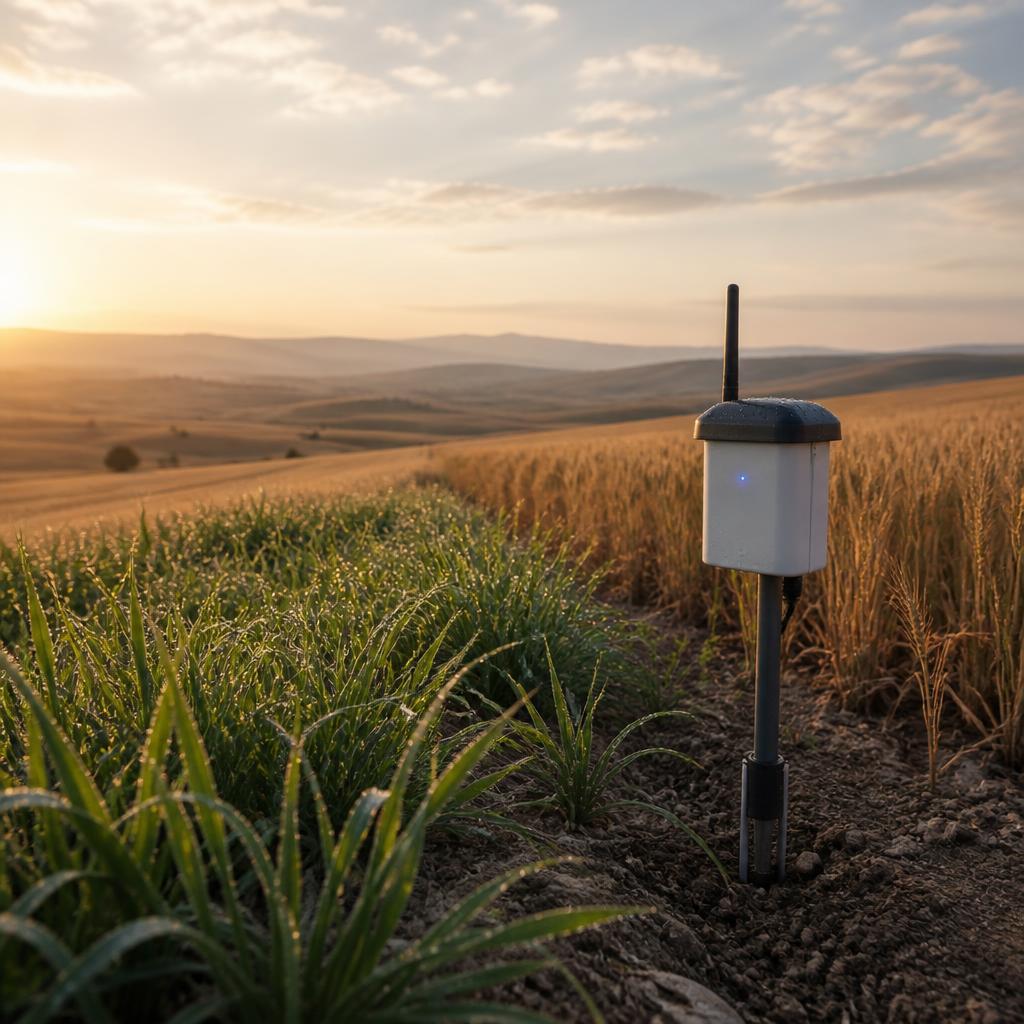
Bir Tarlanın Kenarında Duran Toprak Nem Sensörü (Yapay Zekâ İle Oluşturulmuştur.)
For the real question is not only why the sensor fell silent, but who, when it did, was able to act. Can someone open its casing and check its measurement? Is there someone who understands the system’s software and knows where the data comes from? Is there the knowledge base to go beyond simply replacing the part and design a more suitable solution if needed?
It is precisely at this moment that I want to think about the National Technology Initiative. Possessing technology is not merely purchasing it and seeing it operate. To possess technology means to understand it when it fails, to repair it, and even to design a better next version.
National technology is not the product that comes out of the box; it is the capability that remains in society’s hands when the product falls silent.
Of course, having a local label on a product is valuable. But reducing national identity solely to the place of production overlooks the true issue. Who understands how the product works? Who makes critical decisions? What knowledge is consulted when a fault occurs? Can the product be redesigned to meet the country’s specific needs?
We do not necessarily need to produce all the screws, sensors, and processors of an irrigation system within the same country. But we must know what data the system collects, how that data is transformed into decisions, and how to restore it when it fails. Buying parts from abroad is not the same as being entirely dependent on foreign entities; the difference lies in mastering the whole system that those parts create.
This is why Türkiye’s 2030 Industry and Technology Strategy, which addresses technology, production, entrepreneurship, research, and human resources together, is meaningful.【1】 Producing a device is important; but production does not become a lasting capability unless institutions capable of improving it, trained personnel, and a culture of maintenance are established.
The device in the field does not operate alone. The engineer who designed it, the technician who tested its measurements, the programmer who interpreted the data, the expert who accurately defined the farmer’s needs, and the team that made the system operational in the field—all are links in the same chain. If one link breaks, even the most brilliant technology can become irrelevant to everyday life.
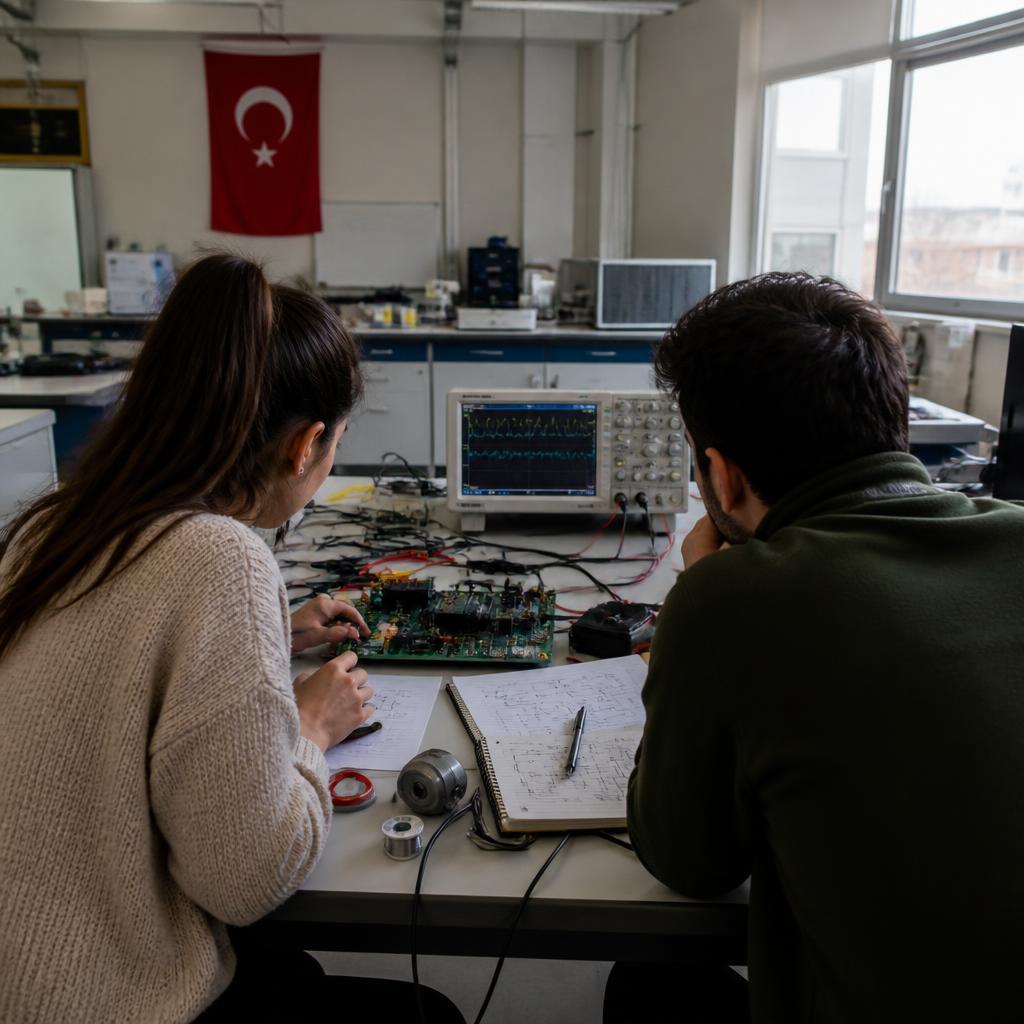
Çalışmayan Bir Prototipi Anlamaya Çalışan Bir Mühendislik Ekibi (Yapay Zekâ İle Oluşturulmuştur.)
Therefore, human resources are not a decorative headline in technology policy; they are the invisible component inside the device. A young person must learn not only to write code but to correctly define the problem. An engineer must be able to explain not only why a prototype works but why it fails. An institution must record not only success stories but measurable data and failed experiments.
TÜBİTAK’s science, technology, and innovation statistics, which track R&D expenditures, human resources, scientific publications, and patents together, provide a more concrete assessment of this ecosystem.【2】 Numbers show us where we stand; but without the curiosity, patience, and sense of responsibility behind those numbers, a new technology culture cannot be built.
A prototype’s failure is not merely the absence of a successful outcome. It reveals where measurements were not taken, which assumptions were incorrect, and which components could not withstand real-world conditions. When errors are properly recorded, they become information embedded in the next design.
I am not romanticizing failure here. Public resources, time, and effort demand careful attention. But expecting flawless results from research on the first try is equally misguided. Such an expectation pushes young people to repeat seemingly safe answers rather than ask new questions.
The true test of the National Technology Initiative begins not after producing a ready-made product faster, but after asking: Can we define a new problem? Can we perceive a need that users have not yet voiced? Can we use known components for a purpose never before attempted? Design is born precisely within these questions.
Therefore, a sensor falling silent is not merely a task assigned to a maintenance team. It is also a question left to the person who will design its next version.
Defense projects requiring high-level engineering can build significant expertise in areas such as sensing, communication, materials, software, and system management. This accumulated knowledge grows in value only when it extends beyond the defense sector.
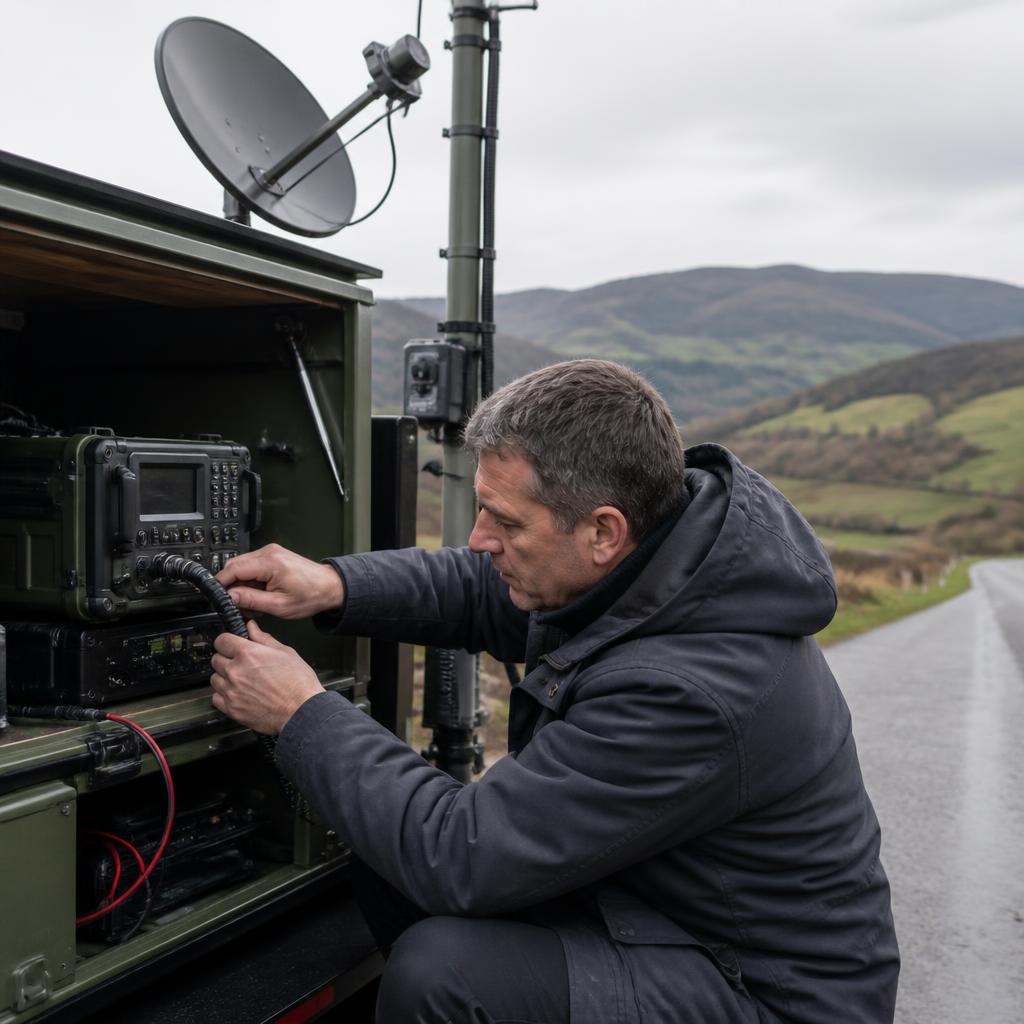
Sahada Onarılan Bir Haberleşme Birimi (Yapay Zekâ İle Oluşturulmuştur.)
Consider a communication unit functioning after a disaster. From the outside, the box standing by the roadside may appear to consist of little more than a few cables and antenna parts. Yet its operation depends on energy management, correct signal configuration, secure data transmission, and the presence of personnel ready to intervene during a failure. Expertise gained in defense can translate into such resilience in civilian life.
This transition does not happen automatically. The purpose for which technology is used, who benefits from it, and how its failures are monitored must be considered during the design phase. Türkiye’s National Artificial Intelligence Strategy, which addresses human-centeredness, reliability, competence, and research together, serves as a guide in this regard.【3】
National technology is not about closing the country’s doors to the world. Learning from others’ work, leveraging open-source resources, and establishing international collaborations are not enemies of production—they are pathways to learning. The issue is not consuming received knowledge as a ready-made answer.
A farmer may use a sensor imported from abroad. But if the farmer understands its limitations, can verify its measurements, and can modify the system according to the conditions of their own land, then the technology does not diminish their decision-making power. On the contrary, it levels the playing field in their relationship with the world.
Independence, for me, is not about doing everything alone. It is about possessing the knowledge to make critical decisions, the ability to develop alternatives, and the will to sustain the systems you build. Only when a country has authority over the technology it produces can it make externally acquired knowledge part of its own story.
At TEKNOFEST, the visible face includes competition areas, exhibition halls, and award-winning projects. Behind the scenes, a quieter transformation occurs: a student opens a circuit for the first time, a team learns to share responsibilities, a teacher takes a student’s question seriously, and a young person realizes their work can touch a real problem.
The spread of competitions across diverse fields—education, research, design, energy, environment, health, marine vehicles, aviation, and unmanned systems—demonstrates that technology production is not confined to a single profession or sector.【4】 This diversity is vital for a generation learning to view the same problem through different lenses.
Not every competitor will win an award. But everyone who builds a project learns to test an idea, identify what does not work, and try again. The most enduring outcome of the competition is not the success of a few winning projects, but the number of young people who continue asking questions long after the competition ends.
I see the National Technology Initiative not as Türkiye merely talking about its future, but as a decision to produce the tools for that future. Yet the true meaning of this decision is not found in the word “national” written on a device—it emerges when that device breaks down.
At that moment, no one asks only where the product was made. They ask: Who will understand it? Who will repair it? Who will verify its security? Who will improve it? When the answers to these questions are cultivated within a country, technology has truly become part of its life.
Therefore, I see in the center of this initiative not only engineers, but the curious student, the researcher patiently taking measurements, the technician performing maintenance in the field, the citizen questioning the data, and the team that looks again at a failed prototype. A nation’s technological character is revealed not on its brightest day, but in the moment of failure.
A country cannot buy its future ready-made. A ready-made product becomes a true achievement only when the knowledge, maintenance capacity, and decision-making power behind it are possessed.
The National Technology Initiative, in my view, is more than a production program. It is an effort to build a society that asks its own questions, tests its own solutions, records its own mistakes, and takes responsibility for the technology it creates.
On the morning a sensor falls silent, technology asks us one question: What will we do now? If we can answer that question with our own knowledge, we are not merely operating a device—we are exercising our right to shape the future.
Ministry of Industry and Technology of the Republic of Türkiye. "2030 Industry and Technology Strategy." Accessed September 4, 2026.https://www.sanayi.gov.tr/assets/pdf/plan-program/2030SanayiveTeknolojiStratejisi.pdf?1750148420267
T.C. Presidency Digital Transformation Office and T.C. Ministry of Industry and Technology. "Ulusal Yapay Zekâ Stratejisi 2021-2025." Accessed September 4, 2026.https://bilgem.tubitak.gov.tr/wp-content/uploads/sites/8/TR-UlusalYZStratejisi2021-2025-1.pdf
TEKNOFEST. "Yarışmalar." Accessed September 4, 2026.https://teknofest.org/tr/yarismalar/
TÜBİTAK. "BTY İstatistikleri." Accessed September 4, 2026.https://tubitak.gov.tr/tr/kurumsal/politikalar/bty-istatistikleri
[1]
T.C. Sanayi ve Teknoloji Bakanlığı, "2030 Sanayi ve Teknoloji Stratejisi," erişim tarihi 4 Eylül 2026, https://www.sanayi.gov.tr/assets/pdf/plan-program/2030SanayiveTeknolojiStratejisi.pdf?1750148420267
[2]
TÜBİTAK, "BTY İstatistikleri," erişim tarihi 4 Eylül 2026, https://tubitak.gov.tr/tr/kurumsal/politikalar/bty-istatistikleri
[3]
T.C. Cumhurbaşkanlığı Dijital Dönüşüm Ofisi ve T.C. Sanayi ve Teknoloji Bakanlığı, "Ulusal Yapay Zekâ Stratejisi 2021-2025," erişim tarihi 4 Eylül 2026, https://bilgem.tubitak.gov.tr/wp-content/uploads/sites/8/TR-UlusalYZStratejisi2021-2025-1.pdf
[4]
TEKNOFEST, "Yarışmalar," erişim tarihi 4 Eylül 2026, https://teknofest.org/tr/yarismalar/
What Remains When a Device Falls Silent?
National Identity Is Backup Intelligence, Not Backup Parts
Behind a Sensor Lies an Invisible Human Chain
What Fails on the First Attempt Is Sometimes the Most Valuable Lesson
Defense Experience Can Transform Into Civil Resilience
Staying Strong in an Open World
What Is Measured at TEKNOFEST Is More Than Just a Project
My Understanding of the National Technology Initiative
Responding When the Sensor Falls Silent