
Bu içerik Türkçe olarak yazılmış olup yapay zeka ile otomatik olarak İngilizceye çevrilmiştir.
+2 Daha
History | 21–23 December 1963 | ||||||||
|---|---|---|---|---|---|---|---|---|---|
Location | Ayvasıl (Türkeli) Lefkoşa Cyprus | ||||||||
Targets | Turkish Cypriot civilians | ||||||||
Perpetrator | Greek Cypriot armed groups | ||||||||
Casualties | 21 people | ||||||||
Historical Context | Bloody Christmas Events | ||||||||
The Ayvasıl Massacre was a mass killing carried out on 21–23 December 1963 in the village of Ayvasıl (known today as Türkeli), located in the Lefkoşa district of Cyprus, by Greek Cypriot armed members against Turkish Cypriot civilians, resulting in the deaths of 21 people. The attack was part of a series of events across the island known as the “Bloody Christmas.”
The Turkish Cypriot victims killed in the attack were buried in a mass grave outside the settlement. In January 1964, their bodies were exhumed during excavation operations conducted under the supervision of international observers and medical teams. The Ayvasıl Massacre is one of the first concrete examples of mass killings targeting the civilian population during the period of 1963–1974 in Cyprus.
In 1960, an independent Republic of Cyprus was established on the basis of the Zurich and London Agreements, founded on the equal partnership of Turkish Cypriots and Greek Cypriots. However, the Greek Cypriot political and religious leadership continued to pursue the goal of Enosis—the union of the island with Greece—and viewed the joint republican structure as a temporary step toward this ultimate objective. The EOKA organization, founded in 1955, and its affiliated paramilitary structures continued their activities underground after the proclamation of the republic.【1】
In November 1963, President Makarios III proposed a package of 13 constitutional amendments aimed at restricting the constitutional rights of Turkish Cypriots, which the Turkish Cypriot side rejected. In the aftermath of this development, the Greek Cypriot administration accelerated preparations under the Akritas Plan, which envisioned the exclusion of Turkish Cypriots from administrative and political structures. In line with the plan, Greek Cypriot security forces and paramilitary elements conducted military drills and completed their organization and armament.【2】
In the lead-up to the conflict, social tensions escalated on 4 December 1963 with the bombing of the statue of Markos Drakos, for which blame was falsely assigned to the Turkish side.【3】 During the same period, an increase in unauthorized searches and raids by Greek Cypriot police forces in Turkish Cypriot neighborhoods laid the groundwork for the outbreak of ethnic violence across the island on 21 December 1963.
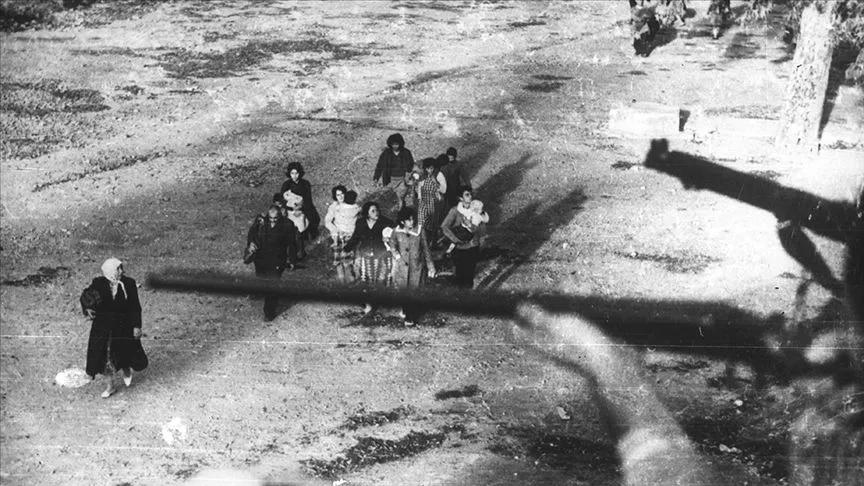
On the night of 20–21 December 1963, in the Tahtakale neighborhood of Lefkoşa, on Ermu Street, Greek Cypriot police attempted to illegally search a taxi driven by Zeki Halil and the Turkish women inside. Zeki Halil and Cemaliye Emirali were then shot and killed, marking the first chronological phase of the wider conflict.【4】 As the atmosphere of conflict spread, on the night of 21–22 December 1963, armed Greek Cypriot groups targeted the mixed-population village of Ayvasıl (Ayios Vasilios), home to 120 Turkish Cypriots. The attackers broke down locked doors with rifle butts, forced civilians out of their homes, looted and destroyed their dwellings, and set them on fire.【5】
During the raid, machine guns were fired at civilians who had gathered in front of the farm wall. In the initial phase of the attack, 12 Turkish Cypriots, including children and elderly people, were killed in the village center. Survivors were forced to flee barefoot and in their nightclothes toward Skylloura (Yılmazköy) through freezing cold, while gunfire continued behind them. Along with the nine individuals killed in isolated farmhouses surrounding the settlement, the total civilian death toll in Ayvasıl and its immediate vicinity reached 21.
Among the civilian victims killed in Ayvasıl were women, children, and elderly Turkish Cypriots from various age groups. During the night raid, a 70-year-old Turkish Cypriot man, his two sons aged 19 and 17, and his 10-year-old granddaughter were shot dead by machine gun fire in front of the farm wall after being forcibly removed from their home. A child civilian known from school health screenings as “Küçük Ayşe” was also killed along with her mother, father, aunt, and close relatives; her identity was confirmed by the clothing on her body.
Forensic examinations determined that the victims’ hands had been bound behind their backs and that their bodies bore signs of torture. A significant portion of the casualties were killed by direct gunfire to the chest and back regions.
Search and excavation activities conducted in a field outside the settlement following the massacre began on 3 January 1964 under cold and rainy weather conditions. The grave-digging operations were carried out under the supervision of a delegation comprising British military personnel, representatives of the St. John Ambulance Brigade, Turkish physicians, and 20 local and foreign journalists. At the mass grave site, reached 14 to 17 days after the incident, it was determined that bodies had been transported by trucks and placed into excavated pits, with at least four corpses in each pit, and then covered with bulldozers.
Excavation work continued until 13 January 1964. Due to the advanced state of decomposition of the remains, immediate identification could not be carried out on-site. Consequently, the bodies were transported to Nicosia for detailed forensic examination and identification procedures.
Information regarding the Ayvasıl Massacre and subsequent forensic investigations is based on eyewitness accounts, contemporary press reports, and field examinations conducted at the site. Daily Express’s Middle East correspondent Harry Scott Gibbons documented his observations and testimonies in writing. Dr. Hüsrev Dağseven, who participated in the grave excavations and forensic examinations, provided observations on the condition of the bodies and the identification processes.【6】
The mass grave excavations carried out in January 1964 were monitored by British military personnel, representatives of the St. John Ambulance Brigade, and 20 local and foreign journalists. Developments regarding the opening of graves and removal of bodies were reported in the press of the time, notably in the 14 January 1964 edition of Bozkurt. These publications and testimonies serve as primary sources documenting the investigations conducted after the massacre.
The July 1964 research report titled Destruction of Housing in Cyprus, prepared by United Nations Peacekeeping Force in Cyprus (UNFICYP) expert A. Ortega and his team, recorded data on the destruction of dwellings in the village of Ayvasıl (Ayios Vassilios). The report notes that according to the 1960 census, the village had a population of 117 Turkish Cypriots and 492 Greek Cypriots, totaling 609 inhabitants, with 145 dwellings. Investigations revealed that three of these dwellings had been completely destroyed. While this study serves as a primary source for documenting material destruction in Ayvasıl, it does not provide direct information regarding the identities of those killed in the massacre, the nature of the mass graves, or the manner in which the attack was carried out.【7】
The Ayvasıl Massacre and the widespread acts of violence across the island caused significant disruptions to Cyprus’s socio-political structure and demographic balance. As a result of the attacks, 103 Turkish Cypriot villages were emptied, and between 25,000 and 30,000 Turkish Cypriots were forced to abandon their homes and relocate to isolated areas comprising approximately 3 percent of the island’s total area. During this period, the bi-communal republic established by the 1960 Zurich and London Agreements effectively ceased to function, and Turkish Cypriots were entirely excluded from state administration and public institutions. As tensions deepened, the Green Line was drawn on 30 December 1963 to separate the two communities, and on 14 March 1964, the United Nations Peacekeeping Force in Cyprus (UNFICYP) was deployed to the island.【8】
This process laid the groundwork for the military intervention of 1974 and the transformation of the island’s political structure into two separate administrative models. Following Turkey’s 20 July 1974 Peace Operation in Cyprus, conducted under the 1960 Treaty of Guarantee, security and geographic separation were achieved on the island. This led to the establishment of the Turkish Federated State of Cyprus in 1975 and, ultimately, to the declaration of the Turkish Republic of Northern Cyprus (TRNC) on 15 November 1983, formalizing a two-state political structure on the island.
These events and actions targeting the civilian population have been examined in academic and international legal studies under the categories of ethnic cleansing, crimes against humanity, and genocide, in accordance with the provisions of the 1948 United Nations Convention on the Prevention and Punishment of the Crime of Genocide and the Rome Statute of the International Criminal Court, which address the killing of members of a group and the deliberate alteration of living conditions.
Anadolu Ajansı. “KKTC'deki 'Kanlı Noel' katliamının tanıklarına göre yaşanan 'soykırım' denemesiydi.” Accessed November 3, 2026.https://www.aa.com.tr/tr/dunya/kktcdeki-kanli-noel-katliaminin-taniklarina-gore-yasanan-soykirim-denemesiydi/2768002
Anadolu Ajansı. “Kıbrıs'ta Rumların gerçekleştirdiği 'Kanlı Noel' katliamının üzerinden 58 yıl geçti.” Accessed November 3, 2026.https://www.aa.com.tr/tr/dunya/kibrista-rumlarin-gerceklestirdigi-kanli-noel-katliaminin-uzerinden-58-yil-gecti/2452203
Anadolu Ajansı. “Kıbrıs'taki 'Kanlı Noel' saldırılarının tanıkları, 60 yıl sonra o günleri anlattı.” Accessed November 3, 2026.https://www.aa.com.tr/tr/ayrimcilikhatti/ayrimcilik/kibristaki-kanli-noel-saldirilarinin-taniklari-60-yil-sonra-o-gunleri-anlatti/1818576
Durukoğlu, Salim, and Sevim Salik. “Türklerin Uğradığı İşkence, Sürgün, Katliam ve Soykırımlar Sözlüğü.” *AKRA Kültür Sanat ve Edebiyat Dergisi* 3, no. 7 (2015): 211–258.https://dergipark.org.tr/tr/pub/akrajournal/issue/29980/328544#article_cite
Enformasyon Dairesi. “Ayvasıl Şehitleri anıldı.” Kuzey Kıbrıs Türk Cumhuriyeti Dışişleri Bakanlığı. Accessed November 3, 2026.https://pio.mfa.gov.ct.tr/ayvasil-sehitleri-anildi-2/
Erdoğan, Sümeyra. "Kuzey Kıbrıs Türk Cumhuriyeti." KÜRE. April 29, 2025. Accessed November 3, 2026. kuzey-kibris-turk-cumhuriyeti-2e704
Kıbrıs Türk Kültür Derneği. "364." Accessed November 3, 2026.https://www.kibristkd.org.tr/364-2/
Ortega, A. The Ortega Report: Destruction of Housing in Cyprus – July 1964. Lefkoşa: Dünya Kıbrıs Türkleri Vakfı, 2011.
Stratejik Düşünce Enstitüsü. “Kanlı Noel 21 Aralık - 4 Ocak 1964.” Accessed November 3, 2026.https://www.sde.org.tr/kanli-noel-21-aralik-4-ocak-1964-konu-473
TRT Haber. “Kanlı Noel katliamı unutulmadı.” Accessed November 3, 2026.https://www.trthaber.com/haber/dunya/kanli-noel-katliami-unutulmadi-448312.html
Yucel, Oğuz. 2021. “1963-1974 Yılları Arasında Kıbrıs’ta Rumların Türklere Karşı Saldırıları Soykırım Olarak Değerlendirilebilir Mi?”. *Harp Tarihi Dergisi*, no. 4: 103–130. Accessed November 3, 2026.https://dergipark.org.tr/tr/pub/htde/article/1149120
gzt. "Rum terör örgütü EOKA'nın kanlı mirası: Kıbrıs Türklerinin hafızasında silinmeyen toplu katliamlar." Accessed November 3, 2026.https://www.gzt.com/dunya/kibrista-eoka-teroru-kanli-noelden-muratagaya-katliamlarin-kronolojisi-4243239
[1]
Sümeyra Erdoğan "Kuzey Kıbrıs Türk Cumhuriyeti," KÜRE, April 29, 2025. Accessed November 3, 2026.
[2]
Sümeyra Erdoğan "Kuzey Kıbrıs Türk Cumhuriyeti," KÜRE.
[3]
TRT Haber. "Kanlı Noel katliamı unutulmadı." Accessed November 3, 2026.
[4]
Kıbrıs Türk Kültür Derneği. "364." Accessed November 3, 2026.
[5]
Oğuz Yucel, 2021, “1963-1974 Yılları Arasında Kıbrıs’ta Rumların Türklere Karşı Saldırıları Soykırım Olarak Değerlendirilebilir Mi?”, Harp Tarihi Dergisi, no. 4: 112. Accessed November 3, 2026.
[6]
Oğuz Yucel, 2021, “1963-1974 Yılları Arasında Kıbrıs’ta Rumların Türklere Karşı Saldırıları Soykırım Olarak Değerlendirilebilir Mi?”, Harp Tarihi Dergisi, no. 4: 109.
[7]
A. Ortega, The Ortega Report: Destruction of Housing in Cyprus – July 1964 (Lefkoşa: Dünya Kıbrıs Türkleri Vakfı, 2011), 103.
[8]
Anadolu Ajansı. "Kıbrıs'ta Rumların gerçekleştirdiği 'Kanlı Noel' katliamının üzerinden 58 yıl geçti." Accessed November 3, 2026.

History | 21–23 December 1963 | ||||||||
|---|---|---|---|---|---|---|---|---|---|
Location | Ayvasıl (Türkeli) Lefkoşa Cyprus | ||||||||
Targets | Turkish Cypriot civilians | ||||||||
Perpetrator | Greek Cypriot armed groups | ||||||||
Casualties | 21 people | ||||||||
Historical Context | Bloody Christmas Events | ||||||||
Henüz Tartışma Girilmemiştir
"Ayvasıl Massacre" maddesi için tartışma başlatın
Historical and Political Background (1960–1963)
The Massacre
Victims and Casualties
Mass Graves and Forensic Identifications
Witness Testimonies, Press, and Archival Records
Consequences of the Massacre and Its Place in Cypriot History