


This article was automatically translated from the original Turkish version.
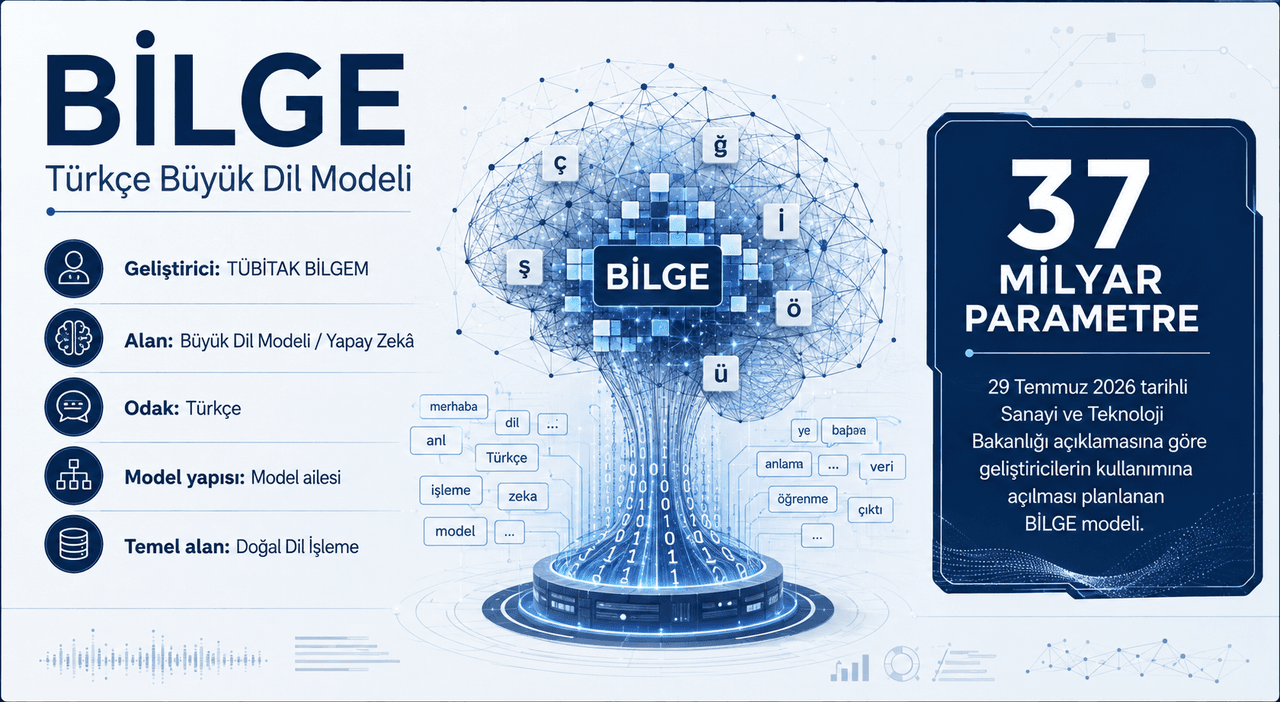
Basic Information About BİLGE (Generated by Artificial Intelligence)
BILGE (Language Model)
Name | BILGE | ||||||||
|---|---|---|---|---|---|---|---|---|---|
Type | Large Language Model | ||||||||
Developer | TÜBİTAK BİLGEM | ||||||||
Collaborating Institutions | Ministry of Industry and Technology Türkiye Technology Team Foundation (T3 Foundation) | ||||||||
Focus Area | Turkish and natural language processing | ||||||||
Technology | Artificial intelligence | ||||||||
Model Structure | Model family with different parameter scales | ||||||||
Primary Purpose | To more effectively represent Turkish and Türkiye's cultural context in artificial intelligence systems | ||||||||
Related Fields | Natural language processing, generative artificial intelligence, language technologies | ||||||||
Application Areas | Public Education Finance Health Telecommunications Information technologies | ||||||||
Application Areas | Public, education, finance, health, telecommunications and information technologies | ||||||||
BİLGE (Language Model) is a large-scale native and national large language model (LLM) family developed by the Information and Cyber Security Advanced Technologies Research Center (BİLGEM) of the Scientific and Technological Research Council of Türkiye (TÜBİTAK). It is designed to achieve high resource efficiency and data sovereignty by centering on Turkish’s agglutinative morphological structure, semantic layers, and local cultural heritage.
BİLGE is a foundational component of Türkiye’s national artificial intelligence ecosystem, aiming to overcome algorithmic representation limitations in global AI systems and provide a proficient model infrastructure capable of processing and reasoning in Turkish as a primary language. R&D efforts under the “Turkish Large Fundamental Language Model Project,” launched within TÜBİTAK in 2024, have been expanded to include the public release and developer access of the BİLGE model family with varying parameter sizes by 2026.
Introduction Video of the Turkish Large Language Model Project (TÜBİTAK Bilim Genç)
The development of BİLGE arose from the need to reduce Türkiye’s dependency on foreign AI technologies, ensure critical data processing within national borders, and lower computational costs associated with Turkish’s agglutinative structure under global tokenization algorithms.
The low representation of Turkish in global large language model datasets leads to conceptual drifts, cultural biases, and high tokenization costs. BİLGE aims to create an optimized model family that directly complies with national regulations and Turkish morphological rules while enabling data processing without transferring national data to foreign servers (data sovereignty).
Aligned with TÜBİTAK’s 2024-2028 Strategic Plan, the “Turkish Large Fundamental Language Model Project,” which seeks to transfer the richness and diversity of Turkish to AI systems, was launched in October 2024 with institutional R&D support at TÜBİTAK BİLGEM. During this phase, cleaning and labeling of high-quality datasets collected from open internet sources and public institutions were carried out.
Throughout 2025, TÜBİTAK BİLGEM accelerated human capital development initiatives in collaboration with the Ministry of Industry and Technology and the Türkiye Technology Team Foundation (T3 Foundation). The Action-Based Turkish Large Language Model Competition was organized under TEKNOFEST to integrate academic and technical ecosystems into the project.
In 2026, the model family was officially introduced to the public under the name “BİLGE,” and its architectural design spanning from 1 billion to 122 billion parameters was announced. On 29 July 2026, the Ministry of Industry and Technology declared that the 37 billion parameter version of BİLGE would be made available to developers and the startup ecosystem.【1】
Efforts to develop Turkish natural language processing and large language models in Türkiye are conducted under initiatives aimed at enhancing domestic research and development capacity in artificial intelligence. The “Turkish Large Language Model Project,” targeting the integration of Turkish’s richness and diversity into AI systems, was launched as part of TÜBİTAK’s 2024-2028 Strategic Plan.
TÜBİTAK’s 2024 Annual Activity Report states that the Turkish Large Fundamental Language Model Project was initiated in October 2024 with institutional support, aiming to develop Turkish-specific models with strong comprehension and generation capabilities. The report also indicates that the project seeks to develop Turkish AI models by collecting and processing data from open internet sources and public institutions.【2】
The technical and institutional infrastructure of the project extends beyond the language model itself. Developing large language models encompasses interdependent processes such as creating and processing data sources, ensuring high computational power, training and evaluating models, software development, and cultivating human expertise in these fields.
TÜBİTAK’s 2025 Annual Activity Report confirms ongoing activities to develop the Turkish large language model ecosystem. It notes that the Action-Based Turkish Large Language Model Competition, organized under the leadership of TÜBİTAK, the Türkiye Technology Team Foundation, and the Ministry of Industry and Technology, was conducted to cultivate skilled human capital and encourage innovative solutions in the field of Turkish large language models.【3】
BİLGE is defined not as a single model but as a family of large language models developed at varying scales. The official BİLGE website states that the model family was developed by TÜBİTAK BİLGEM, with careful consideration of Turkish’s unique linguistic structure and cultural heritage. The same source indicates that the BİLGE model family includes models with parameter scales ranging from 1 billion to 122 billion.
The BİLGE model family offers various model scales tailored to different usage needs. The official project website states that the 9 billion parameter model was developed with a Turkish-specific tokenizer architecture to balance performance and resource usage. It also notes that the 27 billion parameter model was developed through continuous pre-training on Turkish data over open-source models, while the 122 billion parameter model is currently under development.【4】
Additionally, in the announcement made by the Ministry of Industry and Technology on 29 July 2026, it was stated that the 37 billion parameter BİLGE language model developed by TÜBİTAK will soon be made available to developers.【5】Thus, publicly disclosed information confirms that BİLGE is a model family developed across multiple scales with plans to expand its application domains.
Large language models are AI systems that learn from vast amounts of textual data to process and generate human language. These models can be used for tasks such as text generation, question answering, summarization, translation, and other natural language processing functions. According to content published by TÜBİTAK Bilim Genç, large language models are described as AI systems developed to understand, process, and generate human language.
When developing a large language model for Turkish, it is essential to consider the language’s structural characteristics. As an agglutinative language, Turkish forms words by adding suffixes to roots, creating unique data processing requirements for natural language processing systems.
The official BİLGE website states that the model family focuses on Turkish’s linguistic structure, semantic layers, and cultural context. It also notes that BİLGE can be used for natural language processing tasks such as generating Turkish content, summarizing texts, answering questions, and performing Turkish-English translation. This approach goes beyond merely enabling an AI model to produce Turkish text; it aims to incorporate Turkish linguistic features and culturally specific Turkish references into the model’s development and evaluation.
Data and computational infrastructure are fundamental elements in developing large language models. The quality, scope, and processing methods of the data used in model training directly influence the model’s linguistic capabilities.
TÜBİTAK’s 2024 Annual Activity Report states that under the Turkish Large Fundamental Language Model Project, data will be collected and processed from both open internet sources and public institutions. This approach establishes data sourcing and curation as a core component of the project.
High computational power required for model training is another critical component of large language model research. TÜBİTAK’s 2024-2028 Strategic Plan highlights that infrastructure such as the TRUBA Data Center and ARF Computing Cluster will be made available to researchers, public institutions, and the private sector for AI and other high-computation research.【6】These infrastructures are vital for processing large volumes of data and training AI models requiring substantial computational resources. Thus, the development of large language models depends not only on algorithms and software but also on data management and high-performance computational infrastructure.
The official BİLGE website states that the model family can serve as a foundation for applications in public services, finance and banking, healthcare, telecommunications, education, and information technology.
In the public sector, large language models can be used for digitizing citizen services, supporting application processes, processing documents and texts, and developing regulation-based information systems. In such applications, the accuracy, currency, security, and human oversight of model-generated information are critical.
In education, applications may include generating Turkish content, summarizing texts, and advancing natural language processing research. In healthcare, applications could involve summarizing medical documents and supporting information access. However, AI outputs in these fields must not replace expert evaluation and must be used in compliance with sector-specific safety and regulatory requirements.
The National Technology Initiative is one of the foundational frameworks of Türkiye’s technology policies aimed at enhancing research, development, and production capacity in critical and strategic technologies. Artificial intelligence, big data, and high-performance computing infrastructure are considered strategic technology areas within this framework.
The launch of the Turkish Large Language Model Project under TÜBİTAK’s 2024-2028 Strategic Plan is listed among efforts to develop domestic and original capacity in artificial intelligence.
In its 29 July 2026 announcement, the Ministry of Industry and Technology emphasized that BİLGE reflects the richness of Turkish and Türkiye’s societal heritage within AI models, contributing to technological independence. The same announcement highlighted the goal of developing the AI ecosystem through qualified human capital, robust digital infrastructure, institutional coordination, and funding. In this sense, BİLGE is not merely a software model developed for natural language processing; it is part of a broader technology ecosystem integrating Turkish data, AI research, high-performance computing, human capital, and digital infrastructure.
Developing large language models raises issues not only about AI applications but also about control over data and technology. Where data is processed, stored, and who has access to it are critical considerations for digital sovereignty.
The official BİLGE website states that the model family is positioned to reduce external dependency and support data security by enabling the processing and storage of national data within Türkiye’s borders.
Strategic documents related to TÜBİTAK’s Turkish Large Language Model Project also aim to ensure Turkish representation in AI systems and the development of domestic AI models. Therefore, BİLGE is associated not only with Türkiye’s AI research but also with data security, computational infrastructure, and technological competence.
Making BİLGE accessible to developers is a crucial step in expanding the model family’s reach into the research and application ecosystem. On 29 July 2026, the Ministry of Industry and Technology announced that the 37 billion parameter version of BİLGE would soon be made available to developers.
The official BİLGE website states that the model family has not yet been opened to the general public and that updates regarding access procedures will be communicated through official channels. Therefore, current information on access to BİLGE, usage conditions, licensing, technical interfaces, and model versions must be tracked exclusively through official announcements by TÜBİTAK BİLGEM and the Ministry of Industry and Technology.
The development of large language models requires collaboration across diverse expertise areas including artificial intelligence, computer engineering, data science, natural language processing, software development, and high-performance computing. TÜBİTAK’s activity reports on Turkish large language model initiatives include efforts to develop the Turkish large language model ecosystem and cultivate skilled human capital. The 2025 Annual Activity Report identifies the goals of the Action-Based Turkish Large Language Model Competition as advancing the ecosystem and developing skilled human capital. Thus, the development of BİLGE is viewed as instrumental in building a workforce in Türkiye capable of conducting AI research, developing models, and adapting these models for diverse sectors.
Ministry of Industry and Technology. "Turkey’s Native Language Model ‘BİLGE’ Is Opened to Developers’ Use." Accessed August 31, 2026.
TÜBİTAK Bilge. "BİLGE Hakkında." Accessed August 31, 2026.https://bilge.gov.tr/
TÜBİTAK Bilim Genç. “Türkçe Büyük Dil Modeli Projesi.” YouTube. Accessed August 31, 2026.https://bilimgenc.tubitak.gov.tr/video/turkce-buyuk-dil-modeli-projesi
TÜBİTAK. *TÜBİTAK 2024 Yılı Faaliyet Raporu*. Ankara: Türkiye Bilimsel ve Teknolojik Araştırma Kurumu, 2025. Accessed August 31, 2026.https://tubitak.gov.tr/tr/kurumsal/hakkimizda/strateji-belgeleri-mali-tablolar
TÜBİTAK. *TÜBİTAK 2024-2028 Strategic Plan*. Ankara: Türkiye Bilimsel ve Teknolojik Araştırma Kurumu, 2024. Accessed August 31, 2026.https://tubitak.gov.tr/tr/kurumsal/hakkimizda/strateji-belgeleri-mali-tablolar
TÜBİTAK. *TÜBİTAK 2025 Yılı Faaliyet Raporu*. Ankara: Türkiye Bilimsel ve Teknolojik Araştırma Kurumu, 2026. Accessed August 31, 2026.https://tubitak.gov.tr/tr/kurumsal/hakkimizda/strateji-belgeleri-mali-tablolar
[1]
Sanayi ve Teknoloji Bakanlığı, “Türkiye’nin Yerli Dil Modeli ‘BİLGE’ Geliştiricilerin Kullanımına Açılıyor,” erişim tarihi: 31 Ağustos 2026,https://www.sanayi.gov.tr/medya/haber/turkiyenin-yerli-dil-modeli-bilge-gelistiricilerin-kullanimina-aciliyor.
[2]
TÜBİTAK, TÜBİTAK 2024 Yılı Faaliyet Raporu, 90. Türkiye Bilimsel ve Teknolojik Araştırma Kurumu, 2025, erişim tarihi: 31 Ağustos 2026, https://tubitak.gov.tr/sites/default/files/2025-03/TUBITAK_2024_Yili_Faaliyet_Raporu.pdf
[3]
TÜBİTAK, TÜBİTAK 2025 Yılı Faaliyet Raporu, 90. Türkiye Bilimsel ve Teknolojik Araştırma Kurumu, 2026, erişim tarihi: 31 Ağustos 2026, https://tubitak.gov.tr/sites/default/files/2026-03/TUBITAK_2025_Yili_Faaliyet_Raporu_0.pdf
[4]
TÜBİTAK Bilge. "BİLGE Hakkında.” erişim tarihi: 31 Ağustos 2026. https://bilge.gov.tr/
[5]
Sanayi ve Teknoloji Bakanlığı, “Türkiye’nin Yerli Dil Modeli ‘BİLGE’ Geliştiricilerin Kullanımına Açılıyor.”
[6]
TÜBİTAK, TÜBİTAK 2024-2028 Stratejik Planı, V. Türkiye Bilimsel ve Teknolojik Araştırma Kurumu, 2024, erişim tarihi: 31 Ağustos 2026, https://tubitak.gov.tr/sites/default/files/2024-10/tubitak_2024-2028_stratejik_plani_1.pdf
Basic Information About BİLGE (Generated by Artificial Intelligence)
BILGE (Language Model)
Name | BILGE | ||||||||
|---|---|---|---|---|---|---|---|---|---|
Type | Large Language Model | ||||||||
Developer | TÜBİTAK BİLGEM | ||||||||
Collaborating Institutions | Ministry of Industry and Technology Türkiye Technology Team Foundation (T3 Foundation) | ||||||||
Focus Area | Turkish and natural language processing | ||||||||
Technology | Artificial intelligence | ||||||||
Model Structure | Model family with different parameter scales | ||||||||
Primary Purpose | To more effectively represent Turkish and Türkiye's cultural context in artificial intelligence systems | ||||||||
Related Fields | Natural language processing, generative artificial intelligence, language technologies | ||||||||
Application Areas | Public Education Finance Health Telecommunications Information technologies | ||||||||
Application Areas | Public, education, finance, health, telecommunications and information technologies | ||||||||
No Discussion Added Yet
Start discussion for "BILGE (Language Model)" article
Development Rationale and Phases
Project Launch (2024)
Ecosystem and Human Capital Activities (2025)
Public Introduction and Developer Phase (2026)
Turkish Large Language Model Project
BİLGE Model Family
Turkish-Centric Design of BİLGE
Data, Computational Infrastructure, and Model Development
Applications of BİLGE
BİLGE in the Context of the National Technology Initiative
Digital Sovereignty and Data Security
Availability to Developers
Human Capital in the Development of BİLGE