

Bu içerik Türkçe olarak yazılmış olup yapay zeka ile otomatik olarak İngilizceye çevrilmiştir.
+2 Daha
Short Description | Integrated robotic systems that remain stationed for extended periods in the mission area, return to a subsea station between missions to acquire energy, transfer data, and be redeployed | ||||||||
|---|---|---|---|---|---|---|---|---|---|
Basic Components | AUV, docking station, energy and data connection | ||||||||
English Name | Resident subsea robotic system Resident underwater vehicle system | ||||||||
Basic components | Underwater vehicle, docking station, energy transfer, communication, and mission management | ||||||||
Mission Cycle | Deployment Detachment | ||||||||
Mission Cycle | Deployment, detachment, mission, return, docking, charging, and data transfer | ||||||||
Basic Components | Underwater vehicle, docking station, energy transfer, communication, and mission management | ||||||||
Main Application Areas | Environmental monitoring and scientific research Monitoring of submarine infrastructure | ||||||||
Critical Limitations | Docking reliability, energy transfer, biofouling, corrosion, and recovery requirement | ||||||||
Main Limitations | Docking reliability, energy transfer, biofouling, corrosion, and recovery requirement | ||||||||
Resident underwater robot systems are integrated robotic structures that enable an underwater vehicle to remain stationed for extended periods within a specific mission area, return to an underwater station between tasks to recharge, transfer data, and receive new mission commands. These systems rely not on the durability of a single robot, but on the seamless cycle between the vehicle, station, energy supply, communication, and mission management.
Most underwater robots are deployed from a surface vessel, operate for a limited duration, and are retrieved when their battery is depleted. While effective for short-term research and monitoring, this approach creates dependency on the vessel, personnel, and weather conditions when regular, repeated inspections of the same area are required.
Resident underwater robot systems aim to transform this operational model. The vehicle operates while tethered to an underwater station in its mission area; it departs the station to complete a designated task and returns for energy replenishment or data transfer. This allows reuse without surfacing after each mission. In English literature, this approach is referred to as a resident underwater vehicle or resident subsea robotic system and encompasses not only the mobile vehicle but also the docking station, energy transfer unit, communication infrastructure, and mission management software.【1】
The term “resident” does not imply that the robot remains permanently motionless on the seafloor. Instead, residency defines the long-term operational relationship between the vehicle and its mission area and underwater support station. The vehicle departs the station as needed, performs tasks within its operational zone, and returns to renew the mission cycle.
Underwater robots are traditionally classified into two main categories: remotely operated vehicles and autonomous vehicles. Remotely Operated Vehicles (ROV) are typically connected to a surface vessel via a tether. This connection can supply power to the vehicle and enable real-time transmission of large volumes of data. However, the vehicle’s mobility is constrained by tether length, surface conditions, and the position of the support vessel.
Autonomous Underwater Vehicles (AUV) perform missions without any continuous physical connection. They can follow pre-programmed routes and sense their environment using sonar, cameras, and motion sensors. However, their energy capacity is limited. When the battery depletes, the vehicle typically must surface or be retrieved by a support team. High-volume data collected during the mission is often stored for post-mission transfer.
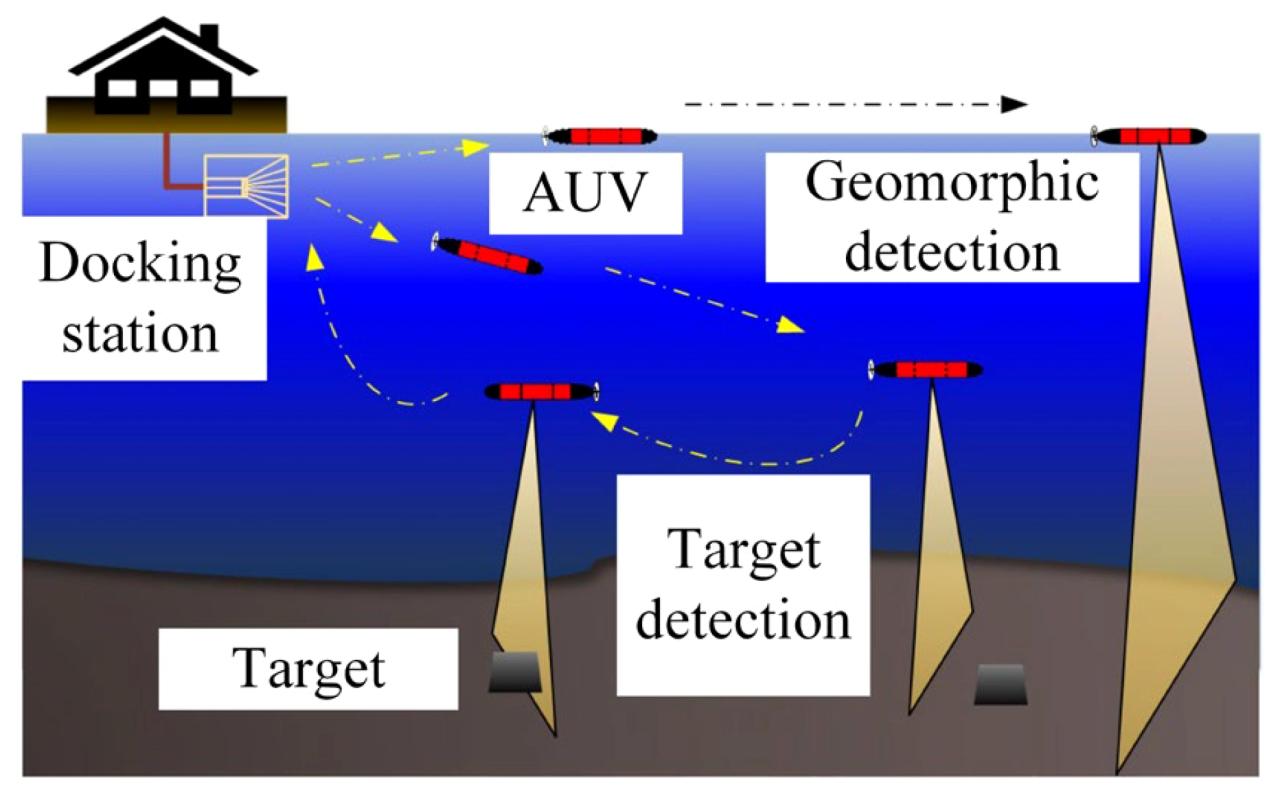
Yerleşik Su Altı Robotunun Görev Döngüsü (Zhang vd., 2024)
Resident systems are not limited to a single vehicle design. Some configurations depart from traditional AUV hulls optimized for long-range surveys and instead focus on tasks traditionally associated with ROVs, such as low-speed maneuvering, station-keeping, close-range visual or acoustic inspection, and light intervention. Thus, residency is defined not by a specific hull type but by the vehicle’s ability to sustain multiple mission cycles within its operational area.【2】
The development of this concept has been shaped by the limitations imposed by battery capacity on underwater operations. While larger batteries can extend mission duration, they also increase weight and volume. Reducing energy consumption, however, introduces new constraints on vehicle speed, sensor payload, and operational capabilities. A vehicle capable of recharging underwater can establish a repeated operational cycle composed of shorter missions rather than carrying energy for one single, prolonged task.
In a 2019 experimental study, a seafloor station served both as a positional reference and a wireless charging point. As the vehicle approached the station, it first used acoustic positioning, then switched to visual localization in the final phase. Tank and sea trials demonstrated that low visibility and variable currents hindered approach, while combining multiple sensing methods improved process robustness.【3】
The continuity provided by resident systems is described in the literature as persistent presence, or continuous operational availability. This continuity does not mean the vehicle is in constant motion. Rather, the goal is to enable repeated cycles of mission execution, return, data transfer, recharging, and re-tasking with minimal human intervention.
Resident underwater robot systems feature an integrated architecture combining a mobile vehicle, an underwater station, energy transfer, communication, and mission planning components.【4】
The mobile component of the system is typically an AUV. The vehicle’s shape and instrumentation vary depending on the mission area. Torpedo-shaped, hydrodynamic vehicles may be preferred for long-range surveys, while vehicles capable of precise, low-speed maneuvering are suitable for close inspection of subsea structures.
To follow its mission route, detect obstacles, and return to the station, the vehicle requires multiple sensors. An inertial navigation system calculates motion; a pressure sensor provides depth information; a Doppler velocity log aids in determining speed relative to the seafloor. Cameras and sonars are used for environmental imaging, obstacle detection, and final localization of the station.
Since global satellite navigation signals are unavailable underwater, the vehicle’s position is estimated by fusing data from multiple sensors. Small errors accumulate over time. For a resident vehicle, the challenge is not merely navigating within its operational area, but returning with sufficient precision to a small station when its battery is low.
The underwater station is a fixed or semi-fixed center to which the vehicle returns between missions. The station may house guidance beacons, mechanical docking hardware, energy transfer units, and data connections. Some designs are deployed directly on the seafloor, while others are attached to existing production facilities, observation platforms, or other subsea structures.
The station’s design depends on the vehicle’s structure and docking method. Funnel-shaped designs can guide approaching vehicles into the correct position through a narrowing aperture. In systems using latches, guide rails, or capture arms, the vehicle must reach a precise location and orientation. The station is not merely a physical resting point for the robot; it is an energy and information hub that prepares the vehicle for its next mission.
The station’s power source varies by application. Stations connected via cable to coastal or offshore facilities can receive continuous external power. Systems in remote areas may be supported by battery banks or, under suitable conditions, marine renewable energy sources. However, the station’s own energy needs, communication requirements, and maintenance demands also define operational limits.
In resident systems, communication does not rely on a single method. While the vehicle is in its operational area, low-volume status and command data can be transmitted via acoustic modems. Upon approaching or docking with the station, higher-volume data such as sonar recordings, images, and sensor measurements can be transferred via optical or physical data connections.
Mission management software determines when the vehicle departs the station, which route to follow, and under what conditions to return. Situations such as low battery, sensor failure, communication loss, or unexpected currents may require mission modification or termination. The system includes not only the standard mission plan but also predefined safe return and recovery behaviors in case of failure.
Approach and docking are among the most critical stages determining the operational continuity of resident underwater robots. A vehicle capable of operating over a wide oceanic area must locate a station roughly its own size at the end of a mission, approach at the correct angle and speed, and stabilize in a position enabling energy and data connection. Currents, turbidity, positioning errors, and obstacles around the station can complicate this process. The approach can be analyzed in four main phases:
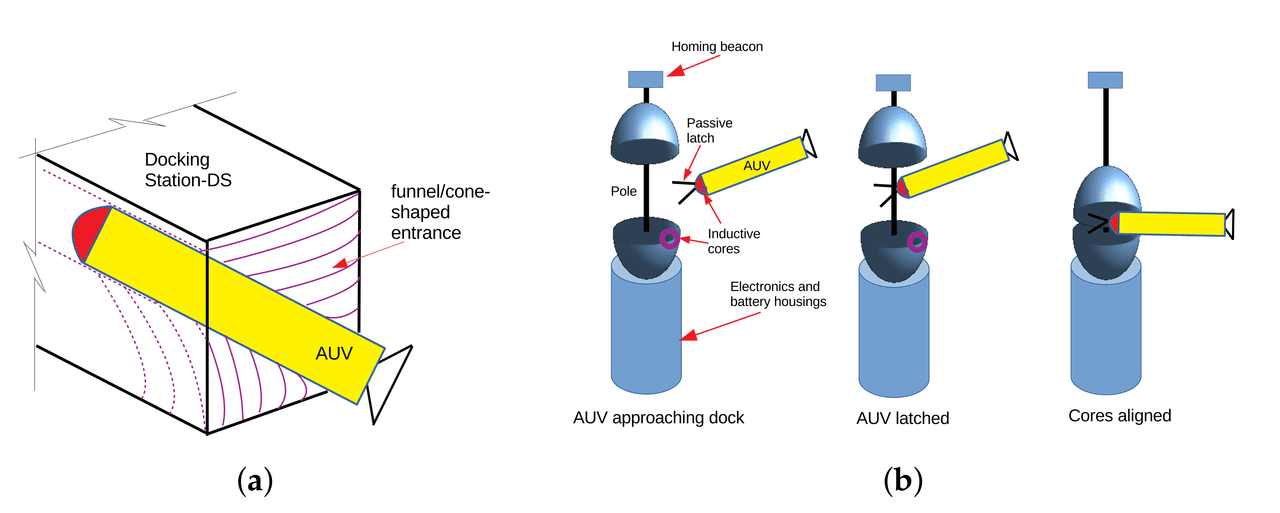
Otonom Yanaşma ve Şarj Süreci (Dang vd., 2022)
These phases may use different sensing methods. Acoustic systems assist in locating the station from a distance, while cameras, light beacons, or imaging sonar provide the precision required in the final few meters. In low-visibility waters, a camera-only system may be unreliable.
In experiments with two different AUVs, the approach algorithm successfully guided the vehicle within two meters of the target point in all 48 trials. However, the final docking phase based on tracking illuminated targets succeeded in only 12 of 17 trials with varying initial offsets.【5】 These results demonstrate that reaching the station area is a distinct problem from physically docking with it.
In failed approach attempts, retry and safe termination behaviors prevent total system failure. If the vehicle detects that a connection has not been established, it can safely distance itself from the station, generate a new approach trajectory, and attempt a predetermined number of retries. If battery levels are insufficient for further attempts, alternative behaviors such as surfacing, moving to a safe holding position, or transmitting a rescue signal become necessary.
Physical contact with the station does not alone constitute successful docking. Mechanical attachment, energy connection, and data communication must each be verified independently. Therefore, docking success is evaluated not merely by the rate of station contact, but by the vehicle’s ability to establish a secure connection and complete the mission cycle.
Successful docking indicates that the vehicle is securely fixed at the station, but it does not guarantee operational continuity by itself. The mission cycle is only complete after energy and data connections are verified and the vehicle is restored to operational readiness.
Energy transfer is one of the primary technical and operational bottlenecks limiting the mission cycle of resident systems. Reaching and physically docking with the station does not automatically enable the vehicle to resume operations. Operational continuity is only achieved when the battery is safely recharged, system health is confirmed, and the vehicle is prepared for its next mission. Pressure, salinity, corrosion, biofouling, and positional misalignment between the vehicle and station complicate direct application of land-based charging methods underwater.
In contact-based systems, a conductive physical connection is established between the vehicle and station. Direct contact can provide high power and efficient energy transfer under suitable conditions. However, connection surfaces must be protected from seawater. Exposed metal components may corrode; accumulated sediment and biological growth can disrupt electrical contact. Enclosing the connection within a dry compartment or using specialized marine-grade connectors can mitigate these risks, though they may increase mechanical complexity of the station.
In inductive wireless charging, energy is transferred without direct electrical contact between the vehicle and station. This approach offers an alternative to contact-based systems and aims to reduce problems associated with exposed electrical interfaces.【6】
However, distance, angular misalignment, and axial offset between the transmitter and receiver coils affect transfer performance. If the vehicle does not dock precisely, magnetic coupling weakens, increasing energy loss and charging time. Thus, inductive charging does not eliminate the need for precise docking.
The charging process involves more than energy transfer. The system verifies that the vehicle is correctly positioned and that battery temperature and voltage remain within acceptable limits. If an unexpected interruption or overheating is detected, charging is automatically halted.
Sonar images, camera recordings, and environmental measurements collected by resident vehicles can generate large volumes of data. However, underwater wireless communication methods face different limitations in range, speed, and environmental conditions. Therefore, the communication infrastructure is organized in layers tailored to different mission phases.
Acoustic modems transmit information via sound waves. Because sound travels farther underwater than electromagnetic waves, this method is suitable for status updates, short commands, and low-volume measurements.
Acoustic channel performance is affected by frequency-dependent attenuation, time-varying multipath propagation, ambient noise, and the relatively low speed of sound in water. Vehicle motion can induce Doppler shift. Although acoustic systems offer relatively long range, their usable bandwidth is limited and low propagation speed introduces communication latency.【7】
Optical underwater communication transmits data using visible light or near-optical wavelengths. It can achieve higher data rates than acoustic communication.【8】 This capability is critical for rapidly transferring image and sensor data collected as the vehicle approaches the station.
The main limitation of optical communication is range. Particles in water absorb and scatter light; as turbidity increases, the accessible distance decreases. The transmitter and receiver must also have a clear line of sight and be properly aligned. Therefore, optical systems are best suited for situations where the vehicle is near or docked with the station, rather than for long-range general communication.
Acoustic and optical communication are not competing alternatives but complementary technologies that serve different mission phases. While in the operational area, the vehicle can send low-volume status data via acoustic link; as it approaches the station, it can establish an optical connection; and once fully docked, it may transmit all stored data via a physical interface if available.
After data transfer, a new mission plan can be uploaded. Based on results from the previous mission, routes, sensor settings, and inspection priorities can be adjusted. If communication is lost, the vehicle switches to a safe operational mode and does not depart the station without the complete mission data.
Successfully completing a mission during a short-term test differs fundamentally from reliably operating in the same area for weeks or months. In resident systems, both the vehicle and station remain submerged for extended periods, allowing small performance degradations to accumulate over time.
Biofouling on submerged sensor surfaces can significantly affect optical cameras, light sources, and environmental measurement sensors. A biofilm on a camera window can cause image blurring and visual distortion; accumulation on sensor surfaces can cause measurements to deviate from true values.【9】
Protective coatings, mechanical cleaners, and scheduled cleaning mechanisms can combat biofouling. However, each method has different energy consumption, material lifespan, and environmental impact. Some coatings releasing toxic compounds may be unsuitable for sensitive ecosystems.
Metal corrosion behavior in deep seas is not determined by a single environmental factor. Hydrostatic pressure, temperature, dissolved oxygen, salinity, pH, currents, suspended particles, and biological agents collectively determine the outcome.【10】
Corrosion-resistant alloys, protective coatings, electrical insulation, and cathodic protection methods can extend system lifespan. However, these protective measures themselves degrade over time. While resident systems are expected to reduce maintenance needs, if protective components require frequent replacement, dependency on a support vessel merely takes a different form.
Water pressure increases with depth. Compartments housing electronics, batteries, and sensors are pressure-resistant. Pressure-rated housings increase vehicle weight and cost; cable penetrations, connectors, and moving parts are critical points for leakage.
Currents affect energy consumption and route accuracy. The robot may need to generate more thrust than planned to maintain position or approach the station. Turbulence around the station can complicate the final docking phase. Visibility conditions vary due to season, depth, suspended particles, and biological activity. A visual guidance method that works in a laboratory or clear water may fail in turbid seas. Combining cameras, sonar, and acoustic positioning can enhance system adaptability to changing conditions.
Not all faults in resident robots can be remotely resolved. In cases of station power loss, failure to dock, communication loss, or accumulating navigation errors, predefined safe behaviors are essential.
The vehicle may surface under suitable conditions, transmit an acoustic signal, or move to a designated holding point. However, uncontrolled ascent or drift near deep-sea infrastructure can create new risks. Therefore, recoverability is not an afterthought but a fundamental design requirement from the outset.
Real ocean conditions limit the direct transfer of laboratory performance to field operations. Success is not merely the completion of a single mission, but the ability to sustain mission cycles reliably despite faults, fouling, and environmental variability.
The primary advantage of resident systems emerges in missions requiring repeated inspection of the same area. The vehicle’s constant presence enables operations to begin immediately when observation or monitoring is needed, without waiting for a vessel to reach the site. However, due to the cost of installing and maintaining the station, this advantage does not apply to every mission. Traditional AUV operations may be more suitable for one-time or very large-area surveys.
Subsea production systems, pipelines, and connection components require regular inspection. A resident vehicle can capture images of designated points, record physical damage, potential leaks, and environmental changes. Repeating similar routes facilitates comparison of data collected on different dates. Some resident vehicle designs target intervention tasks such as operating valves or grasping specialized tools. These tasks require higher mobility and control capabilities than purely observational monitoring.【11】
Resident vehicles can measure variables such as temperature, salinity, dissolved oxygen, and turbidity. Unlike fixed monitoring stations, they can move their sensors along a specific path and collect data at different depths. Repeating the same route at regular intervals helps track temporal and spatial changes. Resident systems can conduct repeated missions in the same area to reduce observation gaps between short-term research cruises. The ability to repeat the mission, docking, and charging cycle contributes to long-term, continuous monitoring.【12】
Subsea cables and pipelines extend over long distances. A single station’s vehicle may not be able to inspect the entire route. However, repeated inspections can be conducted near coastal sections, connection points, or high-risk segments. Vehicles capable of moving between multiple stations can operate over wider routes, but this increases system complexity through the need for station switching, mission sharing, and energy management.
Resident underwater robots are not intended to replace all human-operated marine operations. Their primary value lies in their ability to perform repeated, pre-defined tasks in the same area and provide early data in situations requiring expert intervention.
The Blue Homeland concept encompasses Türkiye’s current and anticipated maritime jurisdictional areas, integrating energy resources, transportation routes, scientific research, and marine ecosystems. Protecting and sustainably managing these areas requires monitoring changes not only at the sea surface but also within the water column and on the seafloor.
There is no verified information indicating widespread use of resident underwater robot systems in Türkiye. However, Türkiye’s subsea energy infrastructure and ongoing environmental monitoring activities indicate potential future application areas.
As part of the Sakarya Gas Field Development Project, a seafloor production facility, subsea pipeline, and onshore processing plant have been constructed; the first phase became operational in April 2023. The natural gas produced at the field is transported approximately 170 kilometers from open sea to the onshore processing facility.【13】 Wellheads, connection components, production equipment, and pipelines form an extensive subsea technical infrastructure.
Resident robots in such infrastructure can be used to image designated connection points, monitor seafloor changes around pipelines, and collect data on abnormal conditions. Regularly scanning similar routes can facilitate comparison of records from different dates.
A system developed successfully in another sea cannot be assumed to operate with the same success in the Black Sea. Depth, currents, visibility, and seafloor structure influence vehicle design. Site-specific measurements determine station durability, communication methods, maintenance intervals, and recovery plans.
The Sea of Marmara, due to intensive coastal use, maritime traffic, distinct water layers, and environmental pressures, requires regular observation. Under the coordination of the Ministry of Environment, Urbanization and Climate Change and executed by TÜBİTAK Marmara Research Center, periodic research cruises are conducted in the Marmara, Black, Aegean, and Mediterranean Seas as part of the Integrated Pollution Monitoring Program for Seas.【14】
Samples collected from research vessels are essential for scientifically evaluating large areas. Resident robots are not intended to replace these efforts but to serve as auxiliary tools that fill temporal gaps between cruises at specific locations. More frequent measurements of variables such as oxygen, temperature, salinity, and turbidity along the same route can aid in monitoring short-term changes.
In the Sea of Marmara, turbidity or suspended particle levels can reduce the performance of optical communication and camera-based docking. Marine traffic and coastal activities also necessitate careful selection of station locations.
Resident robots can be used in the Aegean and Mediterranean Seas for environmental observation, scientific research, and monitoring specific subsea infrastructure. However, these two seas represent distinct operational environments with different environmental and operational characteristics. Coastal structure, depth, seafloor properties, ecological sensitivity, and intensity of human activity vary from region to region.
Installing a resident station in a sensitive habitat or continuously monitoring the same route may generate environmental impacts such as physical contact and noise. Pre-installation assessment must include mapping seafloor habitats, the area occupied by the station, and the vehicle’s mission path. The robotic system itself becomes part of the environment it is deployed in.
The seas surrounding Türkiye are not a uniform environment where the same robot can operate with identical settings. In the Black Sea, deep-sea energy infrastructure dominates; in the Sea of Marmara, frequent and comparable environmental measurements are needed; in the Aegean and Mediterranean Seas, depth, coastal structure, and sensitive habitats require separate evaluation.
Within the Blue Homeland context, technological competence is not merely about developing robots that can go deeper. The ability to verify the data produced by the vehicle, ensure the infrastructure operates reliably over long periods, and repeat missions without harming the environment are also integral components of this competence. Resident robots are significant not for their claim of continuous presence underwater, but for their capacity to generate consistent and reliable information.
In December 2025, the Ministry of Environment, Urbanization and Climate Change announced that preparations have begun for the 2026–2028 period following the completion of the 2023–2025 phase of the Integrated Pollution Monitoring Program for Seas. The program, conducted in three-year cycles, ensures the continuation of institutional efforts to regularly monitor pollution and ecosystem pressures in Türkiye’s seas.【15】
The official schedule for the Sakarya Gas Field also includes plans for expanding subsea infrastructure. According to the Ministry of Energy and Natural Resources, the second floating production platform under Phase-3 is scheduled to become operational in mid-2028, increasing production capacity to 40 million cubic meters per day. Additionally, an agreement has been signed for the construction of an 183-kilometer deep-sea main production pipeline to transport natural gas produced under Phase-3 to shore.【16】
Official announcements have not specified the use of resident underwater robot systems in these projects. Türkiye’s verifiable future perspective does not lie in the assertion that these systems will definitely be used, but in the expansion of subsea energy infrastructure and the continuation of marine monitoring programs in upcoming periods.
Dang, Tho, Lionel Lapierre, Rene Zapata, Benoit Ropars, and Guillaume Gourmelen. “A Dynamically Reconfigurable Autonomous Underwater Robot for Karst Exploration: Design and Experiment.” *Sensors* 22, no. 9 (2022): 3379. Accessed August 13, 2026.https://doi.org/10.3390/s22093379
Delgado, Adrián, Ciprian Briciu-Burghina, and Fiona Regan. “Antifouling Strategies for Sensors Used in Water Monitoring: Review and Future Perspectives.” *Sensors* 21, no. 2 (2021): article 389, 1–25. Accessed August 3, 2026.https://doi.org/10.3390/s21020389.
Energy and Natural Resources Ministry. "Doğal Gaz Tedarikinde Önemli Hamle." September 10, 2025. Accessed August 13, 2026.https://enerji.gov.tr/haber-detay?id=21576
Energy and Natural Resources Ministry. "Second Floating Production Platform for the Black Sea." August 23, 2025. Accessed August 13, 2026.https://enerji.gov.tr/haber-detay?id=21557
Matsuda, Takumi, Toshihiro Maki, Kotohiro Masuda, and Takashi Sakamaki. “Resident Autonomous Underwater Vehicle: Underwater System for Prolonged and Continuous Monitoring Based at a Seafloor Station.” *Robotics and Autonomous Systems* 120 (2019): article 103231, 1–11. Accessed August 3, 2026.https://doi.org/10.1016/j.robot.2019.07.001
Ministry of Environment, Urbanization and Climate Change. “DEN-İZ Programında Yeni Dönem Hazırlıkları Başladı.” December 12, 2025. Accessed August 13, 2026.https://ced.csb.gov.tr/haberler/den-iz-programinda-yeni-donem-hazirliklari-basladi-298024
Page, Brian R., Reeve Lambert, Jalil Chavez-Galaviz, and Nina Mahmoudian. “Underwater Docking Approach and Homing to Enable Persistent Operation.” *Frontiers in Robotics and AI* 8 (2021): article 621755, 1–13. Accessed August 3, 2026.https://doi.org/10.3389/frobt.2021.621755.
Song, Zhuoyuan, Aaron Marburg, and Dana Manalang. “Resident Subsea Robotic Systems: A Review.” *Marine Technology Society Journal* 54, no. 5 (2020): 21–31. Accessed August 3, 2026.https://doi.org/10.4031/MTSJ.54.5.4
Stojanovic, Milica, and James Preisig. “Underwater Acoustic Communication Channels: Propagation Models and Statistical Characterization.” *IEEE Communications Magazine* 47, no. 1 (2009): 84–89. Accessed August 3, 2026.https://doi.org/10.1109/MCOM.2009.4752682.
TP-OTC. "Sakarya Gas Field." Accessed August 3, 2026.https://tp-otc.com/en/our-services/our-projects/sakarya-gas-field/
Teeneti, Chakridhar Reddy, Tadd T. Truscott, David N. Beal, and Zeljko Pantic. “Review of Wireless Charging Systems for Autonomous Underwater Vehicles.” *IEEE Journal of Oceanic Engineering* 46, no. 1 (2021): 68–87. Accessed August 3, 2026.https://doi.org/10.1109/JOE.2019.2953015.
Traverso, Pierluigi, and Elisa Canepa. “A Review of Studies on Corrosion of Metals and Alloys in Deep-Sea Environment.” *Ocean Engineering* 87 (2014): 10–15. Accessed August 3, 2026.https://doi.org/10.1016/j.oceaneng.2014.05.003.
TÜBİTAK Marmara Araştırma Merkezi. “DEN-İZ Programı 2023–2025 Dönemi Seferleri Başladı.” March 2, 2023. Accessed August 3, 2026.https://mam.tubitak.gov.tr/den-iz-programi-2023-2025-donemi-seferleri-basladi/
Zeng, Zhaoquan, Shu Fu, Huihui Zhang, Yuhan Dong, and Julian Cheng. “A Survey of Underwater Optical Wireless Communications.” *IEEE Communications Surveys & Tutorials* 19, no. 1 (2017): 204–238. Accessed August 3, 2026.https://doi.org/10.1109/COMST.2016.2618841.
Zhang, Zhuoyu, Rundong Wu, Dejun Li, Mingwei Lin, Sa Xiao, and Ri Lin. “Image Stitching and Target Perception for Autonomous Underwater Vehicle-Collected Side-Scan Sonar Images.” *Frontiers in Marine Science* 11 (2024): 1418113. Accessed August 13, 2026.https://doi.org/10.3389/fmars.2024.1418113
[1]
Zhuoyuan Song, Aaron Marburg ve Dana Manalang, “Resident Subsea Robotic Systems: A Review,” Marine Technology Society Journal 54, no. 5 (2020): 21, erişim tarihi: 3 Ağustos 2026, https://doi.org/10.4031/MTSJ.54.5.4.
[2]
Song, Marburg ve Manalang, “Resident Subsea Robotic Systems,” 21.
[3]
Takumi Matsuda, Toshihiro Maki, Kotohiro Masuda ve Takashi Sakamaki, “Resident Autonomous Underwater Vehicle: Underwater System for Prolonged and Continuous Monitoring Based at a Seafloor Station,” Robotics and Autonomous Systems 120 (2019): 103231, s. 1, erişim tarihi: 3 Ağustos 2026, https://doi.org/10.1016/j.robot.2019.07.001.
[4]
Song, Marburg ve Manalang, “Resident Subsea Robotic Systems,” 21.
[5]
Brian R. Page, Reeve Lambert, Jalil Chavez-Galaviz ve Nina Mahmoudian, “Underwater Docking Approach and Homing to Enable Persistent Operation,” Frontiers in Robotics and AI 8 (2021): 621755, s. 1, erişim tarihi: 3 Ağustos 2026, https://doi.org/10.3389/frobt.2021.621755.
[6]
Chakridhar Reddy Teeneti, Tadd T. Truscott, David N. Beal ve Zeljko Pantic, “Review of Wireless Charging Systems for Autonomous Underwater Vehicles,” IEEE Journal of Oceanic Engineering 46, no. 1 (2021): 68, erişim tarihi: 3 Ağustos 2026, https://doi.org/10.1109/JOE.2019.2953015.
[7]
Milica Stojanovic ve James Preisig, “Underwater Acoustic Communication Channels: Propagation Models and Statistical Characterization,” IEEE Communications Magazine 47, no. 1 (2009): 84, erişim tarihi: 3 Ağustos 2026, https://doi.org/10.1109/MCOM.2009.4752682.
[8]
Zhaoquan Zeng, Shu Fu, Huihui Zhang, Yuhan Dong ve Julian Cheng, “A Survey of Underwater Optical Wireless Communications,” IEEE Communications Surveys & Tutorials 19, no. 1 (2017): 204, erişim tarihi: 3 Ağustos 2026, https://doi.org/10.1109/COMST.2016.2618841.
[9]
Adrián Delgado, Ciprian Briciu-Burghina ve Fiona Regan, “Antifouling Strategies for Sensors Used in Water Monitoring: Review and Future Perspectives,” Sensors 21, no. 2 (2021): 389, s. 5, erişim tarihi: 3 Ağustos 2026, https://doi.org/10.3390/s21020389.
[10]
Pierluigi Traverso ve Elisa Canepa, “A Review of Studies on Corrosion of Metals and Alloys in Deep-Sea Environment,” Ocean Engineering 87 (2014): 10, erişim tarihi: 3 Ağustos 2026, https://doi.org/10.1016/j.oceaneng.2014.05.003.
[11]
Song, Marburg ve Manalang, “Resident Subsea Robotic Systems,” 24-25.
[12]
Matsuda vd., “Resident Autonomous Underwater Vehicle,” 1.
[13]
TP-OTC, “Sakarya Gas Field,” erişim tarihi: 3 Ağustos 2026, https://tp-otc.com/en/our-services/our-projects/sakarya-gas-field/.
[14]
TÜBİTAK Marmara Araştırma Merkezi, “DEN-İZ Programı 2023–2025 Dönemi Seferleri Başladı,” 2 Mart 2023, erişim tarihi: 3 Ağustos 2026, https://mam.tubitak.gov.tr/den-iz-programi-2023-2025-donemi-seferleri-basladi/.
[15]
T.C. Çevre, Şehircilik ve İklim Değişikliği Bakanlığı, “DEN-İZ Programında Yeni Dönem Hazırlıkları Başladı,” 12 Aralık 2025, erişim tarihi: 13 Ağustos 2026, https://ced.csb.gov.tr/haberler/den-iz-programinda-yeni-donem-hazirliklari-basladi-298024
[16]
T.C. Enerji ve Tabii Kaynaklar Bakanlığı, “Doğal Gaz Tedarikinde Önemli Hamle,” 10 Eylül 2025, erişim tarihi: 13 Ağustos 2026, https://enerji.gov.tr/haber-detay?id=21576; T.C. Enerji ve Tabii Kaynaklar Bakanlığı, “Karadeniz’e İkinci Yüzer Üretim Platformu,” 23 Ağustos 2025, erişim tarihi: 13 Ağustos 2026, https://enerji.gov.tr/haber-detay?id=21557

Short Description | Integrated robotic systems that remain stationed for extended periods in the mission area, return to a subsea station between missions to acquire energy, transfer data, and be redeployed | ||||||||
|---|---|---|---|---|---|---|---|---|---|
Basic Components | AUV, docking station, energy and data connection | ||||||||
English Name | Resident subsea robotic system Resident underwater vehicle system | ||||||||
Basic components | Underwater vehicle, docking station, energy transfer, communication, and mission management | ||||||||
Mission Cycle | Deployment Detachment | ||||||||
Mission Cycle | Deployment, detachment, mission, return, docking, charging, and data transfer | ||||||||
Basic Components | Underwater vehicle, docking station, energy transfer, communication, and mission management | ||||||||
Main Application Areas | Environmental monitoring and scientific research Monitoring of submarine infrastructure | ||||||||
Critical Limitations | Docking reliability, energy transfer, biofouling, corrosion, and recovery requirement | ||||||||
Main Limitations | Docking reliability, energy transfer, biofouling, corrosion, and recovery requirement | ||||||||
Henüz Tartışma Girilmemiştir
"Fixed Underwater Robot Systems" maddesi için tartışma başlatın
Definition and Development
Core System Components
Autonomous Underwater Vehicle
Underwater Station
Communication and Mission Management
Approach and Docking Process
Underwater Energy Transfer
Contact-Based Energy Transfer
Inductive Energy Transfer
Data Communication and Mission Renewal
Acoustic Communication
Optical Communication
Technical Challenges of Long-Term Stationing
Biofouling
Corrosion and Material Durability
Pressure, Currents, and Variable Visibility
Fault Management and Recoverability
Applications
Monitoring Subsea Energy Infrastructure
Environmental Monitoring and Scientific Research
Monitoring Subsea Cables and Pipelines
Potential in the Context of Türkiye’s Seas and Blue Homeland
Subsea Energy Infrastructure in the Black Sea
Environmental Monitoring in the Sea of Marmara
Potential Missions in the Aegean and Mediterranean Seas
Future Perspective