

This article was automatically translated from the original Turkish version.

National Artificial Intelligence Strategy (2021-2025) (Generated with Artificial Intelligence)
Document Type | National Strategy Document | ||||||||
|---|---|---|---|---|---|---|---|---|---|
Effective Date | 20 August 2021 | ||||||||
Legal Basis | Presidential Circular No. 2021/18 (Official Gazette, No. 31574) | ||||||||
Preparing Institutions | Presidential Office of Digital Transformation (CBDDO); Ministry of Industry and Technology (MIT) | ||||||||
Scope Period | 2021-2025 | ||||||||
Strategic Structure | 6 Strategic Priorities, 24 Objectives, 119 Measures | ||||||||
Parent Vision | "Digital Türkiye" Vision, "National Technology Initiative" | ||||||||
Guiding Body | National Artificial Intelligence Strategy Guidance Board (Under the Deputy Presidency of the President) | ||||||||
Successor | Türkiye Artificial Intelligence Action Plan (2026-2030) | ||||||||
National Artificial Intelligence Strategy (NAIS) is Türkiye's first national artificial intelligence (AI) strategy document. Prepared in collaboration between the Presidency of Digital Transformation (PDT) and the Ministry of Industry and Technology (MIT), the strategy entered into force on 20 August 2021 when it was published in the Official Gazette No. 31574 under Presidential Decree No. 2021/18.【1】 The document outlines a roadmap for Türkiye’s AI development between 2021 and 2025, centered around six strategic priorities, 24 objectives, and 119 measures, in alignment with the "Digital Türkiye" vision and the "National Technology Initiative."【2】 The strategy has positioned Türkiye among the countries that have published a national AI strategy.
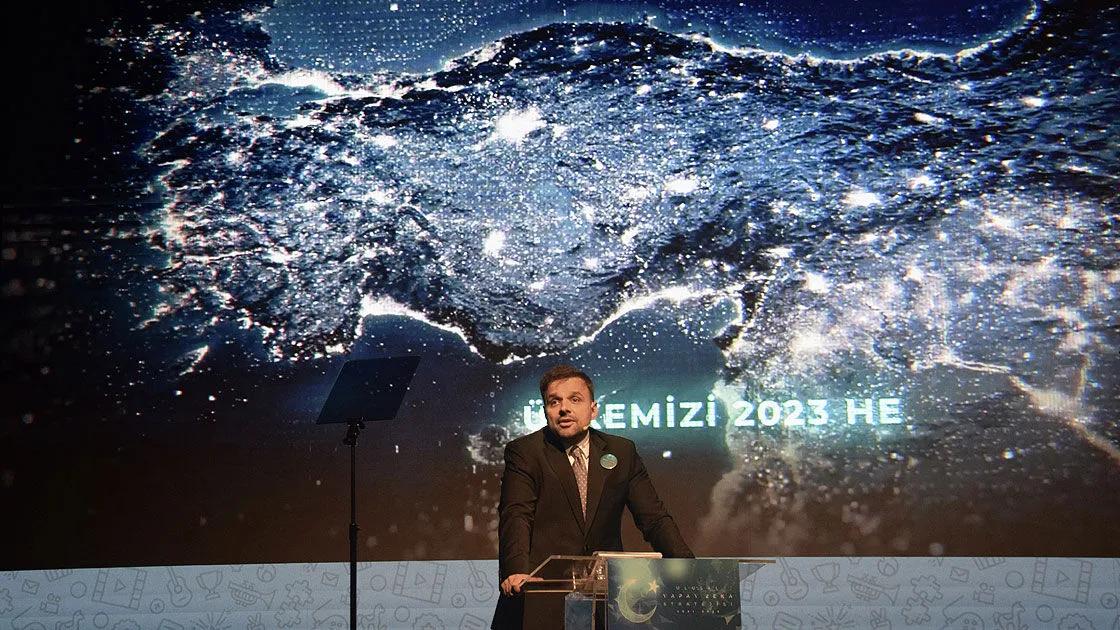
Statement of the Presidency Digital Transformation Office on Artificial Intelligence Research (AA)
The responsibility for preparing the NAIS was assigned to the PDT and MIT through Measure No. 473.1 in the 2021 Presidential Annual Program, developed in accordance with the Eleventh Development Plan.【3】 A participatory approach was adopted during the document’s development: consultations were held with the Presidency and its affiliated institutions, 16 ministries and 13 affiliated agencies, 38 private sector representatives, three civil society organizations, 26 universities, and 103 experts from diverse disciplines. Additionally, 108 institutions and organizations participated in two workshops coordinated by the PDT and MIT, during which Türkiye’s strengths, weaknesses, opportunities, and threats were identified.【4】
The strategy was presented to the public at a meeting held on 24 August 2021 at Gebze Information Valley. Ali Taha Koç, President of the PDT, stated during the presentation that the strategy aims to increase AI’s contribution to gross domestic product to 5 percent by 2025.【5】 In the foreword of the strategy document, President Recep Tayyip Erdoğan wrote: "We believe the time has come to make a human-centered breakthrough in artificial intelligence on behalf of our country."【6】
The vision of the NAIS is defined as "generating global value through a agile and sustainable AI ecosystem for a prosperous Türkiye." This vision is structured around three dimensions—organizational competence, strategic alignment, and governance—and three core competency areas: skills, data, and infrastructure.【7】 The strategy identifies six strategic priorities within this framework.【8】
Under this priority, the strategy aims to support the employment of researchers and practitioners, establish new undergraduate and graduate programs at universities, define professional roles and competencies, and expand algorithmic thinking and AI ethics education for youth before higher education.
This priority includes activating AI-focused venture capital funds, establishing clustering and centers of excellence for advanced R&D activities, and improving public incentives.
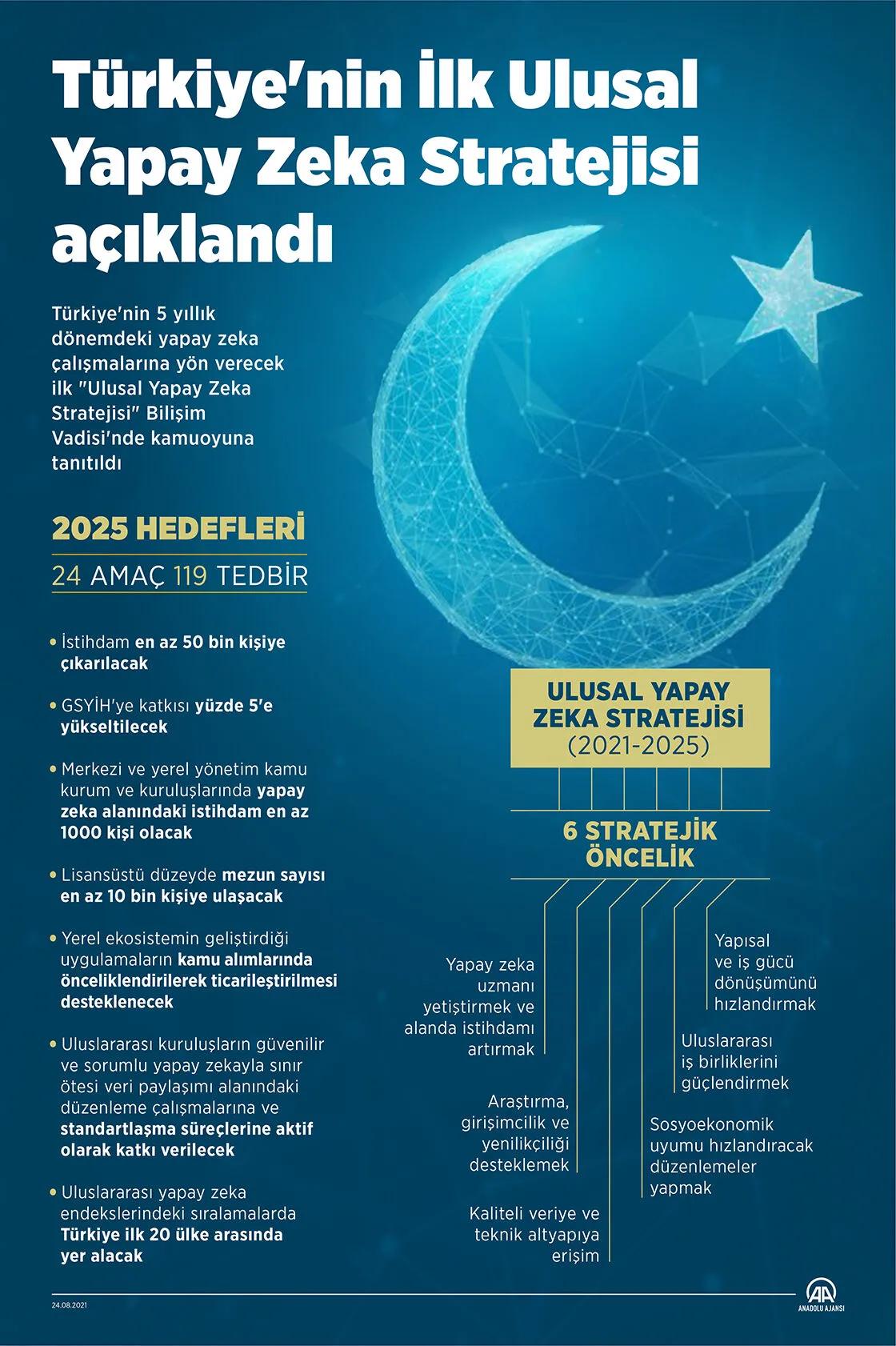
Ulusal Yapay Zekâ Stratejisi (2021-2025), 6 Stratejik Öncelik İnografiği (AA)
Under this heading, the strategy anticipates administrative, legal, and technical efforts to enable secure data sharing, accelerating initiatives such as the Open Government Data Portal and the National Data Dictionary, and establishing a "Public Data Space" to ensure secure inter-institutional data governance.
This priority encompasses initiatives addressing the ethical and legal dimensions of AI, establishing a regulatory sandbox mechanism, and ensuring administrative and legal regulations adapt to AI-driven transformation.
Within this scope, Türkiye aims to actively participate in data governance and trustworthy, responsible AI initiatives, and to encourage participation in European Union multiannual financial framework programs and cross-border calls for projects.
This priority includes supporting structural transformation in public and private sector institutions, developing the AI Maturity Model and AI Project Management Guide, and testing the "Trusted AI Badge" approach.
The high-level targets set for the end of the NAIS implementation period in 2025 are: increasing AI’s contribution to gross domestic product to 5 percent; raising employment in the AI sector to 50,000 people and public sector AI employment to 1,000 people; achieving 10,000 graduate-level graduates; prioritizing and commercializing domestic AI applications in public procurement; and positioning Türkiye among the top 20 countries in international AI indices.【9】
A two-tier governance mechanism has been designed for implementing the NAIS. At the upper tier, the National Artificial Intelligence Strategy Steering Board, chaired by the Assistant to the President and comprising the President of the PDT and the Deputy Minister of Industry and Technology, monitors the strategy’s implementation through quarterly meetings.【10】 The second tier consists of mechanisms ensuring administrative and technical coordination.【11】 Institutional structures under the strategy have also been strengthened:
According to progress reports on the implementation of the strategy, work has been carried out on 120 of the 122 actions identified under the NAIS.【13】 During this period, Türkiye became a member of the Global Partnership on Artificial Intelligence (GPAI) on 22 November 2022 and actively participated in the OECD Artificial Intelligence Governance Working Group and the Artificial Intelligence Mirror Committee initiatives.【14】
On the decision of the Steering Board chaired by Vice President Cevdet Yılmaz, the National Artificial Intelligence Strategy 2024-2025 Action Plan was updated in line with the Twelfth Development Plan and put into effect. This plan, comprising 71 actions, focuses on developing domestic large language models, organizing national competitions for domestic generative AI applications, launching the "Artificial Intelligence Literacy Campaign," and designing a customized "Artificial Intelligence Education Model" to transform the existing workforce.【15】 【16】
The NAIS and its action plans are policy documents that guide public sector AI initiatives but do not have binding legal force.【17】 Nevertheless, concrete steps toward a legal framework were taken during the strategy’s implementation period. On 2 October 2024, the Grand National Assembly of Türkiye, under Decision No. 1426 and in accordance with Articles 98 of the Constitution and 104 and 105 of its Internal Regulations, decided to open a parliamentary investigation and establish a Parliamentary Artificial Intelligence Investigation Commission composed of 22 members. The decision was published in the Official Gazette No. 32683 on 5 October 2024.【18】 Under the chairmanship of MP Fatih Dönmez of the AK Party from Eskişehir, the commission conducted its work from 14 January 2025 for four months and submitted its report to TBMM Speaker Numan Kurtulmuş on 26 February 2026.【19】 According to an assessment by a legal academic, while the report does not have direct legal regulatory effect, it is considered a document that may serve as a foundation for future legislative efforts within the TBMM.【20】
The institutional structure was reorganized near the end of the NAIS’s initial implementation period: by Presidential Decrees No. 191 and 192 published in the Official Gazette on 25 December 2025, authority over AI governance, legislation, policy, and strategy formulation was transferred to the Presidency of Cybersecurity and the newly renamed General Directorate of National Technology and Artificial Intelligence, Ministry of Industry and Technology.【21】
While preparing the NAIS, documents from countries that had published national AI strategies between 2016 and 2019—including the United States, China, South Korea, Canada, Japan, Singapore, Germany, France, India, the United Kingdom, and Russia—were reviewed, along with the OECD Council’s AI Recommendation and the approaches of the European Union and the World Economic Forum.【22】 At the time of the strategy’s preparation, Türkiye ranked 67th among 172 countries in the Public Sector AI Readiness Index by Oxford Insights and the International Development Research Centre (IDRC), and 41st among 54 countries in the Tortoise Media Global AI Index.【23】
Academic comparative studies have evaluated Türkiye’s approach against those of other countries. According to a study published in the Journal of the Faculty of Economic and Administrative Sciences, Anadolu University, when compared with the United States, Bulgaria, China, and Poland, Türkiye’s approach addresses various dimensions of data management, privacy, and governance, encourages the use of open data sources, and tracks recent developments in data policies.【24】 Compared with the European Union’s Artificial Intelligence Act No. 2024/1689, which entered into force in August 2024, the NAIS is assessed as a non-binding, framework-type policy document, unlike the legally binding nature of the EU regulation.【25】
In an assessment published in the TRT Academy Journal at the time of the strategy’s release, the six strategic priorities of the NAIS were highlighted, along with the intention to test approaches such as the "Trusted AI Badge," and the strategic document’s shared assumptions were emphasized as a "living and continuously evolving reference."【26】 Another study published in the Journal of Information and Communication Technologies examined AI regulatory efforts in the European Union and the United States and offered recommendations for Türkiye’s regulatory initiatives alongside the NAIS.【27】 A separate study published in the Journal of the Faculty of Economic and Administrative Sciences, Anadolu University provided a comparative evaluation of Türkiye’s data policies against selected countries.【28】
Before the completion of the NAIS’s 2021-2025 implementation period, a new document was prepared to succeed it. President Erdoğan presented the Türkiye Artificial Intelligence Action Plan (2026-2030) to the public at the Türkiye Artificial Intelligence Summit on 13 June 2026. The plan entered into force on 18 August 2026, published in the Official Gazette No. 33344 under Presidential Decree No. 2026/9 dated 17 August 2026.【29】 The decree noted that significant achievements had been made under the implementation of the NAIS issued under Decree No. 2021/18, but that a new action plan was needed to update the country’s vision in light of the new era in which AI is reshaping the global economy, public services, and social structures.【30】
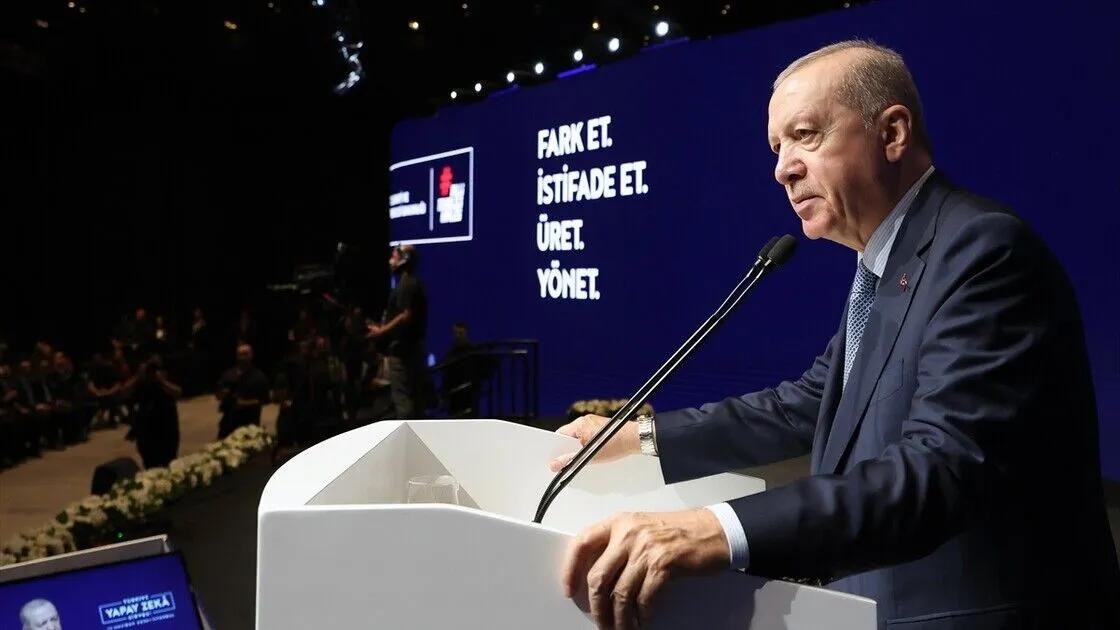
Cumhurbaşkanı Erdoğan, Türkiye Yapay Zeka Zirvesi 2026 (AA)
The new action plan, prepared under the coordination of the Ministry of Industry and Technology, is built upon the principles of human-centeredness, trustworthiness, ethical responsibility, digital sovereignty, and sustainable development. The plan is structured around four core pillars: "Recognize, Leverage, Produce, and Govern." President Erdoğan announced that under the first pillar, "Recognize," the National Artificial Intelligence Literacy Program will be launched, providing training to five million citizens across 81 provinces through workshops over two years, and developing 10,000 advanced experts and 100,000 application professionals. The same announcement also stated that by 2030, the installed capacity of data centers will be increased to at least one gigawatt.【31】
Anadolu Ajansı. "Cumhurbaşkanı Yardımcısı Yılmaz: Ulusal Yapay Zeka Stratejisi Eylem Planının Uygulanmasına Başlandı." July 24, 2024. Accessed September 14, 2026.https://www.aa.com.tr/tr/ekonomi/cumhurbaskani-yardimcisi-yilmaz-ulusal-yapay-zeka-stratejisi-eylem-planinin-uygulanmasina-baslandi/3283790
Anadolu Ajansı. "Meclis Yapay Zeka Araştırma Komisyonu, Raporunu TBMM Başkanı Kurtulmuş'a Sundu." Accessed September 14, 2026.https://www.aa.com.tr/tr/politika/meclis-yapay-zeka-arastirma-komisyonu-raporunu-tbmm-baskani-kurtulmusa-sundu/3841064
Anadolu Ajansı. "TBMM Yapay Zeka Araştırma Komisyonu, Çalışma Takvimi ve Komisyona Davet Edileceklerin Tespiti İçin Toplandı." January 28, 2025. Accessed September 14, 2026.https://www.aa.com.tr/tr/politika/tbmm-yapay-zeka-arastirma-komisyonu-calisma-takvimi-ve-komisyona-davet-edileceklerin-tespiti-icin-toplandi/3464746
Anadolu Ajansı. "Türkiye Yapay Zeka Alanına 'Damga'sını Vurmaya Hazırlanıyor." July 24, 2024. Accessed September 14, 2026.https://www.aa.com.tr/tr/bilim-teknoloji/turkiye-yapay-zeka-alanina-damgasini-vurmaya-hazirlaniyor/3283849
Anadolu Ajansı. "Türkiye Yapay Zeka Eylem Planı'na İlişkin Cumhurbaşkanı Genelgesi Resmi Gazete'de." August 18, 2026. Accessed September 14, 2026.https://www.aa.com.tr/tr/bilim-teknoloji/turkiye-yapay-zeka-eylem-planina-iliskin-cumhurbaskani-genelgesi-resmi-gazetede/4030067
Anadolu Ajansı. "Türkiye'nin Yapay Zeka Stratejisi Belirlendi." August 20, 2021. Accessed September 14, 2026.
Anadolu Ajansı. "Türkiye'nin İlk Ulusal Yapay Zeka Stratejisi Açıklandı." August 24, 2021. Accessed September 14, 2026.https://www.aa.com.tr/tr/bilim-teknoloji/turkiyenin-ilk-ulusal-yapay-zeka-stratejisi-aciklandi/2344314
Anadolu Ajansı. "Ulusal Yapay Zeka Stratejisi Adım Adım Hedeflerine Ulaşıyor." Accessed September 14, 2026.https://www.aa.com.tr/tr/dosya-haber/ulusal-yapay-zeka-stratejisi-adim-adim-hedeflerine-ulasiyor/3197270
Aydın, Atilla, and Zümrüt Müftüoğlu. "Ulusal Yapay Zekâ Stratejisi ile Ülkemiz Yeni Bir Atılım Başlatmıştır." TRT Akademi 6, no. 13 (2021): 889–895. Accessed September 14, 2026.https://doi.org/10.37679/trta.1002524
BTDünyası. "TBMM'de 22 Üyeli Yapay Zekâ Komisyonu Kuruluyor." Accessed September 14, 2026.https://btdunyasi.net/tbmmde-22-uyeli-yapay-zeka-komisyonu-kuruluyor/
Güçlütürk, Osman Gazi. "Yapay Zeka Regülasyonu: Neden, Nasıl, Ne Zaman?" Anadolu Ajansı (AA Analiz), January 15, 2026, updated July 28, 2026. Accessed September 14, 2026.https://www.aa.com.tr/tr/analiz/yapay-zeka-regulasyonu-neden-nasil-ne-zaman/3800025
Official Gazette. "Presidential Circular No. 2021/18: National Artificial Intelligence Strategy (2021–2025)." August 20, 2021, No. 31574. Accessed September 14, 2026.
Official Gazette. "Presidential Circular No. 2026/9: Turkey Artificial Intelligence Action Plan (2026–2030)." August 18, 2026, No. 33344. Accessed September 14, 2026.https://www.resmigazete.gov.tr/eskiler/2026/08/20260818-8.pdf
Polat, Ebru. "Yapay Zekâ Stratejilerinde Veri Politikaları: Seçili Ülkelerin Karşılaştırmalı Değerlendirmesi." *Anadolu Üniversitesi İktisadi ve İdari Bilimler Fakültesi Dergisi* 26, no. 1 (2025): 408–439. Accessed September 14, 2026.https://doi.org/10.53443/anadoluibfd.1551561
Presidency of Digital Transformation Office. "National Artificial Intelligence Strategy 2024–2025 Action Plan Published." Accessed September 14, 2026.https://cbddo.gov.tr/duyurular/6846/ulusal-yapay-zeka-stratejisi-2024-2025-eylem-plani-yayimlandi
Presidency of Digital Transformation Office. *National Artificial Intelligence Strategy 2021-2025*. Ankara: CBDDO, August 2021. Accessed September 14, 2026.https://www.bilgem.tubitak.gov.tr/wp-content/uploads/sites/8/TR-UlusalYZStratejisi2021-2025-1.pdf
T.C. Presidency of Communication. "President Erdoğan Announces Turkey's Artificial Intelligence Action Plan." Accessed September 14, 2026.https://www.iletisim.gov.tr/turkce/haberler/detay/cumhurbaskani-erdogan-turkiye-yapay-zeka-eylem-planini-acikladi
Yamak, Yasemin. "Yapay Zekâ ile İlgili Güncel Düzenleme Çalışmaları: AB, ABD ve Türkiye Açısından İncelenmesi." *Bilgi Teknolojileri ve İletişim Dergisi* 3, no. 1 (2025): 35–68. Accessed September 14, 2026.https://dergipark.org.tr/tr/pub/btkdergi/article/1650906
[1]
Resmî Gazete, "2021/18 Sayılı Cumhurbaşkanlığı Genelgesi: Ulusal Yapay Zekâ Stratejisi (2021-2025)," 20 Ağustos 2021, Sayı 31574, erişim tarihi: 14 Eylül 2026, https://www.resmigazete.gov.tr/eskiler/2021/08/20210820-22.pdf
[2]
Cumhurbaşkanlığı Dijital Dönüşüm Ofisi Başkanlığı, Ulusal Yapay Zekâ Stratejisi 2021-2025 (Ankara: CBDDO, Ağustos 2021), 8, erişim tarihi: 14 Eylül 2026, https://www.bilgem.tubitak.gov.tr/wp-content/uploads/sites/8/TR-UlusalYZStratejisi2021-2025-1.pdf
[3]
CBDDO, Ulusal Yapay Zekâ Stratejisi, 7, 13.
[4]
CBDDO, Ulusal Yapay Zekâ Stratejisi, 16–17.
[5]
Anadolu Ajansı. "Türkiye'nin İlk Ulusal Yapay Zeka Stratejisi Açıklandı." Accessed September 14, 2026.
[6]
CBDDO, Ulusal Yapay Zekâ Stratejisi, 1.
[7]
CBDDO, Ulusal Yapay Zekâ Stratejisi, 7, 15–16.
[8]
CBDDO, Ulusal Yapay Zekâ Stratejisi, 8–10.
[9]
CBDDO, *Ulusal Yapay Zekâ Stratejisi*, 10; Anadolu Ajansı, "Türkiye'nin Yapay Zeka Stratejisi Belirlendi," August 20, 2021, Accessed September 14, 2026,https://www.aa.com.tr/tr/bilim-teknoloji/turkiyenin-yapay-zeka-stratejisi-belirlendi/2340868
[10]
CBDDO, Ulusal Yapay Zekâ Stratejisi, 9–10.
[11]
CBDDO, Ulusal Yapay Zekâ Stratejisi, 83–84.
[12]
CBDDO, Ulusal Yapay Zekâ Stratejisi, 39–40.
[13]
Anadolu Ajansı, "Ulusal Yapay Zeka Stratejisi Adım Adım Hedeflerine Ulaşıyor," erişim tarihi: 14 Eylül 2026, https://www.aa.com.tr/tr/dosya-haber/ulusal-yapay-zeka-stratejisi-adim-adim-hedeflerine-ulasiyor/3197270
[14]
Anadolu Ajansı, "Ulusal Yapay Zeka Stratejisi Adım Adım Hedeflerine Ulaşıyor."
[15]
Cumhurbaşkanlığı Dijital Dönüşüm Ofisi Başkanlığı, "Ulusal Yapay Zekâ Stratejisi 2024-2025 Eylem Planı Yayımlandı," erişim tarihi: 14 Eylül 2026, https://cbddo.gov.tr/duyurular/6846/ulusal-yapay-zeka-stratejisi-2024-2025-eylem-plani-yayimlandi; Anadolu Ajansı, "Cumhurbaşkanı Yardımcısı Yılmaz: Ulusal Yapay Zeka Stratejisi Eylem Planının Uygulanmasına Başlandı," 24 Temmuz 2024, erişim tarihi: 14 Eylül 2026, https://www.aa.com.tr/tr/ekonomi/cumhurbaskani-yardimcisi-yilmaz-ulusal-yapay-zeka-stratejisi-eylem-planinin-uygulanmasina-baslandi/3283790
[16]
Anadolu Ajansı, "Türkiye Yapay Zeka Alanına 'Damga'sını Vurmaya Hazırlanıyor," July 24, 2024, Accessed September 14, 2026,https://www.aa.com.tr/tr/bilim-teknoloji/turkiye-yapay-zeka-alanina-damgasini-vurmaya-hazirlaniyor/3283849
[17]
Osman Gazi Güçlütürk, "Yapay Zeka Regülasyonu: Neden, Nasıl, Ne Zaman?," Anadolu Ajansı (AA Analiz), 15 Ocak 2026, erişim tarihi: 14 Eylül 2026, https://www.aa.com.tr/tr/analiz/yapay-zeka-regulasyonu-neden-nasil-ne-zaman/3800025
[18]
BTDünyası. "TBMM'de 22 Üyeli Yapay Zekâ Komisyonu Kuruluyor." Accessed September 14, 2026.
[19]
Anadolu Ajansı, "Meclis Yapay Zeka Araştırma Komisyonu, Raporunu TBMM Başkanı Kurtulmuş'a Sundu," Accessed September 14, 2026,https://www.aa.com.tr/tr/politika/meclis-yapay-zeka-arastirma-komisyonu-raporunu-tbmm-baskani-kurtulmusa-sundu/3841064; Anadolu Ajansı, "TBMM Yapay Zeka Araştırma Komisyonu, Çalışma Takvimi ve Komisyona Davet Edileceklerin Tespiti İçin Toplandı," January 28, 2025, Accessed September 14, 2026,https://www.aa.com.tr/tr/politika/tbmm-yapay-zeka-arastirma-komisyonu-calisma-takvimi-ve-komisyona-davet-edileceklerin-tespiti-icin-toplandi/3464746
[20]
Güçlütürk, "Yapay Zeka Regülasyonu."
[21]
Güçlütürk, "Yapay Zeka Regülasyonu."
[22]
CBDDO, Ulusal Yapay Zekâ Stratejisi, 13–14, 20.
[23]
CBDDO, Ulusal Yapay Zekâ Stratejisi, 36–37.
[24]
Ebru Polat, "Yapay Zekâ Stratejilerinde Veri Politikaları: Seçili Ülkelerin Karşılaştırmalı Değerlendirmesi," Anadolu Üniversitesi İktisadi ve İdari Bilimler Fakültesi Dergisi 26, no. 1 (2025): 408, erişim tarihi: 14 Eylül 2026, https://doi.org/10.53443/anadoluibfd.1551561
[25]
Güçlütürk, "Yapay Zeka Regülasyonu."
[26]
Atilla Aydın ve Zümrüt Müftüoğlu, "Ulusal Yapay Zekâ Stratejisi ile Ülkemiz Yeni Bir Atılım Başlatmıştır," TRT Akademi 6, no. 13 (2021): 893–894, erişim tarihi: 14 Eylül 2026, https://doi.org/10.37679/trta.1002524
[27]
Yasemin Yamak, "Yapay Zekâ ile İlgili Güncel Düzenleme Çalışmaları: AB, ABD ve Türkiye Açısından İncelenmesi," Bilgi Teknolojileri ve İletişim Dergisi 3, no. 1 (2025): 35–68, erişim tarihi: 14 Eylül 2026, https://dergipark.org.tr/tr/pub/btkdergi/article/1650906
[28]
Polat, "Yapay Zekâ Stratejilerinde Veri Politikaları," 425–428.
[29]
Official Gazette, "Presidential Circular No. 2026/9: Turkey Artificial Intelligence Action Plan (2026–2030)," August 18, 2026, No. 33344, Accessed September 14, 2026,https://www.resmigazete.gov.tr/eskiler/2026/08/20260818-8.pdf; Anadolu Ajansı, "Presidential Circular on Turkey’s Artificial Intelligence Action Plan Published in Official Gazette," August 18, 2026, Accessed September 14, 2026,https://www.aa.com.tr/tr/bilim-teknoloji/turkiye-yapay-zeka-eylem-planina-iliskin-cumhurbaskani-genelgesi-resmi-gazetede/4030067
[30]
Anadolu Ajansı. "Türkiye Yapay Zeka Eylem Planına İlişkin Cumhurbaşkanı Genelgesi Resmi Gazete'de."
[31]
Presidency of the Republic of Türkiye, "President Erdoğan Announces Turkey's Artificial Intelligence Action Plan," Accessed September 14, 2026,https://www.iletisim.gov.tr/turkce/haberler/detay/cumhurbaskani-erdogan-turkiye-yapay-zeka-eylem-planini-acikladi

National Artificial Intelligence Strategy (2021-2025) (Generated with Artificial Intelligence)
Document Type | National Strategy Document | ||||||||
|---|---|---|---|---|---|---|---|---|---|
Effective Date | 20 August 2021 | ||||||||
Legal Basis | Presidential Circular No. 2021/18 (Official Gazette, No. 31574) | ||||||||
Preparing Institutions | Presidential Office of Digital Transformation (CBDDO); Ministry of Industry and Technology (MIT) | ||||||||
Scope Period | 2021-2025 | ||||||||
Strategic Structure | 6 Strategic Priorities, 24 Objectives, 119 Measures | ||||||||
Parent Vision | "Digital Türkiye" Vision, "National Technology Initiative" | ||||||||
Guiding Body | National Artificial Intelligence Strategy Guidance Board (Under the Deputy Presidency of the President) | ||||||||
Successor | Türkiye Artificial Intelligence Action Plan (2026-2030) | ||||||||
No Discussion Added Yet
Start discussion for "National Artificial Intelligence Strategy (2021–2025)" article
Preparation Process and Legal Basis
Vision and Strategic Priorities
1. Talent Development and Employment
2. Research and Innovation
3. Data and Technical Infrastructure
4. Socioeconomic Alignment
5. International Cooperation
6. Structural and Workforce Transformation
2025 Targets
Governance Mechanism and Institutional Structure
Implementation Process and 2024-2025 Action Plan
Legal Framework and Institutional Developments
International Comparative Position
Academic Evaluations
Türkiye Artificial Intelligence Action Plan (2026-2030)