
Bu içerik Türkçe olarak yazılmış olup yapay zeka ile otomatik olarak İngilizceye çevrilmiştir.
Coordinating Institution | Türkiye Space Agency (TUA) | ||||||||
|---|---|---|---|---|---|---|---|---|---|
Public Announcement | 9 February 2021 | ||||||||
Strategy Period | 2022 - 2030 | ||||||||
Motto | Look at the Sky, See the Moon | ||||||||
Overarching Vision | National Technology Initiative | ||||||||
Seven Core Policies | Independent access to space Nationality in critical technologies Contribution to science Peaceful use Soft power Commercial benefit Social awareness | ||||||||
Sixteen Programs | AYAP Domestic Satellite Development BKZS Access to Space and Spaceport Space Atmosphere Research Ground-Based Observation of Space Objects Space Industry Ecosystem Space Technologies Development Zone Space Awareness and Human Resources Turkish Astronaut and Science Mission | ||||||||
Monthly Targets | AYAP-1 AYAP-2 | ||||||||
Pilot Project | RASAT | ||||||||
National Space Program is a comprehensive state program designed to coordinate and integrate Türkiye’s decade-long vision, strategies, goals, and projects in the field of space policy.【1】 The program’s primary objective is to assess Türkiye’s current potential in space technologies in light of global developments, reduce external dependencies in this field, and position space technologies as an instrument of national development.【2】
Developed under the coordination of the Türkiye Space Agency (TUA), the program was announced to the public on 9 February 2021 and transformed into an official strategic document covering the period 2022–2030 through a Presidential Circular dated 24 May 2022.【3】 The program aims to elevate Türkiye among leading nations in space and aerospace technologies through ten distinct sub-programs including the Lunar Research Program, indigenous satellite development, regional positioning system, spaceport, and human spaceflight, and is regarded as the comprehensive manifestation of the National Technology Initiative vision in the space domain.
Türkiye’s accumulation in the space domain is rooted in an aviation industry tradition dating back to the early years of the Republic. In 1925, an aviation company named “Tayyare ve Motor Türk Anonim Şirketi” (TOMTAŞ) was established in Kayseri; it was closed in 1928 and converted into the state-owned Kayseri Aircraft Factory.【4】
In the same year, the Turkish Aeronautical Association (THK) established a glider factory in Ankara, and in 1933, the Institute of Astronomy—now operating as the Department of Astronomy and Space Sciences—was opened at Istanbul University.【5】 The aircraft factory established by THK in Ankara Etimesgut in 1942 continued production until 1956; the Ankara Wind Tunnel, opened in 1950 and currently operated by TÜBİTAK-SAGE, continues to function as a strategic test laboratory for aviation and aerospace industries.【6】
Turkish Aerospace Industries Inc. (TUSAŞ), established in 1973, became operational in 1976; in 1975, the Military Electronics Industry (ASELSAN) was founded to work in the field of avionics. In 1984, facilities for Turkish Aviation and Space Industries (TAI) in Ankara and Turkish Engine Industries (TEI) for jet engine production in Eskişehir were launched.【7】
Between 1985 and 1995, as part of efforts to develop the national defense industry, organizations such as HAVELSAN, ELROKSAN, MİKES, and SAVRONİK became operational; in 1988, ROKETSAN was established to assume a pioneering role in rocket and missile programs, and the Defense Industry Research and Development Institute (SAGE) under TÜBİTAK was restructured under its current name.【8】
In 1990, at the suggestion of the State Planning Organization, the Committee on Space Science and Technologies (UBİTEK) was established within TÜBİTAK to serve as a platform for evaluating Türkiye’s accumulated knowledge in space science and technologies. In 1993, space technologies were declared one of the priority areas under the “Turkish Science and Technology Policy 1993–2003” objectives, and the same year saw the proposal for establishing a space agency through a Prime Ministry circular.【9】
In 1994, the Türksat 1B communications satellite was placed into orbit by the French company Aerospatiale; in 1996, the Türksat 1C satellite was launched by the same company.【10】 In 1997, a draft law was prepared to establish a “National Space and Aviation Council” under the secretariat of TÜBİTAK, and cooperation talks were initiated between Türkiye and the European Space Agency.【11】 During this period, records indicate that Türkiye did not yet have its own national space institution and could only participate in space programs through bilateral agreements.
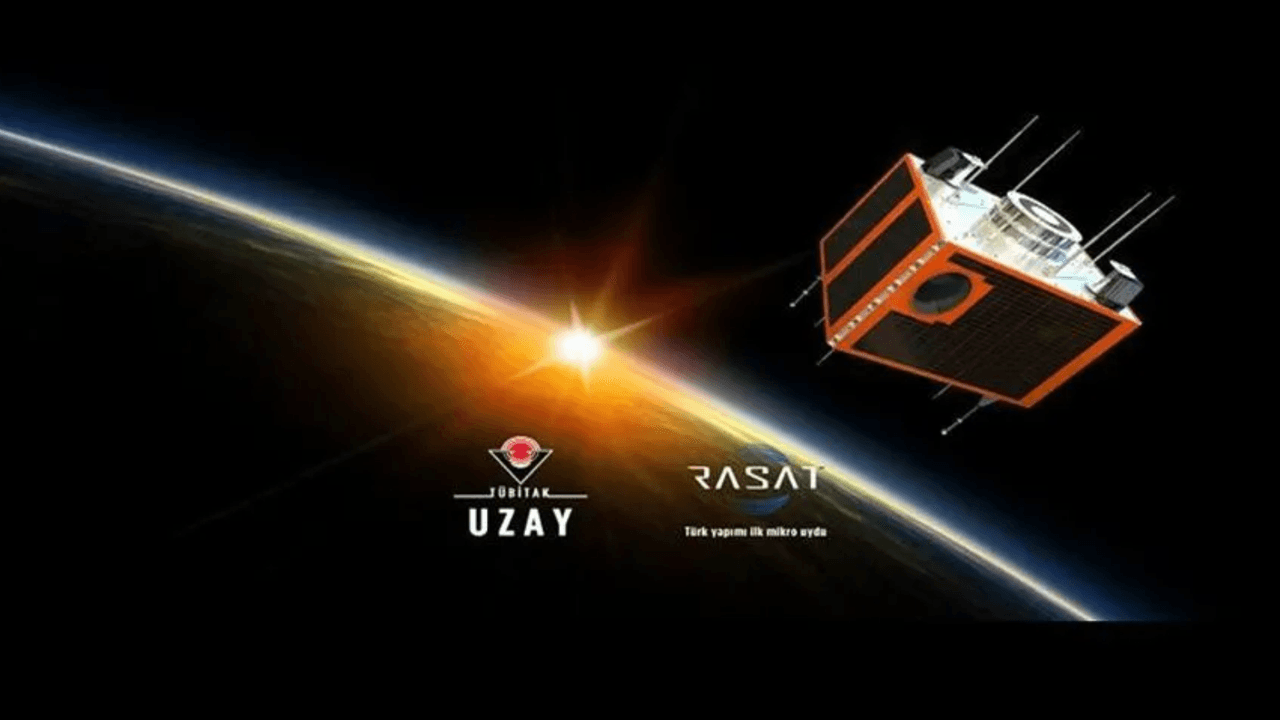
Türkiye's First Domestic Earth Observation Satellite RASAT. (Anadolu Ajansı)
RASAT, Türkiye’s first domestically designed and manufactured Earth observation satellite, was developed by TÜBİTAK Space Technologies Research Institute (TÜBİTAK UZAY).【12】 The entire design, production, and testing phases of the satellite were carried out by Turkish engineers and technicians at TÜBİTAK UZAY facilities in Ankara without the use of foreign partners or consultants.【13】
Critical subsystems such as the flight computer, flight software, high-speed communication system, and image compression system were also designed and produced using domestic capabilities.【14】 Weighing approximately 100 kilograms, RASAT has a 7.5-meter black-and-white and 15-meter multispectral imaging capacity; the acquired images are intended for use in urban and regional planning, forestry, agriculture, and disaster management.【15】
RASAT was launched on 17 August 2011 aboard a Dnepr rocket from the Yasny Launch Site in the Orenburg Region near the Kazakhstan border of the Russian Federation. The first signals from the satellite, which reached its target orbit 969 seconds after launch at an altitude of 687 kilometers above Earth, were received by TÜBİTAK UZAY’s ground station in Ankara. The launch service contract was finalized through a tender process in August 2009, and the satellite was sent to the Yasny site for a 15-day pre-launch preparation period.【16】
Through the RASAT project, Türkiye demonstrated its capabilities in satellite design, manufacturing, testing, and operation. The subsystems developed in the project are targeted for use in subsequent indigenous satellite and space missions, and the RASAT platform is intended to serve as a test and validation tool for future generations of Turkish satellite missions.【17】 TÜBİTAK UZAY, established in 1985, has internationally validated its expertise in the design, production, and testing of small satellites through this project.【18】
The Türkiye Space Agency, responsible for preparing and implementing the National Space Program, began its operations on 13 December 2018.【19】 Established under the Ministry of Industry and Technology, the Agency is tasked with preparing and implementing the National Space Program in accordance with space policies determined by the Presidency. The Agency’s institutional structure, legal basis, and organizational chart are the subject of a separate provision; here, only its role during the program’s preparation process is addressed.
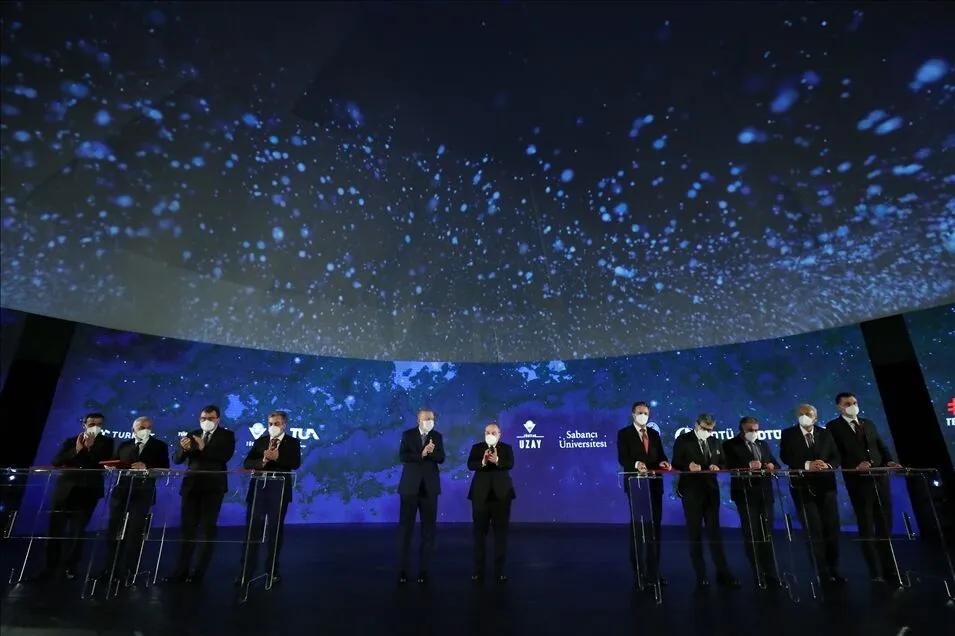
Milli Uzay Programı Tanıtım Toplantısı (Anadolu Ajansı)
The National Space Program was officially announced to the public on 9 February 2021 at a ceremony held at the Beştepe National Congress and Culture Center. Attendees included President Recep Tayyip Erdoğan, then Minister of Industry and Technology Mustafa Varank, Speaker of the Grand National Assembly Mustafa Şentop, Vice President Fuat Oktay, and AK Party Deputy Chairman Numan Kurtulmuş.
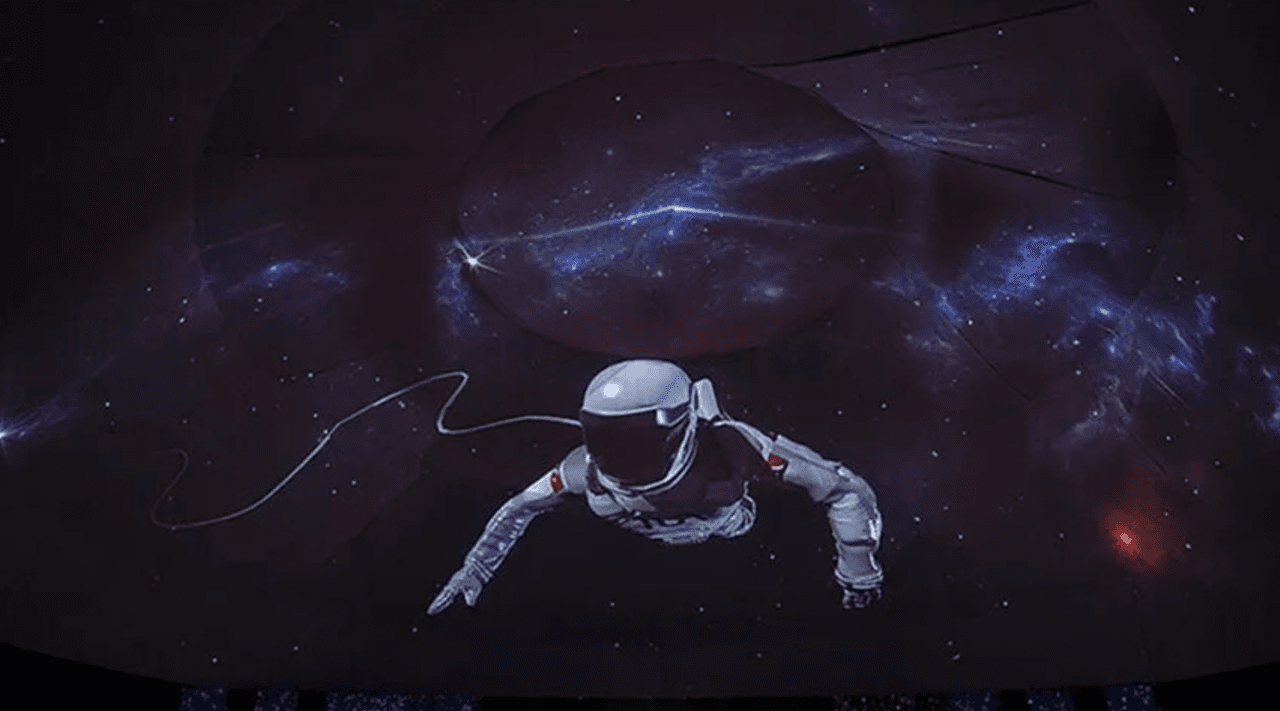
During the ceremony, three-dimensional space imagery was projected onto the ceiling of the congress center, the institutional logo of the Türkiye Space Agency was unveiled to the public for the first time, and protocols and agreements were signed among stakeholder institutions. The program was announced under the motto “Look to the Sky, See the Moon.”【20】
In defining the program’s ten goals, seven core policies were adopted: independent access to space, national sovereignty in critical technologies, contribution to science, peaceful use, soft power, commercial benefit, and societal awareness.【21】 The strategy document notes that the global space economy, valued at $424 billion as of 2020 and growing at approximately 8 percent annually, is expected to expand further in areas such as space tourism, satellite constellations, in-space manufacturing, and space mining; approximately 80 percent of this growth is projected to originate from commercial space activities.【22】 The document also records that less than 1 percent of active satellites worldwide belong to Türkiye, confirming that the space domain remains an area with significant development potential for the country.【23】
To operationalize the program’s strategic goals, four protocols and agreements were signed at the launch ceremony: the “Protocol on the Establishment of a National Satellite Manufacturing Company” consolidating indigenous satellite production under a single entity among TUSAŞ, Türksat, and TÜBİTAK UZAY; a scientific and technological cooperation protocol between the Türkiye Space Agency and Istanbul Technical University; a satellite monitoring software project agreement between the Türkiye Space Agency, Sabancı University, and TÜBİTAK UZAY; and a cooperation protocol between the Türkiye Space Agency, Middle East Technical University, and ODTÜ Teknokent for the establishment of a Space Technology Development Zone.【24】
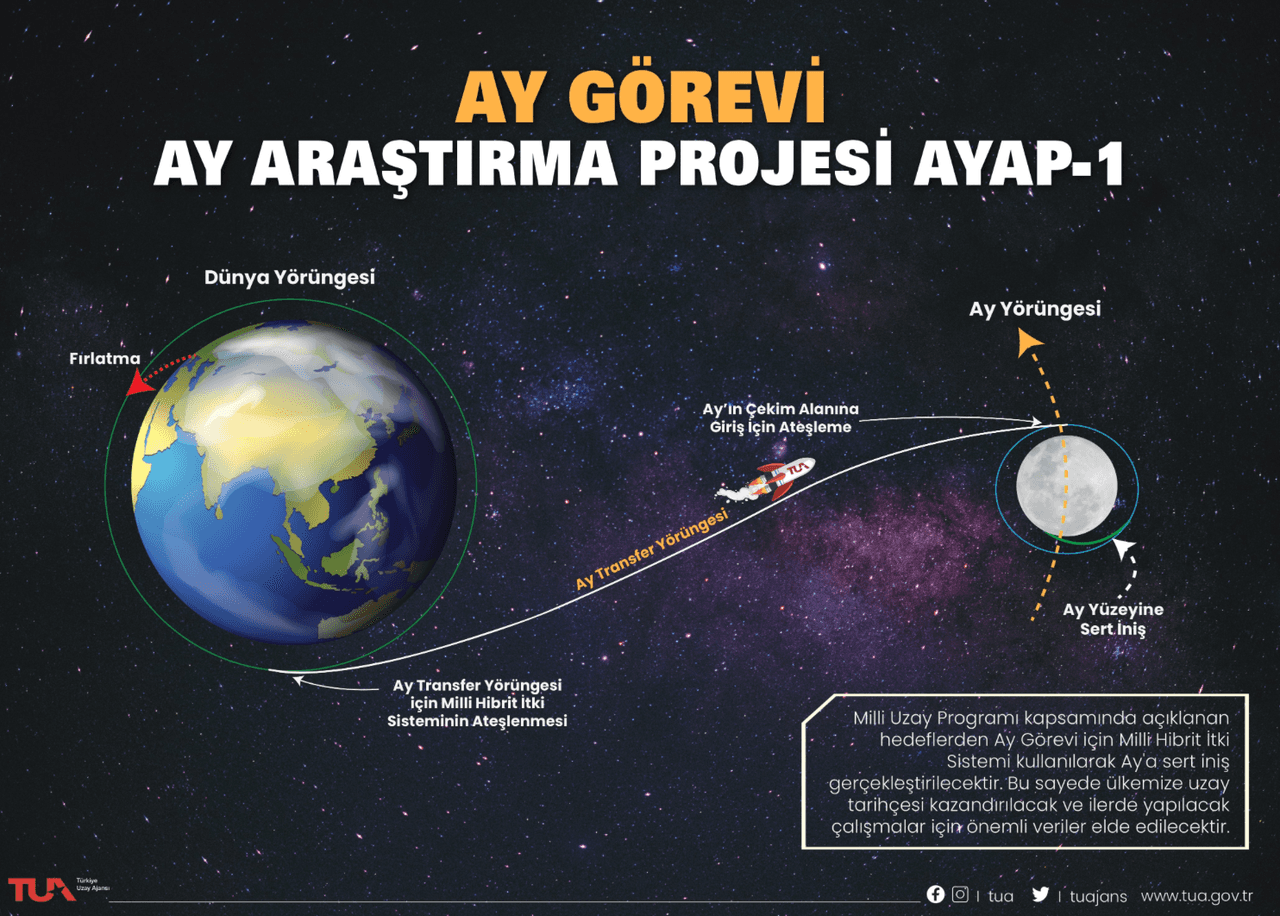
Ay Araştırma Projesi AYAP- 1 (Türkiye Uzay Ajansı)
The program’s priority is to gain experience in launch and propulsion technologies by sending a national rover to the lunar surface, join the select group of countries that have reached the Moon, and contribute to international science through scientific experiments conducted by the rover. The program is planned in two phases: in the first phase, the spacecraft named AYAP-1, to be launched into Earth orbit through international cooperation, will ignite its domestically developed hybrid rocket engine in space to perform a hard landing on the Moon; completion of this phase is targeted by the end of 2023, the centennial of the Republic.【25】
In the second phase, the spacecraft named AYAP-2, to be launched into space using a national launch vehicle, will reach the Moon using indigenous engines, perform a soft landing, and deploy its rover to conduct scientific research on the lunar surface; its arrival at the Moon is planned for 2028. The program’s strategy anticipates that spacecraft system design and integration will be conducted nationally, that technology gains in each phase will be planned to support the next phase without excessively increasing risk, and that universities will make maximum contributions to the selection of scientific payloads destined for the lunar surface.【26】
The objective of this sub-program is to gradually consolidate fragmented satellite production capabilities across various institutions under a national company coordinated by the Türkiye Space Agency, thereby creating a commercially competitive brand capable of competing globally in next-generation satellite development. The strategy envisions this consolidation being carried out in a manner that preserves competitiveness and economically leverages existing infrastructure.【27】
It is noted that globally, only five countries and one bloc currently operate navigation satellite systems: the United States (GPS), Russia (GLONASS), the European Union (Galileo), and China (BeiDou) have global coverage; India (NavIC) and Japan (QZSS) have regional systems. Türkiye aims to develop its own regional positioning and timing system.
The program proceeds incrementally: first, enhancing the resilience of existing systems; second, establishing a Satellite-Based Augmentation System (SBAS); and finally, deploying a fully operational RPTS satellite constellation. Critical components such as atomic clocks are expected to be developed to the maximum extent possible using domestic capabilities.
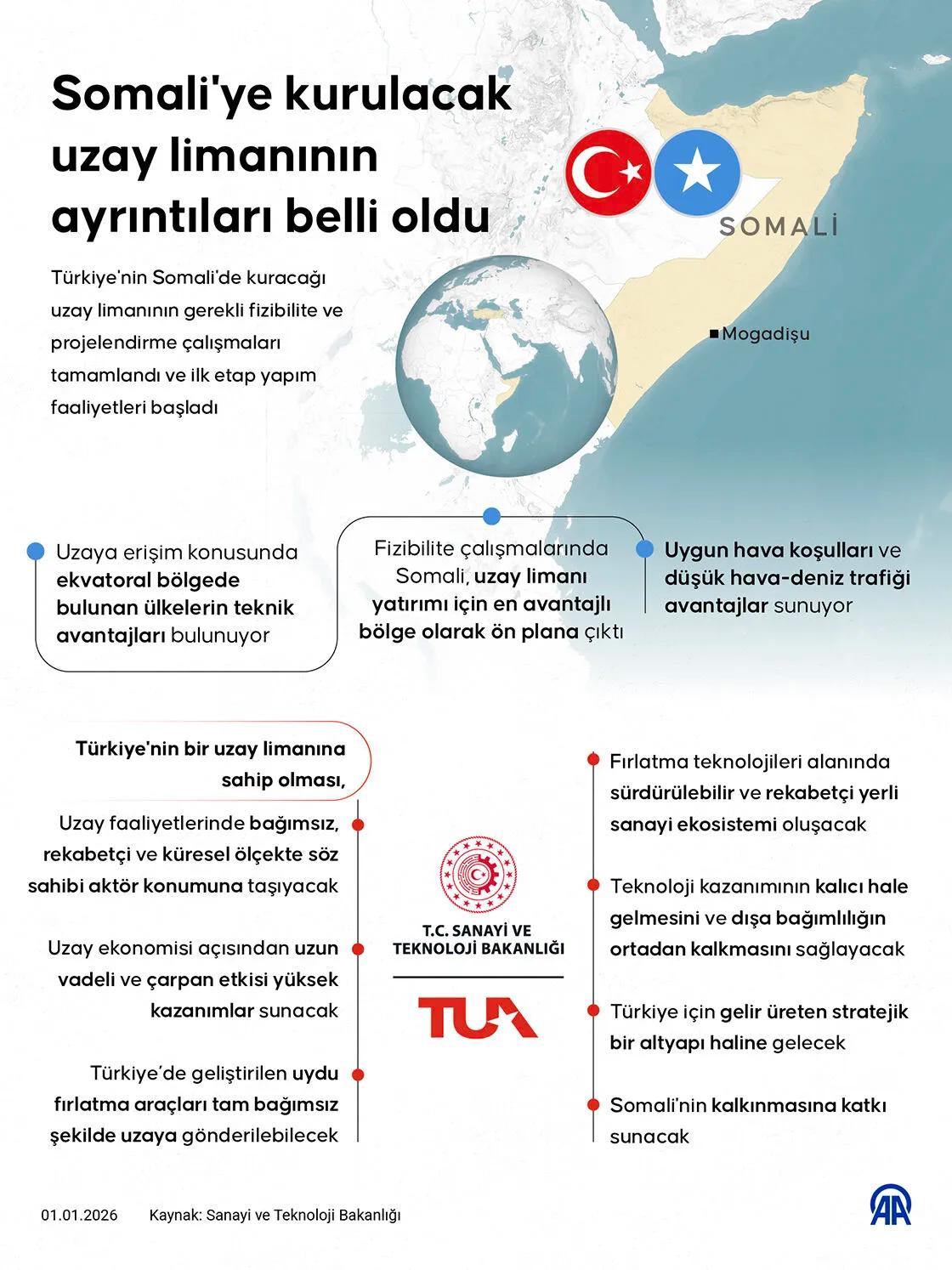
Uzay Limanı Projesi (Anadolu Ajansı)
The program’s goal is to grant Türkiye the independent capability to launch its own space vehicles into space and to establish a sustainable, competitive industrial ecosystem for launch technologies. Strategic principles include conducting a feasibility study to evaluate suitable launch vehicles and spaceport options, developing a roadmap for critical technologies, and establishing international collaborations that also consider commercial activities.【28】
In the field of space weather, which studies solar storms and variable conditions in the upper atmosphere, the aim is to establish a Space Weather Application Center (SWAC) to monitor risks that can affect satellite lifespans and communication services. The program also encompasses projects on radiation-hardened semiconductor design and production, and the integration of the TÜBİTAK National Observatory in Antalya with the Eastern Anatolia Observatory in Erzurum, along with the phased establishment of measurement stations.
Recognizing the rapid increase in the number of space debris and active satellites—with hundreds of thousands of objects larger than one centimeter currently in orbit—this sub-program aims to establish robotic telescopes with a diameter exceeding one meter to track low-brightness objects and to create a dedicated observation center for this purpose.【29】 Advanced technology projects targeting optical, laser-based ranging, and radar technologies are also planned under the program.
The objective of this sub-program is to establish a sustainable, innovative, and competitive space industry ecosystem that gradually achieves self-sufficiency, transforming the space domain into a technologically and economically productive sector. The strategy envisions creating a value chain that clarifies the roles of universities, research institutions, the private sector, and users, and establishing a single company to consolidate public capabilities in the satellite domain.
As of August 2021, 89 technology development zones had been declared in Türkiye, 73 of which were active and employed 72,399 people; the program aims to establish a dedicated space-focused technology development zone in collaboration with Middle East Technical University.【30】 This zone is intended to serve as a core for Türkiye’s space ecosystem by bringing together high-value-added firms.
Given that errors in space projects are typically irreversible and costly, the program emphasizes that developing a skilled human resource base is one of its critical components. To this end, the program aims to prevent brain drain, attract back qualified Turkish professionals abroad, provide academic scholarships and project support, organize regular space awareness events, and establish new graduate programs in collaboration with universities.【31】
Noting that approximately 600 individuals from 38 countries have crossed the Kármán line (100 kilometers altitude) to date, but no Turkish citizen has yet traveled to space, this sub-program aims to enable a Turkish citizen to access space through international cooperation and participate in scientific activities. Its objectives include providing Turkish scientists opportunities in space research, enhancing Türkiye’s visibility in the space domain, inspiring younger generations toward this field, and building knowledge in space biology.
At the time of the National Space Program’s announcement, the integration of İMECE, Türkiye’s first indigenous high-resolution Earth observation satellite, had been completed and testing was underway. Türksat 6A, developed in line with the program’s goal of an indigenous communications satellite, was launched in July 2024, placing Türkiye among the few nations capable of producing their own communications satellites.
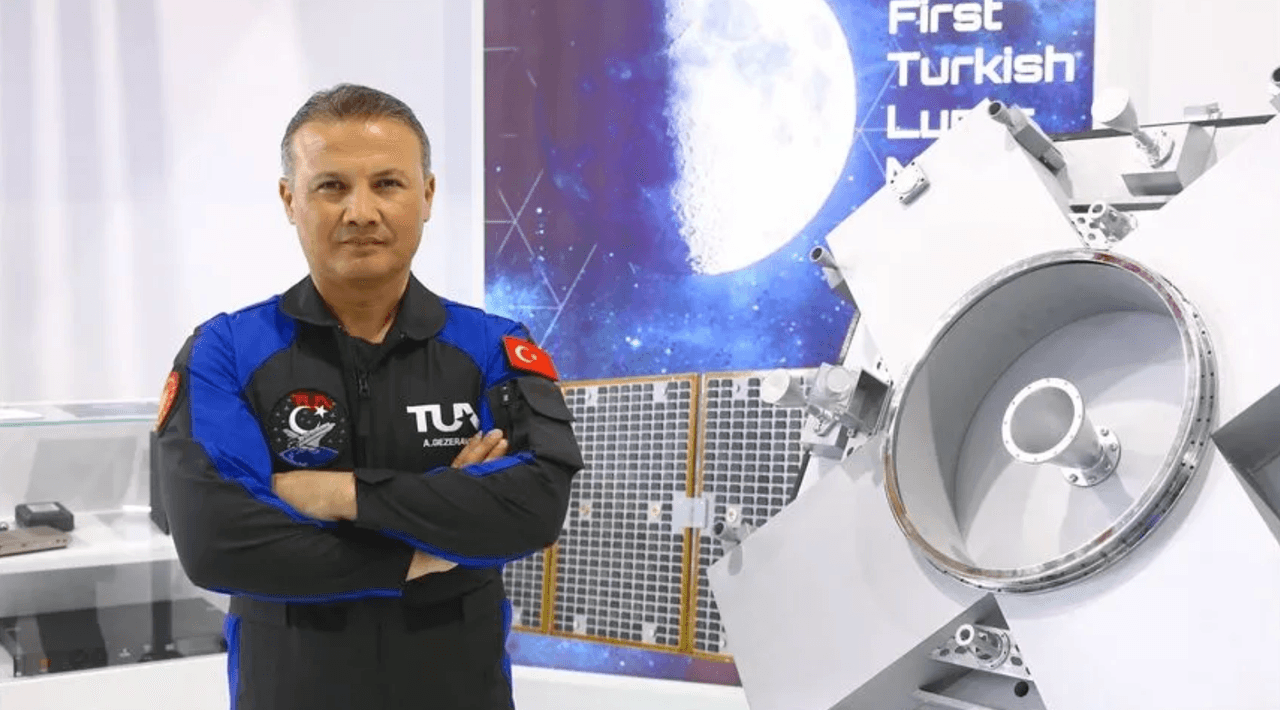
İlk Türk Astronot Alper Gezeravcı (Anadolu Ajansı)
The “Turkish Astronaut and Science Mission” goal of the National Space Program was realized with the spaceflight of Alper Gezeravcı aboard the Ax-3 mission. The SpaceX Dragon capsule carrying Gezeravcı was launched on 18 January 2024 at 16:49 Eastern Time (00:49 Türkiye time on 19 January) from NASA’s Kennedy Space Center in Florida aboard a Falcon 9 rocket. The Falcon 9 rocket, 70 meters long and 3.7 meters in diameter, successfully returned to Cape Canaveral after separating from the Dragon capsule.
After a 36-hour journey, Gezeravcı reached the International Space Station, earning the title of “first Turkish astronaut,” and conducted 13 scientific experiments over 14 days on topics including microgravity, human health in space, and the study of Tuz Gölü plant species in the space environment.【32】 Alongside Gezeravcı, the Ax-3 mission included mission commander Michael Lopez-Alegria, Italian Air Force pilot Walter Villadei, and Swedish astronaut Marcus Wandt representing the European Space Agency.【33】 Subsequently, with Tuva Cihangir Atasever’s “Suborbital Spaceflight,” Türkiye succeeded in sending two citizens to space within a single year.【34】
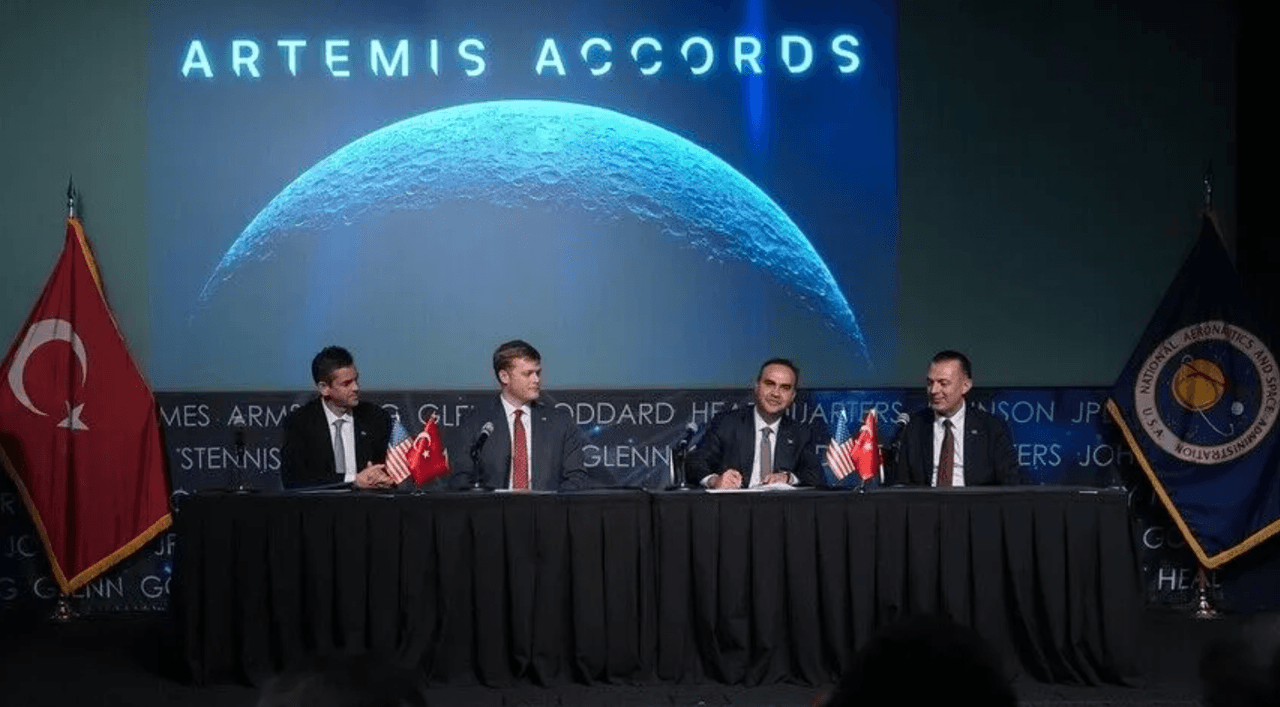
Uluslararası Uzay İşbirliği Programı Artemis Anlaşmaları İmzası (Anadolu Ajansı)
On 1 September 2026, Türkiye signed the Artemis Accords at NASA’s headquarters in Washington, becoming the 71st country to join the agreement.【35】 Representing Türkiye at the ceremony were Minister of Industry and Technology Mehmet Fatih Kacır and President of the Türkiye Space Agency Yusuf Kıraç; the United States was represented by NASA Director Jared Isaacman and State Department official Connor Tomlinson.【36】
NASA Director Isaacman noted during the ceremony that Türkiye had demonstrated a bold vision in this field and that both countries shared the vision of returning astronauts to the lunar surface. The Artemis Accords, based on the 1967 Outer Space Treaty, are a non-binding multilateral declaration of principles aimed at improving the responsible exploration of space; they include provisions on registration of space objects, prevention of interference among activities, and sharing of scientific data.【37】 The United States, along with Australia, Canada, Italy, Japan, Luxembourg, the United Arab Emirates, and the United Kingdom, were the initial signatories on 13 October 2020. NASA’s institutional social media account announced that Türkiye had joined the group of nations committed to the peaceful exploration of space and the enhancement of prosperity in this domain.【38】
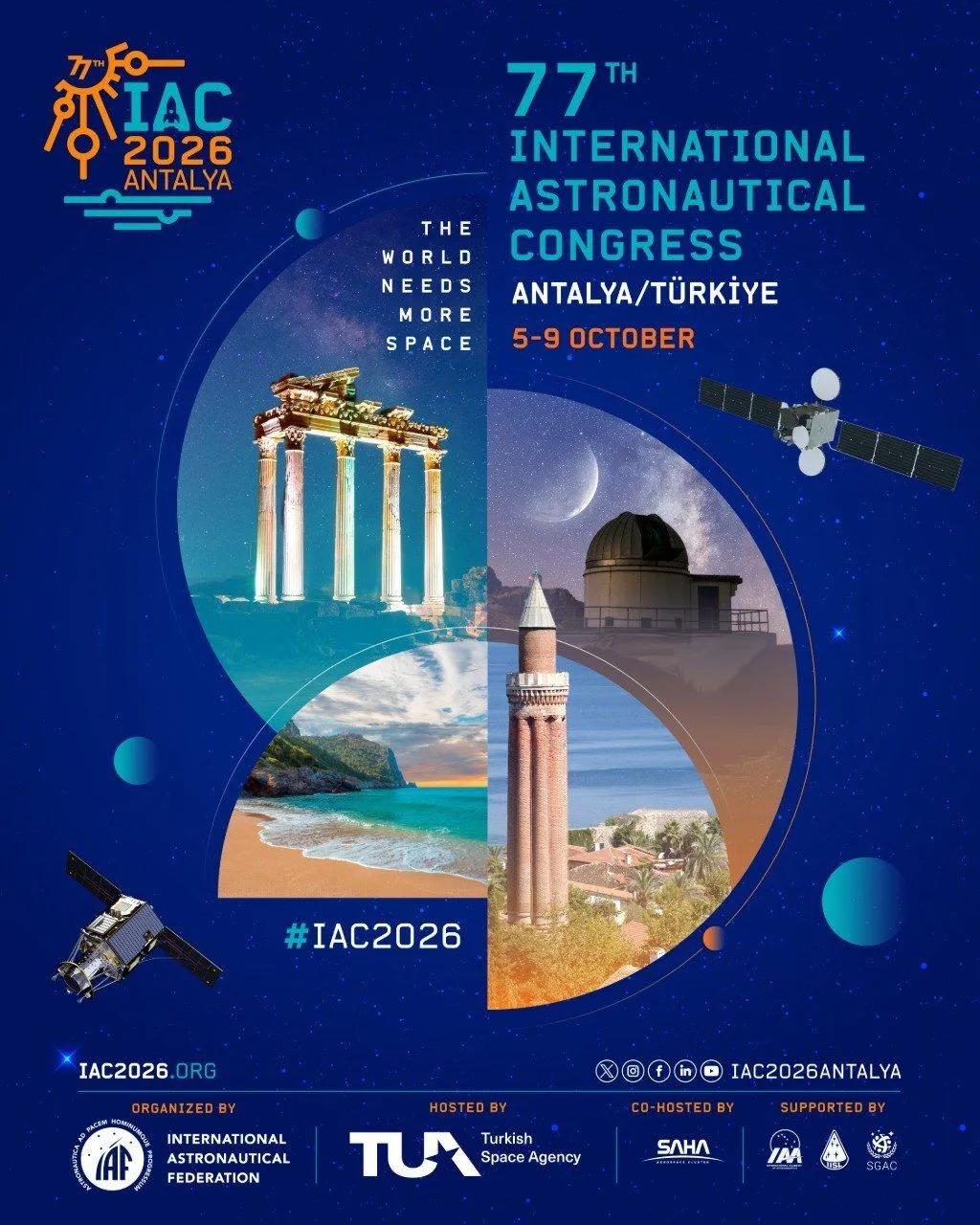
77. Uluslararası Uzay Kongresi (Anadolu Ajansı)
Türkiye will host the 77th International Astronautical Congress (IAC) in Antalya from 5 to 9 October 2026.【39】 Coordinated by the Ministry of Industry and Technology and hosted by the Türkiye Space Agency and SAHA İstanbul, the congress will be held at the Antalya NEST Congress Center and is expected to attract more than 10,000 space and aerospace sector representatives, entrepreneurs, astronauts, and academics from around the world.【40】 The congress is projected to increase Türkiye’s share of the global space economy, anticipated to reach $1.8 trillion by 2035.【41】
The election of Türkiye Space Agency President Yusuf Kıraç as Vice President of the International Astronautical Federation (IAF) and Chair of the Asia-Pacific Space Cooperation Organization Council is regarded as a milestone reinforcing Türkiye’s weight in space diplomacy. Following the Artemis Accords signing ceremony, Minister Kacır stated that U.S. President Donald Trump’s personal attendance at the NATO Summit to be held in Ankara in July 2026 would strengthen bilateral space cooperation plans. Kacır emphasized that Türkiye is undergoing a societal mobilization in aviation and space technologies and that high public awareness has been generated in this domain.【42】
The National Space Program was shaped within the framework of the National Technology Initiative vision led by the Presidency. The program’s ten goals aim to reduce Türkiye’s external dependencies in space technologies and advance existing capabilities through national technologies.【43】 The program is not limited to the space domain alone; it also seeks to translate advancements in fields such as robotics, sensors, automation, quantum technology, rocket technology, and space medicine into terrestrial applications.【44】
Anadolu Ajansı. "Gözlem uydusu RASAT yörüngedeki 9. yılını tamamladı." Accessed September 4, 2026.https://www.aa.com.tr/tr/bilim-teknoloji/gozlem-uydusu-rasat-yorungedeki-9-yilini-tamamladi/1944482
Anadolu Ajansı. "Milli Uzay Programı Tanıtıldı." Anadolu Ajansı Foto Galeri. Accessed September 4, 2026.https://www.aa.com.tr/tr/pg/foto-galeri/milli-uzay-programi-tanitildi/0
Anadolu Ajansı. "Türkiye'nin Uzay Vizyonu Bu Yıl Küresel Bir Gövde Gösterisine Dönüşecek." Accessed September 4, 2026.https://www.aa.com.tr/tr/bilim-teknoloji/turkiyenin-uzay-vizyonu-bu-yil-kuresel-bir-govde-gosterisine-donusecek/3802760
Anadolu Ajansı. "Türkiye'nin ev sahibi olacağı 77. Uluslararası Uzay Kongresi'ne rekor katılım başvurusu." Anadolu Ajansı. Accessed September 4, 2026.https://www.aa.com.tr/tr/ekonomi/turkiyenin-ev-sahibi-olacagi-77-uluslararasi-uzay-kongresine-rekor-katilim-basvurusu/4002019
Anadolu Ajansı. "Türkiye'nin İlk Uzay Yolcusu Gezeravcı'nın Yer Aldığı Ax-3 Misyonunun Yolculuğu Başladı." Accessed September 4, 2026.https://www.aa.com.tr/tr/bilim-teknoloji/turkiyenin-ilk-uzay-yolcusu-gezeravcinin-yer-aldigi-ax-3-misyonunun-yolculugu-basladi/3113008
Anadolu Ajansı. "Türkiye, Uluslararası Uzay İşbirliği Programı Artemis Anlaşmaları'na İmza Attı." Accessed September 4, 2026.https://www.aa.com.tr/tr/bilim-teknoloji/turkiye-uluslararasi-uzay-isbirligi-programi-artemis-anlasmalarina-imza-atti/4043241
Anadolu Ajansı. "Uzay Limanı Projesi Türkiye'nin 'uzay vatan' stratejisine güç katacak." Accessed September 4, 2026.https://www.aa.com.tr/tr/bilim-teknoloji/uzay-limani-projesi-turkiyenin-uzay-vatan-stratejisine-guc-katacak/3785708
Anadolu Ajansı. "İlk Türk astronotun uzay yolculuğu için geri sayım sürüyor." Accessed September 4, 2026.https://www.aa.com.tr/tr/bilim-teknoloji/ilk-turk-astronotun-uzay-yolculugu-icin-geri-sayim-suruyor/3109967
Gözcelioğlu, Bülent. "Türkiye'de Tasarlanan ve Üretilen İlk Yer Gözlem Uydusu Rasat Uzayda!" TÜBİTAK Bilim ve Teknik 44, no. 747 (September 2011): 10–11. Accessed September 4, 2026.https://services.tubitak.gov.tr/edergi/yazi.pdf?dergiKodu=4&cilt=44&sayi=747&sayfa=10&yaziid=32216
Kılıç Ekici, Özlem. "Türkiye'nin Uzay Çalışmalarındaki Yol Haritası Açıklandı." *TÜBİTAK Bilim ve Teknik*, no. 640 (March 2021): 14–16. Accessed September 4, 2026.https://bilimteknik.tubitak.gov.tr/wp-content/uploads/sites/154/2025/09/38be92ba-752e-4271-a510-9cb5b441d7a0-1.pdf
Türkiye Uzay Agency. "Milli Uzay Programı Hakkında." TUA. Accessed September 4, 2026.https://tua.gov.tr/tr/milli-uzay-programi/milli-uzay-programi-hakkinda
Türkiye Uzay Agency. "Milli Uzay Programı." TUA, Accessed September 4, 2026.https://tua.gov.tr/tr/milli-uzay-programi
Türkiye Uzay Agency. "National Space Program Strategy Document 2022–2030." General Notice, May 24, 2022. Accessed September 8, 2026.https://cdn.tua.gov.tr/62988f09d2a2e.pdf
Türkiye Uzay Ajansı. "AYAP-1." TUA. Accessed September 4, 2026.https://tua.gov.tr/tr/proje/ayap-1-2
Özalp, Tamer. "Türkiye'de Havacılık ve Uzay Çalışmaları." *TÜBİTAK Bilim ve Teknik* 33, no. 396 (November 2000): 42–45. Accessed September 4, 2026.https://services.tubitak.gov.tr/edergi/yazi.pdf?dergiKodu=4&cilt=33&sayi=396&sayfa=42&yaziid=12381
[1]
Türkiye Uzay Ajansı, "Milli Uzay Programı," TUA, Erişim tarihi 4 Eylül 2026, https://tua.gov.tr/tr/milli-uzay-programi
[2]
Türkiye Uzay Ajansı, "Milli Uzay Programı Hakkında," TUA, Erişim tarihi 4 Eylül 2026, https://tua.gov.tr/tr/milli-uzay-programi/milli-uzay-programi-hakkinda
[3]
Türkiye Uzay Ajansı, "Milli Uzay Programı Strateji Belgesi 2022-2030," Genelge, 24 Mayıs 2022, erişim tarihi 8 Eylül 2026, https://cdn.tua.gov.tr/62988f09d2a2e.pdf
[4]
Tamer Özalp, "Türkiye'de Havacılık ve Uzay Çalışmaları," TÜBİTAK Bilim ve Teknik 33, no. 396 (November 2000): 42,
[5]
Özalp, "Aviation and Space Research in Türkiye," 42.
[6]
Özalp, "Aviation and Space Research in Türkiye," 42.
[7]
Özalp, "Aviation and Space Studies in Türkiye," 42–43.
[8]
Özalp, "Aviation and Space Research in Türkiye," 43.
[9]
Özalp, "Aviation and Space Research in Türkiye," 43.
[10]
Özalp, "Aviation and Space Research in Türkiye," 43.
[11]
Özalp, "Aviation and Space Research in Türkiye," 43-44.
[12]
Gözcelioğlu, Bülent. "Türkiye'de Tasarlanan ve Üretilen İlk Yer Gözlem Uydusu Rasat Uzayda!" TÜBİTAK Bilim ve Teknik 44, no. 747 (September 2011): 10.
[13]
Gözcelioğlu, "Türkiye'de Tasarlanan ve Üretilen İlk Yer Gözlem Uydusu Rasat Uzayda!," 10.
[14]
Gözcelioğlu, Bülent. "Türkiye'de Tasarlanan ve Üretilen İlk Yer Gözlem Uydusu Rasat Uzayda!" TÜBİTAK Bilim ve Teknik 44, no. 747 (September 2011): 10.
[15]
Gözcelioğlu, "Türkiye'de Tasarlanan ve Üretilen İlk Yer Gözlem Uydusu Rasat Uzayda!," 10.
[16]
Gözcelioğlu, "Türkiye'de Tasarlanan ve Üretilen İlk Yer Gözlem Uydusu Rasat Uzayda!," 10.
[17]
Gözcelioğlu, "Türkiye'de Tasarlanan ve Üretilen İlk Yer Gözlem Uydusu Rasat Uzayda!," 10.
[18]
Gözcelioğlu, "Türkiye'de Tasarlanan ve Üretilen İlk Yer Gözlem Uydusu Rasat Uzayda!," 10.
[19]
Özlem Kılıç Ekici, "Türkiye'nin Uzay Çalışmalarındaki Yol Haritası Açıklandı," TÜBİTAK Bilim ve Teknik, no. 640 (March 2021): 14,
[20]
Kılıç Ekici, "Türkiye'nin Uzay Çalışmalarındaki Yol Haritası Açıklandı," 14.
[21]
Türkiye Uzay Ajansı, "Milli Uzay Programı Strateji Belgesi 2022-2030," 20.
[22]
Türkiye Uzay Ajansı, "Milli Uzay Programı Strateji Belgesi 2022-2030," 1-2.
[23]
Türkiye Uzay Ajansı, "Milli Uzay Programı Strateji Belgesi 2022-2030," 11.
[24]
Kılıç Ekici, "Türkiye'nin Uzay Çalışmalarındaki Yol Haritası Açıklandı," 16.
[25]
Türkiye Uzay Ajansı, "Milli Uzay Programı Strateji Belgesi 2022-2030," 21.
[26]
Türkiye Uzay Ajansı, "Milli Uzay Programı Strateji Belgesi 2022-2030," 21.
[27]
Türkiye Uzay Ajansı, "Milli Uzay Programı Strateji Belgesi 2022-2030," 23.
[28]
Türkiye Uzay Ajansı, "Milli Uzay Programı Strateji Belgesi 2022-2030," 29.
[29]
Türkiye Uzay Ajansı, "Milli Uzay Programı Strateji Belgesi 2022-2030," 35.
[30]
Türkiye Uzay Ajansı, "Milli Uzay Programı Strateji Belgesi 2022-2030," 39.
[31]
Türkiye Uzay Ajansı, "Milli Uzay Programı Strateji Belgesi 2022-2030," 41-43.
[32]
Anadolu Ajansı. "Türkiye'nin İlk Uzay Yolcusu Gezeravcı'nın Yer Aldığı Ax-3 Misyonunun Yolculuğu Başladı." Accessed September 4, 2026.https://www.aa.com.tr/tr/bilim-teknoloji/turkiyenin-ilk-uzay-yolcusu-gezeravcinin-yer-aldigi-ax-3-misyonunun-yolculugu-basladi/3113008
[33]
Anadolu Ajansı. "Türkiye'nin İlk Uzay Yolcusu Gezeravcı'nın Yer Aldığı Ax-3 Misyonunun Yolculuğu Başladı."
[34]
Anadolu Ajansı. "Türkiye'nin Uzay Vizyonu Bu Yıl Küresel Bir Gövde Gösterisine Dönüşecek." Accessed September 4, 2026.
[35]
Anadolu Ajansı. "Türkiye, Uluslararası Uzay İşbirliği Programı Artemis Anlaşmaları'na İmza Attı." Accessed September 4, 2026.https://www.aa.com.tr/tr/bilim-teknoloji/turkiye-uluslararasi-uzay-isbirligi-programi-artemis-anlasmalarina-imza-atti/4043241
[36]
Anadolu Ajansı. "Türkiye, Uluslararası Uzay İşbirliği Programı Artemis Anlaşmaları'na İmza Attı."
[37]
Anadolu Ajansı. "Türkiye, Uluslararası Uzay İşbirliği Programı Artemis Anlaşmaları'na İmza Attı."
[38]
Anadolu Ajansı. "Türkiye, Uluslararası Uzay İşbirliği Programı Artemis Anlaşmaları'na İmza Attı."
[39]
Anadolu Ajansı, "Turkey's Space Vision Will Become a Global Body Display This Year."
[40]
Anadolu Ajansı, "Turkey's Space Vision Will Become a Global Body Display This Year."
[41]
Anadolu Ajansı, "Turkey's Space Vision Will Become a Global Body Display This Year."
[42]
Hakan Çopur, "Türkiye, Uluslararası Uzay İşbirliği Programı Artemis Anlaşmaları'na İmza Attı."
[43]
Türkiye Uzay Ajansı, "Milli Uzay Programı Hakkında."
[44]
Türkiye Uzay Ajansı, "Milli Uzay Programı Strateji Belgesi 2022-2030," 2.

Coordinating Institution | Türkiye Space Agency (TUA) | ||||||||
|---|---|---|---|---|---|---|---|---|---|
Public Announcement | 9 February 2021 | ||||||||
Strategy Period | 2022 - 2030 | ||||||||
Motto | Look at the Sky, See the Moon | ||||||||
Overarching Vision | National Technology Initiative | ||||||||
Seven Core Policies | Independent access to space Nationality in critical technologies Contribution to science Peaceful use Soft power Commercial benefit Social awareness | ||||||||
Sixteen Programs | AYAP Domestic Satellite Development BKZS Access to Space and Spaceport Space Atmosphere Research Ground-Based Observation of Space Objects Space Industry Ecosystem Space Technologies Development Zone Space Awareness and Human Resources Turkish Astronaut and Science Mission | ||||||||
Monthly Targets | AYAP-1 AYAP-2 | ||||||||
Pilot Project | RASAT | ||||||||
Henüz Tartışma Girilmemiştir
"National Space Program" maddesi için tartışma başlatın
Historical Background
Early Aviation Industry (1925–1975)
Establishment of Defense and Space Institutions (1975–1990)
Space Policy Efforts (1990–2011)
Indigenous Satellite Technology: RASAT
Design and Production Process
Launch and Orbital Placement
RASAT’s Legacy
Establishment of the Türkiye Space Agency
Introduction of the National Space Program
Launch Ceremony
Core Policies of the Program
Implementation Protocols
The Ten Sub-Programs of the National Space Program
Lunar Research Program (AYAP)
Indigenous Satellite Development Program and Single-Entity Initiative
Regional Positioning and Timing System (RPTS) Program
Space Access and Spaceport Program
Technological Research on Space Weather
Ground-Based Observation and Tracking of Space Objects
Development of the Space Industry Ecosystem
Space Technology Development Zone
Space Awareness and Human Resource Development
Turkish Astronaut and Science Mission Program
Concrete Steps of the Program
Advancement of Indigenous Satellite Technology
First Turkish Astronaut Sent to Space
International Cooperation
Participation in the Artemis Accords
Hosting the International Astronautical Congress (IAC) 2026
Türkiye’s Rising Role in Space Diplomacy
Place within the National Technology Initiative