

This article was automatically translated from the original Turkish version.
Country | Türkiye | ||||||||
|---|---|---|---|---|---|---|---|---|---|
User Institution | Turkish Armed Forces | ||||||||
Related Contexts | National Technology Initiative Complete Technological Independence Defense Industry Unmanned Aerial Systems Blue Homeland Green Homeland Sky Homeland Gray Homeland | ||||||||
Related Contexts | National Technology Initiative Unmanned Aerial Vehicles | ||||||||
Subject Summary | In Turkish unmanned aerial vehicles, national subsystems refer to the design, production, and integration of IHA platform components such as propulsion, payload, sensor, ammunition, communication, and command-control systems using domestic capabilities. These subsystems consist of hardware and software elements that enable the IHA's fundamental functions such as flight, mission execution, and data transmission. The design or production of a platform in Türkiye does not necessarily imply that all its subsystems are national. Therefore, the localization of subsystems is one of the important indicators of technological independence at the component level. | ||||||||
Core Subsystems | Propulsion Systems Payload and Sensor Systems Ammunition Systems Communication and Command-Control Systems Satellite Infrastructure | ||||||||
Major Institutions | TEI ASELSAN Roketsan TÜBİTAK HAVELSAN Baykar TUSAŞ | ||||||||
Relationship with the National Technology Initiative | The National Technology Initiative is a technology and industry approach aimed at enabling Türkiye to develop, produce, and transform critical technologies into globally competitive products. The defense industry has become one of the most prominent application areas of this approach, contributing to the establishment of domestic development capacity in critical technologies such as UAVs, missiles, radar, and satellites. | ||||||||
Strategic Commentary | The development of national subsystems enables UAVs to be developed not merely as aerial platforms but as national mission systems integrating propulsion, sensing, data, decision, and effect components. | ||||||||
National subsystems in Turkish unmanned aerial vehicles, refer to the design, production, and integration of propulsion, payload, munitions, communication, and command-and-control components of unmanned aerial vehicle (UAV) platforms using domestic capabilities. Subsystems consist of hardware and software elements that enable the platform to perform flight, mission execution, and data transmission functions. Subsystem development is an implementation of the technological independence policy under the National Technology Initiative at the component level.
The fact that a platform’s design and assembly are carried out domestically does not imply that its subsystems are also domestically sourced. Subsystem localization is a distinct metric from platform localization. Even if a vehicle’s design and assembly are conducted domestically, if its engine, sensor, munitions, or data link are imported, the production, export, and maintenance of the platform remain subject to the supplier country’s approval. Subsystem programs in Türkiye were established as a separate area of focus following the concrete emergence of this dependency in the 2000s.
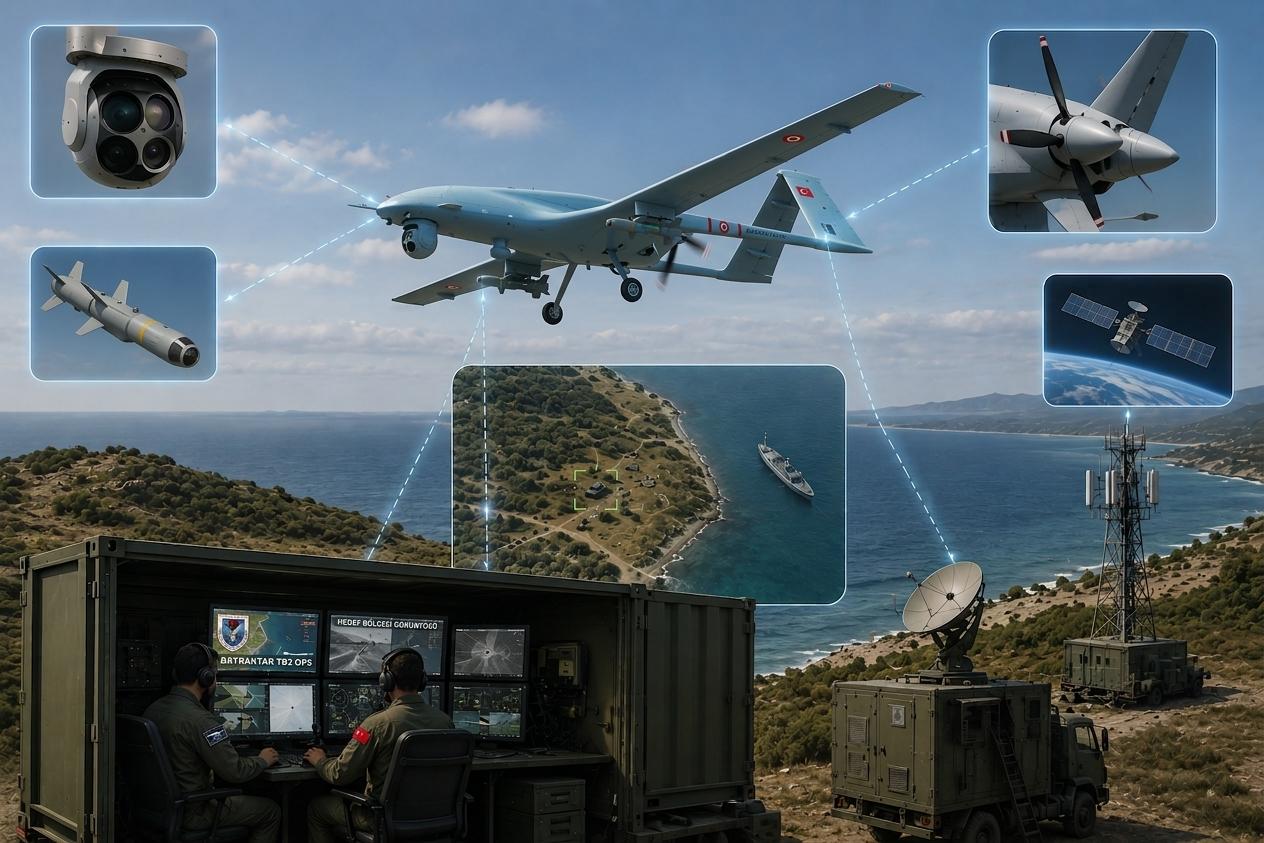
Basic System Components of a UAV (Generated by Artificial Intelligence)
An unmanned aerial vehicle system consists of four interdependent components: the air vehicle and propulsion system, the mission-specific payload, the ground control station, and the data link connecting these elements.【1】
Each component corresponds to a distinct engineering discipline. Airframe and aerodynamic design capabilities do not encompass engine, sensor, or data link capabilities. Therefore, competence in unmanned aerial vehicle technology is evaluated as the collective capability of its subsystems.
The concept of localization is applied at two levels in defense industry practice. Platform localization refers to the domestic design and final assembly of the aircraft. Component localization indicates the proportion of subsystems sourced from domestic resources. If a critical subsystem is imported, the production, export, and maintenance of the platform remain dependent on the supplier country’s approval. Component localization provides independence in supply security, maintenance, configuration changes, and software update processes. The localization rate is calculated based on the costs of subsystems, materials, and labor.【2】
Türkiye initiated its unmanned aerial vehicle procurement program in the late 1980s. With no domestic supply alternative available, the acquisition strategy was based entirely on foreign procurement.【3】 The first target drone system introduced into the Turkish Land Forces inventory was the Meggitt BTT-3 Banshee, produced by Target Technology Ltd., and it entered service in 1989.【4】 In 1994, flights began with Canadair CL-89 reconnaissance UAVs provided as a gift by Germany, but the system was quickly removed from inventory due to logistical difficulties and accident incidents.【5】
The most comprehensive procurement of the era involved General Atomics’ Gnat 750 and I-Gnat unmanned aerial vehicles. These systems entered inventory in 1995 and were used by the Land Forces for tactical surveillance and support missions until 2005.【6】 Between 2007 and 2010, to meet urgent operational needs, the Land Forces leased a Heron medium-altitude long-endurance (MALE) system and a Searcher UAV from Aeronautics Defense Systems Ltd., as well as three Aerostar UAVs from the same company, which were added to the inventory in 2008.【7】
Ten Heron systems procured for the Turkish Armed Forces were added to the Air Forces inventory in 2010 under a $150 million contract. The Heron became the first unmanned aerial vehicle system to enter the Air Forces inventory.【8】 Some subsystems of the Heron system were developed by Turkish companies. Within this framework, the ASELFLIR-300T camera produced by ASELSAN, the satellite ground terminal developed by SAVRONIK, and the remote video terminal and portable image evaluation system developed by MİLSOFT were integrated onto the platform.【9】
The contract for unarmed Heron systems was signed in 2005; however, significant difficulties arose during the integration of the electro-optic payload, and the supplier avoided providing spare parts.【10】 Between 2008 and 2009, Türkiye suspended the agreement due to military operations in Gaza, further delaying deliveries.【11】 Following developments in May 2010, the cancellation of joint exercises between the two countries affected the delivery, deployment, and maintenance processes of the ten Heron systems.【12】
On 21 June 2010, then Chief of the General Staff İlker Başbuğ stated that Turkish security forces had begun using Heron systems for surveillance missions in the mountainous regions along the Iraqi border.【13】 In June 2018, then Minister of National Defense Nurettin Canikli stated that Israeli-made unmanned aerial vehicles could not be effectively utilized.【14】 The Heron procurement process demonstrated that when a platform is acquired from abroad, subsystem integration, spare parts procurement, and maintenance activities remain subject to the political preferences of the supplier country.【15】
In 2008, negotiations were conducted with the United States regarding the procurement of RQ-1 Predator and MQ-9 Reaper unmanned aerial vehicles. In December 2008, a foreign military sales request was submitted for four MQ-1 Predators and six MQ-9 Reapers, but the process was not completed.【16】 In March 2014, a request was made for the sale of an unarmed variant, but this initiative also failed to yield results.【17】 In May 2016, Defense Industries President İsmail Demir stated that restrictions imposed on the sale of certain weapon systems had directed Türkiye toward developing its own technologies.【18】
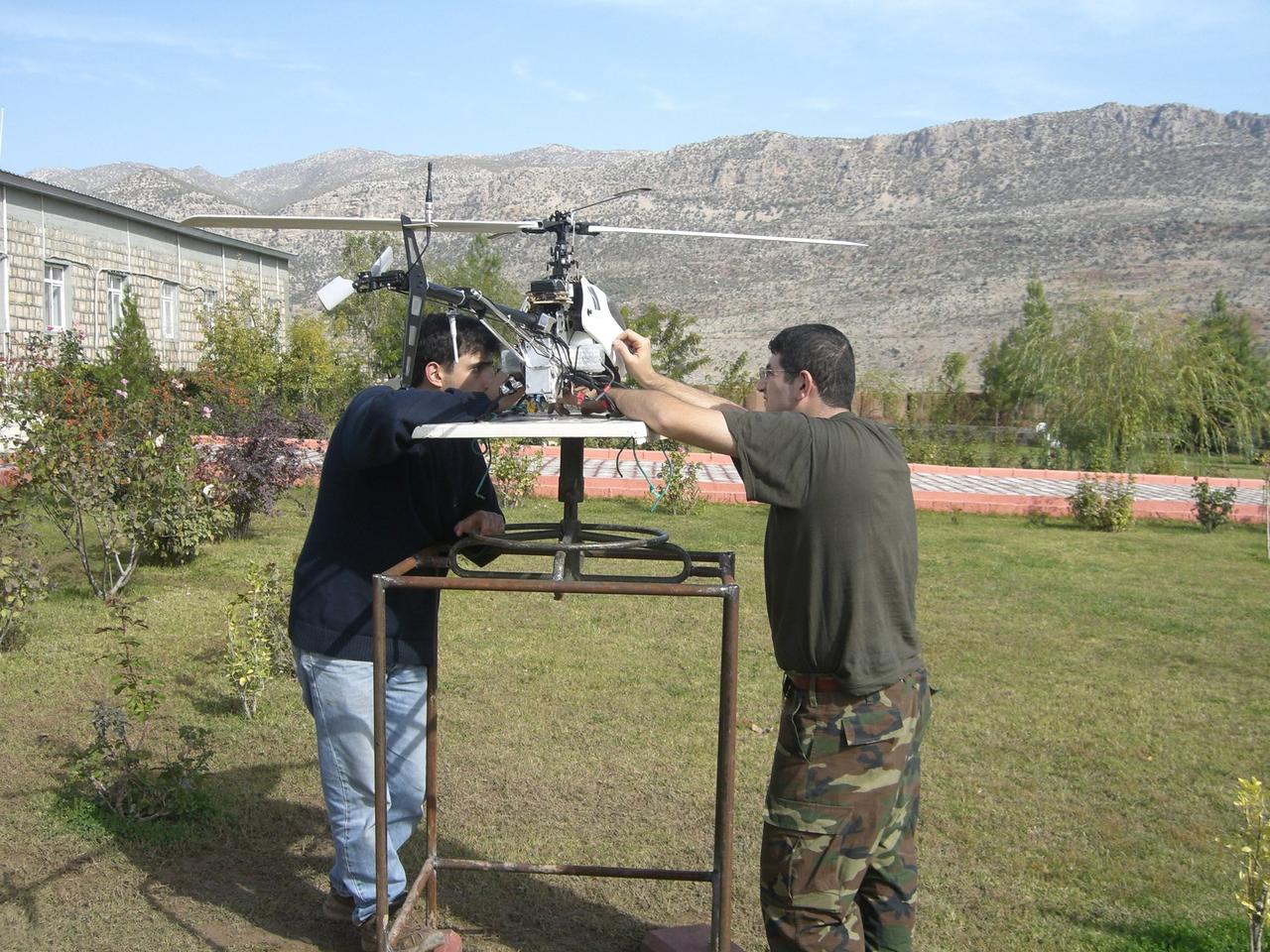
Malazgirt Döner Kanat Mini İHA Saha Testlerinden Bir Kare (Anadolu Ajansı)
Domestic unmanned aerial vehicle development and production activities began in the early 1990s and intensified from 2004 onward. During this period, Türkiye developed its first domestically produced UAV, the İHA-X1 (1990); its first indigenous target drones, Turna and Keklik (1995); Pelikan and Baykuş under the UAV Technology and Product Development Projects (2003); and Martı under the Digital Imaging Project (2004).【19】
The ANKA Multi-Mission Intelligence, Surveillance, and Reconnaissance System Project, led by TUSAŞ, was launched in 2004, with its first flight conducted in December 2010. The project scope included the development of three prototypes and their associated ground systems.【20】
The Bayraktar mini unmanned aerial vehicle system, initiated in 2005 by Kalekalıp and Baykar Makina as a joint venture, became Türkiye’s first indigenous UAV to enter the Turkish Armed Forces inventory in 2007.【21】
Alongside these platforms, efforts were also directed toward developing subsystem components and the human resources required to produce them.【22】
The propulsion system is a key subsystem that determines the endurance, payload capacity, and maximum altitude of an unmanned aerial vehicle. In propeller-driven platforms, power loss at high altitudes is significant; thus, the engine’s power output at critical altitudes is a decisive design criterion.
The first flights of the ANKA platform were conducted using an imported engine with 155 horsepower. According to Mahmut Faruk Akşit, General Manager of TEI, difficulties encountered in sourcing this engine led to the initiation of the TEI-PD170 project.【23】 The national engine development initiative was launched under the auspices of the Defense Industries Presidency to develop Türkiye’s first indigenous and national aviation engine capable of meeting the power requirements of medium-altitude long-endurance (MALE) class unmanned aerial vehicles.【24】
The TEI-PD170 is a four-stroke, liquid-cooled turbodiesel aviation engine developed by TUSAŞ Motor Industries (TEI).【25】 The engine produces 172 horsepower. It features a two-stage series turbocharging system, which limits power loss at high altitudes. Its dry weight is 162 kilograms, and its service ceiling is 45,000 feet.【26】
The engine is compatible with JP-8, JET-A1, JP-5, and EN 590 fuels.【27】 This feature ensures compatibility with fuel types used in military platforms.
The engine’s full-authority digital engine control unit (FADEC) is produced and its software is developed by TEI. The engine is designed in accordance with civil aviation standards.【28】 At the delivery ceremony, the Defense Industries Presidency announced that the engine achieves approximately 90 percent localization based on subsystem, material, and labor costs.【29】
The TEI-PD170 is used on the ANKA and AKSUNGUR platforms.【30】 According to TEI’s General Manager in 2021, over sixty engines have been produced and delivered to TUSAŞ and Baykar; some are being used in Bayraktar TB3 development efforts, while others are allocated for the C variant of Bayraktar AKINCI.【31】 Domestic production enables the management of maintenance, spare parts, and logistics processes within the country.【32】
The TEI-PD222ST is an upgraded version of the TEI-PD170. While maintaining the same dimensions as the PD170, it produces 225 horsepower and is approximately five kilograms lighter.【33】 The engine was designed with emphasis on high takeoff power. Although it retains high-altitude capability, its power output at 35,000–40,000 feet is lower than that of the PD170 at the same altitude.【34】 This distinction indicates that the two engines were developed for different mission profiles.
The TS1400 is a turbofan engine developed by TEI. Its initial official tests have been successfully completed.【35】 Turbofan engines are primarily used in rotary-wing platforms. The accumulated design, material, and control software expertise in propulsion technologies also supports the development of engine families for unmanned systems.
Domestic production of the engine removes dependence on the supplier country’s approval for platform production volume, export, and maintenance. Domestic development of the engine control software enables configuration changes and performance improvements to be carried out without requiring external authorization.
The propulsion system is one of the fundamental subsystems that determine the endurance, payload capacity, and maximum altitude of an unmanned aerial vehicle. Engine capacity directly affects not only the sensors and munitions the platform can carry but also mission duration and operational radius. Therefore, the development of indigenous aviation engines constitutes one of the key technological areas enabling unmanned aerial vehicles to be employed with diverse mission payloads.
The payload is the complete set of hardware enabling an unmanned aerial vehicle to execute its mission. In reconnaissance and surveillance missions, electro-optical and infrared systems form the primary sensor group, providing target detection, classification, tracking, and laser designation. Integrating data from these sensors with communication and command-and-control systems enables the use of reconnaissance data in intelligence and targeting processes.
ASELSAN has been conducting research and development on electro-optic systems integrated into aerial platforms since the 1990s.【36】 ASELSAN’s CATS and ASELPOD systems in its aerial electro-optic product line have reached serial production volumes and are in operational use.【37】
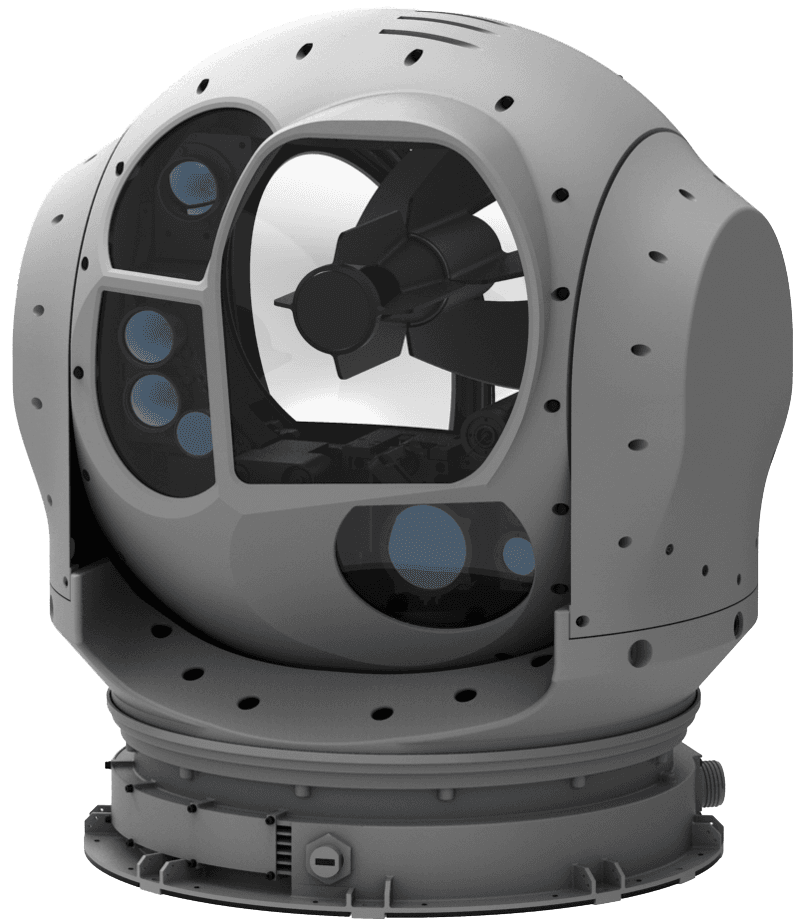
ASELSAN CATS Elektro-Optik Keşif, Gözetleme ve Hedefleme Sistemi (ASELSAN CATS)
CATS (Common Aperture Targeting System) is an electro-optic reconnaissance, surveillance, and targeting system developed for fixed-wing and rotary-wing aerial platforms, including unmanned aerial vehicles, helicopters, and aircraft.【38】
CATS was developed by ASELSAN as a national electro-optic reconnaissance, surveillance, and targeting system; it completed acceptance tests on the ANKA-S in 2018 and entered inventory. Following the suspension of certain electro-optic system export licenses to Türkiye in 2020, the serial production and integration of CATS into other UAV platforms gained further importance.【39】
Over 200,000 flight hours have been completed using CATS; in more than 2,800 munition engagements conducted with the system, a 98 percent success rate was achieved.【40】
The integration of reconnaissance and targeting functions within a single system ensures the seamless linkage between the sensor and munition. This architecture enables the entire process—from target detection to laser designation and guidance of precision munitions—to be executed within a unified mission framework.【41】
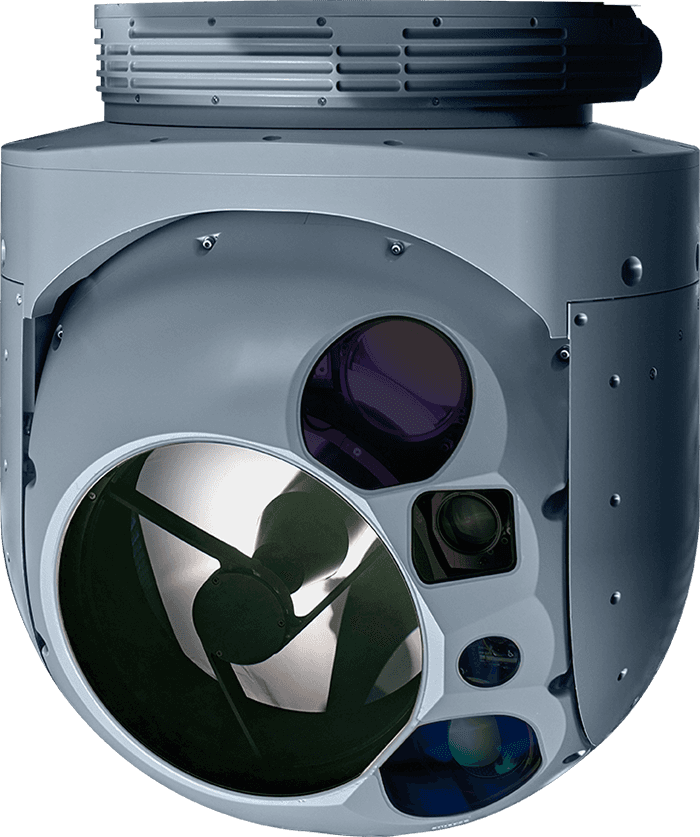
ASELSAN ASELFLIR-500 Elektro-Optik Çok Görevli Sistemi (ASELFLIR-500)
ASELFLIR-500 is an electro-optic reconnaissance, surveillance, and targeting system. It is planned for use on various platforms, primarily high-altitude unmanned aerial vehicles.【42】
Its high-resolution electro-optical and infrared detection capability forms part of the sensor infrastructure designed to enhance the effectiveness of unmanned platforms in long-duration reconnaissance and targeting missions. In addition, the ASELSAN MURAD AESA radar used on KIZILELMA serves as a radar sensor for detecting and tracking aerial targets at long ranges.
The coordinated operation of radar, electro-optic systems, and other platform subsystems creates an architecture that expands situational awareness and targeting capabilities in unmanned combat aircraft.【43】
In armed unmanned aerial vehicles, munitions are a primary payload determining the platform’s strike capability. Munition integration is conducted in parallel with air vehicle design, considering weight, balance, electrical interfaces, carriage capacity, and guidance chain requirements. Therefore, advancements in propulsion and payload capacity directly affect the variety of munitions that can be integrated onto the platform.

MAM-L ve MAM-C (Anadolu Ajansı)
The Bayraktar TB2, in its armed configuration, carries MAM-L and MAM-C type laser-guided light munitions.【44】 On the ANKA-S variant, MAM-L and MAM-C munitions developed by Roketsan and guided bombs developed by TÜBİTAK SAGE have been integrated.【45】
The Bayraktar AKINCI employs Roketsan-produced MAM-L, MAM-C, and Small Guided Munition (KGK), along with various other weapon systems.【46】 The Bayraktar TB3 can be armed with MAM-C and MAM-L munitions; its higher payload capacity also enables it to carry different mission-specific munitions such as MAM-T and KEMANKEŞ.【47】
On the Aksungur platform, precision-guided munitions such as SOM-J and L-UMTAS, developed by TÜBİTAK SAGE, can be integrated.【48】 A more advanced example of munition integration diversity is found in KIZILELMA. The platform can carry TEBER-82 and TOLUN munitions, which were successfully employed from internal munition bays during tests conducted in 2026.【49】 Internal munition carriage is part of a design approach aimed at preserving a low radar cross-section in addition to increasing munition capacity.
Laser-guided munitions operate on the principle of laser designation by an electro-optic system. Therefore, munitions and reconnaissance/targeting systems are used within the same mission chain. The CATS system performs both observation and laser designation functions on unmanned aerial vehicles.【50】
World’s First Autonomous Unmanned Combat Aircraft Formation Flight: KIZILELMA (Baykar Technologies)
In next-generation unmanned systems, this chain is no longer limited to the sensor-munition relationship within a single platform. Data from radar, electro-optical, and infrared sensors is processed through data links, command-and-control software, and, when necessary, AI-supported systems to enable target detection, tracking, and engagement. KIZILELMA’s intelligent swarm autonomy, demonstrated by two prototypes conducting autonomous flight formations in December 2025, exemplifies an approach in which sensors, software, communication, and platform control are integrated within a broader network.【51】
Within this integrated framework, the propulsion system provides endurance and payload capacity, sensors enable reconnaissance and target detection, the data and command-and-control infrastructure processes the acquired information, and munitions deliver the effect on target. Thus, unmanned aerial vehicles developed under the National Technology Initiative function not as the sum of independent subsystems but as integrated mission systems combining propulsion, sensing, data, decision, and effect chains.
The data link is the subsystem enabling command and data flow between the unmanned aerial vehicle and the ground control station. Command-and-control software ensures the processing of acquired data, its sharing across different platforms, and its utilization in decision-making processes. In modern operational environments, this structure is not viewed merely as a communication channel but as an integrated infrastructure that transforms information from sensors, unmanned platforms, satellite systems, and other operational elements into a unified operational picture. In this context, data link and command-and-control systems are among the fundamental elements enabling the transition from individual platform usage to collaborative, network-supported operations under the National Technology Initiative.
Military tactical communication systems form the infrastructure for transmitting data, voice, and imagery between land, air, and sea platforms.【52】 These systems enable real-time sharing of information from diverse platforms and allow command-and-control elements to operate over a common data environment. Therefore, the tactical communication infrastructure not only facilitates communication between platforms but also transfers intelligence, surveillance, and reconnaissance data to relevant command-and-control elements. At a broader level, the C4ISR approach integrates command, control, communications, computers, intelligence, surveillance, and reconnaissance elements into a unified network structure.【53】
Thus, data collected from air, land, sea, and space-based sensors can be evaluated within a shared operational picture rather than on individual platforms. The high volume of imagery, location, and sensor data generated by unmanned aerial vehicles makes reliable transmission and interpretation of this data as critical as the platform itself.
Satellite communication also serves as a complementary element of this network architecture, enabling data, voice, and imagery transmission between ground stations and air, land, and sea platforms, thereby maintaining command-and-control links even beyond line-of-sight distances.【54】 This capability allows unmanned aerial vehicles to function not merely as short-range tactical assets but as remote sensors and execution units within a broader command-and-control network.
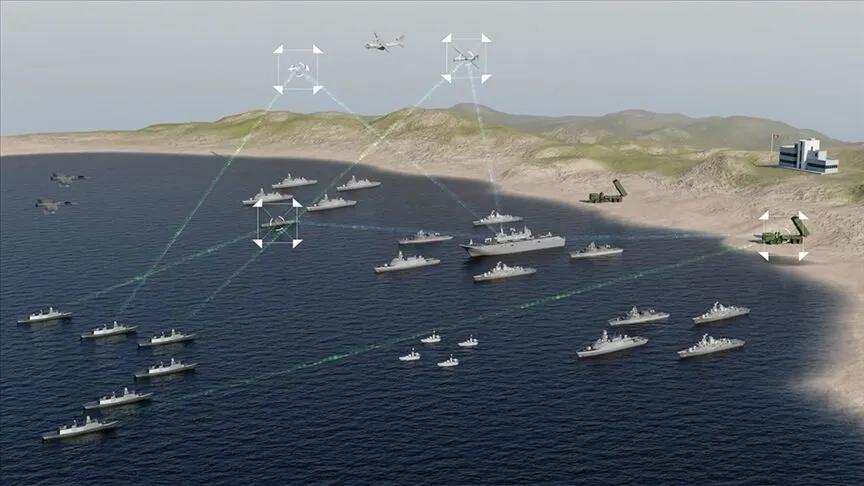
ADVENT War Management System's Representative War Model Integrating All Platforms (Anadolu Ajansı)
ADVENT is a network-enabled command-and-control system developed by HAVELSAN engineers. The system is in use within the Turkish Navy. It provides a structure for combining information from diverse sensors and platforms into a unified operational picture and enabling command authorities to make decisions based on this data.【55】
The core principle of this approach is that platforms can leverage each other’s sensor, communication, and command-and-control capabilities rather than operating independently. For instance, the integration of the TENGİZ unmanned underwater vehicle, developed by STM, with the ADVENT system is an example of incorporating unmanned maritime assets into the existing command-and-control architecture alongside aerial assets.【56】
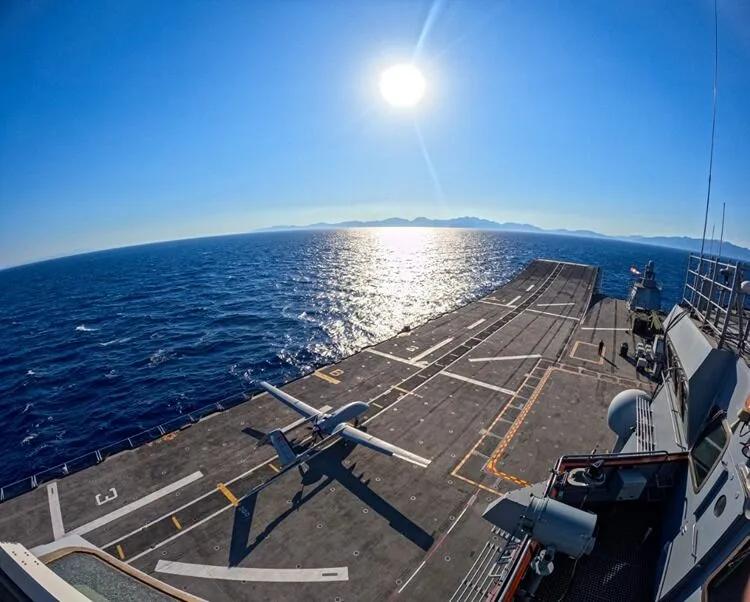
Bayraktar TB3 on the Deck of TCG Anadolu (Anadolu Ajansı)
During a 2026 overseas NATO exercise, the ADVENT architecture connected TCG Anadolu and Bayraktar TB3 within a single decision center.【57】
This enables information from different platforms to be evaluated within the same command-and-control structure and supports coordinated mission execution. Such network-enabled architectures are also vital for transforming intelligence data into operational value. Imagery and target information captured by an unmanned aerial vehicle’s electro-optical, infrared, or other sensors can be transmitted via the data link to relevant command-and-control elements, where it is combined with data from other sensors to support target detection, tracking, and decision-making. This aims to reduce the time lag between intelligence production and operational execution.
The software dimension of the command-and-control architecture is also a critical component of this transformation. In this regard, then Defense Industries President Haluk Görgün stated the following regarding the commissioning of SANCAR:
"The deterrent power of platforms is growing not just through their hardware but through their intelligence—that is, their software and integration capabilities. Therefore, we must comprehensively strengthen the domestic software and artificial intelligence ecosystem, data security, and skilled human resources that sustain these capabilities."【58】
In line with this approach, command-and-control systems have evolved into technological layers that unify software, data processing, artificial intelligence, communication, and decision-support capabilities within a single architecture in the context of UAVs.
As network-centric operations expand, protecting communication and data infrastructure has become as critical as maintaining command-and-control capability. Disruption of platform connectivity, alteration of data, or unauthorized access can directly impact operational effectiveness. Therefore, cybersecurity is regarded as a complementary element of the data link and command-and-control architecture.
In this context, the TÜBİTAK Information and Cyber Security Advanced Technologies Research Center (BİLGEM) was established in 2010. The center conducts research and development activities focused on ensuring the security, integrity, and real-time transfer of military and civilian data through the development of domestic cybersecurity technologies.【59】 Companies such as ASELSAN, HAVELSAN, and STM in the defense industry are also developing cybersecurity solutions.【60】
Thus, data security has evolved from being an independent subfield to becoming an integral component of communication, command-and-control, and intelligence infrastructure. Within this framework, the communication dimension of the National Technology Initiative establishes a multi-layered architecture in which tactical communication systems, data links, satellite communications, network-enabled command-and-control systems, and cybersecurity technologies complement each other.
The primary function of this architecture is to securely collect, transmit, integrate, and convert data generated by different platforms into decision-making inputs. Thus, the communication infrastructure has transformed from a mere technical means of enabling platform-to-platform communication into a strategic technological domain that supports intelligence production and the continuity of collaborative operations.【61】
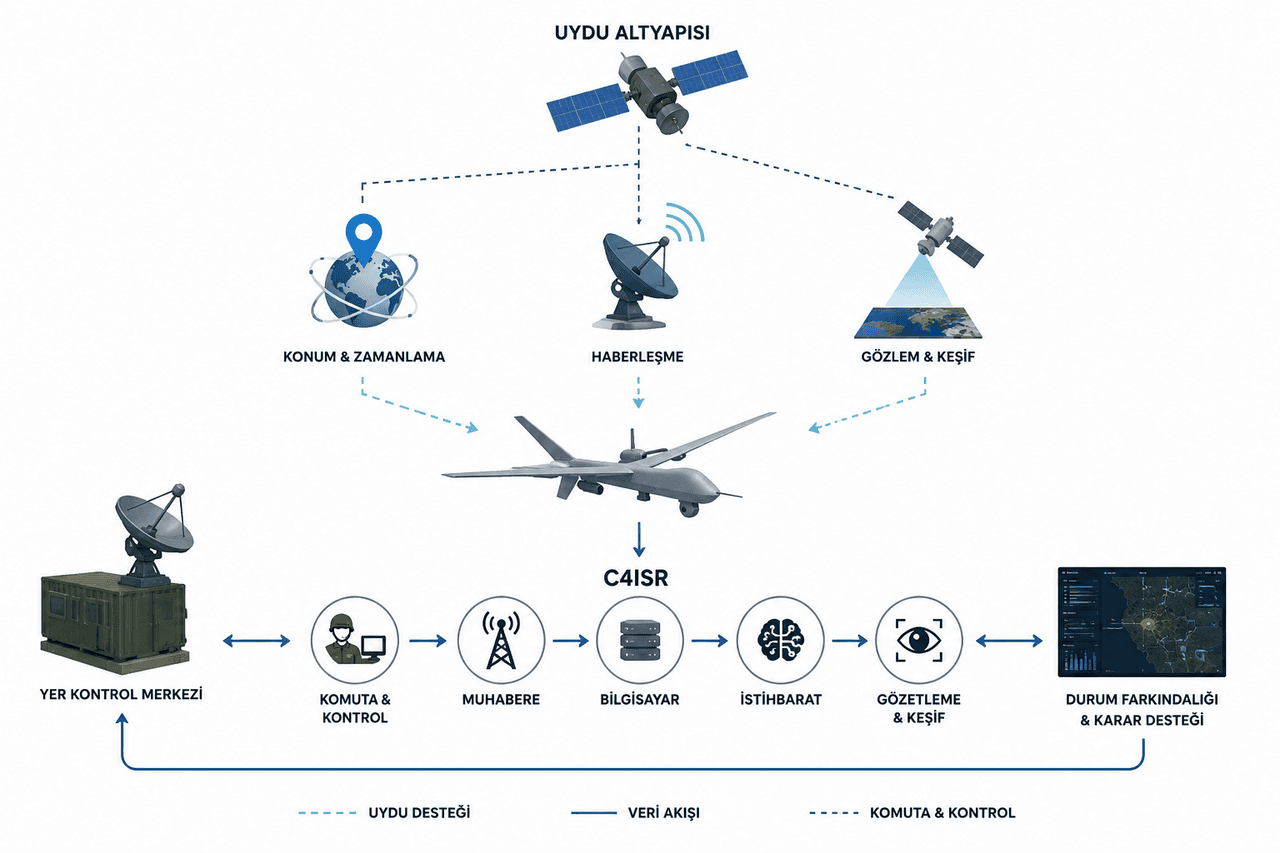
Uydu Destekli C4ISR İHA Sistemi (Yapay Zeka ile Oluşturulmuştur)
Satellite infrastructure is one of the fundamental components supporting unmanned aerial vehicles in positioning, communication, and intelligence activities. Positioning systems generate navigation, location, and timing data; satellite communication enables communication and command-and-control beyond line-of-sight; and satellite-based observation and reconnaissance systems facilitate the collection of intelligence data over vast geographic areas.
These systems also contribute to the data transfer and information generation processes within the C4ISR (Command, Control, Communications, Computers, Intelligence, Surveillance, and Reconnaissance) infrastructure of UAVs.【62】 In this regard, satellite technologies are not only components of Türkiye’s independence in space but also essential elements of the technological infrastructure enabling long-range communication, positioning, intelligence, and decision support for UAVs.
The primary functions of satellite infrastructure for unmanned aerial vehicles are maintaining beyond-line-of-sight communication and providing navigation and timing information. In missions conducted beyond the direct data link range, satellite communication (SATCOM) ensures the continuity of command and data transmission between the aircraft and ground control elements. In Türkiye, integration and flight tests of the national satellite communication system developed by CTECH have been completed on the ANKA-S platform, thereby further localizing a subsystem on the platform.【63】 Satellite communication capabilities are also included in the AKSUNGUR platform developed by TUSAŞ, with a satellite range exceeding 5,000 kilometers specified for the platform.【64】 The Bayraktar TB3 can be commanded from long distances using both line-of-sight (LOS) and beyond-line-of-sight (BLOS) communication capabilities.【65】

Fergani Uzay (Fergani Uzay)

ULUĞ BEY Projesinin En Güncel Bileşeni: FGN-100-D3 (Anadolu Ajansı)
Positioning and timing data are also critical for UAV navigation. One initiative aimed at reducing dependence on foreign global navigation satellite systems is the Ulugh Beg Global Positioning System, being developed by Fergani Space, established under the leadership of Selçuk Bayraktar. The project, based on a constellation of low-earth-orbit satellites, aims to establish a national positioning and timing network independent of foreign GNSS infrastructure upon completion.【66】
During the early period of Türkiye’s reliance on foreign UAVs, challenges in maintenance, spare parts, and technical support demonstrated that operational continuity depends on more than merely acquiring the aircraft. Delays in returning aircraft sent abroad for Heron system maintenance and disruptions in the supply chain exemplified the limitations imposed by dependence on external sources for critical capabilities.【67】
In domestically developed UAV programs, localization of engines, electro-optic reconnaissance and targeting systems, data links, and munitions has established a structure enabling reconnaissance, surveillance, target detection, and engagement functions to be conducted primarily with national subsystems. Thus, the technical foundation of UAV use in counterterrorism is not merely the platform itself but the coordinated operation of sensors, communication, propulsion, and munition subsystems.
Bayraktar TB3 Takeoff and Landing Tests from TCG Anadolu (Anadolu Agency)
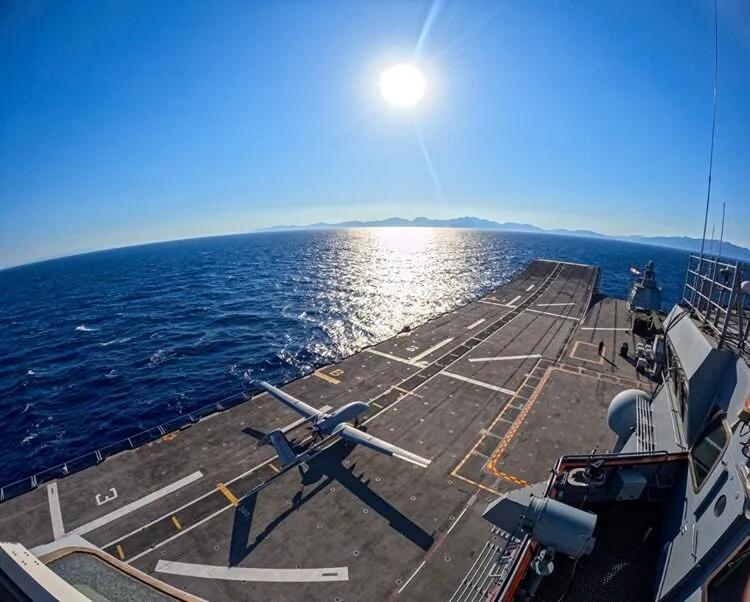
One example of integrated use of national subsystems is the operations conducted by the Bayraktar TB3 from naval platforms. The TB3 flies with the TEI-developed PD170 engine, and tests have been conducted on its use of ASELSAN’s ASELFLIR-500 and CATS electro-optic systems and Roketsan’s MAM-L and MAM-T munitions.【68】 The platform’s beyond-line-of-sight communication capability enables command-and-control beyond the range of direct terrestrial data links.
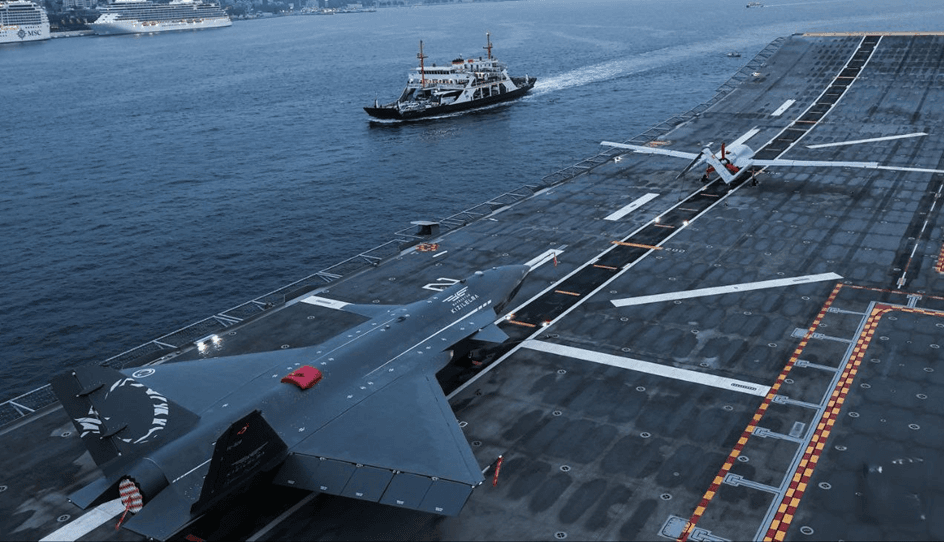
Bayraktar KIZILELMA is displayed on the deck of TCG Anadolu
As of June 2025, the Bayraktar TB3 has completed over 100 sorties from TCG Anadolu. These activities demonstrate that ship-based UAV operations require more than just short-runway takeoff and landing capability; they demand the coordinated operation of propulsion, electro-optic sensors, satellite communication, data link, and munition systems within a unified mission architecture.【69】

Milli Teknoloji Hamlesi Logosu (T3 Vakfı)
The fundamental importance of UAV subsystems under the National Technology Initiative lies in reducing dependency on foreign procurement for critical technologies and extending technological independence from the platform level to the component level. The Ministry of Industry and Technology’s 2030 Industry and Technology Strategy identifies the domestic development of critical technologies and the strengthening of technological independence as core objectives of the National Technology Initiative.【70】
The development of engines such as the TEI-PD170, electro-optic systems such as CATS and ASELFLIR-500, national satellite communication solutions, and indigenous guided munitions in Turkish UAV systems constitutes the implementation of this approach at the UAV subsystem level. Thus, localization encompasses not only the design and production of the aircraft but also the domestic development of all components necessary for mission execution: propulsion, sensing, communication, and effect.
ASELSAN. "CATS (Common Aperture Targeting System)." Accessed September 2, 2026.https://wwwcdn.aselsan.com/api/file/CATS_ENG%20%281%29.pdf.
Anadolu Ajansı. "Bayraktar TB3 SİHA Kısa Pistli Gemiden İniş ve Kalkış Yapmayı Başaran İlk İnsansız Hava Aracı Oldu." YouTube, November 19, 2024. Accessed September 3, 2026.
Anadolu Ajansı. "Bayraktar TB3, TCG Anadolu'daki Testlerinde 100 Sortiyi Tamamladı." June 3, 2025. Accessed August 10, 2026.https://www.aa.com.tr/tr/savunma-sanayisi/bayraktar-tb3-tcg-anadoludaki-testlerinde-100-sortiyi-tamamladi/3587413
Anadolu Ajansı. "Israel Fails to Send Herons Back." September 8, 2011. Accessed September 2, 2026.https://www.aa.com.tr/en/archive/israel-fails-to-send-herons-back/413749
Anadolu Ajansı. "Millî Hava Araçlarının 'Keskin Gözlerinden' Kaçış Yok." April 6, 2023. Accessed September 2, 2026.https://www.aa.com.tr/tr/savunma-sanayisi/milli-hava-araclarinin-keskin-gozlerinden-kacis-yok/2865115
Anadolu Ajansı. "Roketsan MAM-L ve MAM-C Mini Akıllı Mühimmatları." October 18, 2020. Accessed September 3, 2026.https://cdnuploads.aa.com.tr/uploads/Contents/2020/10/18/thumbs_b_c_1b5d808dccc43598b5d02279b1a90c05.jpg
Anadolu Ajansı. "Türkiye'nin Millî Havacılık Motoru TEI-PD170'in TUSAŞ'a Teslimatı Gerçekleştirildi." January 16, 2020. Accessed September 2, 2026.https://www.aa.com.tr/tr/turkiye/turkiyenin-milli-havacilik-motoru-tei-pd170in-tusasa-teslimati-gerceklestirildi/1703688
Anadolu Ajansı. "İHA'ların Keşif, Gözetleme ve Hedefleme Sistemlerine ASELSAN'dan Yerli Çözüm." March 20, 2021. Accessed September 2, 2026.https://www.aa.com.tr/tr/bilim-teknoloji/ihalarin-kesif-gozetleme-ve-hedefleme-sistemlerine-aselsandan-yerli-cozum/2182297
Baykar Technologies. "Bayraktar #KIZILELMA | Dünyada İlk Defa: Otonom Yakın Kol Uçuşu." YouTube, December 28, 2025. Accessed September 3, 2026.https://www.youtube.com/watch?v=ybYoWDsgU8Q
Baykar Teknoloji. "Bayraktar KIZILELMA." KÜRE, November 4, 2024. Accessed August 1, 2026.
Baykar Teknoloji. "Bayraktar TB3." KÜRE, January 7, 2026. Accessed August 1, 2026.
Baykar Teknoloji. "Kızılelma Dâhili Mühimmat Yuvasından İlk Atış Testlerini Başarıyla Tamamladı!" Last updated July 30, 2026. Accessed August 2, 2026.https://baykartech.com/tr/haberler/kizilelma-dahili-muhimmat-yuvasindan-ilk-atis-testlerini-basariyla-tamamladi/
Ceylan, Mehmet Fatih. "Sadece Mavi Vatan Üzerinden mi Seyrüsefere Çıkacağız? Yeşil, Gök ve Gri Vatanlar Nerede?" Ankara Politikalar Merkezi, June 20, 2021. Accessed August 1, 2026.https://apm.org.tr/2021/06/20/sadece-mavi-vatan-uzerinden-mi-seyrusefere-cikacagiz-yesil-gok-ve-gri-vatanlar-nerede/
Düz, Sibel. The Ascension of Turkey as a Drone Power: History, Strategy, and Geopolitical Implications. SETA Analysis No. 65. Ankara: SETA Foundation for Political, Economic and Social Research, 2020. Accessed September 16, 2026.
Düztürk, Mete. "MAM-C." KÜRE, June 26, 2025. Accessed September 3, 2026.https://kureansiklopedi.com/tr/detay/mam-c-6eefa
Görgün, Haluk. "HAVELSAN Teknoloji SİDA Hizmete Alma, Tesisler Temel Atma ve Açılış Töreni Konuşması." Speech, HAVELSAN Technology Campus, Ankara, February 24, 2026. Reported in "Cumhurbaşkanı Erdoğan'ın Katılımıyla SANCAR SİDA Hizmete Alındı." İhlas Haber Ajansı, February 24, 2026. Accessed September 2, 2026.
Güneş, Ahsen. "Askeri Taktik İletişim Sistemleri." KÜRE, July 15, 2025. Accessed August 2, 2026.https://kureansiklopedi.com/tr/detay/askeri-taktik-iletisim-sistemleri-e9b99
Kahveci, Muzaffer, and Nazlı Can. "İnsansız Hava Araçları: Tarihçesi, Tanımı, Dünyada ve Türkiye'deki Yasal Durumu." Selçuk Üniversitesi Mühendislik, Bilim ve Teknoloji Dergisi 5, no. 4 (2017): 511–535. Accessed September 2, 2026.
Karakoç, Edanur. "FGN-100-D3." KÜRE, March 31, 2026. Accessed August 4, 2026.
Kökçam, Ömer. “T3 Vakfı.” *KÜRE*, January 3, 2025. Accessed September 16, 2026.https://kureansiklopedi.com/tr/detay/t3-vakfi.
Kılıç, Mehmet. "Komuta Kontrol Fonksiyon Alanı ve Türk Silahlı Kuvvetleri İçin Öneriler." Savunma ve Güvenlik Araştırmaları Dergisi 1, no. 2 (2024): 217–242. Accessed August 1, 2026.https://kho.msu.edu.tr/akademik/enstitu/Savunma%20ve%20G%C3%BCvenlik%20Ara%C5%9Ft%C4%B1rmalar%C4%B1%20Dergisi/02/4.pdf
M5 Dergi. “60’dan Fazla TEI-PD170 Motoru Üretti.” September 21, 2021. Accessed September 16, 2026.https://m5dergi.com/savunma-haberleri/tei-60dan-fazla-tei-pd170-motoru-uretti/
Ministry of Industry and Technology of the Republic of Turkey. *2030 Industry and Technology Strategy*. Ankara: Ministry of Industry and Technology of the Republic of Turkey, March 2025. Accessed September 16, 2026.https://www.sanayi.gov.tr/assets/img/popup-image/pdf/SanayiTeknolojiStratejisi2030.pdf
SASAD (Defense Industry Manufacturers Association). "TÜBİTAK Bilişim ve Bilgi Güvenliği İleri Teknolojiler Araştırma Merkezi – BİLGEM." Accessed July 30, 2026.https://www.sasad.org.tr/tubitak-bilisim-ve-bilgi-guvenligi-ileri-teknolojiler-arastirma-merkezi-bilgem
STM. "Büyük Otonom Sualtı Aracı 'TENGİZ' Derinliklere İmzasını Atacak." 2026. Accessed August 1, 2026.https://www.stm.com.tr/tr/basin-bultenleri/buyuk-otonom-sualti-araci-tengiz-derinliklere-imzasini-atacak
TEI (TUSAŞ Motor Sanayii A.Ş.). "TEI-PD170 Turbodizel Havacılık Motoru." Accessed September 16, 2026.https://www.tei.com.tr/urunler/tei-pd170-turbodizel-havacilik-motoru
Türk Havacılık ve Uzay Sanayii A.Ş. (TUSAŞ). "AKSUNGUR." May 1, 2022. Accessed September 16, 2026.https://www.tusas.com/urunler/iha/yuksek-faydali-yuk-kapasitesi/aksungur
Türk Havacılık ve Uzay Sanayii A.Ş. (TUSAŞ). “ANKA-S Yerli ve Milli ‘Uydu Haberleşme Sistemi’ Testlerini Tamamladı.” December 28, 2019. Accessed September 16, 2026.https://www.tusas.com/medya-merkezi/haberler/anka-s-yerli-ve-milli-uydu-haberlesme-sistemi-testlerini-tamamladi
Uygun, Güzide. "Türkiye'nin İnsansız Hava Aracı Tarihçesi." KÜRE Ansiklopedi, May 10, 2025. Accessed September 1, 2026.https://kureansiklopedi.com/tr/detay/turkiyenin-insansiz-hava-araci-tarihcesi
Uzun, Sümeyra. "Fergani Uzay." KÜRE, December 7, 2024. Accessed August 4, 2026.https://kureansiklopedi.com/tr/detay/fergani-uzay-2
Yazıcı, Ayşenur. "TEI-PD170." KÜRE, September 13, 2025. Accessed September 3, 2026.https://kureansiklopedi.com/tr/detay/tei-pd170-e1dd0
Yıldırım, Göksel. "NATO Tatbikatına Damga Vuran İkili, Milli Yazılımla Birbirine Bağlandı." Anadolu Ajansı, February 22, 2026. Accessed August 4, 2026.https://www.aa.com.tr/tr/bilim-teknoloji/nato-tatbikatina-damga-vuran-ikili-milli-yazilimla-birbirine-baglandi/3836987
Yılmaz, Meryem. "ADVENT (Ağ Destekli Veri Entegre Savaş Yönetim Sistemi)." KÜRE, July 6, 2026. Accessed August 2, 2026.https://kureansiklopedi.com/tr/detay/advent-ag-destekli-veri-entegre-savas-yonetim-sist
Öztürk, Esra. "ASELSAN CATS." KÜRE, May 9, 2025. Accessed September 3, 2026.
İhlas Haber Ajansı. "EFES 2026 Tatbikatı'nda Gövde Gösterisi." YouTube, May 21, 2026. Accessed September 3, 2026.https://www.youtube.com/watch?v=hs8XijZYKAY
[1]
Kahveci, Muzaffer, and Nazlı Can. "İnsansız Hava Araçları: Tarihçesi, Tanımı, Dünyada ve Türkiye'deki Yasal Durumu." Selçuk Üniversitesi Mühendislik, Bilim ve Teknoloji Dergisi 5, no. 4 (2017): 511–535, Accessed September 2, 2026,https://dergipark.org.tr/tr/download/article-file/400203.
[2]
Anadolu Ajansı. "Türkiye'nin Millî Havacılık Motoru TEI-PD170'in TUSAŞ'a Teslimatı Gerçekleştirildi." January 16, 2020. Accessed September 2, 2026.https://www.aa.com.tr/tr/turkiye/turkiyenin-milli-havacilik-motoru-tei-pd170in-tusasa-teslimati-gerceklestirildi/1703688
[3]
Sibel Düz, The Ascension of Turkey as a Drone Power: History, Strategy, and Geopolitical Implications, SETA Analysis No. 65 (Ankara: SETA Foundation for Political, Economic and Social Research, Temmuz 2020), 8, erişim 2 Eylül 2026, https://media.setav.org/en/file/2020/07/the-ascension-of-turkey-as-a-drone-power-history-strategy-and-geopolitical-implications.pdf.
[4]
Sibel Düz, The Ascension of Turkey as a Drone Power: History, Strategy, and Geopolitical Implications, SETA Analysis No. 65 (Ankara: SETA Foundation for Political, Economic and Social Research, Temmuz 2020), 8-9, erişim 2 Eylül 2026, https://media.setav.org/en/file/2020/07/the-ascension-of-turkey-as-a-drone-power-history-strategy-and-geopolitical-implications.pdf.
[5]
Sibel Düz, The Ascension of Turkey as a Drone Power: History, Strategy, and Geopolitical Implications, SETA Analysis No. 65 (Ankara: SETA Foundation for Political, Economic and Social Research, Temmuz 2020), 9, erişim 2 Eylül 2026, https://media.setav.org/en/file/2020/07/the-ascension-of-turkey-as-a-drone-power-history-strategy-and-geopolitical-implications.pdf.
[6]
Sibel Düz, The Ascension of Turkey as a Drone Power: History, Strategy, and Geopolitical Implications, SETA Analysis No. 65 (Ankara: SETA Foundation for Political, Economic and Social Research, Temmuz 2020), 9, erişim 2 Eylül 2026, https://media.setav.org/en/file/2020/07/the-ascension-of-turkey-as-a-drone-power-history-strategy-and-geopolitical-implications.pdf.
[7]
Sibel Düz, The Ascension of Turkey as a Drone Power: History, Strategy, and Geopolitical Implications, SETA Analysis No. 65 (Ankara: SETA Foundation for Political, Economic and Social Research, Temmuz 2020), 9, erişim 2 Eylül 2026, https://media.setav.org/en/file/2020/07/the-ascension-of-turkey-as-a-drone-power-history-strategy-and-geopolitical-implications.pdf.
[8]
Sibel Düz, The Ascension of Turkey as a Drone Power: History, Strategy, and Geopolitical Implications, SETA Analysis No. 65 (Ankara: SETA Foundation for Political, Economic and Social Research, Temmuz 2020), 9, erişim 2 Eylül 2026, https://media.setav.org/en/file/2020/07/the-ascension-of-turkey-as-a-drone-power-history-strategy-and-geopolitical-implications.pdf.
[9]
Sibel Düz, The Ascension of Turkey as a Drone Power: History, Strategy, and Geopolitical Implications, SETA Analysis No. 65 (Ankara: SETA Foundation for Political, Economic and Social Research, Temmuz 2020), 9, erişim 2 Eylül 2026, https://media.setav.org/en/file/2020/07/the-ascension-of-turkey-as-a-drone-power-history-strategy-and-geopolitical-implications.pdf.
[10]
Sibel Düz, The Ascension of Turkey as a Drone Power: History, Strategy, and Geopolitical Implications, SETA Analysis No. 65 (Ankara: SETA Foundation for Political, Economic and Social Research, Temmuz 2020), 9, erişim 2 Eylül 2026, https://media.setav.org/en/file/2020/07/the-ascension-of-turkey-as-a-drone-power-history-strategy-and-geopolitical-implications.pdf.
[11]
Sibel Düz, The Ascension of Turkey as a Drone Power: History, Strategy, and Geopolitical Implications, SETA Analysis No. 65 (Ankara: SETA Foundation for Political, Economic and Social Research, Temmuz 2020), 9, erişim 2 Eylül 2026, https://media.setav.org/en/file/2020/07/the-ascension-of-turkey-as-a-drone-power-history-strategy-and-geopolitical-implications.pdf.
[12]
Sibel Düz, The Ascension of Turkey as a Drone Power: History, Strategy, and Geopolitical Implications, SETA Analysis No. 65 (Ankara: SETA Foundation for Political, Economic and Social Research, Temmuz 2020), 9, erişim 2 Eylül 2026, https://media.setav.org/en/file/2020/07/the-ascension-of-turkey-as-a-drone-power-history-strategy-and-geopolitical-implications.pdf.
[13]
Sibel Düz, The Ascension of Turkey as a Drone Power: History, Strategy, and Geopolitical Implications, SETA Analysis No. 65 (Ankara: SETA Foundation for Political, Economic and Social Research, Temmuz 2020), 9, erişim 2 Eylül 2026, https://media.setav.org/en/file/2020/07/the-ascension-of-turkey-as-a-drone-power-history-strategy-and-geopolitical-implications.pdf.
[14]
Sibel Düz, The Ascension of Turkey as a Drone Power: History, Strategy, and Geopolitical Implications, SETA Analysis No. 65 (Ankara: SETA Foundation for Political, Economic and Social Research, Temmuz 2020), 9-10, erişim 2 Eylül 2026, https://media.setav.org/en/file/2020/07/the-ascension-of-turkey-as-a-drone-power-history-strategy-and-geopolitical-implications.pdf.
[15]
Sibel Düz, The Ascension of Turkey as a Drone Power: History, Strategy, and Geopolitical Implications, SETA Analysis No. 65 (Ankara: SETA Foundation for Political, Economic and Social Research, Temmuz 2020), 9-10, erişim 2 Eylül 2026, https://media.setav.org/en/file/2020/07/the-ascension-of-turkey-as-a-drone-power-history-strategy-and-geopolitical-implications.pdf.
[16]
Sibel Düz, The Ascension of Turkey as a Drone Power: History, Strategy, and Geopolitical Implications, SETA Analysis No. 65 (Ankara: SETA Foundation for Political, Economic and Social Research, Temmuz 2020), 10, erişim 2 Eylül 2026, https://media.setav.org/en/file/2020/07/the-ascension-of-turkey-as-a-drone-power-history-strategy-and-geopolitical-implications.pdf.
[17]
Sibel Düz, The Ascension of Turkey as a Drone Power: History, Strategy, and Geopolitical Implications, SETA Analysis No. 65 (Ankara: SETA Foundation for Political, Economic and Social Research, Temmuz 2020), 10, erişim 2 Eylül 2026, https://media.setav.org/en/file/2020/07/the-ascension-of-turkey-as-a-drone-power-history-strategy-and-geopolitical-implications.pdf.
[18]
Sibel Düz, The Ascension of Turkey as a Drone Power: History, Strategy, and Geopolitical Implications, SETA Analysis No. 65 (Ankara: SETA Foundation for Political, Economic and Social Research, Temmuz 2020), 10-11, erişim 2 Eylül 2026, https://media.setav.org/en/file/2020/07/the-ascension-of-turkey-as-a-drone-power-history-strategy-and-geopolitical-implications.pdf.
[19]
Sibel Düz, The Ascension of Turkey as a Drone Power: History, Strategy, and Geopolitical Implications, SETA Analysis No. 65 (Ankara: SETA Foundation for Political, Economic and Social Research, Temmuz 2020), 11, erişim 2 Eylül 2026, https://media.setav.org/en/file/2020/07/the-ascension-of-turkey-as-a-drone-power-history-strategy-and-geopolitical-implications.pdf.
[20]
Sibel Düz, The Ascension of Turkey as a Drone Power: History, Strategy, and Geopolitical Implications, SETA Analysis No. 65 (Ankara: SETA Foundation for Political, Economic and Social Research, Temmuz 2020), 11, erişim 2 Eylül 2026, https://media.setav.org/en/file/2020/07/the-ascension-of-turkey-as-a-drone-power-history-strategy-and-geopolitical-implications.pdf.
[21]
Sibel Düz, The Ascension of Turkey as a Drone Power: History, Strategy, and Geopolitical Implications, SETA Analysis No. 65 (Ankara: SETA Foundation for Political, Economic and Social Research, Temmuz 2020), 12, erişim 2 Eylül 2026, https://media.setav.org/en/file/2020/07/the-ascension-of-turkey-as-a-drone-power-history-strategy-and-geopolitical-implications.pdf.
[22]
Sibel Düz, The Ascension of Turkey as a Drone Power: History, Strategy, and Geopolitical Implications, SETA Analysis No. 65 (Ankara: SETA Foundation for Political, Economic and Social Research, Temmuz 2020), 26, erişim 2 Eylül 2026, https://media.setav.org/en/file/2020/07/the-ascension-of-turkey-as-a-drone-power-history-strategy-and-geopolitical-implications.pdf.
[23]
"TEI, 60'dan Fazla TEI-PD170 Motoru Üretti," *M5 Dergi*, September 21, 2021, Accessed September 16, 2026,https://m5dergi.com/savunma-haberleri/tei-60dan-fazla-tei-pd170-motoru-uretti/.
[24]
TEI (TUSAŞ Motor Sanayii A.Ş.), "TEI-PD170 Turbodizel Havacılık Motoru," erişim 16 Eylül 2026, https://www.tei.com.tr/urunler/tei-pd170-turbodizel-havacilik-motoru.
[25]
Ayşenur Yazıcı, "TEI-PD170," KÜRE Ansiklopedi, 13 Eylül 2025, erişim 16 Eylül 2026, https://kureansiklopedi.com/tr/detay/tei-pd170-e1dd0.
[26]
TEI (TUSAŞ Motor Sanayii A.Ş.), "TEI-PD170 Turbodizel Havacılık Motoru," erişim 16 Eylül 2026, https://www.tei.com.tr/urunler/tei-pd170-turbodizel-havacilik-motoru.
[27]
TEI (TUSAŞ Motor Sanayii A.Ş.), "TEI-PD170 Turbodizel Havacılık Motoru," erişim 16 Eylül 2026, https://www.tei.com.tr/urunler/tei-pd170-turbodizel-havacilik-motoru.
[28]
TEI (TUSAŞ Motor Sanayii A.Ş.), "TEI-PD170 Turbodizel Havacılık Motoru," erişim 16 Eylül 2026, https://www.tei.com.tr/urunler/tei-pd170-turbodizel-havacilik-motoru.
[29]
"Turkey's National Aviation Engine TEI-PD170 Delivered to TUSAŞ," Anadolu Ajansı, January 16, 2020, Accessed September 16, 2026.
[30]
Ayşenur Yazıcı, "TEI-PD170," KÜRE Ansiklopedi, 13 Eylül 2025, erişim 16 Eylül 2026, https://kureansiklopedi.com/tr/detay/tei-pd170-e1dd0.
[31]
"TEI, 60'dan Fazla TEI-PD170 Motoru Üretti," *M5 Dergi*, September 21, 2021, Accessed September 16, 2026.https://m5dergi.com/savunma-haberleri/tei-60dan-fazla-tei-pd170-motoru-uretti/.
[32]
Ayşenur Yazıcı, "TEI-PD170," KÜRE Ansiklopedi, 13 Eylül 2025, erişim 16 Eylül 2026, https://kureansiklopedi.com/tr/detay/tei-pd170-e1dd0.
[33]
"TEI, 60'dan Fazla TEI-PD170 Motoru Üretti," *M5 Dergi*, September 21, 2021, Accessed September 16, 2026.https://m5dergi.com/savunma-haberleri/tei-60dan-fazla-tei-pd170-motoru-uretti/.
[34]
"TEI, 60'dan Fazla TEI-PD170 Motoru Üretti," *M5 Dergi*, September 21, 2021, Accessed September 16, 2026.https://m5dergi.com/savunma-haberleri/tei-60dan-fazla-tei-pd170-motoru-uretti/.
[35]
"Turkey's National Aviation Engine TEI-PD170 Delivered to TUSAŞ," Anadolu Ajansı, January 16, 2020, Accessed September 16, 2026.
[36]
Anadolu Ajansı. "Millî Hava Araçlarının ‘Keskin Gözlerinden’ Kaçış Yok." 6 Nisan 2023, erişim 2 Eylül 2026, https://www.aa.com.tr/tr/savunma-sanayisi/milli-hava-araclarinin-keskin-gozlerinden-kacis-yok/2865115.
[37]
ASELSAN. "CATS (Common Aperture Targeting System)." aselsan.com.tr, erişim 2 Eylül 2026, https://wwwcdn.aselsan.com/api/file/CATS_ENG%20%281%29.pdf.
[38]
ASELSAN. "CATS (Common Aperture Targeting System)." aselsan.com.tr, erişim 2 Eylül 2026, https://wwwcdn.aselsan.com/api/file/CATS_ENG%20%281%29.pdf.
[39]
Anadolu Ajansı. "İHA'ların Keşif, Gözetleme ve Hedefleme Sistemlerine ASELSAN'dan Yerli Çözüm." March 20, 2021. Accessed September 2, 2026.https://www.aa.com.tr/tr/bilim-teknoloji/ihalarin-kesif-gozetleme-ve-hedefleme-sistemlerine-aselsandan-yerli-cozum/2182297
[40]
Anadolu Ajansı. "Millî Hava Araçlarının ‘Keskin Gözlerinden’ Kaçış Yok." 6 Nisan 2023, erişim 2 Eylül 2026, https://www.aa.com.tr/tr/savunma-sanayisi/milli-hava-araclarinin-keskin-gozlerinden-kacis-yok/2865115.
[41]
ASELSAN. "CATS (Common Aperture Targeting System)." aselsan.com.tr, erişim 2 Eylül 2026, https://wwwcdn.aselsan.com/api/file/CATS_ENG%20%281%29.pdf.
[42]
Anadolu Ajansı. "Millî Hava Araçlarının ‘Keskin Gözlerinden’ Kaçış Yok." 6 Nisan 2023, erişim 2 Eylül 2026, https://www.aa.com.tr/tr/savunma-sanayisi/milli-hava-araclarinin-keskin-gozlerinden-kacis-yok/2865115.
[43]
Baykar Teknoloji, "Bayraktar KIZILELMA," KÜRE, 4 Kasım 2024, erişim 1 Ağustos 2026, https://kureansiklopedi.com/tr/detay/bayraktar-kizilelma-720337.
[44]
Güzide Uygun, "Türkiye'nin İnsansız Hava Aracı Tarihçesi," KÜRE Ansiklopedi, May 10, 2025, Accessed September 1, 2026,https://kureansiklopedi.com/tr/detay/turkiyenin-insansiz-hava-araci-tarihcesi-5c6cc.
[45]
Güzide Uygun, "Türkiye'nin İnsansız Hava Aracı Tarihçesi," KÜRE Ansiklopedi, May 10, 2025, Accessed September 1, 2026,https://kureansiklopedi.com/tr/detay/turkiyenin-insansiz-hava-araci-tarihcesi-5c6cc.
[46]
Güzide Uygun, "Türkiye'nin İnsansız Hava Aracı Tarihçesi," KÜRE Ansiklopedi, May 10, 2025, Accessed September 1, 2026,https://kureansiklopedi.com/tr/detay/turkiyenin-insansiz-hava-araci-tarihcesi-5c6cc.
[47]
Güzide Uygun, "Türkiye'nin İnsansız Hava Aracı Tarihçesi," KÜRE Ansiklopedi, May 10, 2025, Accessed September 1, 2026,https://kureansiklopedi.com/tr/detay/turkiyenin-insansiz-hava-araci-tarihcesi-5c6cc. Baykar Teknoloji, "Bayraktar TB3," KÜRE, January 7, 2026, Accessed August 1, 2026,https://kureansiklopedi.com/en/detay/bayraktar-tb3-b898f.
[48]
Güzide Uygun, "Türkiye'nin İnsansız Hava Aracı Tarihçesi," KÜRE Ansiklopedi, May 10, 2025, Accessed September 1, 2026,https://kureansiklopedi.com/tr/detay/turkiyenin-insansiz-hava-araci-tarihcesi-5c6cc.
[49]
"Kızılelma Dâhili Mühimmat Yuvasından İlk Atış Testlerini Başarıyla Tamamladı!," BAYKAR Teknoloji, son güncelleme 30 Temmuz 2026, erişim 2 Ağustos 2026, https://baykartech.com/tr/haberler/kizilelma-dahili-muhimmat-yuvasindan-ilk-atis-testlerini-basariyla-tamamladi/.
[50]
"İHA'ların Keşif, Gözetleme ve Hedefleme Sistemlerine ASELSAN'dan Yerli Çözüm," Anadolu Ajansı, Accessed September 1, 2026.
[51]
Baykar Teknoloji, "Bayraktar KIZILELMA," KÜRE, 4 Kasım 2024, erişim 1 Ağustos 2026, https://kureansiklopedi.com/tr/detay/bayraktar-kizilelma-720337.
[52]
Ahsen Güneş, "Askeri Taktik İletişim Sistemleri," KÜRE, 15 Temmuz 2025, erişim 2 Ağustos 2026, https://kureansiklopedi.com/tr/detay/askeri-taktik-iletisim-sistemleri-e9b99.
[53]
Mehmet Kılıç, "Komuta Kontrol Fonksiyon Alanı ve Türk Silahlı Kuvvetleri İçin Öneriler," Savunma ve Güvenlik Araştırmaları Dergisi 1, sayı 2 (Eylül 2024): 217-242, erişim 1 Ağustos 2026, https://kho.msu.edu.tr/akademik/enstitu/Savunma%20ve%20G%C3%BCvenlik%20Ara%C5%9Ft%C4%B1rmalar%C4%B1%20Dergisi/02/4.pdf.
Mehmet Fatih Ceylan, "Sadece Mavi Vatan Üzerinden mi Seyrüsefere Çıkacağız? Yeşil, Gök ve Gri Vatanlar Nerede?," Ankara Politikalar Merkezi, 20 Haziran 2021, erişim 1 Ağustos 2026, https://apm.org.tr/2021/06/20/sadece-mavi-vatan-uzerinden-mi-seyrusefere-cikacagiz-yesil-gok-ve-gri-vatanlar-nerede/.
[54]
Ahsen Güneş, "Askeri Taktik İletişim Sistemleri," KÜRE, 15 Temmuz 2025, erişim 2 Ağustos 2026, https://kureansiklopedi.com/tr/detay/askeri-taktik-iletisim-sistemleri-e9b99.
[55]
Meryem Yılmaz, "ADVENT (Ağ Destekli Veri Entegre Savaş Yönetim Sistemi)," KÜRE, 6 Temmuz 2026, erişim 2 Ağustos 2026, https://kureansiklopedi.com/tr/detay/advent-ag-destekli-veri-entegre-savas-yonetim-sist.
[56]
STM, "Büyük Otonom Sualtı Aracı 'TENGİZ' Derinliklere İmzasını Atacak," 2026, Accessed August 1, 2026.https://www.stm.com.tr/tr/basin-bultenleri/buyuk-otonom-sualti-araci-tengiz-derinliklere-imzasini-atacak.
[57]
Göksel Yıldırım, "NATO Tatbikatına Damga Vuran İkili, Milli Yazılımla Birbirine Bağlandı," Anadolu Ajansı, 22 Şubat 2026, erişim 4 Ağustos 2026, https://www.aa.com.tr/tr/bilim-teknoloji/nato-tatbikatina-damga-vuran-ikili-milli-yazilimla-birbirine-baglandi/3836987.
[58]
Haluk Görgün, "HAVELSAN Sancar SİDA Hizmete Alma, Tesisler Temel Atma ve Açılış Töreni Konuşması" (speech, HAVELSAN Technology Campus, Ankara, February 24, 2026), cited in "Cumhurbaşkanı Erdoğan'ın Katılımıyla SANCAR SİDA Hizmete Alındı," İhlas Haber Ajansı, February 24, 2026, Accessed September 2, 2026,https://www.iha.com.tr/ankara-haberleri/cumhurbaskani-erdoganin-katilimiyla-sancar-sida-hizmete-alindi-383708173.
[59]
SASAD (Savunma Sanayii İmalatçılar Derneği), "TÜBİTAK Bilişim ve Bilgi Güvenliği İleri Teknolojiler Araştırma Merkezi – BİLGEM," erişim 30 Temmuz 2026, https://www.sasad.org.tr/tubitak-bilisim-ve-bilgi-guvenligi-ileri-teknolojiler-arastirma-merkezi-bilgem.
[60]
SASAD (Savunma Sanayii İmalatçılar Derneği), "TÜBİTAK Bilişim ve Bilgi Güvenliği İleri Teknolojiler Araştırma Merkezi – BİLGEM," erişim 30 Temmuz 2026, https://www.sasad.org.tr/tubitak-bilisim-ve-bilgi-guvenligi-ileri-teknolojiler-arastirma-merkezi-bilgem.
[61]
SASAD (Savunma Sanayii İmalatçılar Derneği), "TÜBİTAK Bilişim ve Bilgi Güvenliği İleri Teknolojiler Araştırma Merkezi – BİLGEM," erişim 30 Temmuz 2026, https://www.sasad.org.tr/tubitak-bilisim-ve-bilgi-guvenligi-ileri-teknolojiler-arastirma-merkezi-bilgem.
[62]
Mehmet Kılıç, "Komuta Kontrol Fonksiyon Alanı ve Türk Silahlı Kuvvetleri İçin Öneriler," Savunma ve Güvenlik Araştırmaları Dergisi 1, sayı 2 (Eylül 2024): 217-242, erişim 1 Ağustos 2026, https://kho.msu.edu.tr/akademik/enstitu/Savunma%20ve%20G%C3%BCvenlik%20Ara%C5%9Ft%C4%B1rmalar%C4%B1%20Dergisi/02/4.pdf.
[63]
Türk Havacılık ve Uzay Sanayii A.Ş. (TUSAŞ), “ANKA-S Yerli ve Milli ‘Uydu Haberleşme Sistemi’ Testlerini Tamamladı,” 28 Aralık 2019, erişim 16 Eylül 2026, https://www.tusas.com/medya-merkezi/haberler/anka-s-yerli-ve-milli-uydu-haberlesme-sistemi-testlerini-tamamladi.
[64]
Türk Havacılık ve Uzay Sanayii A.Ş. (TUSAŞ), “AKSUNGUR,” 1 Mayıs 2022, erişim 16 Eylül 2026, https://www.tusas.com/urunler/iha/yuksek-faydali-yuk-kapasitesi/aksungur.
[65]
Baykar Teknoloji, "Bayraktar TB3," KÜRE, 7 Ocak 2026, erişim 1 Ağustos 2026, https://kureansiklopedi.com/en/detay/bayraktar-tb3-b898f.
[66]
Sümeyra Uzun, "Fergani Uzay," KÜRE, 7 Aralık 2024, erişim 4 Ağustos 2026, https://kureansiklopedi.com/tr/detay/fergani-uzay-2.
[67]
Sibel Düz, The Ascension of Turkey as a Drone Power: History, Strategy, and Geopolitical Implications, SETA Analysis No. 65 (Ankara: SETA Foundation for Political, Economic and Social Research, Temmuz 2020), 9-10, erişim 2 Eylül 2026, https://media.setav.org/en/file/2020/07/the-ascension-of-turkey-as-a-drone-power-history-strategy-and-geopolitical-implications.pdf; Anadolu Ajansı. “Israel fails to send Herons back.” 8 Eylül 2011. erişim 2 Eylül 2026, https://www.aa.com.tr/en/archive/israel-fails-to-send-herons-back/413749.
[68]
TEI (TUSAŞ Motor Sanayii A.Ş.), "TEI-PD170 Turbodizel Havacılık Motoru," erişim 16 Eylül 2026, https://www.tei.com.tr/urunler/tei-pd170-turbodizel-havacilik-motoru; BAYKAR Teknoloji, “Bayraktar TB3 Silahlandı,” 18 Ocak 2025, erişim 16 Eylül 2026, https://baykartech.com/tr/press/bayraktar-tb3-silahlandi/; Anadolu Ajansı, “Bayraktar TB3 TCG Anadolu’daki Testlerinde 100 Sortiyi Tamamladı,” 29 Mayıs 2025, erişim 16 Eylül 2026, https://www.aa.com.tr/tr/savunma-sanayisi/bayraktar-tb3-tcg-anadoludaki-testlerinde-100-sortiyi-tamamladi/3587413.
[69]
Anadolu Ajansı, “Bayraktar TB3 TCG Anadolu’daki Testlerinde 100 Sortiyi Tamamladı,” 3 Haziran 2025, erişim 16 Eylül 2026, https://www.aa.com.tr/tr/savunma-sanayisi/bayraktar-tb3-tcg-anadoludaki-testlerinde-100-sortiyi-tamamladi/3587413.
[70]
T.C. Sanayi ve Teknoloji Bakanlığı, 2030 Sanayi ve Teknoloji Stratejisi (Ankara: T.C. Sanayi ve Teknoloji Bakanlığı, Mart 2025), erişim 16 Eylül 2026, https://www.sanayi.gov.tr/assets/img/popup-image/pdf/SanayiTeknolojiStratejisi2030.pdf.

Country | Türkiye | ||||||||
|---|---|---|---|---|---|---|---|---|---|
User Institution | Turkish Armed Forces | ||||||||
Related Contexts | National Technology Initiative Complete Technological Independence Defense Industry Unmanned Aerial Systems Blue Homeland Green Homeland Sky Homeland Gray Homeland | ||||||||
Related Contexts | National Technology Initiative Unmanned Aerial Vehicles | ||||||||
Subject Summary | In Turkish unmanned aerial vehicles, national subsystems refer to the design, production, and integration of IHA platform components such as propulsion, payload, sensor, ammunition, communication, and command-control systems using domestic capabilities. These subsystems consist of hardware and software elements that enable the IHA's fundamental functions such as flight, mission execution, and data transmission. The design or production of a platform in Türkiye does not necessarily imply that all its subsystems are national. Therefore, the localization of subsystems is one of the important indicators of technological independence at the component level. | ||||||||
Core Subsystems | Propulsion Systems Payload and Sensor Systems Ammunition Systems Communication and Command-Control Systems Satellite Infrastructure | ||||||||
Major Institutions | TEI ASELSAN Roketsan TÜBİTAK HAVELSAN Baykar TUSAŞ | ||||||||
Relationship with the National Technology Initiative | The National Technology Initiative is a technology and industry approach aimed at enabling Türkiye to develop, produce, and transform critical technologies into globally competitive products. The defense industry has become one of the most prominent application areas of this approach, contributing to the establishment of domestic development capacity in critical technologies such as UAVs, missiles, radar, and satellites. | ||||||||
Strategic Commentary | The development of national subsystems enables UAVs to be developed not merely as aerial platforms but as national mission systems integrating propulsion, sensing, data, decision, and effect components. | ||||||||
No Discussion Added Yet
Start discussion for "National Subsystems in Turkish Unmanned Aerial Vehicles" article
Conceptual Framework
Unmanned Aerial Vehicle System Architecture
Platform Localization and Component Localization
Background of Subsystem Localization
Initial Procurement Phase
Heron Procurement and Subsystem Integration
Other Procurement Attempts
Initiation of National Subsystem Programs
Propulsion Systems
Imported Engine Era and National Engine Requirement
TEI-PD170 Turbodiesel Aviation Engine
TEI-PD222ST
TS1400 Turbofan Engine
Impact of Engine Localization on Subsystem Integrity
Payload and Sensor Systems
ASELSAN Electro-Optic System Developments
CATS Electro-Optic Reconnaissance, Surveillance, and Targeting System
ASELFLIR-500
National Munitions
Laser-Guided Light Munitions
Guided Bomb and Missile Integration
Integration of Munition and Sensor Chains
Communication, Data Link, and Command-and-Control
Tactical Communication Systems
ADVENT Network-Enabled Integrated Battle Management System
Cybersecurity and Data Security
Satellite Infrastructure: Positioning, Communication, and Intelligence
Satellite Communication and National Positioning
Operational Relevance and Role in the National Technology Initiative
Use in Counterterrorism
Operations from Naval Platforms
Role in the National Technology Initiative