


This article was automatically translated from the original Turkish version.
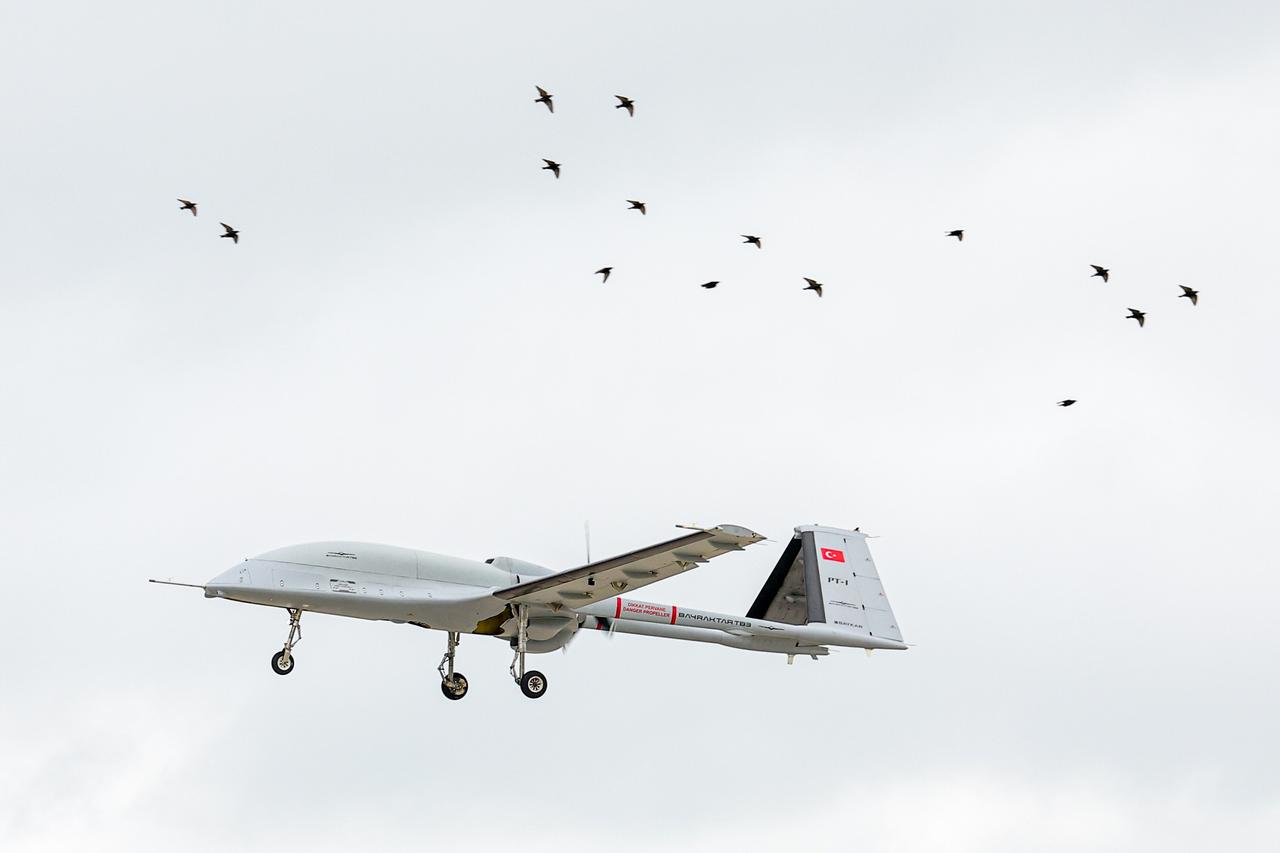
Bayraktar TB3
Bayraktar TB3
National Origin | Türkiye | ||||||||
|---|---|---|---|---|---|---|---|---|---|
Variant | Army and Navy | ||||||||
Type(s) | Armed Unmanned Aerial Vehicle | ||||||||
First Flight(s) | 27 October 2023 | ||||||||
First Launch and Landing from Short-Runway Ships | 19 November 2024 | ||||||||
Bayraktar TB3 is a national and original armed unmanned aerial vehicle (UAV) system developed by Baykar. Designed specifically for maritime operations, it is capable of autonomous takeoff and landing from short-deck vessels. In addition to reconnaissance, surveillance, and intelligence missions, it can effectively carry out strike missions using smart munitions integrated under its wings.
The platform shares structural and visual similarities with the Bayraktar TB2 and stands out with its foldable wing design, the higher-performance TEI PD-170 turbo-diesel engine, air-to-air missile launch capability, and integration of the ASELSAN ASELFLIR-500 electro-optical system. Thanks to its Line-of-Sight (LOS) and Beyond-Line-of-Sight (BLOS) communication capabilities, the system can be remotely commanded over long distances, providing high operational flexibility for both close-range and long-range missions.

Bayraktar TB3 (AA)
On 19 November 2023, during a test flight, the Bayraktar TB3 successfully performed autonomous takeoff and landing from TCG Anadolu, the largest vessel of the Turkish Navy, becoming the first unmanned aerial vehicle in world aviation history to achieve takeoff and landing from a short-deck vessel. The platform, designed for both maritime and land operations, entered the inventory of the Turkish Armed Forces (TAF) as of September 2025.
The Bayraktar TB3 has also drawn international attention as a prominent product of Türkiye’s defense industry. In this context, on 12 February 2025, a contract was signed announcing that the Bayraktar TB3 will join the Indonesian military inventory.
The design and development process of the Bayraktar TB3 was initiated by Baykar Technology in 2020.【1】 The technical specifications of the platform were publicly unveiled on 1 April 2021.【2】 The Bayraktar TB3 was first publicly displayed at TEKNOFEST in Istanbul between 27 April and 1 May 2023.【3】 Ongoing test and development activities have subjected the platform to numerous performance tests, including endurance, electro-optical system identification, altitude trials, engine durability, and short-distance takeoff and landing.
Significant milestones in the Bayraktar TB3 testing process include:
Bayraktar TB3’s First Takeoff and Landing from a Short-Deck Vessel (Selçuk Bayraktar Social Media Account)
Approximately five months after the first ramp test, on 19 November 2024, the Bayraktar TB3 successfully completed its first takeoff and landing from the short-deck flight deck of TCG Anadolu.【12】 Through its test flight from TCG Anadolu, the Bayraktar TB3 became the first unmanned aerial vehicle in world aviation history to achieve takeoff and landing from a short-deck vessel. During its second flight test on 25 November aboard TCG Anadolu, operating off the coast of Çanakkale, it successfully performed two additional takeoffs and landings.【13】
A major milestone in the munitions integration program for the Bayraktar TB3 was successfully completed on 17 January 2025. During the first firing test using the MAM-T munition developed by Roketsan, the target designated by ASELSAN’s ASELFLIR-500 Electro-Optical Reconnaissance, Surveillance, and Targeting System was precisely hit.【14】 With this armament integration, the Bayraktar TB3 has effectively gained the capability to conduct reconnaissance, surveillance, and strike missions against over-the-horizon targets.
As part of its munitions integration tests, the Bayraktar TB3 achieved a milestone on 25 March 2025. During its first firing test with the İHA-122 supersonic missile developed by ROKETSAN, a 6x6 meter target at sea was precisely hit from a distance exceeding 50 kilometers.【15】 This test demonstrated the Bayraktar TB3’s capability to carry and employ supersonic munitions.
During the test, the Bayraktar TB2 UAV marked the target with a laser from the air; the Bayraktar TB3 then coordinated its attack by firing the missile and destroying the target. Thus, the joint operational capability of two different UAVs was successfully demonstrated for the first time.
Following its initial shipboard tests completed in November 2024 off the coast of Mugla Aksaz, the Bayraktar TB3 began a new test phase aboard TCG Anadolu on 22 April 2025. During these operations in the Saros Gulf, the Bayraktar TB3 completed a total of 24 fully autonomous takeoffs and landings.【16】
During the test process, on 25 April 2025, the fourth prototype of the national UAV, Bayraktar TB3 PT-4, participated in tests for the first time. The Bayraktar TB3 PT-4, launched from the Flight Training and Test Center in Keşan, landed on TCG Anadolu to join the test program. Thus, for the first time, two national UAVs were simultaneously deployed aboard TCG Anadolu.
The Baykar Project Team, led by Baykar Board Chairman Selçuk Bayraktar, conducted the test activities. Commander of the Turkish Naval Forces, Admiral Ercüment Tatlıoğlu, monitored the tests from the ship’s bridge and ground control stations.
The Bayraktar TB3 UAV has achieved a significant milestone in test activities conducted aboard the Turkish Navy’s TCG Anadolu. Between 28 May and 2 June 2025, the Bayraktar TB3 successfully completed a total of 100 shipboard takeoffs and landings.【17】 As part of these tests, image-based AI-assisted autonomous takeoff and landing capabilities were also evaluated. In this context, technical capabilities such as visual track following, aircraft carrier detection, runway detection, and ground-based approach angle estimation were validated.

Bayraktar TB3 Taking Off from TCG Anadolu (Baykar)
During the DENİZKURDU 2025 Exercise’s Special Observer Day activities, the Bayraktar TB3 UAVs fulfilled their assigned missions. Bayraktar TB3 UAVs launched consecutively from TCG Anadolu in the Mediterranean Sea successfully executed two salvo strikes against land targets with precise hits.【18】
3 December 2025: During tests conducted off the coast of Antalya, the Bayraktar TB3 demonstrated its ability to coordinate with maritime assets.
Hybrid Operational Concept: A Bayraktar TB3 launched from TCG ANADOLU remotely commanded the ASELSAN Albatros-S Kamikaze Unmanned Surface Vehicle (KİDA) via its data link system to neutralize a target.
Munitions Firing Tests: As part of its firepower capacity, successful firing tests were conducted against land-based targets on an island using MAM-T, MAM-L, and the AI-based mini cruise missile KEMANKEŞ-1.
Steadfast Dart-2026 NATO Exercise (Baykar)
February 2026: During tests conducted as part of NATO’s Steadfast Dart-2026 exercise, the platform’s environmental limits were pushed to their extremes.
Extreme Meteorological Conditions: The Bayraktar TB3 maintained its flight performance in freezing conditions with air temperatures dropping to -5 degrees Celsius, heavy snowfall, and strong winds. It was highlighted as the only aircraft capable of conducting missions under conditions where other manned and unmanned aircraft could not fly.
Autonomous Maritime Operations: The platform, autonomously launched from TCG ANADOLU’s short deck, demonstrated stable flight characteristics despite turbulent sea conditions and performed an autonomous landing on an icy runway.
These test processes confirmed before international military delegations that the Bayraktar TB3 possesses operational capability under all weather conditions and has achieved a high level of reliability in the integration of unmanned systems.
The Bayraktar TB3 is a UAV capable of takeoff and landing from short-deck vessels; its primary distinguishing features include a 1,450 kg maximum takeoff weight, a 280 kg payload capacity, and the indigenous TEI PD-170 engine. Its technical specifications, enabling use in reconnaissance, intelligence, and strike missions through integrated sensor systems, are as follows:【19】
Communication System: The Bayraktar TB3 is equipped not only with conventional Line-of-Sight (LOS) communication but also with a satellite-based communication (SATCOM) module. Thanks to this technology, the Bayraktar TB3 can conduct global operations beyond the range of ground control stations, achieving Beyond-Line-of-Sight (BLOS) connectivity. The 5,700 km distance covered during its 13th test flight demonstrates this capability in practice.

TEI PD-170 Engine (AA)
Power System: The Bayraktar TB3 is powered by the TEI PD-170 turbo-diesel aviation engine. With additional enhancements, the power unit can deliver up to 195 horsepower.
Flight Speed and Endurance: The Bayraktar TB3’s cruise speed ranges between 110–130 KTAS (approximately 200–240 km/h). The planned endurance of 24+ hours exceeded expectations during the 13th test flight, reaching 32 hours. This endurance provides a critical operational advantage for long-duration reconnaissance, surveillance, and intelligence missions conducted from maritime platforms.
Service Ceiling and Operational Altitude: The Bayraktar TB3’s operational altitude is 20,000 feet, with a service ceiling of 25,000 feet. However, during its 55th test flight, it exceeded 36,000 feet, demonstrating performance beyond planned limits. This altitude capability enhances protection against radar and air defense systems and enables more effective surveillance over wider areas.
Maximum Takeoff Weight, Length, Height, and Wingspan
The Bayraktar TB3’s maximum takeoff weight is 1,600 kg, representing the highest weight at which the aircraft can take off fully loaded and fully fueled. The platform’s fuselage length is 8.35 meters, and its height from the ground is 2.6 meters. The wingspan of the Bayraktar TB3 is 14 meters. However, these wings are designed to fold for compatibility with shipboard operations. These dimensional characteristics enable the Bayraktar TB3 to operate effectively both in open-sea missions and in confined areas, particularly on short-deck maritime platforms such as TCG Anadolu.
Bayraktar TB3 Technical Specifications Table (Baykar)
Bayraktar TB3 can perform reconnaissance, surveillance, intelligence, and strike missions depending on its payload. Equipped with a 280 kg payload capacity, this UAV stands out as a versatile and effective platform due to its advanced electro-optical systems and munitions-carrying capability.
İHA-122 Supersonic Missile Firing Test (Selçuk Bayraktar Social Media Account)
One of the most distinguishing features of the Bayraktar TB3 compared to its counterparts is its integration of the ASELSAN ASELFLIR 500 electro-optical system. This advanced technology system provides high performance even during nighttime and adverse weather conditions, thanks to its precise imaging capability and wide-spectrum optical sensors.

Image of Baykar CEO Haluk Bayraktar and Republicorp Founder Norman Joesoef signing an agreement, 12 February 2025 (Anadolu Agency)
The Bayraktar TB3 is planned to enter serial production and join the inventory of the Turkish Armed Forces (TAF) in 2025. Concurrently, its first export was conducted to Indonesia in February 2025. On 12 February 2025, during President Recep Tayyip Erdoğan’s visit to Indonesia, Baykar and Indonesian defense company Republikorp signed a joint production agreement for the export of Bayraktar TB3 and Bayraktar AKINCI. This agreement marks the first export of the Bayraktar TB3. Under the agreement, 60 Bayraktar TB3 and 9 Bayraktar AKINCI units will be exported to Indonesia.【21】
The Bayraktar TB3 is the first unmanned aerial vehicle (UAV) in the world capable of takeoff and landing from short-deck amphibious assault ships. This capability distinguishes the Bayraktar TB3 most significantly from its counterparts. Although UAVs have previously achieved successful takeoffs and landings from aircraft carriers, no unmanned aerial vehicle had previously performed takeoff and landing from a short-deck amphibious assault ship. In this context, when compared with similar UAV systems internationally, the ship-based operational capability, foldable wing structure, and SATCOM-enabled Beyond-Line-of-Sight communication of the Bayraktar TB3 set it apart. These features make the TB3 a more flexible, versatile, and ideal platform for maritime operations.
Anadolu Ajansı. "Bayraktar TB3 Silahlandı." Anadolu Ajansı, January 20, 2025. https://www.aa.com.tr/tr/savunma-sanayisi/bayraktar-tb3-silahlandi/3454229.
Anadolu Ajansı. “Bayraktar TB3 SİHA, Gemiye İniş-Kalkışta Yeni Bir Eşik Atladı.” Accessed April 26, 2025. https://www.aa.com.tr/tr/savunma-sanayisi/bayraktar-tb3-siha-gemiye-inis-kalkista-yeni-bir-esik-atladi/3548923#
Baykar Teknoloji. "Bayraktar TB3 UCAV Hits Target with Supersonic Missile." BaykarTech. Accessed March 26, 2025. https://baykartech.com/tr/haberler/bayraktar-tb3-sihadan-supersonik-fuzeyle-tam-isabet/.
Baykar. "Bayraktar TB3, Gemide 100 Sortiyi Tamamladı." Baykar Teknoloji, June 2, 2024. https://www.baykartech.com/tr/haberler/bayraktar-tb3-gemide-100-sortiyi-tamamladi/.
Selçuk Bayraktar. “We Are the Oarsmen of Our Civilization Ship | #BayraktarTB3 ⚓️ TCG Anadolu.” YouTube video. Accessed April 26, 2025. https://www.youtube.com/watch?v=d6DzlIWTSOw
[1]
Selçuk Bayraktar (@Selcuk). X (Twitter), October 2020. Access 30 June 2025. https://x.com/Selcuk/status/1321843857139605504.
[2]
Savunma Sanayii ST. “Bayraktar TB3 UAV Features Shared.” SavunmaSanayiST.com, 1 April 2021, Access 30 June 2025. https://www.savunmasanayist.com/bayraktar-tb3-siha-ozellikleri-paylasildi/.
[3]
Baykar. “Intense Interest in Bayraktar TB3, First Publicly Exhibited at TEKNOFEST.” Baykar Technology, 28 April 2023. Access 30 June 2025. https://baykartech.com/tr/press/teknofestte-ilk-kez-sergilenen-bayraktar-tb3e-yogun-ilgi/.
[4]
Baykar. “Bayraktar TB3 Successfully Completes First Taxi Test.” Baykar Technology, 15 October 2023. Access 30 June 2025. https://baykartech.com/tr/haberler/bayraktar-tb3-ilk-kosu-testini-basariyla-tamamladi/.
[5]
Baykar. “TB3 Took Off for Anadolu.” Baykar Technology, 23 October 2023, Access 30 June 2025. https://baykartech.com/tr/haberler/tb3-anadolu-icin-havalandi/.
[6]
Anadolu Agency. “Bayraktar TB3 UAV Meets the Sky on the 100th Anniversary of the Republic.” AA, 27 October 2023. Access 30 June 2025. https://www.aa.com.tr/tr/bilim-teknoloji/bayraktar-tb3-siha-cumhuriyetin-100-yilinda-gokyuzuyle-bulustu/3034654.
[7]
Baykar. “Bayraktar TB3 UAV Successfully Completes 32-Hour Endurance Flight Test.” Baykar Technology, 20 December 2023. Access 30 June 2025. https://baykartech.com/tr/haberler/bayraktar-tb3-siha-32-saat-havada-kaldigi-uzun-ucus-testini-basariyla-tamamladi/.
[8]
Baykar. “Bayraktar TB3 Flew with ASELFLIR-500.” Baykar Technology, 27 March 2024. Access 30 June 2025. https://baykartech.com/tr/haberler/bayraktar-tb3-aselflir-500-ile-uctu/.
[9]
Baykar. “Bayraktar TB3 Successfully Completes First Ramp Takeoff Test.” Baykar Technology, 3 June 2024. Access 30 June 2025. https://baykartech.com/tr/haberler/bayraktar-tb3-ilk-rampa-kalkis-testini-basariyla-tamamladi/.
[10]
Baykar. “Bayraktar TB3 UAV Reaches 36,000 Feet with Indigenous Engine.” Baykar Technology, 26 June 2024. Access 30 June 2025. https://baykartech.com/tr/haberler/bayraktar-tb3-siha-yerli-motorla-36-bin-feet-irtifaya-cikti/.
[11]
Anadolu Agency. “Bayraktar TB3 UAV Conducts Its First Public Flight at TEKNOFEST Adana.” AA, 2 October 2024. Access 30 June 2025. https://www.aa.com.tr/tr/teknofest/bayraktar-tb3-siha-halka-acik-ilk-ucusunu-teknofest-adanada-yapti/3349070.
[12]
Baykar. “A First in World Aviation History.” Baykar Technology, 19 November 2024. Access 30 June 2025. https://www.baykartech.com/tr/haberler/dunya-havacilik-tarihinde-bir-ilk/.
[13]
Baykar. “Bayraktar TB3 UAV Continues Shipboard Tests Successfully.” Baykar Technology, 26 November 2024. Access 30 June 2025. https://www.baykartech.com/tr/haberler/bayraktar-tb3-siha-gemi-testlerini-basariyla-surduruyor/.
[14]
Baykar. “Bayraktar TB3 Is Armed.” Baykar Technology, 18 January 2025. Access 30 June 2025. https://www.baykartech.com/tr/haberler/bayraktar-tb3-silahlandi/.
[15]
Baykar. “Precise Hit with Supersonic Missile from Bayraktar TB3 UAV.” Baykar Technology, 25 March 2025. Access 30 June 2025. https://baykartech.com/tr/haberler/bayraktar-tb3-sihadan-supersonik-fuzeyle-tam-isabet/.
[16]
Baykar. “Bayraktar TB3 UAV Crosses a New Threshold in Shipboard Takeoff and Landing.” Baykar Technology, Access 30 June 2025. https://www.baykartech.com/tr/haberler/bayraktar-tb3-siha-gemiye-inis-kalkista-yeni-bir-esik-atladi/.
[17]
Baykar. “Bayraktar TB3 Completes 100 Sorties on Ship.” Baykar Technology, 2 June 2024. https://www.baykartech.com/tr/haberler/bayraktar-tb3-gemide-100-sortiyi-tamamladi/.
[18]
Baykar. “Precise Hit from Bayraktar TB3 during DENİZKURDU.” Baykar Technology, Access 30 June 2025. https://www.baykartech.com/tr/haberler/bayraktar-tb3ten-denizkurdunda-tam-isabet/.
[19]
Baykar. “Bayraktar TB3.” Baykar Technology. Access 30 June 2025. https://baykartech.com/tr/uav/bayraktar-tb3/.
[20]
Baykar. “Bayraktar TB3 Flew with ASELFLIR-500.” Baykar Technology, 27 March 2024. Access 30 June 2025. https://baykartech.com/tr/haberler/bayraktar-tb3-aselflir-500-ile-uctu/.
[21]
Anadolu Agency. “First Export of Bayraktar TB3 UAV to Indonesia.” AA, 12 February 2025. Access 30 June 2025. https://www.aa.com.tr/tr/savunma-sanayisi/bayraktar-tb3-sihanin-ilk-ihracati-endonezyaya-yapilacak/3479941.
[22]
Savunma Sanayii ST. “Mojave UAV Launched from South Korea’s DOKDO LHD.” SavunmaSanayiST.com, 13 November 2024. Access 30 June 2025. https://www.savunmasanayist.com/mojave-iha-guney-koreye-ait-dokdo-lhdden-havalandi/.

Bayraktar TB3
Bayraktar TB3
National Origin | Türkiye | ||||||||
|---|---|---|---|---|---|---|---|---|---|
Variant | Army and Navy | ||||||||
Type(s) | Armed Unmanned Aerial Vehicle | ||||||||
First Flight(s) | 27 October 2023 | ||||||||
First Launch and Landing from Short-Runway Ships | 19 November 2024 | ||||||||
Development Process
Key Test Flights
First Flight from a Short-Deck Vessel
First Armed Test Firing
Supersonic Missile Integration
Multiple Takeoff and Landing Tests on TCG Anadolu
Completed 100 Sorties on TCG Anadolu
DENİZKURDU Exercise
Mediterranean Tests and Joint Operational Capability
NATO Steadfast Dart-2026 Exercise
Technical Specifications
CAPABILITIES
ADVANCED FEATURES
Payloads and Missions
Payload – Intelligence, Surveillance, and Reconnaissance (ISR)
Munitions Loadouts and Missions
Exports and User Countries
International Context and Comparison