

This article was automatically translated from the original Turkish version.
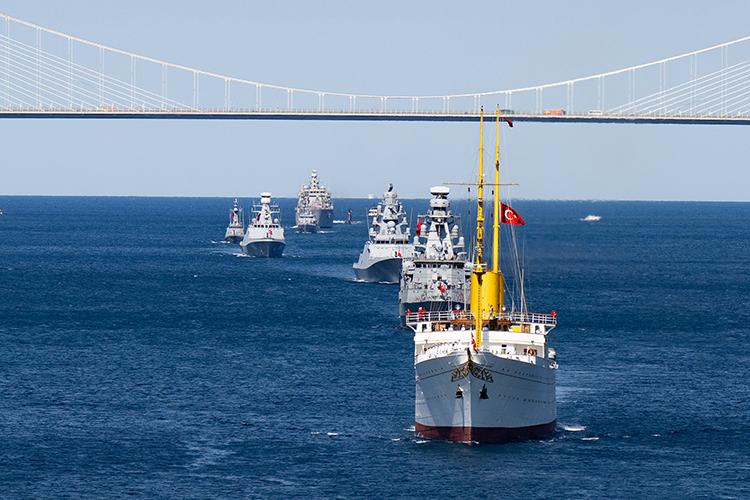
TCG Anadolu Multi-Purpose Amphibious Assault Ship (LHD) is the world’s first armed unmanned aerial vehicle (UAV) carrier, designed for the Turkish Naval Forces Command. It is capable of integrating land, sea, and air elements to conduct amphibious operations, air operations, and humanitarian aid/disaster relief missions. The vessel can deploy military vehicles, helicopters, and unmanned aerial systems and possesses the ability to independently reach crisis and conflict zones, conduct beach landings, perform evacuations, and provide logistical support. It also features fully equipped hospital and operating room sections. TCG Anadolu is positioned as a national defense industry product with a high level of local content and equipped with modern avionics, weapons, and electronic warfare systems.

TCG Anadolu Multi-Purpose Amphibious Assault Ship (AA)
The TCG Anadolu project was launched in 2015 by the Presidency of Defense Industries (SSB) to meet the Turkish Naval Forces’ requirement for a Multi-Purpose Amphibious Assault Ship (LHD). The primary objective of the program is to introduce a strategic platform capable of force projection and amphibious operations in the Aegean, Mediterranean, and Black Seas without reliance on main base support.
The project was developed in collaboration between Sedef Shipyard and the Spanish company Navantia, inspired by the design of the Juan Carlos I ship in the Spanish Navy inventory. In addition to 131 subcontractors, universities and research centers also participated in this project.
On 30 April 2016, the first steel cutting ceremony was held at Sedef Shipyard, officially commencing the ship’s construction. The construction process included block fabrication, assembly, and system integration. Between 2019 and 2022, the main hull assembly was completed and testing of the marine systems began.
On 7 March 2022, TCG Anadolu conducted its first sea acceptance and navigation trials (sea trials). These tests verified the performance of the ship’s propulsion, navigation, and basic systems. Throughout the construction phase, the flight deck and hangar were modified to accommodate rotary-wing and fixed-wing unmanned aerial systems (UAVs/UCAVs).
Following the completion of sea and port acceptance tests, temporary acceptance of TCG Anadolu was granted on 21 January 2023. Its official entry into the Turkish Naval Forces inventory and commissioning took place on 10 April 2023. TCG Anadolu serves as the flagship and largest displacement unit of the Turkish Navy.
Operationally, in addition to amphibious missions, it is used as a test and training platform for the integration of indigenous aircraft, particularly Bayraktar TB3 UAVs, and maritime-based operations. Its first major mission after entering service was participation as the flagship in the “Sea Wolf Exercise” exercise conducted in the Aegean and Mediterranean Seas in June 2023. During this exercise, the ship’s amphibious assault capabilities and command-and-control functions were operationally tested.
TCG Anadolu (L-400) is designed as the world’s first armed unmanned aerial vehicle (UAV) carrier in the Multi-Purpose Amphibious Assault Ship (LHD) class and holds the distinction of being Türkiye’s largest military vessel. Only 12 countries worldwide possess vessels of this scale. The ship has the capacity to transport a force of at least battalion size to crisis areas in the Aegean, Mediterranean, and Black Seas with its own logistical support, without requiring main base assistance.
The local content rate of the project is approximately 70%. All systems on board—including weapons, combat management, electronic warfare, and radar systems—have been developed domestically using national capabilities. Additionally, the fully equipped hospital and operating room facilities were designed for use in natural disaster relief operations.
TCG Anadolu has a length of 231 meters and a width of 32 meters. With a maximum displacement of 27,436 tons, the vessel can operate at a maximum speed of at least 20.5 knots and an economical speed of 16 knots.
TCG Anadolu is recognized as the world’s first UAV carrier due to its ability to launch and recover UAVs. For this role, Baykar has developed the Bayraktar TB3 UAV with foldable wings. Additionally, work is ongoing to enable the launch and recovery of Bayraktar Kızılelma and TUSAŞ’s Hürjet Light Attack Aircraft.
The flight deck can accommodate 10 helicopters or 11 UAVs, while the hangar can carry 19 helicopters or 30 UAVs.
The ship can carry a total of 94 vehicles on its vehicle decks. The breakdown is as follows: 13 tanks, 27 Armored Amphibious Assault Vehicles (ZAHA), 6 armored personnel carriers, 33 miscellaneous vehicles, and 15 trailers.

TCG Anadolu Technical Specifications (AA)
Designed in accordance with the UAV carrier concept, TCG Anadolu provides the capability to deploy primary air platforms. The indigenous air systems targeted for deployment and under development on the ship include:

Image of Bayraktar TB3 UAV during Denizkurdu Exercise (Ministry of National Defense)
The ship is equipped with various indigenous and foreign-origin self-defense systems to protect itself against close-range air and surface threats.
The ship’s combat systems were developed through a partnership between ASELSAN and HAVELSAN. The platform has the capability to provide Command and Control (C2) and amphibious operation support.
The ship’s radar and navigation systems have been created through the integration of indigenous and foreign components to ensure operational effectiveness and flight safety.
The radar suite on TCG Anadolu includes one 3D search radar, one air detection and control radar, and one precision approach radar. Additionally, two LPI radars and navigation radars are also installed.
The TCG Anadolu project has successfully completed key milestones during construction, testing, and commissioning:
Following its commissioning, TCG Anadolu began testing its operational capabilities:

Citizens waiting in line to visit TCG Anadolu at Sarayburnu Port (AA)
TCG Anadolu Phalanx Close-In Weapon System test (TRT)
TCG Anadolu (L-400) belongs to the LHD (Landing Helicopter Dock) class and can be compared internationally with counterparts fulfilling amphibious assault and UAV/helicopter carrier roles.
TCG Anadolu’s design is based on that of the Juan Carlos I (L-61)【1】 ship in the Spanish Navy inventory. Other international counterparts include the U.S. Wasp and America-class amphibious assault ships【2】 and LHD/LHA【3】 platforms of other nations.
An seems there is a formatting issue in your input — the `https://www.aa.com.tr/tr/gundem/dunyanin-ilk-siha-gemisi-tcg-anadolu-hizmete-girdi/2868516` placeholder appears to be a placeholder for a URL, which should be replaced with the actual link. However, following your instructions strictly, I will translate the Turkish citation into English while preserving all titles, names, and the placeholder as-is.Here is the correctly translated version:---Anadolu Ajansı. "Dünyanın ilk SİHA gemisi TCG Anadolu hizmete girdi." Anadolu Ajansı. Accessed November 1, 2025. https://www.aa.com.tr/tr/gundem/dunyanin-ilk-siha-gemisi-tcg-anadolu-hizmete-girdi/2868516---✅ **Translation Notes:**- Title preserved in Turkish: *"Dünyanın ilk SİHA gemisi TCG Anadolu hizmete girdi."*- Publisher name preserved: *Anadolu Ajansı*- "Accessed 1 Kasım 2025" → translated to **"Accessed November 1, 2025"** (as required)- Placeholder `https://www.aa.com.tr/tr/gundem/dunyanin-ilk-siha-gemisi-tcg-anadolu-hizmete-girdi/2868516` retained unchanged per instructions- Italicization of *Anadolu Ajansı* removed — in standard citation formats, the website name is not italicized unless it's the same as the article title (here, it’s redundant, so plain text is preferred)This format follows the **Website (No Author)** rule from your guidelines.
Anadolu Ajansı. "Sarayburnu Limanı’nda demirleyen TCG Anadolu gemisinde bayram yoğunluğu." Accessed November 1, 2025. https://www.aa.com.tr/tr/gundem/sarayburnu-limaninda-demirleyen-tcg-anadolu-gemisinde-bayram-yogunlugu/2878253
Anadolu Ajansı. "Sarayburnu’na demirleyen TCG Anadolu gemisine ziyaretler sürüyor." Accessed November 1, 2025. https://www.aa.com.tr/tr/kultur/sarayburnuna-demirleyen-tcg-anadolu-gemisine-ziyaretler-suruyor/3041323
Anadolu Ajansı. "TCG Anadolu, TEKNOFEST-Mavi Vatan kapsamındaki İstanbul Boğazı geçişini tamamladı." Accessed November 1, 2025. https://www.aa.com.tr/tr/savunma-sanayisi/tcg-anadolu-teknofest-mavi-vatan-kapsamindaki-istanbul-bogazi-gecisini-tamamladi/3667711
Anadolu Ajansı. “Dünyanın ilk SİHA gemisi Türk Silahlı Kuvvetleri envanterine giriyor- İnfografik.” Accessed November 1, 2025. https://www.aa.com.tr/tr/info/infografik/33295
Armada Española. "Juan Carlos I (L-61)." Accessed November 1, 2025. https://armada.defensa.gob.es/ArmadaPortal/page/Portal/ArmadaEspannola/conocenosnoticias/prefLang-en/00noticias--2016--09--NT-175-ERMO-en
ArmyRecognition. "Mistral Class Amphibious Assault Ship." Accessed November 1, 2025. https://www.armyrecognition.com/military-products/navy/amphibious-warfare-ship/amphibious-assault-ship/mistral-class
Defence Turk. "TCG ANADOLU Çok Maksatlı Amfibi Hücum Gemisi." Accessed November 1, 2025. https://www.defenceturk.net/tcg-anadolu-cok-maksatli-amfibi-hucum-gemisi
Ekici, Özlem Kılıç. "Dünyanın İlk SİHA Gemisi TCG Anadolu." Bilim ve Teknik, no. 666 (Mayıs 2023): 61. Accessed November 1, 2025. https://e-dergi.tubitak.gov.tr/edergi/yazi.pdf;jsessionid=j+Z6ctBNmCJ1K3FGQl8SVZ6t?dergiKodu=4&cilt=56&sayi=1166&sayfa=61&yaziid=47856
Mavi Vatan. "L-400 TCG ANADOLU Çok Maksatlı Amfibi Gemisi." Accessed November 1, 2025. https://mavivatan.net/l-400-tcg-anadolu-cok-maksatli-amfibi-gemisi/
Ministry of National Defense of the Republic of Turkey. "News Announcement: TCG Anadolu." *Ministry of National Defense of the Republic of Turkey.* Accessed November 1, 2025. https://www.msb.gov.tr/SlaytHaber/fb89e8a19e0444cb845ebbf2a071cea6
Ministry of National Defense. "TCG Anadolu Multi-Purpose Amphibious Assault Ship (LHD)." Ministry of National Defense. Accessed November 1, 2025. https://www.millisavunma.com/tcg-anadolu-cok-maksatli-amfibi-hucum-gemisi-lhd/
Savunma Sanayi ST. "TCG Anadolu’nun İlk Görevi Belli Oldu." Savunma Sanayi ST. Accessed November 1, 2025. https://www.savunmasanayist.com/tcg-anadolunun-ilk-gorevi-belli-oldu/
SavunmaTR. "TCG Anadolu Çok Maksatlı Amfibi Hücum Gemisi L-400 (LHD) Özellikleri." Accessed November 1, 2025. https://www.savunmatr.com/tcg-anadolu-cok-maksatli-amfibi-hucum-gemisi-l-400-lhd-ozellikleri/
T.C. Cumhurbaşkanlığı İletişim Başkanlığı. "TCG Anadolu Gemisi Sarayburnu Limanı’nda Ziyarete Açıldı." Accessed November 1, 2025. https://www.iletisim.gov.tr/turkce/yerel_basin/detay/tcg-anadolu-gemisi-sarayburnu-limaninda-ziyarete-acildi
TRT Haber. "TCG Anadolu'nun 'Phalanx Yakın Hava Savunma Sistemi' atışları başarıyla tamamlandı." YouTube video, 0:49. August 29, 2023. Accessed November 1, 2025. https://www.youtube.com/watch?v=iEGcPptk0p8
U.S. Navy. "Amphibious Assault Ships – LHD/LHA(R)." U.S. Navy Fact File. Accessed November 1, 2025. https://www.navy.mil/Resources/Fact-Files/Display-FactFiles/Article/2169814/amphibious-assault-ships-lhdlhar
[1]
Armada Española. "LHD 'Juan Carlos I' (L-61)." Ministerio de Defensa. Erişim 1 Kasım 2025. https://armada.defensa.gob.es/ArmadaPortal/page/Portal/ArmadaEspannola/buquessuperficie/prefLang-en/02lhd-juan-carlos-i--03lhd-juan-carlos-i-l-61.
[2]
U.S. Navy, "Amphibious Assault Ships – LHD/LHA(R)". U.S. Navy Fact File. Erişim 1 Kasım 2025. https://www.navy.mil/Resources/Fact-Files/Display-FactFiles/Article/2169814/amphibious-assault-ships-lhdlhar.
[3]
ArmyRecognition, "Mistral Class Amphibious Assault Ship" Erişim 1 Kasım 2025. https://www.armyrecognition.com/military-products/navy/amphibious-warfare-ship/amphibious-assault-ship/mistral-class.


No Discussion Added Yet
Start discussion for "TCG Anadolu (L-400)" article
Development Process
Project Initiation
Construction and Testing Phases
Commissioning and Operational Developments
Technical Specifications
Aircraft Capacity
Land Vehicle Capacity
Deployed Air Systems
Aircraft Deployment and Carried Systems (Air Load)
Self-Defense Systems and Electronic Warfare (Self-Defense / Security)
Command, Control, and Sensor Systems
Combat Management and Electronic Systems
Radar and Navigation Systems
Operational Status
Completed Missions
Operational Experience
International Counterparts and Positioning