


Bu içerik Türkçe olarak yazılmış olup yapay zeka ile otomatik olarak İngilizceye çevrilmiştir.

If you were to picture Gaziantep, you would likely imagine a loom, a sack of spices, or a copper cezve. When you think of Diyarbakır, you might picture its walls, basalt stone, or perhaps watermelon. These images are not wrong.
But they show none of the region’s fastest-growing export categories over the last decade. That category does not sit on shelves, is not loaded onto trucks, and does not go to the port. It crosses borders with an invoice: software.
Below, we will examine the data behind this picture, the economic logic behind it, the legislation that made it possible, and—without exaggeration—its limits.
The fastest way to understand where a region’s economic identity is shifting is to look at who is located in its technology development zones. According to the official list of the Ministry of Industry and Technology, there are six technology development zones in Southeastern Anatolia: those at Gaziantep University and Gaziantep Organized Industrial Zone, as well as those within Dicle, Harran, Batman, and Adıyaman universities【1】.
When we examine the distribution of companies within these zones, an unexpected picture emerges.
As of December 2025, 80 companies operate in Dicle Technopark, 60 of which work in information technology【2】. That is three quarters.
The technopark is operating at 100 percent capacity and employs 500 people within its companies【3】. Chemistry, energy, medical electronics, and agricultural technology are also among its areas of activity; but the numerical weight is unquestionably in information technology.
A similar trend exists in Gaziantep Teknopark. According to data published in April 2021, of the 108 companies in the technopark, software and information technology lead with 62 percent. Electrical-electronic and machinery account for 10 percent, energy for 5 percent, environment for 4 percent, and textile only 3 percent【4】.
Stop and read that last sentence again. In one of Turkey’s textile capitals, within its technology development zone, textile companies account for just three percent.
This is not a data error. It is a sign that the region’s technology production has developed along a path largely independent of its traditional industry. The same trend emerging in two different cities, in different years, is no longer coincidence.
Why? There is no romantic explanation, but there is a very clear economic one.
A classic manufacturing investment considers three factors when choosing a location: proximity to raw materials, energy costs, and access to markets. Historically, Southeastern Anatolia has been at a disadvantage in the third of these.
A container produced in the region must be transported by road to İskenderun or Mersin for export. Every kilometer adds cost; every transfer extends delivery time. This is not a problem of quality for producers in the region; it is a problem of geography.
Software completely escapes this equation. It has no raw material, no warehouse, and no physical cargo subject to customs declarations.
When you break down the cost structure of a software company, you find almost one single item: personnel. Office rent and server expenses exist, of course, but their share of total costs is small.
This creates a dual advantage for the region. First, production costs are independent of logistics. Second, the lower cost of living—and therefore wage levels—compared to major metropolitan areas means the same work can be done at a more competitive price.
When writing this as an advantage, caution is needed: low wages are not a sustainable competitive advantage. A skilled software engineer will relocate if they see a wage gap. Sustainable advantage comes not from wage levels but from the ecosystem that keeps people there.
Another feature of software is that the same team can serve two markets at once. On one hand, solutions can be developed for regional problems; on the other, the same office can sell to the world.
A textile workshop needs customs consultants, transportation agreements, and storage chains to begin exporting. A software company needs none of these.
There are very few high-value-added industries that are not penalized by geographic disadvantage; software leads them all. A line of code written in Diyarbakır is just as distant to a buyer in Frankfurt as one written in Istanbul.
This regional picture is part of a larger national trend.
According to data published by the Ministry of Trade’s Easy Export Platform, Türkiye’s information technology and software exports were approximately $432 million in 2012. This amount rose to $3.87 billion in 2023, $5.33 billion in 2024, and $5.5 billion in 2025【5】.
That is more than a tenfold increase in dollar terms over thirteen years. According to the same source, the sector’s size within Türkiye reached 1.2 trillion liras in 2024, growing 53 percent compared to the previous year【6】.
To understand the significance of this growth, a comparison is useful. In 2025, Türkiye achieved $122.6 billion in total service exports. Of this, $5.5 billion came from information technology and software, and $6.2 billion from education and health services【7】.
Thus, information technology is of the same scale as the combined total of education and health services in service exports. It is a category often overlooked because it lies in the shadow of tourism, yet it is growing quietly.
This national trend finds concrete expression in a single news story from the region.
Three companies operating in Dicle Technopark export the software they develop to more than seventy countries, including the United States, the United Kingdom, Germany, Australia, Russia, India, and China【8】.
The details here reveal the seriousness of the matter. The exported products are not template websites or simple mobile apps. According to Anadolu Agency, these products cover the following areas【9】:
Look at this list again. Banking security software is among the most sensitive products that enter a firm’s financial infrastructure; buyers evaluate the supplier not by geography but by audit history and technical competence.
Image processing and simulation are similarly math-intensive fields. The fact that these products can be exported from Diyarbakır shows that the region has not only low-cost labor but also accumulated expertise.
The same news report includes an assessment by Prof. Dr. Mehmet Akın, General Manager of Dicle Technopark, summarizing the current situation: with current capacity at 100 percent, “a second technopark is needed”【10】.
When an institution’s growth problem is no longer “we cannot find companies” but “there is no space left,” this is a good problem.
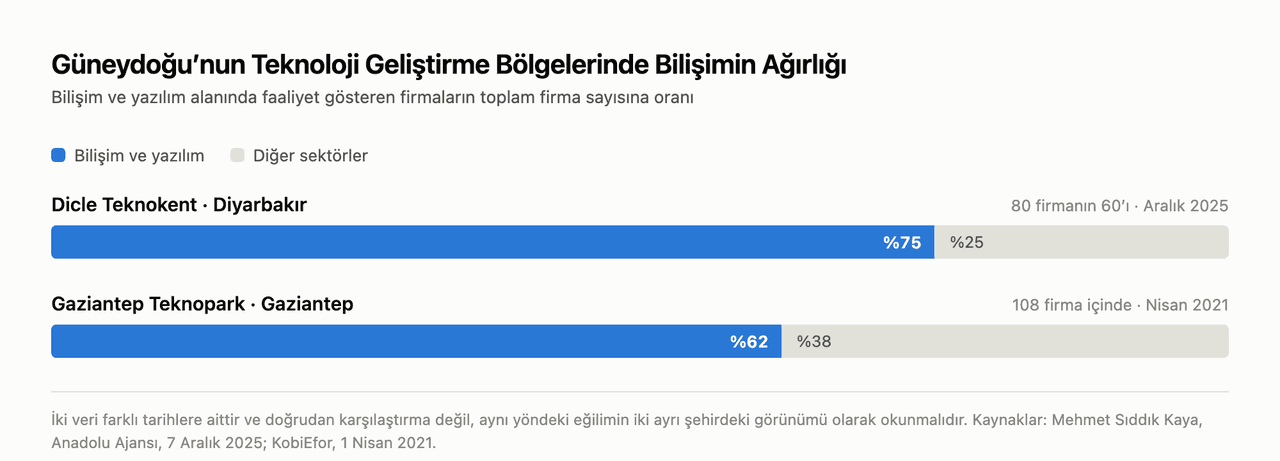
Share of information and software companies in the two technology development regions of Southeastern Türkiye. Chart prepared by the author; data: (Anadolu Ajansı, 7 December 2025) and (KobiEfor, 1 April 2021).
This picture did not emerge spontaneously. Behind it lies a twenty-five-year-old legal framework.
Technology development zones in Türkiye are regulated by Law No. 4691 on Technology Development Zones, adopted on 26 June 2001 and published in the Official Gazette on 7 July 2001【11】. The law defines these zones as areas where technological knowledge is generated, inventions are converted into commercial products, and “contribution is made to regional development through this means.”
Companies operating in these zones can benefit from the following incentives, provided they meet the conditions【12】:
The subtle point here is this: since a software company’s cost structure is almost entirely personnel, an incentive package that reduces tax and premium burdens on staff has the most direct impact on such firms. If the same incentives were offered to a steel plant, their share of total costs would be far smaller.
Thus, although Law 4691 does not distinguish between sectors, its incentive design structurally favors software.
Article 5 of the law requires that at least one university, higher technology institute, or public R&D center located within or in the same province as the zone must be among the founding entities of the management company【13】. This ties technoparks not by accident but by design to university campuses.
For software, this connection is especially valuable. The sector’s only real input is graduates; being right next to a computer engineering department means the raw material is at the door.
The location of Dicle Technopark within Dicle University’s campus and Gaziantep Teknopark within Gaziantep University’s campus is a direct consequence of this logic【14】【15】.
The law also includes a detail favorable to small firms. The number of support personnel eligible for income tax withholding incentives is normally capped at ten percent of the total R&D and design staff. However, a 2021 amendment allows this ratio to be raised to twenty percent for firms with total staff of up to fifteen【16】.
This means a newly established small software team can include its accounting or administrative support staff within the incentive scheme. For a five-person team, this difference is not negligible.
The least discussed but perhaps most important provision of the law for Southeastern Anatolia concerns where personnel work.
Generally, the income tax withholding incentive is tied to personnel physically working within the zone, and the management company is responsible for monitoring this. However, the law introduces exceptions【17】.
In cases where certain activities must be carried out outside the zone due to direct project requirements, the associated salaries can also be included under the incentive. Additionally, time spent outside the zone by personnel pursuing a master’s degree (up to one and a half years) or a doctorate (up to two years) is also covered【18】.
The most significant provision is this: beyond these exceptions, time spent outside the zone by personnel can still be counted under the incentive, provided it does not exceed twenty percent of the total number of personnel in the zone or the total incentive-eligible working hours【19】.
And the law continues: the President of the Republic is authorized to increase this twenty percent threshold “up to one hundred percent, depending on the designated regional and/or sectoral areas or professional groups”.【20】
Read this provision from the perspective of Southeastern Anatolia. The law contains a lever that can raise remote work incentives up to one hundred percent for specific regions. Since software is a product that can be produced remotely, it is the sector that can benefit most from this lever.
Thus, a new law may not be necessary for regional technological development; the question may simply be how to use an existing authority. This is not a blogger’s decision but a policymaker’s; yet we must first recognize that the tool is already in place.
The second opportunity software offers the region is not export but local problem-solving.
The size of the Southeastern Anatolia Project is, in itself, a data problem. According to 2024 data from the GAP Regional Development Administration, the area opened for irrigation has reached 675,250 hectares; this is 60.8 percent of the target of 1,111,355 hectares【21】.
According to the same data, 18 dams and 14 hydroelectric power plants have been completed in the region; annual production capacity is 20.6 billion kilowatt-hours, meeting 27.6 percent of the country’s hydropower production in 2024【22】. The main canal length is 1,496,265 meters【23】.
An irrigation and energy infrastructure of this scale inherently generates demand for software. You cannot manage the water distribution across 675,000 hectares, the maintenance of a canal network exceeding 1,400 kilometers, or the production planning of fourteen power plants using spreadsheets.
Remote sensing for plant health monitoring, irrigation optimization, yield forecasting, crop pattern planning: all of these are data and software tasks. And the engineer who understands this need best is likely the one who has seen the land.
The opportunity here is to produce solutions locally rather than import them from abroad. The inclusion of agricultural technology among the activities of firms in the region’s technoparks【24】 indicates a beginning in this direction.
This picture must also be positioned within a global context.
According to the Ministry of Trade’s sector analysis, the information and communication technology market reached $5 trillion in 2024 and is expected to grow at an average annual rate of 9 percent between 2025 and 2028【25】. The same analysis highlights three key trends【26】:
The common feature of these three areas is that none require a factory. All can be produced with skilled labor, electricity, and internet connectivity. In other words, growth is occurring precisely where geography becomes irrelevant.
A warning must be added: these projections are market forecasts, not certainties. They indicate direction, not guarantees.
What has been described so far is promising. But when examining data, one must avoid being selective.
Only three of the 80 companies in Dicle Technopark are engaged in exports【30】. This ratio shows that exports are not yet an ecosystem-wide behavior but the success of a few pioneering firms.
It is easy to generalize a success story. But presenting the work of three firms as if it represented the capacity of eighty is misreading the data. The right question is: what mechanism will enable the fourth, fifth, and tenth firms to do what these three have done?
Academic literature also calls for caution. The 2019 study by Şengür and Bayzin, which examined firms in a technology development zone, found that R&D budgets remain limited and that incentive mechanisms do not always generate the expected employment effects【31】.
The role of technoparks in local economic development cannot be reduced solely to tax exemptions. Küçük’s study on Gaziantep Teknopark evaluates their contribution to development in conjunction with local actor participation【32】.
In short, legislation provides the necessary condition but not the sufficient one.
Another constraint lies in the educational depth of personnel. According to April 2021 data from Gaziantep Teknopark, the educational level distribution of R&D personnel was as follows: 50 associate degree, 129 bachelor’s, 27 master’s, and 20 doctoral degrees【33】.
The combined proportion of master’s and doctoral graduates among total R&D personnel is approximately one-fifth. Thus, production is primarily carried out by personnel with bachelor’s-level technical qualifications.
This profile is sufficient for routine software development. But when we look at the export categories listed at the beginning of this article—image processing, simulation, banking security—it becomes clear that these fields require postgraduate-level expertise. For a region aiming to increase value-added output, the postgraduate ratio may be a more critical indicator than the number of firms.
The scale of the technoparks in the region also lags behind those in major national centers. Total employment in Dicle Technopark is 500 people【34】; according to April 2021 data, Gaziantep Teknopark had 226 R&D personnel and 30 technical and support staff【35】.
These are not signs of failure. But it is still too early to say “Southeastern Anatolia has become a software hub.” The accurate statement is: software has become dominant in the region’s technology production, and this production is beginning to turn into exports.
This article is not a policy document; but the data points to several directions:
Southeastern Anatolia’s software exports have not yet generated large figures. Three firms represent a small minority among eighty; 500 jobs, when compared to the region’s population, are modest.【39】
But the direction is clear. An industry that requires no raw materials or logistics, whose only input is skilled labor, and that is not penalized by geographic disadvantage, now dominates the region’s technology development zones. In Gaziantep, it is 62 percent; in Diyarbakır, 75 percent.【40】【41】
The geographic spread of the National Technology Initiative may well be exactly this: ensuring high-tech production is not concentrated in a single city, keeping the value created where it is produced, and allowing the product to cross borders with an invoice.
The next time you think of Gaziantep or Diyarbakır, add a screen next to the loom and the walls. Just because it is invisible does not mean it is not there.
Kaya, Mehmet Sıddık. "Dicle Teknokent'ten 70'i Aşkın Ülkeye Yazılım Alanında İhracat." Anadolu Ajansı, December 7, 2025. Accessed September 2, 2026.https://www.aa.com.tr/tr/bilim-teknoloji/dicle-teknokentten-70i-askin-ulkeye-yazilim-alaninda-ihracat/3764273
KobiEfor. "Gaziantep Teknopark'tan Yüksek Katma Değerli, İnovatif Ürünler." April 1, 2021. Accessed September 2, 2026.https://www.kobi-efor.com.tr/gaziantep-teknoparktan-yuksek-katmadegerli-inovatif-urunler
Küçük, Nahide. "Yerel Ekonomik Kalkınmada Yeni Bir Açılım: Teknoparklar (Gaziantep Teknopark Örneği)." Master's thesis,Niğde Üniversitesi Institute of Social Sciences, 2010.YÖK Ulusal Thesis Center, Thesis No: 262033.
Mevzuat. "Teknoloji Geliştirme Bölgeleri Kanunu." Kanun No. 4691. Date Enacted: June 26, 2001. July 6, 2001, no. 24454. Accessed September 2, 2026.https://www.mevzuat.gov.tr/mevzuatmetin/1.5.4691.pdf
T.C. Ministry of Industry and Technology. "TGB Listesi." Technology Development Zones Portal. Accessed September 2, 2026.https://teknopark.sanayi.gov.tr/Home/TgbListesi
T.C. Ministry of Trade. "Yazılım ve Bilişim Sektör Analizi." Kolay İhracat Platformu. Accessed September 2, 2026.https://www.kolayihracat.gov.tr/sektorler/yazilim-ve-bilisim
T.C.GAP Bölge Development Administration. "GAP'ta Son Durum." gap.gov.tr. Accessed September 2, 2026.
Şengür, Mehmet, and Sinem Bayzin. "Üniversite Sanayi İşbirliğinde Teknoparkların Rolü." *Ekonomik ve Sosyal Araştırmalar Dergisi* 15, no. 3 (2019): 299–313. Accessed September 2, 2026.https://dergipark.org.tr/tr/pub/esad/article/629618
[1]
T.C. Sanayi ve Teknoloji Bakanlığı, "TGB Listesi," Teknoloji Geliştirme Bölgeleri Portalı, erişim 2 Eylül 2026, https://teknopark.sanayi.gov.tr/Home/TgbListesi.
[2]
Mehmet Sıddık Kaya, "Dicle Teknokent'ten 70'i Aşkın Ülkeye Yazılım Alanında İhracat," Anadolu Ajansı, December 7, 2025, Accessed September 2, 2026.https://www.aa.com.tr/tr/bilim-teknoloji/dicle-teknokentten-70i-askin-ulkeye-yazilim-alaninda-ihracat/3764273
[3]
Mehmet Sıddık Kaya, "Dicle Teknokent'ten 70'i Aşkın Ülkeye Yazılım Alanında İhracat," Anadolu Ajansı, December 7, 2025, Accessed September 2, 2026.https://www.aa.com.tr/tr/bilim-teknoloji/dicle-teknokentten-70i-askin-ulkeye-yazilim-alaninda-ihracat/3764273
[4]
KobiEfor. "Gaziantep Teknopark'tan Yüksek Katma Değerli, İnovatif Ürünler." April 1, 2021. Accessed September 2, 2026.
[5]
T.C. Ticaret Bakanlığı, "Yazılım ve Bilişim Sektör Analizi," Kolay İhracat Platformu, erişim 2 Eylül 2026, https://www.kolayihracat.gov.tr/sektorler/yazilim-ve-bilisim.
[6]
T.C. Ticaret Bakanlığı, "Yazılım ve Bilişim Sektör Analizi," Kolay İhracat Platformu, erişim 2 Eylül 2026, https://www.kolayihracat.gov.tr/sektorler/yazilim-ve-bilisim.
[7]
T.C. Ticaret Bakanlığı, "Yazılım ve Bilişim Sektör Analizi," Kolay İhracat Platformu, erişim 2 Eylül 2026, https://www.kolayihracat.gov.tr/sektorler/yazilim-ve-bilisim.
[8]
Mehmet Sıddık Kaya, "Dicle Teknokent'ten 70'i Aşkın Ülkeye Yazılım Alanında İhracat," Anadolu Ajansı, December 7, 2025, Accessed September 2, 2026.https://www.aa.com.tr/tr/bilim-teknoloji/dicle-teknokentten-70i-askin-ulkeye-yazilim-alaninda-ihracat/3764273
[9]
Mehmet Sıddık Kaya, "Dicle Teknokent'ten 70'i Aşkın Ülkeye Yazılım Alanında İhracat," Anadolu Ajansı, December 7, 2025, Accessed September 2, 2026.https://www.aa.com.tr/tr/bilim-teknoloji/dicle-teknokentten-70i-askin-ulkeye-yazilim-alaninda-ihracat/3764273
[10]
Mehmet Sıddık Kaya, "Dicle Teknokent'ten 70'i Aşkın Ülkeye Yazılım Alanında İhracat," Anadolu Ajansı, December 7, 2025, Accessed September 2, 2026.https://www.aa.com.tr/tr/bilim-teknoloji/dicle-teknokentten-70i-askin-ulkeye-yazilim-alaninda-ihracat/3764273
[11]
Mevzuat. "Teknoloji Geliştirme Bölgeleri Kanunu." Kanun No. 4691. Kabul Tarihi: 26 Haziran 2001. 6 Temmuz 2001, sayı 24454. Erişim 2 Eylül 2026. https://www.mevzuat.gov.tr/mevzuatmetin/1.5.4691.pdf.
[12]
Mevzuat. "Teknoloji Geliştirme Bölgeleri Kanunu." Kanun No. 4691. Kabul Tarihi: 26 Haziran 2001. 6 Temmuz 2001, sayı 24454. Erişim 2 Eylül 2026. https://www.mevzuat.gov.tr/mevzuatmetin/1.5.4691.pdf.
[13]
Mevzuat. "Teknoloji Geliştirme Bölgeleri Kanunu." Kanun No. 4691. Kabul Tarihi: 26 Haziran 2001. 6 Temmuz 2001, sayı 24454. Erişim 2 Eylül 2026. https://www.mevzuat.gov.tr/mevzuatmetin/1.5.4691.pdf.
[14]
Mehmet Sıddık Kaya, "Dicle Teknokent'ten 70'i Aşkın Ülkeye Yazılım Alanında İhracat," Anadolu Ajansı, December 7, 2025, Accessed September 2, 2026.https://www.aa.com.tr/tr/bilim-teknoloji/dicle-teknokentten-70i-askin-ulkeye-yazilim-alaninda-ihracat/3764273
[15]
KobiEfor. "Gaziantep Teknopark'tan Yüksek Katma Değerli, İnovatif Ürünler." April 1, 2021. Accessed September 2, 2026.
[16]
Mevzuat. "Teknoloji Geliştirme Bölgeleri Kanunu." Kanun No. 4691. Kabul Tarihi: 26 Haziran 2001. 6 Temmuz 2001, sayı 24454. Erişim 2 Eylül 2026. https://www.mevzuat.gov.tr/mevzuatmetin/1.5.4691.pdf.
[17]
Mevzuat. "Teknoloji Geliştirme Bölgeleri Kanunu." Kanun No. 4691. Kabul Tarihi: 26 Haziran 2001. 6 Temmuz 2001, sayı 24454. Erişim 2 Eylül 2026. https://www.mevzuat.gov.tr/mevzuatmetin/1.5.4691.pdf.
[18]
Mevzuat. "Teknoloji Geliştirme Bölgeleri Kanunu." Kanun No. 4691. Kabul Tarihi: 26 Haziran 2001. 6 Temmuz 2001, sayı 24454. Erişim 2 Eylül 2026. https://www.mevzuat.gov.tr/mevzuatmetin/1.5.4691.pdf.
[19]
Mevzuat. "Teknoloji Geliştirme Bölgeleri Kanunu." Kanun No. 4691. Kabul Tarihi: 26 Haziran 2001. 6 Temmuz 2001, sayı 24454. Erişim 2 Eylül 2026. https://www.mevzuat.gov.tr/mevzuatmetin/1.5.4691.pdf.
[20]
Mevzuat. "Teknoloji Geliştirme Bölgeleri Kanunu." Kanun No. 4691. Kabul Tarihi: 26 Haziran 2001. 6 Temmuz 2001, sayı 24454. Erişim 2 Eylül 2026. https://www.mevzuat.gov.tr/mevzuatmetin/1.5.4691.pdf.
[21]
T.C. GAP Regional Development Administration. "GAP'ta Son Durum." gap.gov.tr, Accessed September 2, 2026.
[22]
T.C. GAP Regional Development Agency. "GAP'ta Son Durum." gap.gov.tr, Accessed September 2, 2026.
[23]
T.C. GAP Regional Development Agency. "GAP'ta Son Durum." gap.gov.tr, Accessed September 2, 2026.
[24]
Mehmet Sıddık Kaya, "Dicle Teknokent'ten 70'i Aşkın Ülkeye Yazılım Alanında İhracat," Anadolu Ajansı, December 7, 2025, Accessed September 2, 2026.https://www.aa.com.tr/tr/bilim-teknoloji/dicle-teknokentten-70i-askin-ulkeye-yazilim-alaninda-ihracat/3764273
[25]
T.C. Ticaret Bakanlığı, "Yazılım ve Bilişim Sektör Analizi," Kolay İhracat Platformu, erişim 2 Eylül 2026, https://www.kolayihracat.gov.tr/sektorler/yazilim-ve-bilisim.
[26]
T.C. Ticaret Bakanlığı, "Yazılım ve Bilişim Sektör Analizi," Kolay İhracat Platformu, erişim 2 Eylül 2026, https://www.kolayihracat.gov.tr/sektorler/yazilim-ve-bilisim.
[27]
T.C. Ticaret Bakanlığı, "Yazılım ve Bilişim Sektör Analizi," Kolay İhracat Platformu, erişim 2 Eylül 2026, https://www.kolayihracat.gov.tr/sektorler/yazilim-ve-bilisim.
[28]
T.C. Ticaret Bakanlığı, "Yazılım ve Bilişim Sektör Analizi," Kolay İhracat Platformu, erişim 2 Eylül 2026, https://www.kolayihracat.gov.tr/sektorler/yazilim-ve-bilisim.
[29]
T.C. Ticaret Bakanlığı, "Yazılım ve Bilişim Sektör Analizi," Kolay İhracat Platformu, erişim 2 Eylül 2026, https://www.kolayihracat.gov.tr/sektorler/yazilim-ve-bilisim.
[30]
Mehmet Sıddık Kaya, "Dicle Teknokent'ten 70'i Aşkın Ülkeye Yazılım Alanında İhracat," Anadolu Ajansı, December 7, 2025, Accessed September 2, 2026.https://www.aa.com.tr/tr/bilim-teknoloji/dicle-teknokentten-70i-askin-ulkeye-yazilim-alaninda-ihracat/3764273
[31]
Mehmet Şengür ve Sinem Bayzin, "Üniversite Sanayi İşbirliğinde Teknoparkların Rolü," Ekonomik ve Sosyal Araştırmalar Dergisi 15, sayı 3 (2019): 299–313, erişim 2 Eylül 2026, https://dergipark.org.tr/tr/pub/esad/article/629618.
[32]
Nahide Küçük, "Yerel Ekonomik Kalkınmada Yeni Bir Açılım: Teknoparklar (Gaziantep Teknopark Örneği)" (yüksek lisans tezi, Niğde Üniversitesi Sosyal Bilimler Enstitüsü, 2010), YÖK Ulusal Tez Merkezi, Tez No. 262033.
[33]
"Gaziantep Teknopark'tan Yüksek Katma Değerli, İnovatif Ürünler," KobiEfor, April 1, 2021, Accessed September 2, 2026.https://www.kobi-efor.com.tr/gaziantep-teknoparktan-yuksek-katmadegerli-inovatif-urunler.
[34]
Mehmet Sıddık Kaya, "Dicle Teknokent'ten 70'i Aşkın Ülkeye Yazılım Alanında İhracat," Anadolu Ajansı, December 7, 2025, Accessed September 2, 2026.https://www.aa.com.tr/tr/bilim-teknoloji/dicle-teknokentten-70i-askin-ulkeye-yazilim-alaninda-ihracat/3764273
[35]
KobiEfor. "Gaziantep Teknopark'tan Yüksek Katma Değerli, İnovatif Ürünler." April 1, 2021. Accessed September 2, 2026.
[36]
Mehmet Sıddık Kaya, "Dicle Teknokent'ten 70'i Aşkın Ülkeye Yazılım Alanında İhracat," Anadolu Ajansı, December 7, 2025, Accessed September 2, 2026.https://www.aa.com.tr/tr/bilim-teknoloji/dicle-teknokentten-70i-askin-ulkeye-yazilim-alaninda-ihracat/3764273
[37]
Mevzuat. "Teknoloji Geliştirme Bölgeleri Kanunu." Kanun No. 4691. Kabul Tarihi: 26 Haziran 2001. 6 Temmuz 2001, sayı 24454. Erişim 2 Eylül 2026. https://www.mevzuat.gov.tr/mevzuatmetin/1.5.4691.pdf.
[38]
T.C. GAP Regional Development Agency. "GAP'ta Son Durum." gap.gov.tr, Accessed September 2, 2026.
[39]
Mehmet Sıddık Kaya, "Dicle Teknokent'ten 70'i Aşkın Ülkeye Yazılım Alanında İhracat," Anadolu Ajansı, December 7, 2025, Accessed September 2, 2026.https://www.aa.com.tr/tr/bilim-teknoloji/dicle-teknokentten-70i-askin-ulkeye-yazilim-alaninda-ihracat/3764273
[40]
KobiEfor. "Gaziantep Teknopark'tan Yüksek Katma Değerli, İnovatif Ürünler." April 1, 2021. Accessed September 2, 2026.
[41]
Mehmet Sıddık Kaya, "Dicle Teknokent'ten 70'i Aşkın Ülkeye Yazılım Alanında İhracat," Anadolu Ajansı, December 7, 2025, Accessed September 2, 2026.https://www.aa.com.tr/tr/bilim-teknoloji/dicle-teknokentten-70i-askin-ulkeye-yazilim-alaninda-ihracat/3764273
An Unexpected Ratio
Three Quarters in Diyarbakır
Textile’s Share in Gaziantep Is Three Percent
Software Has No Geography
The Raw Material, Port, and Logistics Equation
The Entire Cost Is Human
From the Same Office, to Local and Global Markets
From $432 Million to $5.5 Billion
Thirteen Years of Growth
Its Place in Service Exports
From Diyarbakır to Seventy Countries
What Kind of Software Is Being Exported
A Second Technopark Is Needed
The Legal Framework That Made This Possible
Law 4691 and Four Incentives
The Meaning of Being Next to a University
Flexibility for Small Teams
The Geographic Lever Within the Law
Time Spent Outside the Zone
From Twenty Percent to One Hundred Percent
The Region’s Own Problems, the Region’s Own Software
The Scale of GAP
From Water to Data
Where Is the World Headed
Cloud, Artificial Intelligence, and Digital Twins
The Other Side of the Medal
Three Companies, Eighty Companies
Are Incentives Always Enough
The Profile of Human Resources
The Scale Problem
What Can Be Done
Conclusion: Quiet but Real