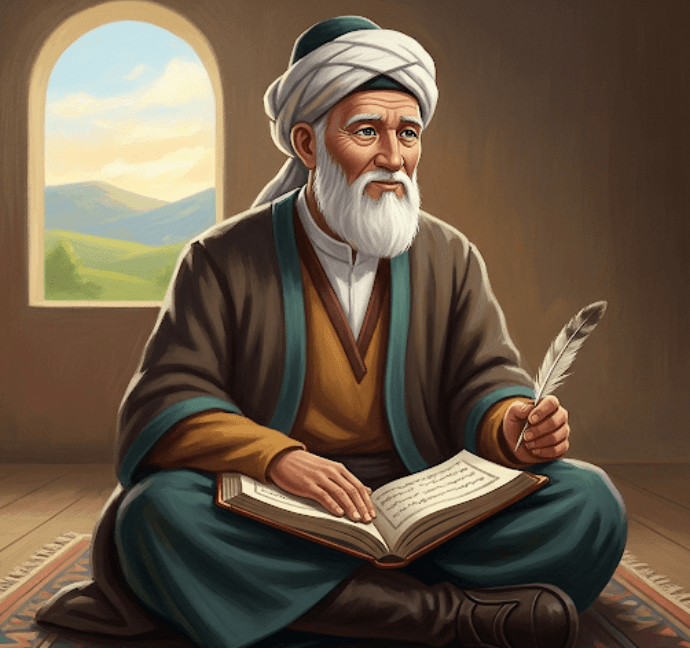




A Leader in the Light of Wisdom: Ahmed Yesevi
A Leader in the Light of Wisdom: Ahmed Yesevi
Hello! Have you ever thought about the kindness, beauty, and right conduct in our lives? Long ago, a wise figure conveyed exactly these values through his poetry and sayings. This wise man’s name is Ahmed Yesevi. He is regarded as one of the most important spiritual leaders of the Turkic world.
(Generated by artificial intelligence.)
Who is Ahmed Yesevi?
Ahmed Yesevi was born in the late 11th century in a place called Sayram, in what is now the territory of Kazakhstan. He lost both his mother and father at an early age. This loss led him to the side of prominent scholars of his time, such as Arslan Baba, where he devoted himself to the pursuit of knowledge. Later, he traveled to Bukhara and studied under Yusuf Hamedani, deepening his understanding further.
Ahmed Yesevi taught the newly Islamizing Turkic tribes the teachings of Islam in their own language, in a way they could easily understand. He showed them that religion was not merely a set of rules, but also encompassed values such as love, tolerance, and kindness. Those who followed his path came to be known as “Yesevis,” and a distinct spiritual path called Yesevism emerged.
The Birth of Yesevism
Ahmed Yesevi did not keep the knowledge and spiritual values he acquired to himself. During his time, he communicated these values to the Turkic tribes newly embracing Islam, using a language they could easily comprehend. He taught people that religion was not only about rituals and laws, but also about virtues such as love, tolerance, humility, and compassion. His teachings spread rapidly among the Turkic peoples. Those who followed his path were called “Yesevis,” and a spiritual path known as Yesevism emerged. This path had a profound influence across a vast geographical area stretching from Central Asia to Anatolia.
(Generated by artificial intelligence.)
Divan-ı Hikmet: A Treasury Filled with Poetry
Ahmed Yesevi’s most important work is a book titled Dîvân-ı Hikmet. This book consists of poems known as hikmet. What is a hikmet? A hikmet is the profound meaning behind a saying or action—much like the justice underlying the rules of a game...
In these hikmets, Ahmed Yesevi taught people to be honest, generous, patient, and to do no harm to others. Because he wrote these poems in Turkish, many people in Central Asia were able to embrace his ideas easily. These poems traveled as far as Anatolia and became a source of inspiration for later sages such as Hacı Bektaş-ı Veli and Yunus Emre.
A Journey Through Time
Ahmed Yesevi lived approximately 900 years ago. During that era, cities such as Bukhara and Samarkand were among the most important centers of science and culture in the world. The printing press had not yet become widespread, so books were copied by hand. Ahmed Yesevi’s hikmets were passed from mouth to mouth and heart to heart until they reached our time. These teachings helped establish a shared cultural bond among the Turkic peoples of Central Asia.