


This article was automatically translated from the original Turkish version.
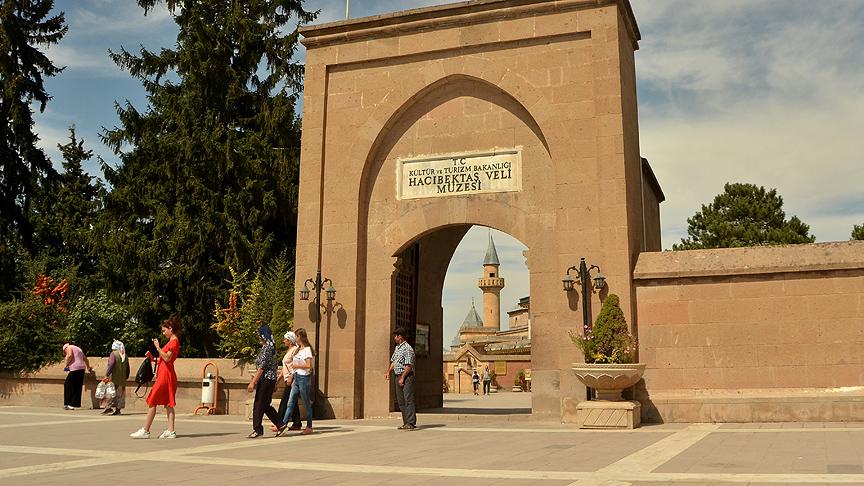
Hacı Bektaş Veli Külliyesi
Location | Hacıbektaş Türkiye Nevşehir | ||||||||
|---|---|---|---|---|---|---|---|---|---|
Establishment | 13th century (by Hacı Bektaş Veli) | ||||||||
Architectural Structure | Three-court complex (Aslanlı Çeşme, Aşevi, Türbe, Halvet Odası) | ||||||||
Status | Under UNESCO Intangible Cultural Heritage | ||||||||
Hacı Bektaş Veli Külliyesi is a historical and cultural complex founded in the 13th century by Hacı Bektaş Veli, who played a significant role in the Islamization of Anatolia and served as the center of the Bektashi order. Located in the Hacıbektaş district of Nevşehir Province, this site has become one of the foundational institutions of Anatolian Alevism, shaping its intellectual and social structure. During the Ottoman period, the complex expanded its political and social influence through its close association with the Janissary Corps.

Hacı Bektaş Veli Türbesi (Ministry of Culture and Tourism of the Republic of Türkiye)
Hacı Bektaş Veli’s arrival in Anatolia coincided with the aftermath of the Mongol invasions, which contributed to his rapid acceptance among the Turkmen populations of the region. Drawing from the tradition of Ahmad Yasawi and regarded among the Horasan Sufis, Hacı Bektaş Veli promoted an understanding of Islam rooted in tolerance, equality, and popular participation. After his death, a dergah was constructed to institutionalize his teachings and gradually became the central hub of Bektashism.
The Hacı Bektaş Veli Külliyesi is organized around three courtyards. The first courtyard contains the entrance and the Aslanlı Çeşme, a fountain that welcomes visitors. The second courtyard houses the guesthouse, communal kitchen, and various service rooms. The third courtyard, regarded as the most sacred, contains the tomb of Hacı Bektaş Veli, the Halvet Odası (Retreat Chamber), the Çilehane (Ascetic Chamber), and the tomb of Balım Sultan. The complex was built as a minimalist interpretation of classical Ottoman architecture, designed with a functional approach to create a mystical and instructional space.

Hacı Bektaş Veli Külliyesi II. Avlu (Ministry of Culture and Tourism of the Republic of Türkiye)
The institutional identity of the complex was significantly shaped in the 16th century through the contributions of Balım Sultan. He systematized the teachings of Bektashism, defined its hierarchy and rituals, and transformed the order into a formalized structure. During this period, the külliye became one of the most influential Alevi-Bektashi centers across Ottoman territories, with numerous affiliated tekkes established in both the Balkans and Anatolia.
Following the proclamation of the Republic and the enactment of the Law on the Closure of Tekkes, Zaviyes, and Türbes in 1925, the complex was officially closed and all religious activities within it were terminated. In 1964, the buildings were transferred to the Ministry of Culture and opened to the public as the “Hacı Bektaş Veli Museum.” Today, it is visited by both adherents of the Alevi-Bektashi faith and local and international tourists interested in cultural heritage.
The Hacı Bektaş Veli Külliyesi was inscribed on UNESCO’s Tentative List of World Heritage Sites on 13 April 2012 under the name “Hacı Bektaş Veli Külliyesi.” This inclusion affirms its universal value, historical significance, and its status as a cultural heritage site worthy of preservation.
In addition, the “Semah” ritual, closely associated with the philosophy of Hacı Bektaş Veli, was added to UNESCO’s Representative List of the Intangible Cultural Heritage of Humanity in 2010.
Today, the Hacı Bektaş Veli Dergâh continues to serve as an important symbol of cultural identity and social memory. The annual Hacı Bektaş Veli Commemoration Ceremonies and Cultural Events, held in August, function both as a religious pilgrimage and as a multicultural gathering. The külliye is widely recognized as one of the most significant contemporary representations of the Alevi-Bektashi belief system.
Anadolu Ajansı. "Hacı Bektaş Veli'nin öğretilerinin yaşatıldığı külliye." Accessed May 21, 2025. https://www.aa.com.tr/tr/kultur-sanat/haci-bektas-velinin-ogretilerinin-yasatildigi-kulliye-/1253578
Esenyurt Merkez Cemevi. "Hacı Bektaş Veli Dergâhı." Esenyurt Merkez Cemevi. Accessed May 21, 2025. https://esenyurtmerkezcemevi.org.tr/haci-bektas-veli-dergahi/
Kılınç, Aslıhan. “Hacı Bektaş Veli Dergâhı’nın Millî Mücadele’ye Desteği.” *HBV Dergisi* 101 (2022): 223–240. Accessed May 21, 2025. https://dergipark.org.tr/en/download/article-file/2390896
T.C.Hacıbektaş Kaymakamlığı Governorship. "Hacı Bektaş Veli Dergâhı ve Müzesi." Hacibektas.gov.tr. Accessed May 21, 2025. https://www.hacibektas.gov.tr
Türkiye Cumhuriyeti Kültür ve Turizm Bakanlığı. “Hacı Bektaş Velî Külliyesi (Dergâhı).” Yaşayan Miras ve Kültürel Etkinlikler Genel Müdürlüğü. Accessed May 21, 2025. https://yakegm.ktb.gov.tr/TR-12618/haci-bektas-veli-kulliyesi-dergahi.html
Türkiye UNESCO National Commission. "Somut Olmayan Kültürel Miras Listeleri." UNESCO Türkiye Millî Komisyonu. Accessed May 21, 2025.
Öz, Enes. “Hacı Bektaş Veli Dergâhı: Millî Mücadele’den Müzeye Geçiş Süreci.” Nevşehir Hacı Bektaş Veli Üniversitesi Açık Accessed Sistemi. Accessed May 21, 2025.

Hacı Bektaş Veli Külliyesi
Location | Hacıbektaş Türkiye Nevşehir | ||||||||
|---|---|---|---|---|---|---|---|---|---|
Establishment | 13th century (by Hacı Bektaş Veli) | ||||||||
Architectural Structure | Three-court complex (Aslanlı Çeşme, Aşevi, Türbe, Halvet Odası) | ||||||||
Status | Under UNESCO Intangible Cultural Heritage | ||||||||
No Discussion Added Yet
Start discussion for "Hacı Bektaş Veli Külliyesi" article
Historical Background
Architectural Structure and Sections
Institutionalization of the Külliye and Bektashism
Closure in the 20th Century and Transformation into a Museum
International Recognition and Cultural Heritage Status
Contemporary Significance and Use