




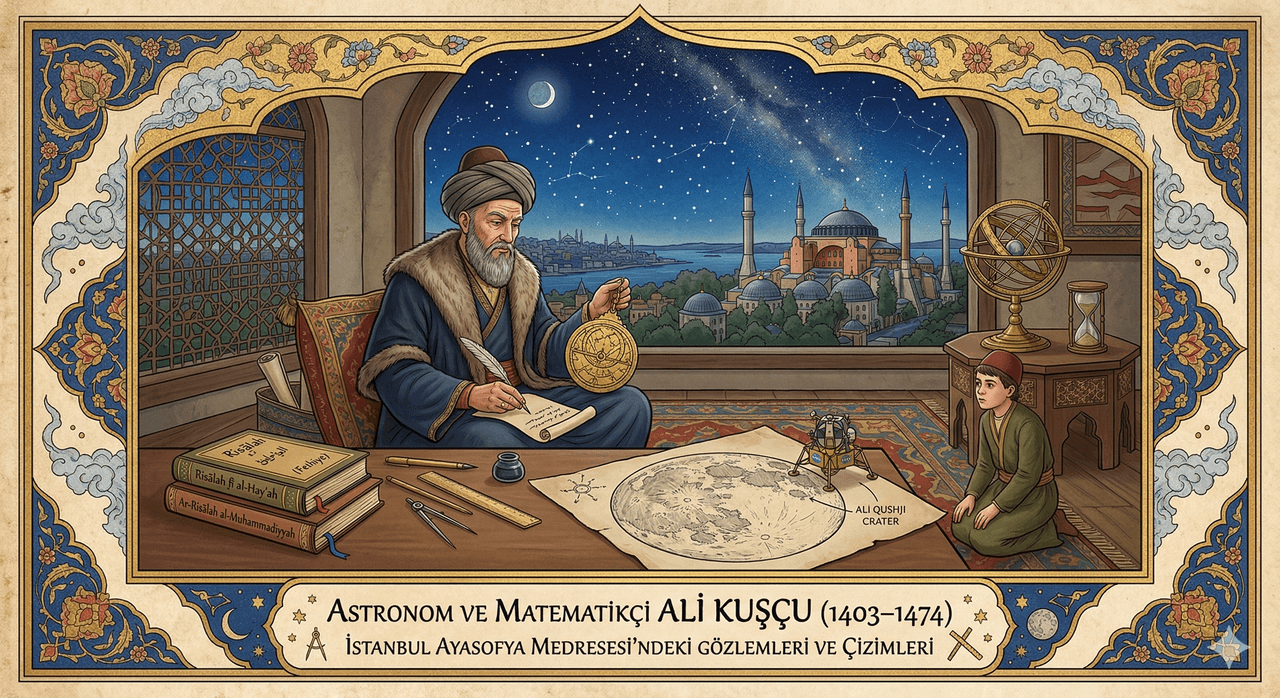
Ali Kuşçu
Ali Kuşçu was born in Samarkand and became one of the greatest astronomers and mathematicians of the Ottoman period due to his fascination with the sky. He mapped the Moon so accurately that a region on the Moon today bears his name.
Where Does the Nickname “Kuşçu” Come From?
Ali Kuşçu’s real name was Ali ibn Muhammad. So why was he called “Kuşçu”? Because his father was the falconer for Ulugh Beg, the great ruler and astronomer of the time. From an early age, Ali was known by this nickname due to his father’s profession, and the entire world came to know him by this name.
The Explorer of the Heavens
While other children played, Ali Kuşçu would gaze upward at the stars. He studied under the most renowned mathematicians of his time in Samarkand. So brilliant was he that his ruler Ulugh Beg addressed him as “my precious son.” He worked at the grand observatory established by Ulugh Beg and calculated the movements of stars and planets with unprecedented accuracy for his era. His work, the Zij-i Ulugh Beg, served as a guide for sailors navigating the oceans for centuries.
The Great Journey to Istanbul
After Ulugh Beg’s death, Ali Kuşçu visited Tabriz during a pilgrimage. There, the Akkoyunlu ruler Uzun Hasan showed him great respect and sent him as an envoy to Fatih Sultan Mehmet. Fatih immediately recognized Ali Kuşçu’s immense scholarly stature and said to him: “Stay in Istanbul and help us elevate science!”
When Ali Kuşçu arrived in Istanbul with his family and books, special delegations were sent to meet him at the border. He was honored with great hospitality at every stop along the way. Upon his arrival in Istanbul, he became a professor at the Ayasofya Medresesi.
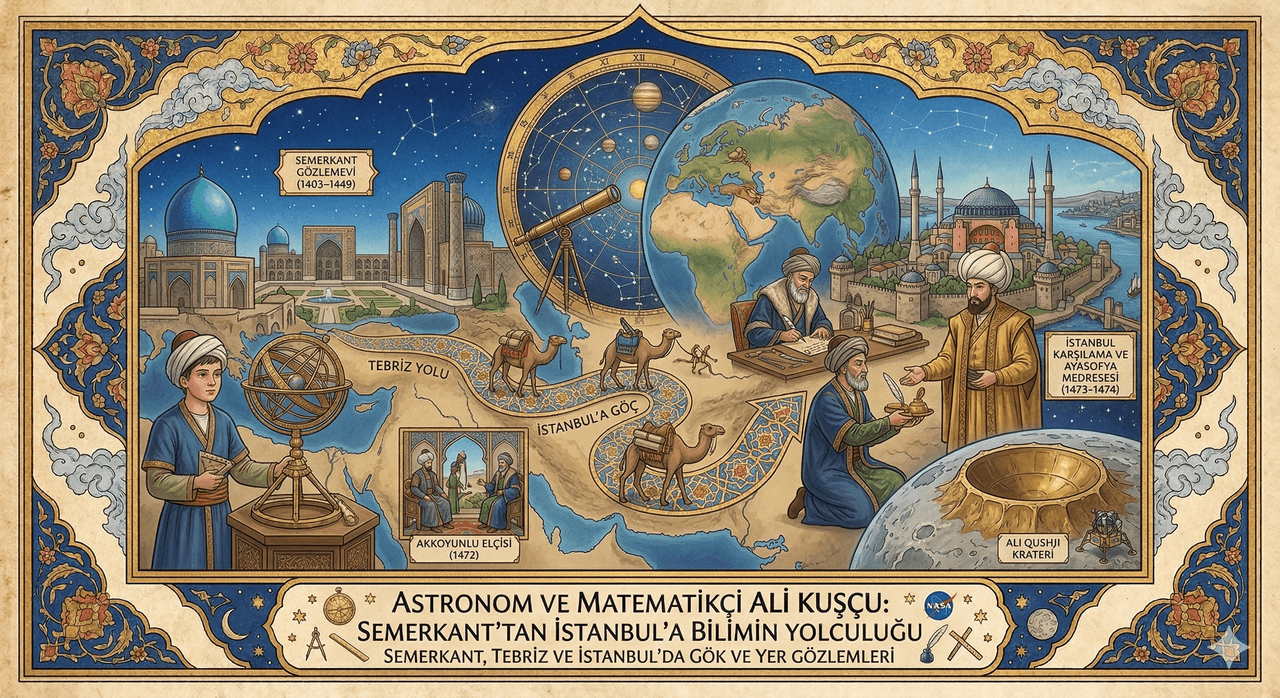
Ali Kuşçu on his journey to Istanbul (generated by artificial intelligence)
Mathematical and Astronomical Genius
Ali Kuşçu did not limit himself to the stars; he was also a master of mathematics. The books he wrote for Fatih Sultan Mehmet—Fethiye (on astronomy) and Muhammediye (on mathematics)—were used for centuries as foundational textbooks in Ottoman medreses.
- Map of the Moon: He created one of the earliest maps of the Moon. Because of this achievement, centuries later NASA named a lunar crater after him.
- Sundial: He constructed a sundial in the courtyard of the Fatih Camii in Istanbul, demonstrating to all how accurately time could be measured.
- Is the Earth Moving? While many of his contemporaries believed the Earth was stationary, Ali Kuşçu used celestial observations to uncover the secrets of the universe.
Love of Writing and Science
Ali Kuşçu worked tirelessly throughout his life. He authored more than thirty works on grammar, mathematics, and astronomy. His arrival in Istanbul marked the beginning of the golden age of mathematics and astronomy in the Ottoman Empire. He trained many students, and even his grandson Mirim Çelebi became a great astronomer like him.
His Final Days Ali Kuşçu died in Istanbul in 1474 and was buried near the Eyüp Sultan Türbesi. His tombstone bears the inscription “Master of Astronomy and Mathematics.” Today, whenever we look at the Moon or solve mathematical problems, we still see the enduring foundations he laid centuries ago.