




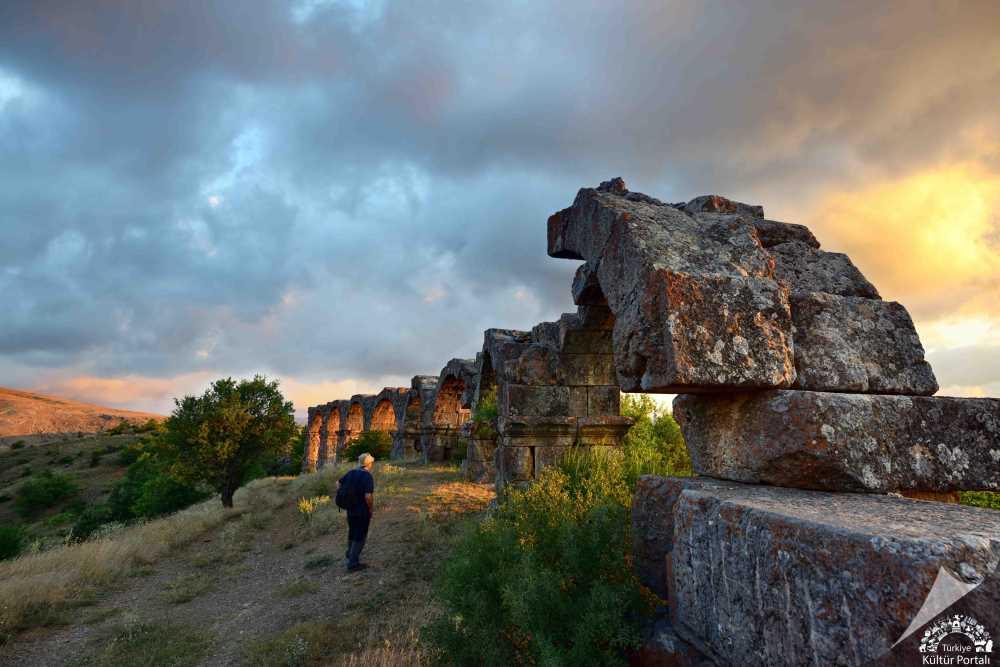
Aqueducts of Pisidian Antioch
Aqueducts are large bridges built by people in very ancient times to transport water from distant sources into their cities. The Pisidia Antiocheia Aqueduct Arches were constructed thousands of years ago near the area of today’s Isparta's Yalvaç district to meet the water needs of The ancient city of Antioch (Antiochia). Antiocheia was a major and populous city during the Roman Empire, so ensuring the population’s easy access to clean water was of great importance. These arches are remarkable structures that demonstrate the engineering knowledge of that era.

Pisidia Antiocheia Aqueduct Arches (Culture Portal)
What Are Aqueduct Arches Used For?
Aqueduct arches are structures designed to carry water from its source to the city along a sloped route. You can think of them like a pipeline, but instead of being underground, this channel passes over large stone bridges. When the terrain is flat or when there is a valley, engineers built tall and sturdy arches to maintain the water’s flow.
In Pisidia Antiocheia, these arches transported water from a source called “Su Çıktı,” approximately 10 kilometers away, into the city. This water was distributed to public fountains and baths. About two-thirds of the city’s water supply was provided by these aqueducts.

Pisidia Antiocheia Aqueduct Arches (Culture Portal)
When Were the Arches Built?
The Pisidia Antiocheia Aqueduct Arches are believed to have been constructed around 2000 years ago, in the 1st century CE, during the Roman Empire. This means that long before you were born, and even before your great-great-grandparents were born, these arches were already transporting water.

Pisidia Antiocheia Aqueduct Arches (Culture Portal)
How Were the Aqueducts Built?
The arches were constructed using precisely cut stone blocks. The thick columns, known as piers, were built by skillfully stacking rectangular stones on top of each other without the use of mortar. The width of the piers reached up to 2.1 meters and their height could reach up to 4 meters.
Water flowed through a channel on top of the arches, known in Latin as canalis. The cross-section of this channel was approximately 30 centimeters in diameter. The water moved steadily downhill along this channel until it reached the city. This system represented an extraordinary engineering achievement by the standards of that time.