




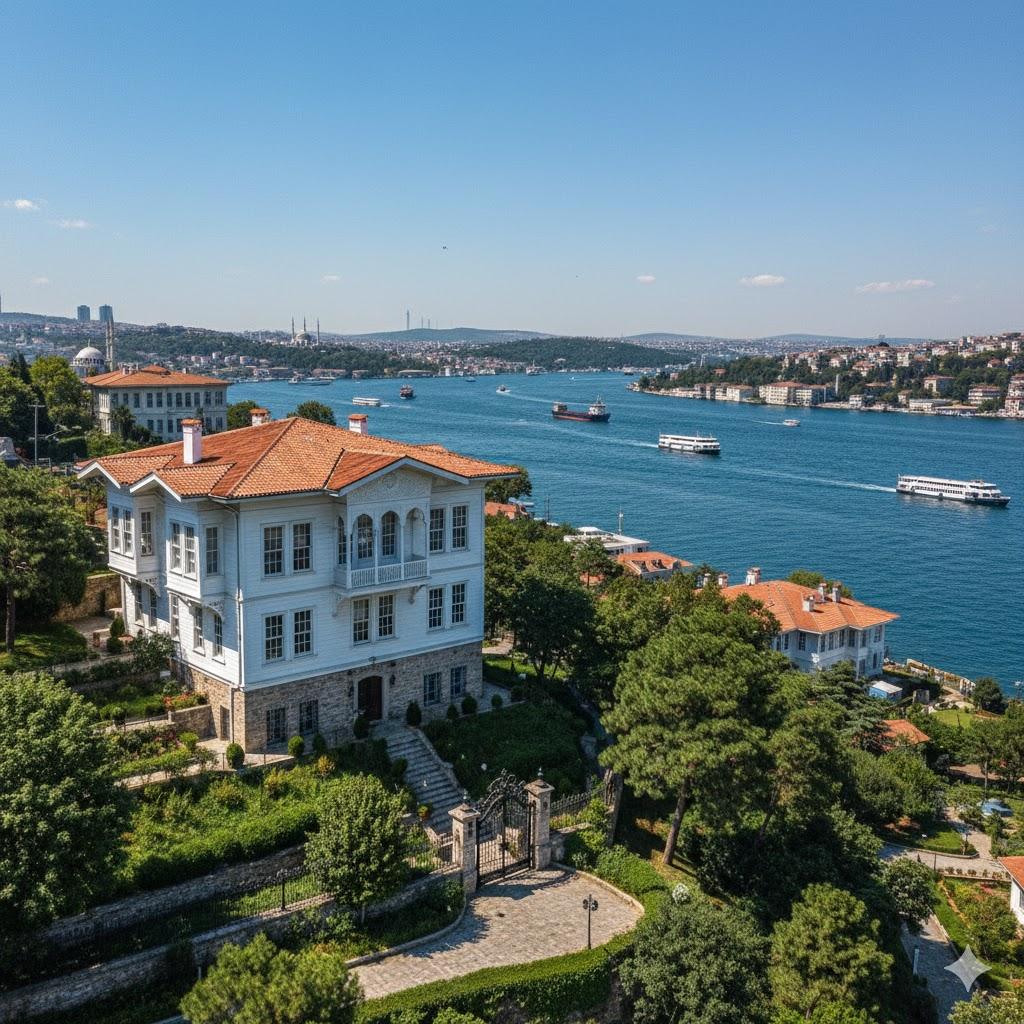
Aşiyan Museum
History: The Story Between Stone Walls
Imagine this house had a soul... In 1906, Tevfik Fikret built this home exactly as he envisioned it, as if painting a canvas with his own dreams, designing it himself. He was writing poetry and constructing his home at the same time! Until 1915, the very end of his life, he lived gazing out its windows at the deep blue waters of the Bosphorus.

(Image generated by artificial intelligence.)
After the poet’s death, the house was purchased by the Istanbul Municipality in 1940 with the aim of creating a memorial space for the prominent writers and works of that era. Thus, when it first opened, it was named the "Museum of New Literature" (a collection of works from the New Literature Movement). Later, a decision was made to move the poet’s remains—naaş: the body of the deceased—to the garden he loved so dearly, directly facing the view he cherished. Following this emotional event, in 1961, the house was permanently renamed the Aşiyan Museum.

(Image generated by artificial intelligence.)
Sections: Living Spaces Through the Poet’s Eyes
Aşiyan is a charming three-story wooden house. Come, let us breathe in its spirit as we wander through its rooms:
Ground Floor: Once, this housed the dining room and kitchen. Even the kitchen contained a special window named by the poet "Socrates’ Window". He gave it this name out of his admiration for the wise philosopher Socrates; it was as if gazing through that window filled one’s soul with wisdom!
First Floor: This is, in essence, a gathering place for literary figures!
- New Literature Room: You will see photographs, books, and memorabilia of the poet’s close friends and fellow writers of the same literary movement. It feels as if literary conversations still whisper within these walls...
- Abdülhak Hamit and Nigar Hanım Rooms: In these rooms, personal belongings, desks, and portraits of Abdülhak Hamit Tarhan, famous for his poem "Makber," and Nigar Hanım, one of our most powerful female poets, are displayed. Each object tells the story of these great artists.
Second Floor: Tevfik Fikret’s Heart: The top floor of the house belonged to the poet himself.

(Image generated by artificial intelligence.)
- Bedroom: This is the most striking space. The very bed on which the poet closed his eyes to life is displayed here, alongside a replica of a death mask—mask: a plaster cast taken from his face after death. Feeling this moment is somewhat sorrowful...
- Study Room: This was both his library and his painting studio! Imagine him seated at his desk, lost in contemplation of the Bosphorus. His own paintings hang on the walls. And the jewel of the room: the famous "Fog Painting", inspired by the poet’s renowned poem "Sis," which captures misty Istanbul, is displayed here!
- Garden: The most tranquil spot in the museum. The poet deeply loved this lush green garden. Now his grave lies here, gazing forever at the view he loved most.
Significance: Why Should We Visit Aşiyan?
Aşiyan is not merely a place displaying old objects; it is a living textbook. It teaches us the life, emotions, and thoughts of a poet through the very walls and objects around us. Seeing the home of this pivotal figure who reshaped Turkish literature adds a new dimension to the poems we read. This is a precious sanctuary that instills in us a deep awareness of preserving our cultural heritage.

(Image generated by artificial intelligence.)