


Attila Han
Attila the Hun
Have there ever been people whose names immediately evoke a vast empire and unimaginable adventures? Attila is one such figure! He was the ruler of the Hunnic Empire, and his name continues to live on in stories and legends told across Europe and Asia for over a thousand years. Should we define Attila merely as a powerful ruler? Let us take a closer look at his and his people’s fascinating world.
A Child of the Steppe
Attila was born approximately 1600 years ago within the vast territories of the Hunnic Empire. His father, Mundzuk, died when Attila was still a young child. As a result, Attila was raised by his uncle, Rua. His uncle did not see him merely as a nephew but as the future leader of the Huns, and thus taught him the art of state governance and the qualities of leadership.
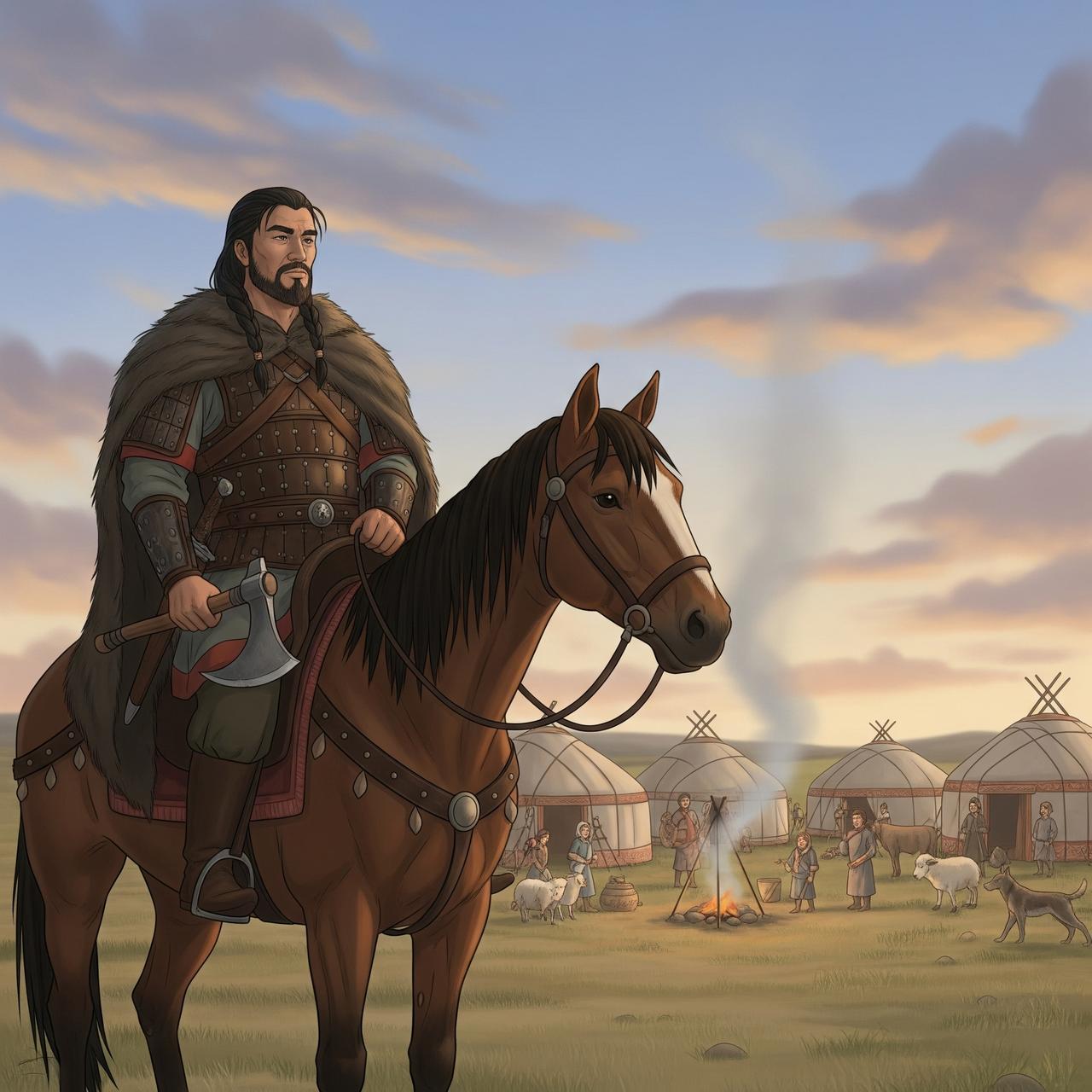
For the Huns, life revolved around the horse. Children learned to ride and shoot arrows almost as soon as they began to walk. Imagine a child aged three or four hunting small animals to practice archery! Attila grew up in this environment and became a brave and skilled warrior.

(Generated by artificial intelligence)
How the Huns Lived
The Huns were a nomadic people. This did not mean they wandered aimlessly from place to place. They moved seasonally between cool summer pastures and warmer winter encampments. They typically lived in felt tents. Their most important possessions were their horses and sheep. They used wool from sheep for clothing, milk for food, and meat for sustenance. Their horses served not only as mounts but also as the source of “kumis,” a fermented dairy drink.
Under Attila’s leadership, the Hunnic Empire established its main center in what is now Hungary. The Roman historian Priscus visited Attila’s court and described him as far from the brutal warlord often imagined. According to Priscus, Attila lived a simple and unpretentious life. While his guests drank from golden and silver cups at feasts, Attila used a wooden cup. This behavior demonstrated his closeness to his people.
Two Different Attilas
Ancient accounts of Attila present two very different portraits of the ruler. Some European historians called him “the Scourge of God” and described how his armies spread fear wherever they marched. In these narratives, Attila appears as an unstoppable force.
Yet there is also the Attila portrayed in the Germanic Nibelungenlied. In this epic, he is known as “Etzel” and is depicted very differently. Etzel is portrayed as a peaceful, just, and wise king who hosted people of different faiths and ethnicities in harmony within his court. This illustrates how historical figures can be perceived very differently across cultures.

(Generated by artificial intelligence)
Attila and the Two Romes
At that time, the Roman Empire had split into two parts: the Western Roman Empire and the Eastern Roman Empire (Byzantium). Attila played political games with both powers like a master chess player.
Relations with the Eastern Roman Empire (Byzantium)
Attila first demonstrated his power against the Eastern Roman Empire. His army advanced through the Balkans, causing alarm. Rather than fight him, the Eastern Roman Emperor offered a treaty. Through agreements such as the Treaty of Margus, the Eastern Roman Empire agreed to pay annual tribute to the Huns. Tribute was a payment made by one state to another to ensure peace or acknowledge dominance. Attila used these payments to enrich his empire and neutralize the Eastern Roman Empire as a threat.
Relations with the Western Roman Empire
Attila’s relationship with the Western Roman Empire began like a film script. Initially, there was friendship between the Huns and the Western Romans. In fact, the Roman general Aetius had spent his youth among the Huns and had become acquainted with Attila. Everything changed when the Western Roman Emperor’s sister, Princess Honoria, secretly sent Attila a ring asking for his help.
Attila interpreted the ring as a marriage proposal and demanded half of the Western Roman Empire as dowry. Naturally, the Romans rejected this demand. This incident provided Attila with a pretext to invade the Western Roman Empire. He marched his army into Gaul (modern-day France), where he faced the combined forces of Rome and the Visigoths—a rival warrior people—led by his former friend Aetius. The Battle of the Catalaunian Plains became one of the largest and bloodiest battles in history. Both sides suffered heavy losses, and no clear victor emerged.
A year after this battle, Attila invaded Italy with his army and captured many cities. As he prepared to march on Rome itself, Pope Leo I appealed to him to spare the city. Attila withdrew, influenced by this request as well as food shortages within his army. This event once again demonstrated his immense power and the weight of his word.
Attila’s Legacy
Attila died unexpectedly in 453. After his death, his sons Ellak, Dengizich, and Ernak struggled to rule the empire, and the Hunnic Empire gradually disintegrated. Yet Attila’s name and deeds were never forgotten. He was not merely a commander but a leader who united disparate tribes into a powerful force. He taught loyalty, courage, and responsibility.
His story reminds us that leadership is not only about the use of force but also about justice and wisdom. Attila continues to live on as a historical figure whose name is remembered after thousands of years, inspiring films and books.
Time Travel: Life in the 5th Century
Let us imagine life in the 5th century, the time of Attila. There were no telephones or the internet. People traveled by horse or on foot. One of the greatest powers was the divided Roman Empire: the Western Roman Empire and the Eastern Roman Empire (Byzantium). Nomadic groups like the Huns, who lived on the steppes, were formidable warriors who moved swiftly thanks to their horses. Even children learned to ride and shoot arrows at a very young age. For the Huns, the horse was not merely a mount but their closest companion.