
This article was automatically translated from the original Turkish version.

Throughout history, humanity has established many great states and empires. Yet among them, the Roman Empire stands out as one of the world’s most distinguished, particularly in terms of continuity and institutional strength. While the empire of Genghis Khan may first come to mind as the “largest empire,” Rome carved out a unique place in history not through its territorial extent, but through its durability, legal system, cultural diversity, and capacity for integration.
Rome’s long lifespan lies in its ability to adapt to different forms of governance: the Monarchy, the Republic, and the Empire. Although each phase had a distinct structure, all strengthened Rome’s political and social foundations. Of course, during this process, there were periods when even the capital of Rome faced grave dangers, confronting invasions and internal unrest. Rome’s gradual expansion allowed it to turn the weakness of neighboring states into advantages; through its military power, diplomatic acumen, and technological skill, it incorporated vast territories into its system.
In its advancement, Rome relied not only on the sword but also on reason. This empire strategically employed its technological innovations, infrastructure systems, roads, and engineering marvels to achieve unexpected successes at critical junctures. Yet, as in every great state, there were times when emperors withdrew from state affairs and turned toward personal passions, weakening governance and leading to power shifts through military coups.
Through these coups, rulers of African and Arab origin even ascended the Roman throne. This diversity reflects not only the empire’s military inclusiveness but also its cultural openness. Rome’s true endurance stemmed from its ability to integrate cultural values across the territories it conquered. The contributions it made in fields such as democracy, philosophy, law, poetry, theater, and architecture continued to exert influence for centuries after the empire’s fall.
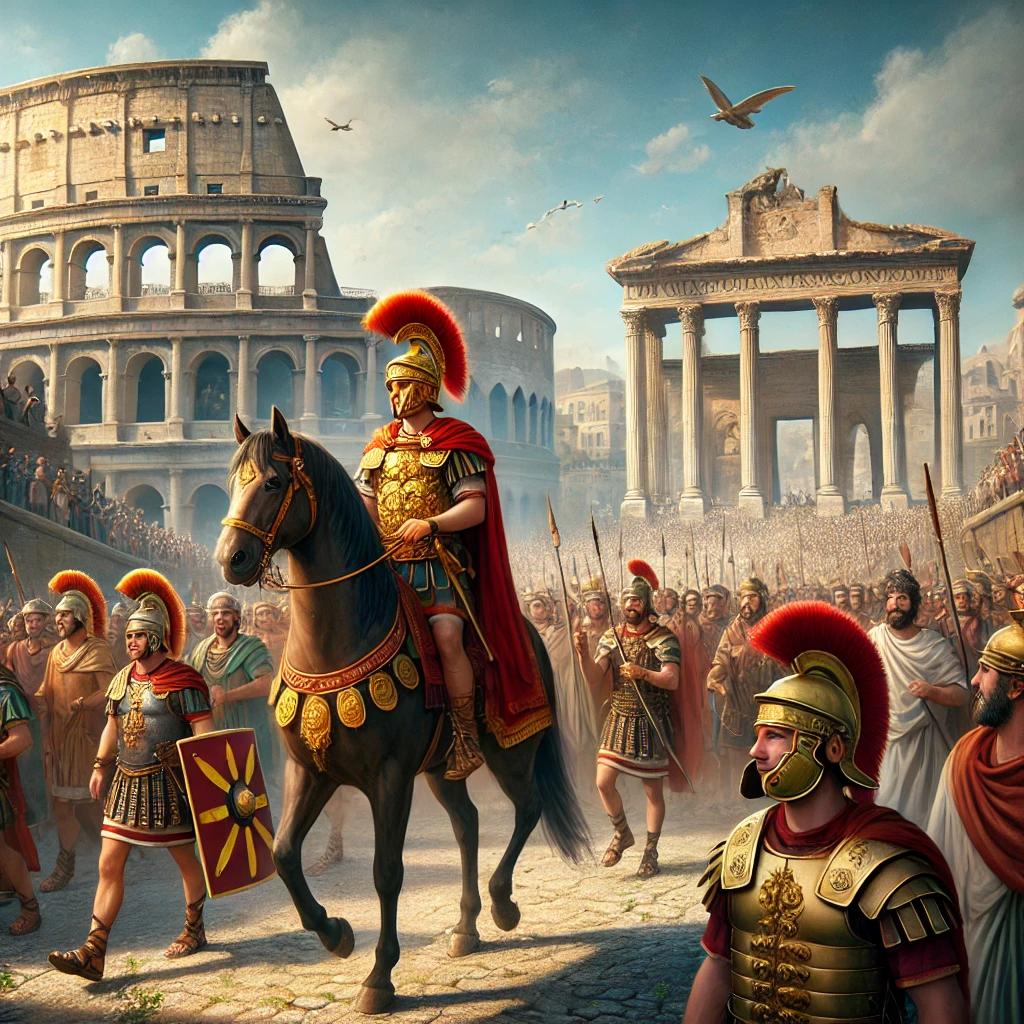
A Depiction of Rome (Generated by Artificial Intelligence)
Perhaps the most striking point is that the decline of this vast civilization occurred on both its eastern and western flanks through connections with the Turks. The state frequently referred to in history as “Byzantium” was in fact the Eastern Roman Empire. After the fall of the Western Roman Empire, it was this eastern empire that preserved order and continuity. In essence, the Eastern Roman Empire served as the organizer and successor to the remnants of the West. Nevertheless, historical narratives often emphasize the Western Roman Empire, even though the structure ensuring administrative continuity lay in the East.
Even in the fall of the Western Roman Empire, the indirect influence of the Turks is evident. Under the leadership of Attila, the Huns displaced Germanic tribes, pushing them westward; these tribes then launched attacks on Roman territories, paving the way for the collapse of the Western Roman Empire. Thus, even in the final act of Western Rome’s history, the trace of the Turks remains visible.
This reality reminds us of the depth and impact of our own history. Although we are often unaware of it, the Turks have made indirect or direct contributions to some of the most significant transformations in world history. These contributions are significant not only militarily but also culturally and historically.
To view history merely as a collection of past events is a profound oversight. The true power of history lies in its ability to guide the future and nurture national consciousness. The example of Rome is important because it demonstrates how a civilization can establish a lasting system.
Our own history, similarly, is unique in terms of continuity, flexibility, and cultural accumulation. Therefore, remembering these legacies of the past can serve as a powerful source of inspiration for achieving future successes that will once again command international admiration.
Eutropius. Kısa Roma Tarihi. Trans. Çiğdem Menzilcioğlu. 2nd ed. Istanbul: Alfa Yayınları, 2017.
Tekin, Oğuz. Eski Yunan ve Roma Tarihine Giriş. 11th ed. Istanbul: İletişim Yayınları, 2016.
The Intersection of Roman and Turkish History
Drawing Inspiration from History