
KURE Kids Header Line
badge icon

This content was originally written in Turkish for children and is automatically translated into English using artificial intelligence.

article-image

Balloon Fish

Last Updated: 17.03.2026

Have you ever thought that some fish can inflate like a frog or a balloon when in danger? The balloon fish, one of the most fascinating creatures of the oceans and seas, gets its name precisely from this unique ability. Let’s get to know this intriguing guest of our waters more closely!


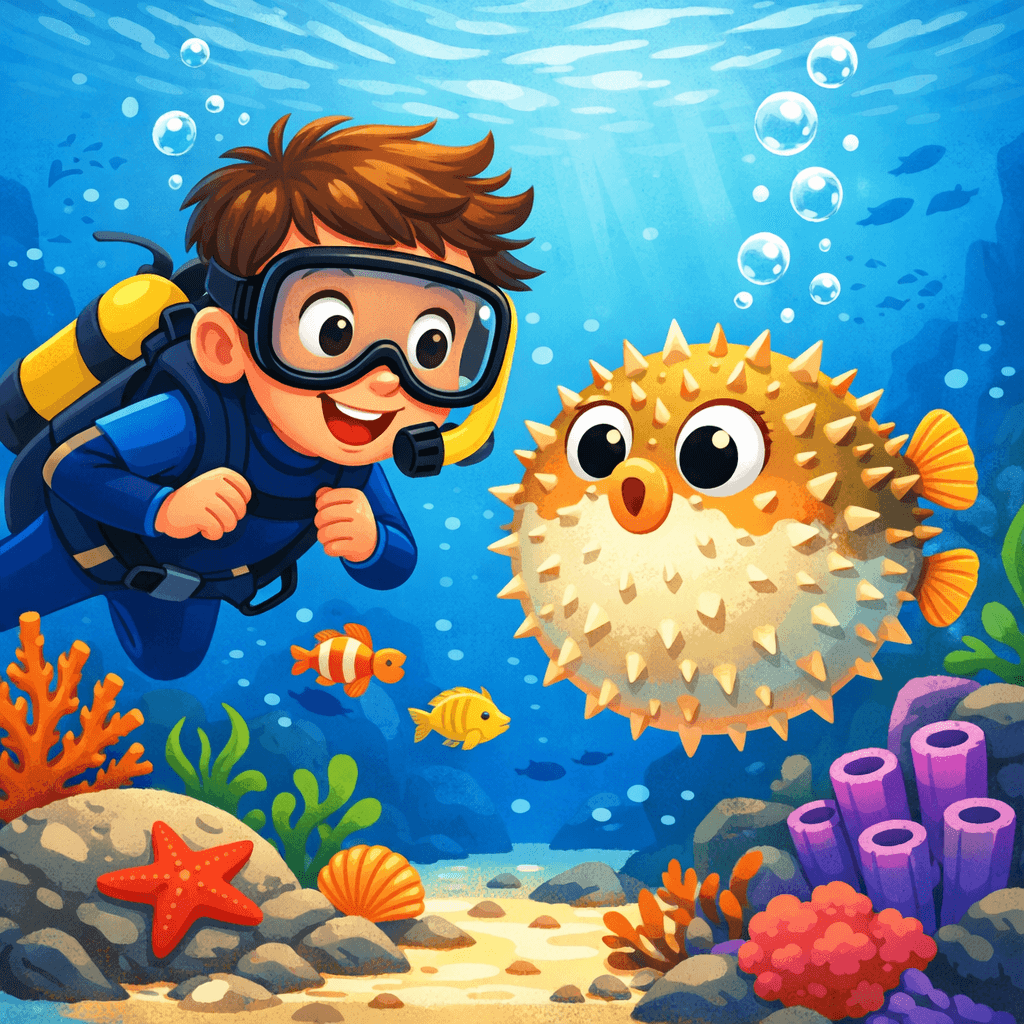
Balloon Fish (Generated by Artificial Intelligence)

What Do Balloon Fish Resemble?

Balloon fish do not have scales like other fish. Instead, they have small, spine-like hard structures on their backs or bellies. In normal conditions, these fish have long and slender bodies, distinguished by spines extending backward from their bodies.

When a balloon fish senses danger, it employs a remarkable defense strategy. It immediately fills its belly with water or air, expanding to several times its normal size and transforming into a large spherical ball. This makes it impossible for larger predators to swallow it.

Where Do They Come From and Where Do They Live?

Actually, balloon fish are not native to our seas. Their ancestral homeland is the warm waters of the Indian Ocean, the Pacific Ocean, and the Red Sea. They typically inhabit depths between 10 and 50 meters, often on sandy or muddy seabeds.

Today, they are commonly found along the coasts of Turkish cities such as Antalya, Mersin, İskenderun, İzmir, and Muğla. Their favorite foods include crabs, shrimp, mollusks, and other small invertebrates living on the seabed. Sometimes, they even dig into the sand to create burrows for themselves.


Balloon Fish (Generated by Artificial Intelligence)

Why Should We Only Admire Them from Afar?

Balloon fish have a critical secret: their bodies contain a toxin that is extremely dangerous to other creatures.Tetrodotoxin, as this toxin is called, is their greatest shield against greedy predators.

The substance found in their flesh and skin is also highly harmful to humans. Since the toxin is not destroyed by heat, cooking does not eliminate its danger. Therefore, experts strongly advise against eating balloon fish or even touching them. The safest way to observe them is from a distance when encountered in the sea.

Time Travel

Balloon fish embarked on a completely new journey in 1869 with the opening of the Suez Canal. Emerging from the waters of the Red Sea, they gradually migrated toward the Mediterranean Sea. Scientists refer to this movement of species between seas as the “Lessepsian migration.” They were first observed along our coasts in the early 2000s and have since multiplied rapidly, becoming an integral part of our seas.


Don't Forget to Look at These!
Science and Technology
cat img
History and Culture
cat img
Art and Literature
cat img
image
Most Read
Thomas Edison
arrow
image
Last Added
Gezegenler Neden Yuvarlaktır?
arrow
ilham-notu-bg
INSPIRATION NOTE FOR CURIOUS KIDS!

Balloon fish inflate by drawing in water to become very large and protect themselves from danger. If you were a sea creature living in the ocean, what superpower would you have to protect yourself? Would you change your color, swim extremely fast, or transform into a different shape? Let’s draw your imaginary sea creature on paper and describe its superpowers!

Who Wrote?
Kids Writing
Authornisa nur bağlantıMarch 17, 2026
bottom-bg-effect-bottom
bottom-bg-effect-top

Pufferfish are remarkable creatures that inflate into a ball when threatened, possessing incredible abilities, yet they also require our utmost caution due to the potent defensive substances they carry in their bodies. They serve as a wonderful example of how living organisms in nature can develop astonishing methods to protect themselves.

Bibliographies

DergiPark. "Türkiye Kıyılarında İstilacı Zehirli Balon Balığı." PDF file. https://dergipark.org.tr/tr/download/article-file/2055645 (Accessed February 26, 2026).

Istilacilar.org. "Balon Balığı." *Denizel İstilacı Yabancı Türler Kataloğu.* Accessed February 26, 2026. https://www.istilacilar.org/denizel-istilaci-yabanci-turler-katalogu/balon-baligi/

Tarım TV. "Uzmanlardan balon balığı uyarısı." Tarım Orman Ekranı, January 4, 2024. https://www.tarimtv.gov.tr/tr/video-detay/uzmanlardan-balon-baligi-uyarisi-18306 (Accessed February 26, 2026).

T.C. Ministry of Agriculture and Forestry – General Directorate of Fisheries and Aquatic Products. “2025 Yılı Balon Balığı Avcılığının Desteklenmesi Kapsamında Balon Balığı Alımları 1 Aralık 2025 Tarihi İtibariyle Sona Ermiştir.” Duyuru, December 2, 2025. https://www.tarimorman.gov.tr/BSGM/Sayfalar/Detay.aspx?OgeId=200&Liste=Duyuru Accessed February 26, 2026.

TÜBİTAK Bilim Genç. "Türkiye’nin Balon Balıkları." Bilim Genç – TÜBİTAK, December 19, 2019. https://bilimgenc.tubitak.gov.tr/yeryuzu-turkiyenin-balon-baliklari (Accessed February 26, 2026).

TÜBİTAK Bilim ve Teknik. "Balon Balığı." PDF file, 2 pp. https://bilimteknik.tubitak.gov.tr/wp-content/uploads/sites/154/2025/09/a1b4a7f3-0fca-48a8-851f-9414dd406b36-1.pdf (Accessed February 26, 2026).

TÜDAV (Türk Deniz Araştırmaları Vakfı). "Bu Balığa Dikkat Ediniz.. Balon Balığı." Çalışmalar > Denizel Biyoçeşitlilik > Biyolojik Yayılım. Accessed February 26, 2026. https://tudav.org/calismalar/denizel-biyocesitlilik/biyolojik-yayilim/bu-baliga-dikkat-ediniz-balon-baligi/

ilham-notu-bg
ilham-notu-bg
ilham-notu-bg
HEYY!
Did You Know?
These?
Lamb
Lamb
Ask to Küre