


This article was automatically translated from the original Turkish version.
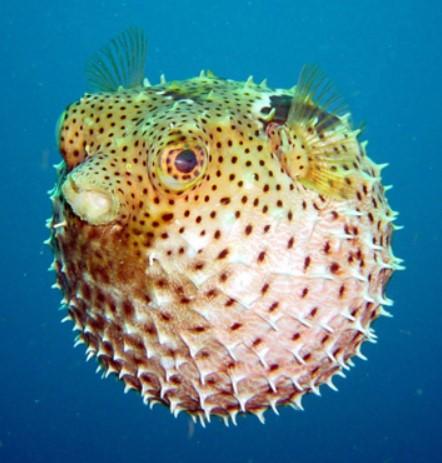
Balloon Fish
Type(s) | Tetraodontidae | ||||||||
|---|---|---|---|---|---|---|---|---|---|
Family | Tetraodontiformes | ||||||||
Native Country | Indian, Pacific and Atlantic Oceans | ||||||||
Average Lifespan | 10–20 years | ||||||||
Height / Weight | 5–60 cm / 100–2000 g | ||||||||
Color Variations | Gray, yellowish-brown, spotted | ||||||||
Social Structure | Usually solitary, some species in pairs | ||||||||
Conservation Status (IUCN) | Generally Least Concern (LC), some species Data Deficient (DD) | ||||||||
Diet(s) | Mollusks algae crustaceans | ||||||||
The pufferfish is a type of fish belonging to the family Tetraodontidae, known for its ability to inflate its body and whose majority are toxic. These species activate their defense mechanisms by rapidly inflating themselves with water or air, especially when threatened. Commonly known as “fugu,” pufferfish have attracted both scientific and popular interest due to their biological characteristics and cultural impact. Due to their toxicity, pufferfish are prepared and served in Japanese cuisine only by chefs who have undergone specialized training. Scientifically classified under the family Tetraodontidae, most of these species contain tetrodotoxin, a potent neurotoxin.

Pufferfish (unsplash)
Pufferfish typically range in length from 5 to 60 cm and are recognized by their short, rounded, and muscular body structure. Instead of scales, their bodies may have spiny structures. Their eyes are prominent and highly sensitive to environmental changes. Most species possess four strong, beak-like teeth fused together; this structure enables them to crush hard and shelled prey.
Their most distinctive feature is the ability to inflate their bodies several times their normal size by swallowing water or air when threatened. This behavior serves as a deterrent to predators and makes the fish difficult to swallow. The tetrodotoxin present in their skin or internal organs is powerful enough to cause rapid paralysis by affecting the central nervous system.

Pufferfish (pixabay)
Pufferfish are primarily found in tropical and subtropical seas, especially along the coastal waters of the Indian, Pacific, and Atlantic Oceans. Some species can also live in estuaries and freshwater environments adapted to saline conditions. They inhabit areas near coral reefs, beneath rocks, and in depressions on the seafloor. Most species are benthic, meaning they live on or near the ocean floor. Some species can also be observed in open ocean waters.
Human activities, global climate change, and ballast water from ships have caused certain pufferfish species to expand beyond their natural habitats, for example into regions such as the Mediterranean Sea. This process can lead to invasive behaviors that threaten the ecological balance of local ecosystems.
Most pufferfish contain tetrodotoxin (TTX), an extremely toxic substance. This neurotoxin blocks sodium channels in nerve cells, potentially causing muscle paralysis, respiratory failure, and fatal outcomes. Tetrodotoxin is concentrated primarily in the liver, ovaries, skin, and intestines of the fish.
It is believed that the toxin is not produced by the fish itself but is synthesized through symbiotic bacterial species such as Pseudomonas and Vibrio. The concentration of the toxin varies among species, but even a few milligrams can be lethal to humans. Consequently, the culinary consumption of pufferfish is subject to strict legal regulations.

Pufferfish (unsplash)
Pufferfish are generally slow-moving and mostly solitary animals. While some species are active during the day, others are nocturnal. Their feeding habits include both herbivorous and carnivorous behaviors. Their primary food sources include crustaceans, sea snails, mollusks, seaweed, and small invertebrates. Their strong jaw structures allow them to crush hard shells to consume their prey.
Young pufferfish feed on plankton, while adult individuals target larger organisms. Some species exhibit opportunistic feeding behavior and may consume dead animals.
Pufferfish are egg-laying species. Their breeding seasons typically coincide with spring and summer months. Female fish lay thousands of eggs near the water surface, which are then fertilized by males. The eggs hatch within a few days, releasing planktonic larvae.
After the planktonic stage, larvae grow and migrate to coastal areas where they complete their development. In some species, reproductive behaviors include sexual selection, parental care, and territorial defense.
The pufferfish is known as “fugu” in Japanese cuisine and is considered a delicacy. Preparing this dish is an extremely delicate process and may only be performed by licensed chefs who have undergone specialized training. In Japan, chefs wishing to serve fugu must complete years of rigorous education. Improperly cleaned pufferfish consumption poses a serious public health risk, as it can lead to death.
Pufferfish are also popular among aquarium hobbyists. However, due to their toxic nature and aggressive behavior, they are recommended only for experienced aquarists.
Overall, pufferfish are classified by the IUCN as species of least concern. However, this status varies among species. Factors such as habitat loss, overfishing, and marine pollution can negatively impact local populations of certain species. High demand for fugu in commercial fisheries has led to uncontrolled harvesting of some species in certain regions.
In newly colonized areas such as the Mediterranean Sea, they are regarded as invasive species. In particular, Lagocephalus sceleratus is a species that threatens fisheries and poses a high risk to human health in the Mediterranean ecosystem.
Anadolu Ajansı. "Balon Balığı Akdeniz’in Ekolojisine ve Ekonomisine Zarar Verdi." Anadolu Ajansı, December 26, 2019. Accessed June 12, 2025. https://www.aa.com.tr/tr/ekonomi/balon-baligi-akdenizin-ekolojisine-ve-ekonomisine-zarar-verdi-/1651669
Aydın Tarım of Agriculture and Forestry. "Balon Balığı Avcılığının Desteklenmesine Dair Tebliğ Yayımlandı." T.C. Tarım veOrman Bakanlığı, 2021. Accessed June 12, 2025. https://aydin.tarimorman.gov.tr/Haber/918/Balon-Baligi-Avciliginin-Desteklenmesine-Dair-Teblig-Yayimlandi
Bentur, Yedidia, et al. "Lagocephalus sceleratus (Gmelin, 1789), a Lessepsian Migrant Fish Causing Severe Poisoning in the Eastern Mediterranean." *Toxicon* 52, no. 8 (2008): 964–968. https://www.sciencedirect.com/science/article/abs/pii/S0041010108005424
Bilim Genç. "Yeryüzü: Türkiye’nin Balon Balıkları." TÜBİTAK Bilim Genç, 2021. Accessed June 12, 2025. https://bilimgenc.tubitak.gov.tr/yeryuzu-turkiyenin-balon-baliklari
Coro, Gianluca, et al. "Forecasting the Ongoing Invasion of Lagocephalus sceleratus in the Mediterranean Sea." *Ecological Modelling* 371 (2018): 37–49. https://www.sciencedirect.com/science/article/pii/S0304380018300164
Emaar Akvaryum. "Balon Balığı." Accessed June 12, 2025. https://emaarakvaryum.com/canlilarimiz/balon-baligi/
International Union for Conservation of Nature (IUCN). Diodon hystrix: Linnaeus, 1758. Accessed June 12, 2025. https://www.iucnredlist.org/species/166947/57282334
International Union for Conservation of Nature (IUCN). Lagocephalus sceleratus: Gmelin, 1789. Accessed June 12, 2025. https://www.iucnredlist.org/species/193703/2263034
Ministry of Agriculture and Forestry. "Decision Made to Increase Support Amounts for Invasive Balloon Fish Hunting by Up to 400%." _Republic of Turkey Ministry of Agriculture and Forestry_, 2023. Accessed June 12, 2025. https://www.tarimorman.gov.tr/BSGM/Haber/281/Tarim-Ve-Orman-Bakani-Yumakli-Istilaci-Balon-Baligi-Avciligi-Destekleme-Tutarlarinda-Yuzde-400e-Varan-Artis-Karari-Verildi
Pixabay. "Pufferfish Ocean." Pixabay Free Images, 2025. Accessed June 12, 2025. https://pixabay.com/images/search/pufferfish%2bocean/
SSI MyDiveGuide. "Porcupine Fish." Accessed June 12, 2025. https://www.divessi.com/tr/mydiveguide/marine-life-detail/fishes-salt/porcupine-fish
TUDAV. "Bu Balığa Dikkat Ediniz: Balon Balığı." Türk Deniz Araştırmaları Vakfı, 2023. Accessed June 12, 2025. https://tudav.org/calismalar/denizel-biyocesitlilik/biyolojik-yayilim/bu-baliga-dikkat-ediniz-balon-baligi/
Unsplash. "Pufferfish Photos." Unsplash, 2025. Accessed June 12, 2025. https://unsplash.com/s/photos/pufferfish
Yeditepe Üniversitesi. "Balon Balığı Tehlikesi: Kasları Felç Ederek Ölüme Yol Açıyor." Yeditepe Üniversitesi, 2024. Accessed June 12, 2025. https://yeditepe.edu.tr/tr/balon-baligi-tehlikesi-kaslari-felc-ederek-olume-yol-aciyor

Balloon Fish
Type(s) | Tetraodontidae | ||||||||
|---|---|---|---|---|---|---|---|---|---|
Family | Tetraodontiformes | ||||||||
Native Country | Indian, Pacific and Atlantic Oceans | ||||||||
Average Lifespan | 10–20 years | ||||||||
Height / Weight | 5–60 cm / 100–2000 g | ||||||||
Color Variations | Gray, yellowish-brown, spotted | ||||||||
Social Structure | Usually solitary, some species in pairs | ||||||||
Conservation Status (IUCN) | Generally Least Concern (LC), some species Data Deficient (DD) | ||||||||
Diet(s) | Mollusks algae crustaceans | ||||||||
Morphology and Physical Characteristics
Habitat and Distribution
Toxin and Toxic Effects
Behavior and Feeding
Reproduction and Development
Relationship with Humans and Cultural Significance
Conservation Status