



Bangladesh
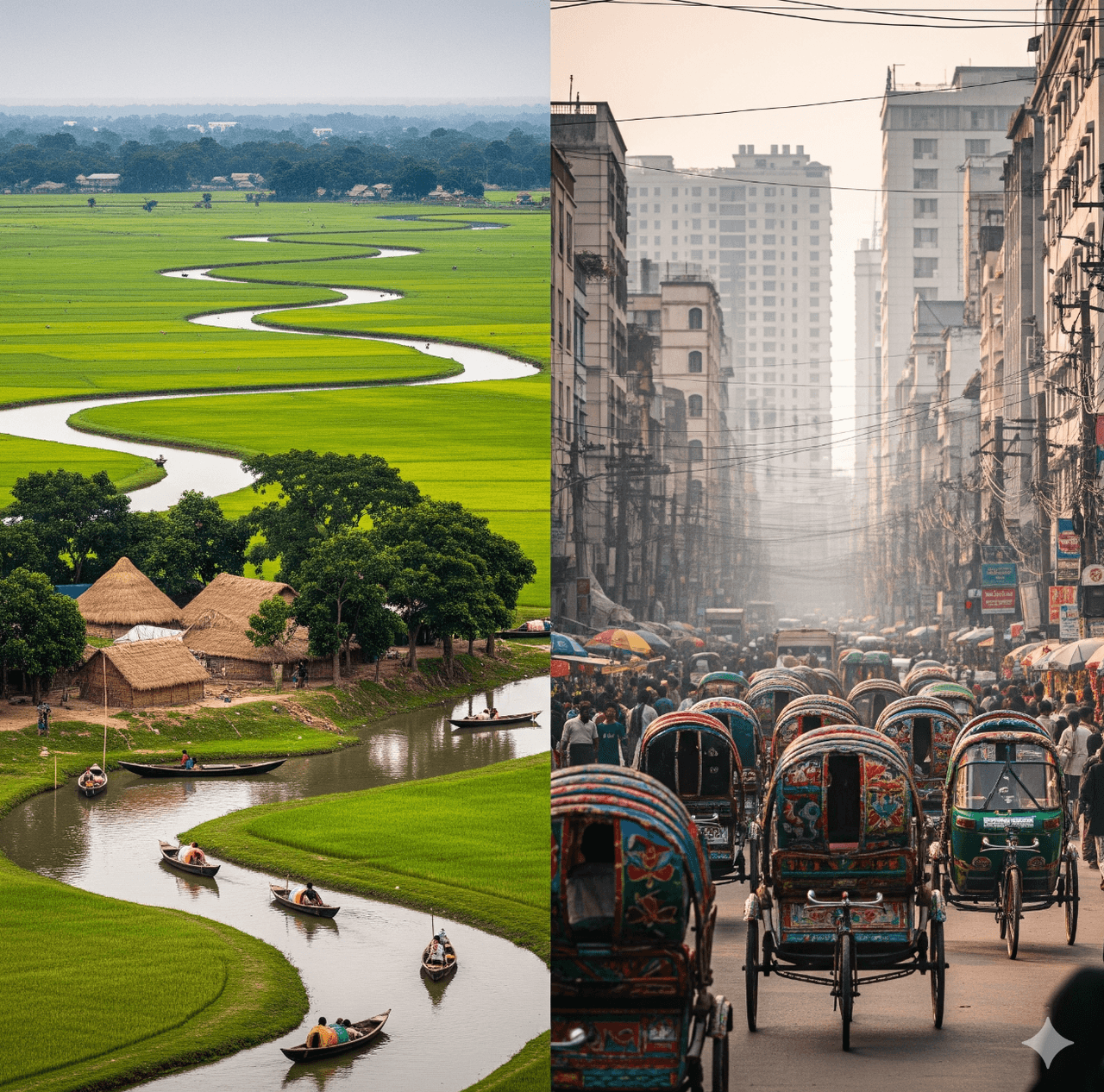
Bangladesh is bordered by India and shares a small boundary with Myanmar only in its southeast. Geographically located in eastern South Asia, it is known for its deltas, rivers, and fertile plains.
Capital and Major Cities
The capital of Bangladesh is Dhaka. Dhaka is the country’s largest center, renowned for its dense population, textile industry, and cultural diversity. Chittagong (Chattogram) is an important port city, while Khulna and Sylhet are notable for their industrial and cultural significance.

Dhaka (Generated by artificial intelligence)
What Is the Culture of Bangladesh Like?
Bangladesh culture is rooted in Bengali traditions and shares common origins with the Bengal region of India. Literature (particularly the works of Rabindranath Tagore and Kazi Nazrul Islam), folk music, intricately embroidered textiles known as Nakshi kantha, and hospitality are prominent cultural elements. “Baul” music has been inscribed on UNESCO’s Intangible Cultural Heritage list.
Language and Flag
The official language of Bangladesh is Bengali (Bangla). It is one of the most widely spoken languages in the world.
The flag consists of a red circle on a green background. Green symbolizes nature and hope, while red represents the blood shed in the struggle for independence and the rising sun.

(Generated by artificial intelligence)
Bangladeshi Cuisine
The foundation of Bangladeshi cuisine is rice and fish. The most beloved fish is hilsa, typically cooked with mustard sauce. Biryani, dal (lentil soup), and panta bhat (fermented rice) are also widely consumed. Meals are generally spicy and served with a variety of dishes. In Bangladesh, eating is not merely about nourishment but also a cultural practice that brings families and communities together.

Panta bhat (Generated by artificial intelligence)
History and Modern Development
Bangladesh declared its independence in 1971 following the Liberation War against Pakistan. Despite being one of the most densely populated and poorest countries in the second half of the 20th century, it has achieved economic growth in recent decades through its textile industry, microfinance initiatives, and increased female participation in the labor force.

Padma River (Generated by artificial intelligence)
Natural and Historical Attractions
The Sundarbans Mangrove Forests, the world’s largest mangrove area and the habitat of the Bengal tiger, are listed as a UNESCO World Heritage Site. Srimangal tea plantations and Cox’s Bazar, one of the world’s longest natural beaches, are notable natural sites. The Paharpur Buddhist Monastery and historic mosques in Bagerhat are significant cultural heritage landmarks.

Paharpur Buddhist Monastery (Generated by artificial intelligence)
Relationship with Türkiye
Bangladesh and Türkiye share historical ties and diplomatic relations. Türkiye was among the first countries to recognize Bangladesh’s independence in 1971. Today, cooperation continues in the fields of education, trade, and humanitarian aid.