



Blind Man's Buff
Körebe is an old game in which a child’s eyes are covered and they try to locate their friends by touch, playable both indoors and outdoors. Each player takes turns being the “ebe” with their eyes covered. The ebe attempts to identify who they have touched. In Türkiye, the game has also been known by regional names such as “kör keçi” or “kör çepiç” regional. Blind man’s buff remains one of the games still known to children today games, valued both for its entertainment and cultural significance.
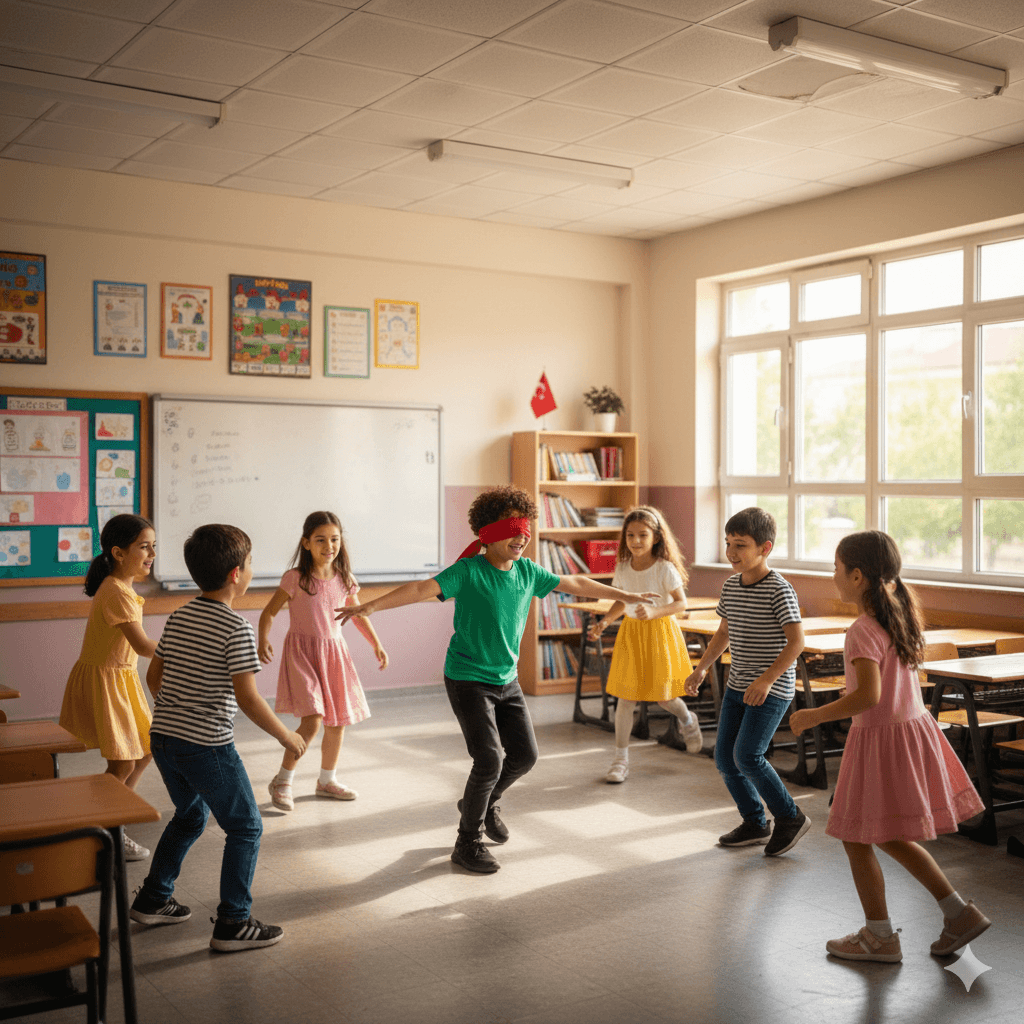
Children playing körebe in class (generated by artificial intelligence.)
Rules and Variations of Play
1. Selecting the ebe and covering the eyes: Before the game begins, one player is chosen as the ebe, and their eyes are covered with a cloth or handkerchief. For this reason, the game is sometimes called “eye-covering game”.
2. Playing area and arrangement: Players gather within a pre-determined space, which may be a circle, a room, or an open field. In some regions, players form a ring around the ebe; in others, they move freely.
3. The ebe’s search and touch: With eyes covered, the ebe extends their arms forward and tries to locate friends by touch. Upon touching another player, the ebe uses their hands to feel the head, face, or upper body to identify them. If the ebe correctly identifies the person, that player is expected to say their name. If the identification is correct, the touched player becomes the new ebe; if not, the same ebe continues.
4. Method of capture: In some variations, the ebe attempts to catch one of the other players, and the caught player becomes the new ebe. In various regions of Anatolia, minor additions are made to this basic rule—for example, requiring the ebe to identify the player solely by touch, or incorporating additional rhymes and behaviors.
5. Continuation and winner: The game continues with the selection of a new ebe. In traditional understanding, the ebe holds a negative, losing role. The game persists until a new ebe is chosen, and the player who never becomes ebe is considered the winner.

Children playing körebe at home (generated by artificial intelligence.)
Preservation and Importance of Traditional Games
Traditional games teach children to collaborate, share, and follow rules. They also carry cultural values, oral traditions, and shared customs of play. Games such as seksek, saklambaç, and körebe, played in schools and on streets, are examples of this.

Children playing körebe on the street (generated by artificial intelligence.)