
KURE Kids Header Line
article-image
badge icon

This content was originally written in Turkish for children and is automatically translated into English using artificial intelligence.

Blue-ringed Octopus

Last Updated: 02.12.2025

What Is the Blue-Ringed Octopus?

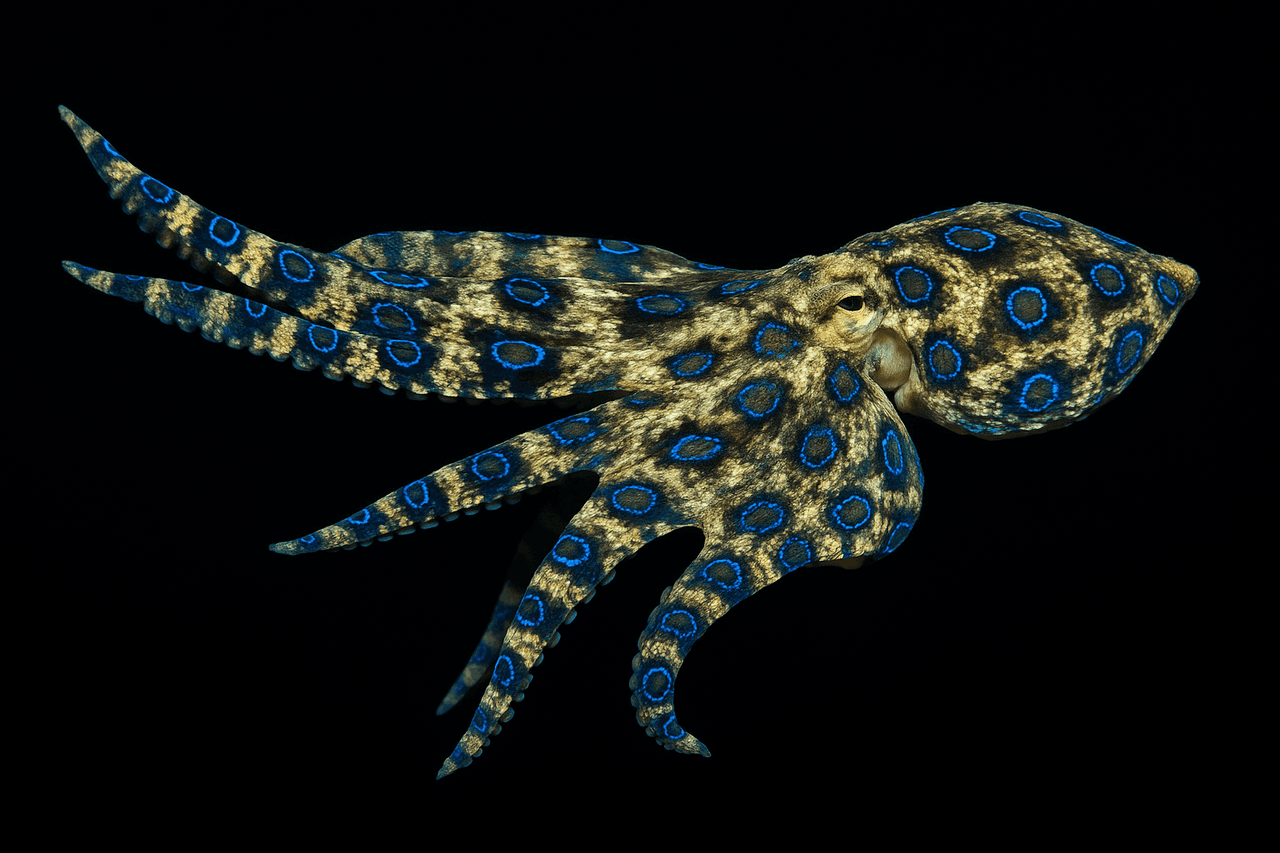
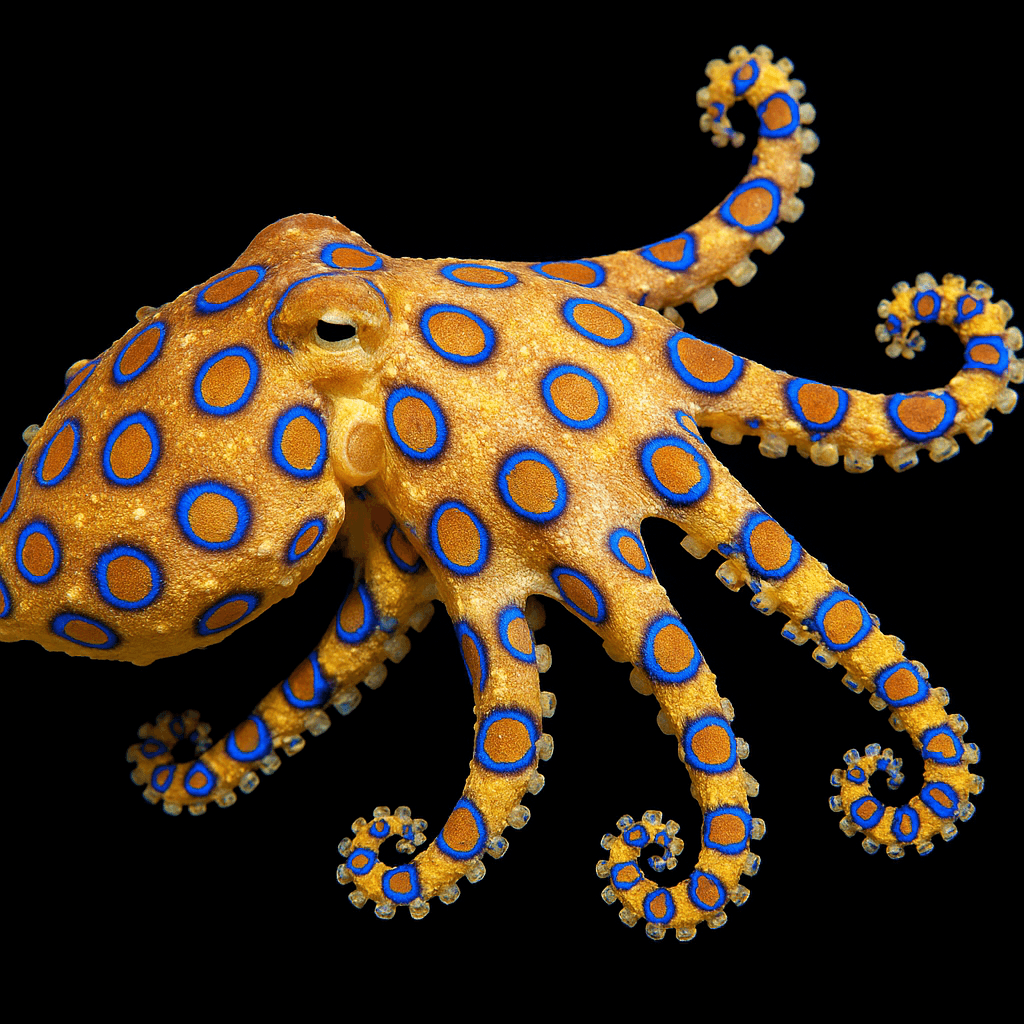
The blue-ringed octopus is a very small but highly striking marine creature. When threatened, the bright blue rings on its body instantly become prominent. These rings serve as a warning signal to predators: “Stay away from me!”

Blue-Ringed Octopus (Generated by Artificial Intelligence)


Where Does It Live?

This species of octopus inhabits warm coastal waters of the Indian and Pacific Oceans. It is commonly found along the coasts of Australia, Japan, the Philippines, and Indonesia. It prefers to hide among coral reefs, among seaweed, or between rocks.


What Does It Look Like?

Its body length, including its arms, measures 12–20 cm.


Normally, it is brown or yellowish in color.


When threatened, the bright blue rings on its body rapidly appear.


It is highly agile and can squeeze through very narrow spaces.


What Does It Eat?

Blue-ringed octopuses feed on crabs, shrimp, and small fish. They capture their prey with their arms and bite it with a hard, beak-like mouth.


Is It Poisonous?

Yes! This octopus carries one of the most potent venoms in nature: Tetrodotoxin (TTX).


It is extremely dangerous to humans.


Bites are often painless but can cause severe effects within minutes.


For this reason, touching these octopuses is highly risky.


Blue-Ringed Octopus (Generated by Artificial Intelligence)


Lifecycle

Blue-ringed octopuses have a very short lifespan: 1–2 years.


Females lay eggs only once during their lifetime.


During the incubation period (approximately six weeks), they carry the eggs beneath their bodies.


Shortly after hatching, the young begin life independently.

Don't Forget to Look at These!
🔬 Science And Technology
cat img
🏛 History And Culture
cat img
🎨 Art And Literature
cat img
image
Most Read
Thomas Edison
arrow
image
Last Added
Gezegenler Neden Yuvarlaktır?
arrow
ilham-notu-bg
INSPIRATION NOTE FOR CURIOUS KIDS!

Learning about marine life is very exciting. But remember! Touching some animals can be dangerous. Observing them from a distance and protecting them is the safest approach.

Who Wrote?
Kids Writing
AuthorSümeyye Akkanat TerzioğluDecember 2, 2025
bottom-bg-effect-bottom
bottom-bg-effect-top

Blue-ringed octopuses are small marine animals recognized by their bright blue rings and capable of secreting the deadly tetrodotoxin (TTX). This species, found in the Indian and Pacific Oceans, uses its potent venom to immobilize prey and protect itself from predators.

Bibliographies


Gözcelioğlu, Bülent. “Mavi Halkalı Ahtapot.” *TÜBİTAK Bilim ve Teknik.* (2021) Accessed July 31, 2025. https://e-dergi.tubitak.gov.tr/edergi/yazi.pdf?dergiKodu=4&cilt=54&sayi=1086&sayfa=82&yaziid=45095

Marinebio. "Blue-ringed Octopuses." Accessed July 31, 2025. https://www.marinebio.org/species/blue-ringed-octopuses/hapalochlaena-maculosa/

Natural History Museum. "The blue-ringed octopus: small, vibrant and exceptionally deadly." Accessed July 31, 2025. https://www.nhm.ac.uk/discover/blue-ringed-octopus-small-vibrant-deadly.html

ilham-notu-bg
ilham-notu-bg
ilham-notu-bg
HEYY!
Did You Know?
These?
Lamb
Lamb
Ask to Küre