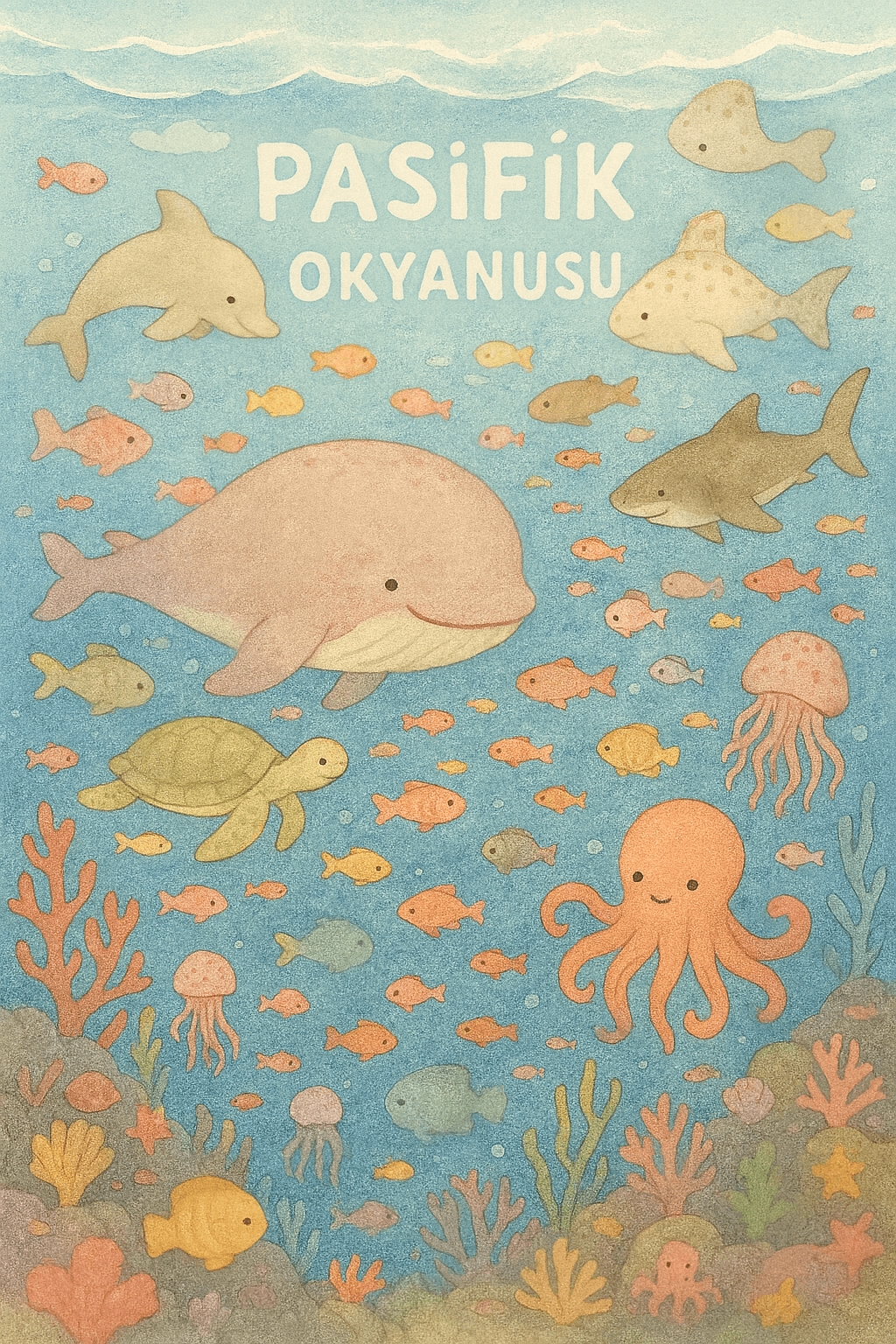




Pacific Ocean
The Pacific Ocean is the largest and deepest ocean on Earth, covering more than one-third of the planet’s surface! Due to its vast size, it contains thousands of islands. The Pacific is one of the most important bodies of water shaping our planet’s atmosphere, climate, and life.
🌎Where Is the Pacific Ocean Located?
The Pacific Ocean lies east of Asia and Australia and west of the American continents.
When you look at a map, you see a huge blue area between two major continents—that is the Pacific.
Famous islands such as Hawaii are located in the middle of this ocean. Japan, the Philippines, and New Zealand are also countries bordering the Pacific.

A child observing (generated by artificial intelligence)
🐠 What Life Exists in the Pacific?
The Pacific Ocean is one of the most biodiverse regions on Earth.
Here you will find:
- Colorful coral reefs
- Whales
- Dolphins
- Sea turtles
- Sharks
- Small but vital plankton
Corals act like the oceans’ forests, providing habitats for most marine life.
📏 How Deep Is the Pacific Ocean?
- The average depth of the Pacific Ocean is about 4,280 meters.
- Its deepest point, the Mariana Trench, reaches 10,984 meters, making it the deepest place on Earth.
- That equals 11 kilometers—so even if you turned Mount Everest upside down and placed it there, its peak would still be underwater!
📐 How Large Is the Pacific Ocean?
- The total surface area of the Pacific Ocean is 165 million square kilometers.
- This is larger than all the continents combined.
- It covers 32 percent of the Earth’s surface.
- More than 25,000 islands lie within the Pacific, outnumbering the total of all other oceans combined.
🔥 What Is the “Ring of Fire”?
- The Pacific coastlines host numerous volcanoes and earthquake zones.
- Scientists call this hazardous region the Pacific Ring of Fire.
- Seventy-five percent of the world’s active volcanoes are located here.
🌡️ The Pacific’s Major Role in Climate
- The Pacific carries a large portion of the planet’s heat and water vapor.
- About one-third of the world’s rainfall is generated by air currents originating over the Pacific.
- Phenomena such as El Niño and La Niña cause droughts in some regions and extreme rainfall in others.
🌊 Pacific Currents
The most important currents are:
- The Kuroshio Current: Warms the coasts of Japan.
- The California Current: Cools the western coast of the Americas.
- The Equatorial Currents: Guide the migration routes of whales.
These currents are vital for marine life and climate patterns.
🐚 Quick Facts About Biodiversity
- More than 600 species of coral are found in the Pacific.
- Approximately 2,000 new species are discovered in the ocean each year.
- The blue whale, the largest animal on Earth, lives in Pacific waters.
- The Pacific provides habitat for 70 percent of all marine life on the planet.
How Does the Pacific Ocean Influence the Atmosphere?
As the largest body of water on Earth, the Pacific plays a dominant role in shaping global climate.
For example:
- Warm water vapor rising from the Pacific generates rainfall.
- Atmospheric events known as El Niño and La Niña alter global temperatures and precipitation patterns.
- Storms and typhoons mostly form over the Pacific.
Therefore, the Pacific acts like the Earth’s “climate engine.”

Marine life in the Pacific Ocean (generated by artificial intelligence)
🧭 How Was the Pacific Ocean Discovered?
The discovery of the Pacific began thousands of years ago, when Pacific Islanders undertook long sea voyages to reach distant islands. Later, the famous explorer Ferdinand Magellan entered the ocean in 1520 and, finding its waters unusually calm, named it “Pacific,” meaning “peaceful.”