




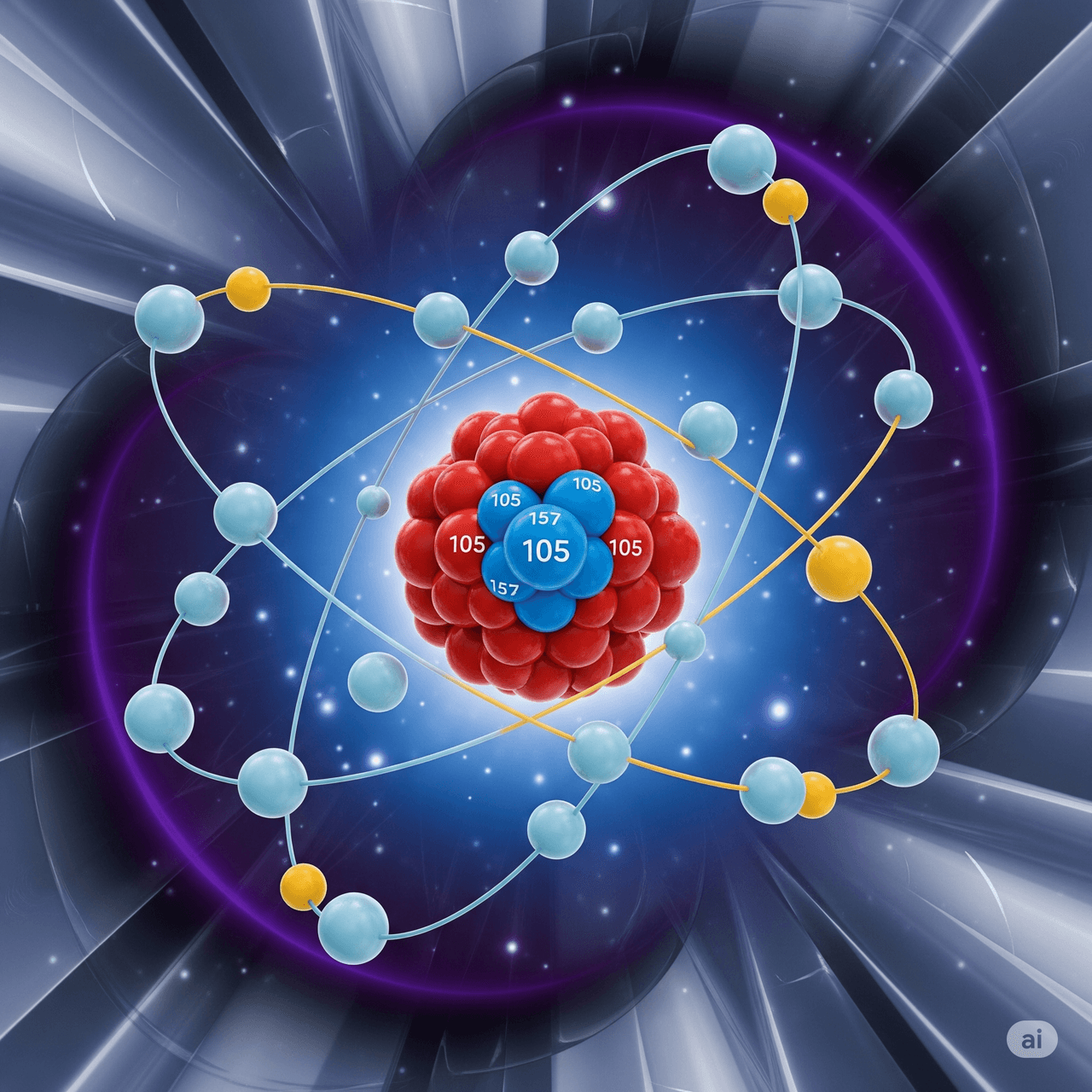
Dubnium Element
Dubnium is a synthetic element with the symbol Db and atomic number 105. It does not occur naturally and is produced only in laboratories. It is radioactive and has a very short half-life, so it is used exclusively in scientific research.
(Generated by Artificial Intelligence.)
History
Dubnium was synthesized artificially in the 1960s by Soviet and American scientists. Its name derives from the Joint Institute for Nuclear Research in Dubna, Russia. The discovery of this element marked a significant step in the study of superheavy elements.
Physical Properties
Dubnium is predicted to have a metallic appearance. However, due to the extremely small quantities produced in laboratory conditions, its physical properties have not been fully observed. Theoretically, it is a dense and hard metal.

(Generated by Artificial Intelligence.)
Chemical Properties
Dubnium belongs to the group of transition metals and exhibits chemical behavior similar to niobium and tantalum. Due to its radioactivity, its compounds are handled with great care in laboratory settings.
Applications
Dubnium has no practical applications. It is produced and used in only minute quantities for scientific research and to study the properties of superheavy elements.
Natural Occurrence
Dubnium does not occur in nature. It is produced entirely in laboratory environments through nuclear reactions. Consequently, obtaining and studying this element is both difficult and costly.
Scientific Importance and Future Perspectives
Dubnium is of great importance in the study of superheavy elements and atomic nuclei. In the future, investigating its properties may provide new insights in nuclear science and fundamental physics.