



Erzincan Museum
Erzincan Museum is located on Ordu Street, adjacent to the Erzincan Binali Yıldırım University Foundation, along the historic Silk Road. The museum building is a two-story architectural structure with a covered area of 2,030 square meters. Opened to the public on 3 May, the institution has safeguarded the region’s historical heritage. According to museum management data, the collection inventory comprises 2,337 artifacts, of which 387 are displayed in exhibition halls.【1】
Chronological Scope of the Collection and Civilizations
The museum’s collection encompasses portable cultural artifacts from the Urartian, Roman, Byzantine, Seljuk and Ottoman civilizations. The majority of archaeological finds date from the Urartian period. Exhibition areas feature ethnographic elements reflecting Erzincan’s local culture, including scale models of Kemaliye houses, traditional clothing, jewelry and handwoven kilims. The institution also includes interactive zones supported by thematic applications, informational panels and documentaries related to archaeological sites such as Altıntepe Castle and the Karas Village Kurgan Burial Mound.【2】
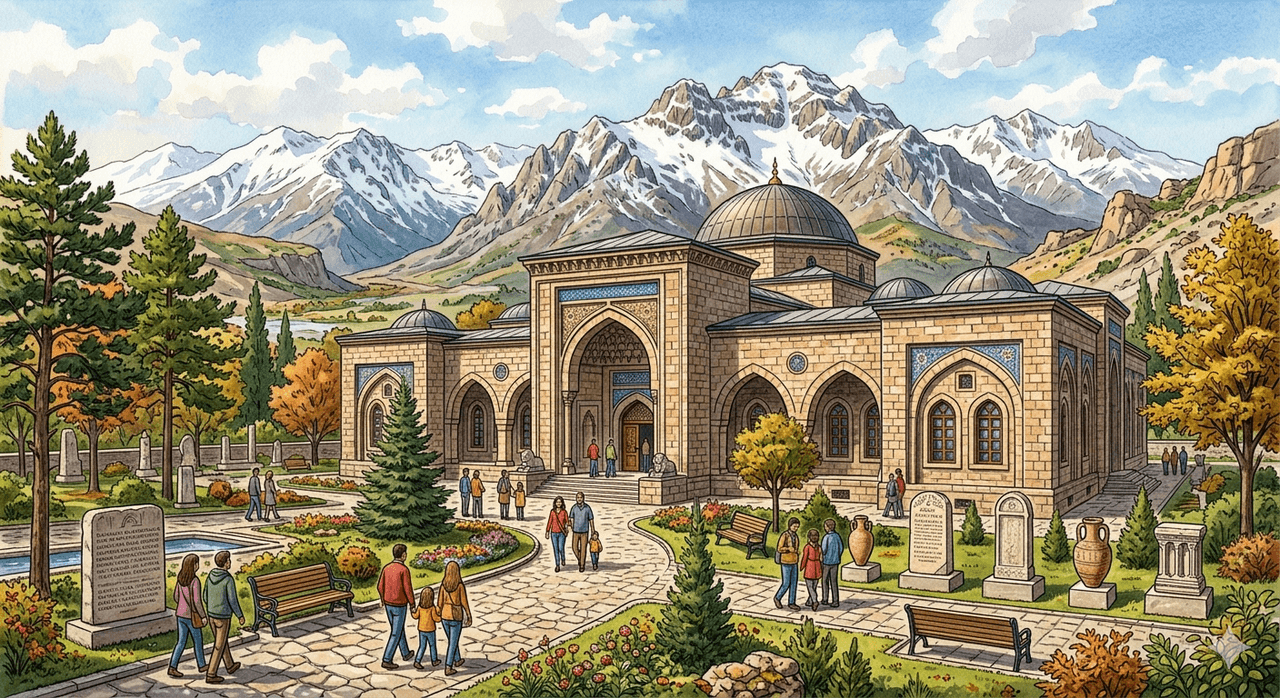
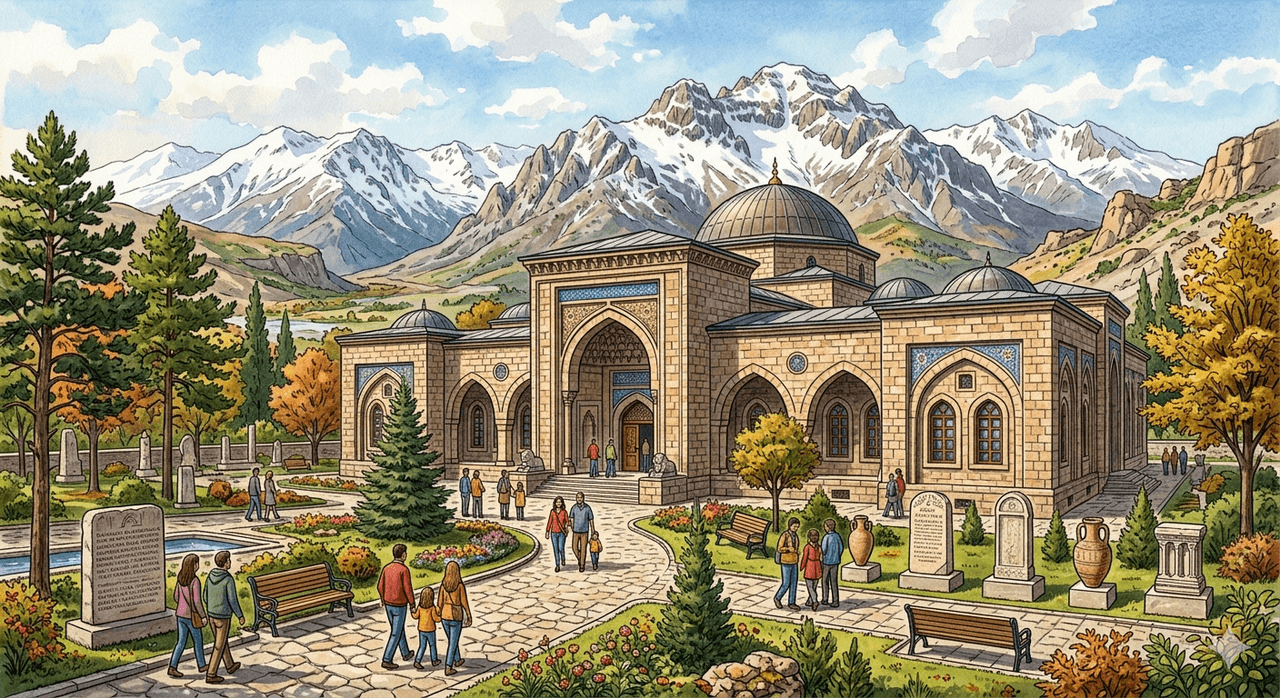
Visual representing Erzincan Museum (generated by artificial intelligence)
Altıntepe Discoveries and the Urartian Heritage
The archaeological foundation of the museum consists of artifacts excavated from the Altıntepe site, located 15 kilometers from the city center. These artifacts, dated to the 8th century BCE, include ivory decorative objects, metal helmets, shields, ceramics and wall paintings. Altıntepe is regarded as one of the best-preserved Urartian cities to survive to the present day, and museum reconstructions provide scientific insights into the social and military structures of that era.
Byzantine Coin Collection and Numismatic Studies
Numismatic studies have been conducted on 27 Byzantine coins registered in the museum’s inventory between 2009 and 2014. The chronological range of these coins spans from the reign of Emperor Justin I (518–527) to that of Constantine X (1059–1067). Of the examined specimens, 26 were minted in copper (follis and half-follis) and one in gold (histamenon). The coins were produced in the mints of Constantinople, Antioch and Nicomedia. Depictions on the coins include emperors in their period attire, religious figures, monograms and mint marks.
Medieval Ceramics and the Sgraffito Technique
In 2010, 28 medieval ceramics were added to the museum’s collection after being discovered stacked inside a storage vessel (pithos) during infrastructure works in Hamidiye Neighborhood. Of these, 24 were produced using the sgraffito (scratching) technique and four using a single-color glaze technique. The collection includes 11 plates, 14 bowls and three jugs. Decorative motifs on the ceramics, which resemble those of 12th and 13th century Anatolian Seljuk productions, feature geometric, botanical and fish patterns. The intact condition of the ceramics within a single vessel provides scientific evidence regarding the storage and transport of ceramics for commercial purposes during the medieval period.
Social Memory and the Earthquake Corner
The “Earthquake Corner” within the museum is a section dedicated to the city’s recent history. Models of public buildings destroyed in the 1939 Erzincan earthquake are exhibited to preserve the city’s collective memory. Since its opening, the museum has welcomed over 16,000 visitors in its first six months, functioning as an information center that brings the region’s history and cultural heritage to a broad public.
Citations
[1]
Anadolu Ajansı, “Erzincan Museum, which includes an earthquake corner, was visited by 16,000 people in six months,” 29 October 2023, access date: 5 April 2026,https://www.aa.com.tr/tr/kultur/deprem-kosesi-de-bulunan-erzincan-muzesini-6-ayda-16-bin-kisi-gezdi/3036675.
[2]
Muhammed Haluk Özkan and Muhammed Lütfi Kındığılı, “Erzincan Museum Byzantine Coins (2009–2014),” OANNES - Journal of International Ancient History Research 6, no. 1 (March 2024): 21–45, access date: 5 April 2026,https://dergipark.org.tr/en/download/article-file/3295351.