



George Frideric Handel
Have you ever thought that music can tell a story without words? George Frideric Handel was a composer who masterfully conveyed emotions through notes. His music was performed in grand palaces and intimate salons alike, and it is still played today. Let us now explore his life together!
👩🏻🍼Birth and Childhood
George Frideric Handel was born on 23 February 1685 in Halle, Germany. His father was a barber-surgeon who wished his son to pursue a different profession. Yet Handel’s heart belonged to music. As a child, he secretly practiced instruments at home, and his mother recognized his talent and supported him.

Young Handel attempting to play the violin at home (Image generated by artificial intelligence).
🎼Interest in Music and Education
Handel’s formal musical training began at an early age. During his studies, he developed his skills by playing the organ in churches and working with teachers. He later traveled to cities with vibrant musical scenes such as Hamburg and Italy, where he studied opera and the Baroque style. The experience he gained over the years made him a powerful composer, and he eventually settled in England.

Handel during his youth (Image generated by artificial intelligence).
🎹 Which Instruments Did He Play?
Handel is best known for his skill on the organ and the harpsichord (a keyboard instrument considered the predecessor of the piano). These instruments frequently feature prominently in his compositions. He also wrote compelling works for string and wind instruments, thanks to his deep understanding of orchestral textures.

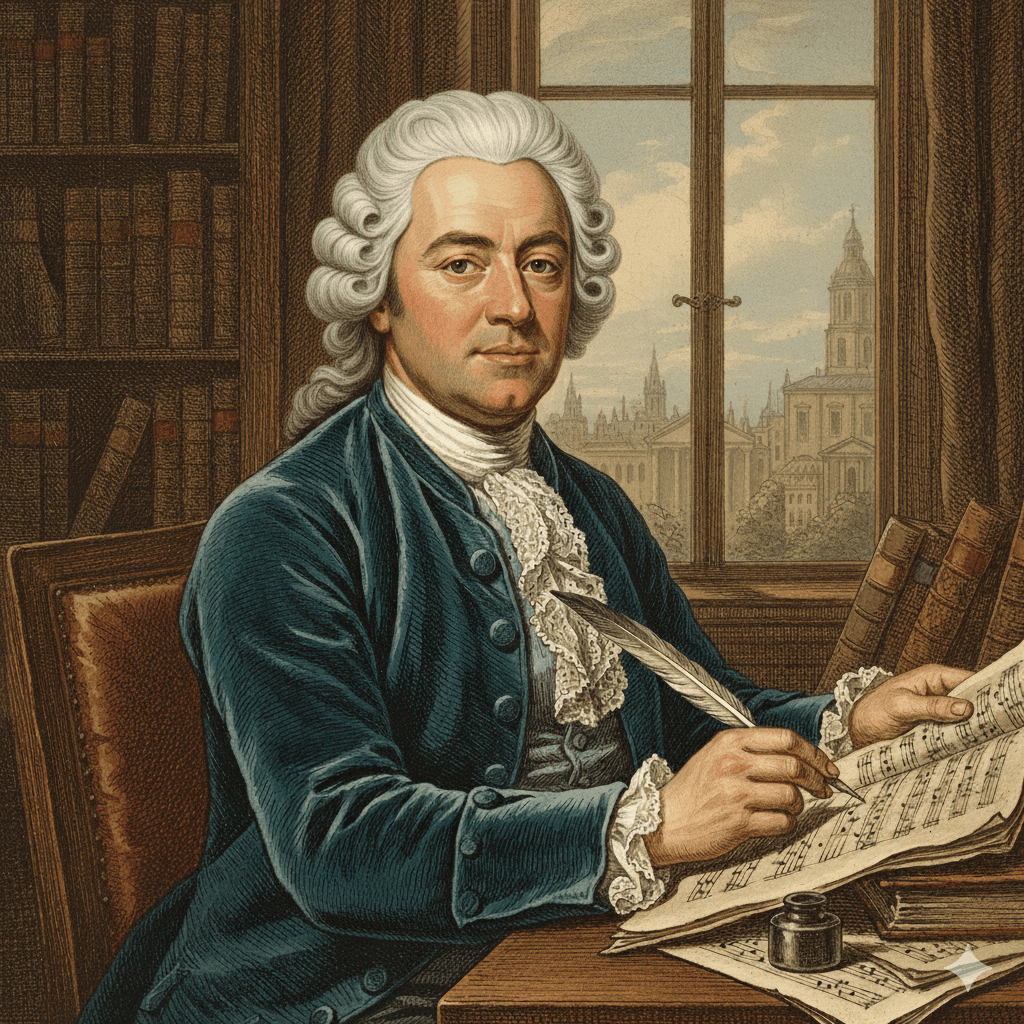
Handel composing new works (Image generated by artificial intelligence).
🏛️ What Did He Achieve?
In his youth, Handel studied opera in Italy and later achieved great success in England. In London, he composed music for the royal court, organized opera seasons, and captivated both the public and the nobility. Throughout his life, he composed operas, oratorios, and various instrumental works. Despite health problems in his later years, he continued to create until his death in 1759.
🎶 His Works and Style
Handel composed a vast number of works: operas, oratorios, cantatas, and instrumental pieces. His music typically features powerful melodies, dramatic moments, and large choral sections. Listening to his music evokes both the grandeur of courtly spectacle and the solemnity of religious ceremony, as his compositions were written for diverse purposes.

An oratorio scene from the 1600s (Image generated by artificial intelligence).
🌟 His Most Famous Works
🎵Messiah (1741): Handel’s most renowned oratorio. The “Hallelujah” chorus from this work is world-famous.
🎵Water Music & Music for the Royal Fireworks: These compositions were written for royal celebrations and remain widely beloved by audiences.
🎻 His Most Popular Work: Sarabande
Handel’s piece titled “Sarabande” is one of the most striking examples of Baroque elegance. With its slow, deliberate, and emotionally rich rhythm, it draws listeners into deep stillness. This piece continues to be frequently used in films and stage performances today.
Handel - Sarabande (Keyboard Suite in D Minor) (YouTube)
🌍 Handel’s Legacy Today
Handel’s works are still performed around the world; choirs and orchestras frequently include his oratorios and select pieces in their programs. Music scholars and conservatories also study his compositions, as Handel serves as a vital bridge between the Baroque era and the English oratorio tradition.