


This article was automatically translated from the original Turkish version.
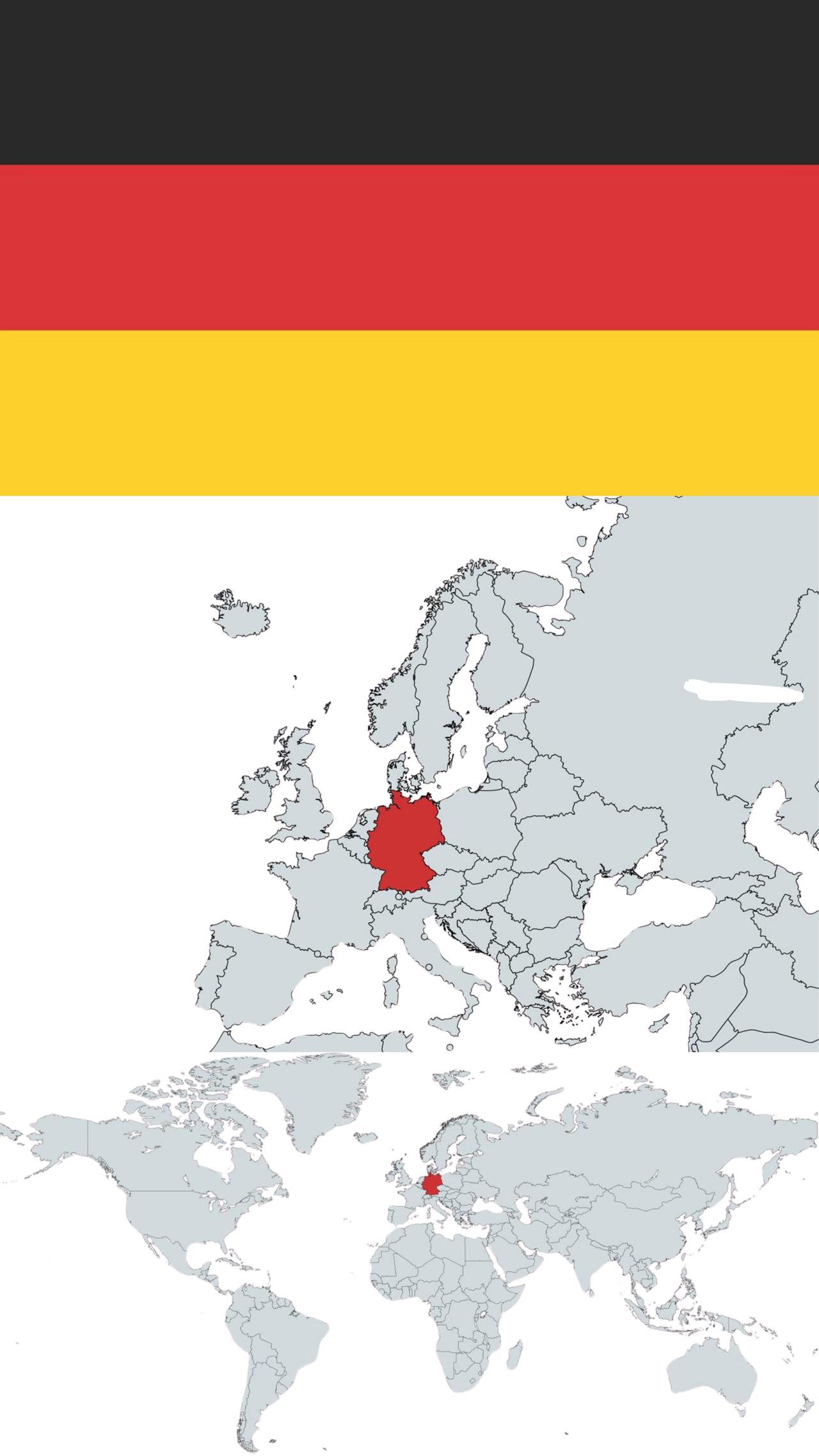
Official Name(s) | Federal Republic of Germany (Bundesrepublik Deutschland) | ||||||||
|---|---|---|---|---|---|---|---|---|---|
Form of Government(s) | Federal Parliamentary Republic | ||||||||
Capital(s) | Berlin | ||||||||
Official Language(s) | German | ||||||||
Area(s) | 357 022 km² | ||||||||
Population | 84 million (2024 estimate) | ||||||||
Currency(s) | Euro (€) (EUR) | ||||||||
Time Zone | UTC+1 (Winter) / UTC+2 (Summer) | ||||||||
GDP (2024) | 4.5 trillion USD | ||||||||
GDP Per Capita | 54,000 USD | ||||||||
Main Economic Sectors | Industry, Services, Automotive, Chemicals, Finance, Information Technology | ||||||||
Major Export Products | Automotive, Machinery, Chemical Products, Electronics, Steel | ||||||||
Major Trade Partners | China, United States, France, Netherlands, United Kingdom, Italy | ||||||||
Largest Cities | Berlin, Hamburg, Munich, Cologne, Frankfurt, Stuttgart | ||||||||
NATO Membership | Member since 1955 | ||||||||
EU Membership | Member since 1957 | ||||||||
Highest Point | Zugspitze (2,963 m) | ||||||||
Main Rivers | Rhine, Elbe, Danube, Weser, Oder | ||||||||
Tourist Attractions | Berlin Wall, Cologne Cathedral, Neuschwanstein Castle, Black Forest | ||||||||
Famous Festivals | Berlin Film Festival, Cologne Carnival | ||||||||
Famous Dishes | Bratwurst, Schnitzel, Pretzel, Sauerkraut, Kara Orman Pastası | ||||||||
Famous Artists/Philosophers | Goethe, Nietzsche, Kant, Beethoven, Bach, Wagner | ||||||||
Sports and Achievements | FIFA Dünya Kupası (4 times), Bundesliga, Formula 1, Olimpiyatlar | ||||||||
Country Code (Phone) | +49 | ||||||||
Internet Domain Name | .de | ||||||||
Germany is a federal republic located in Central Europe, covering an area of approximately 357,000 km² and recognized as one of the most influential countries in the continent politically, economically and culturally. It shares borders with Denmark to the north, Poland and the Czech Republic to the east, Austria and Switzerland to the south, and France, Luxembourg, Belgium and the Netherlands to the west. Germany’s diverse geography features extensive lowlands in the north, forested and hilly regions in the center, and elevated areas extending toward the Alps in the south. With a temperate climate, Germany evolved from the medieval Holy Roman Empire into a modern nation-state, playing a decisive role in shaping Europe’s political structure.

Flag of Germany
Germany is governed by a federal system composed of 16 states, with Berlin as its capital. As Europe’s largest economy, Germany holds a leading position in the fields of industry, technology and innovation. It is also a country renowned for its cultural heritage, contributions to academic research and artistic achievements, having been a pivotal actor in Europe’s political dynamics throughout history. Directly affected by global events such as the Second World War and the Holocaust, Germany adopted its current political structure with the reunification of East and West Germany in 1990. Through its economic strength, industrial infrastructure, innovative technologies and international cooperation, Germany continues to be a decisive actor on the global stage.
Germany’s national anthem is the third stanza of the song known as “Das Lied der Deutschen” (The Song of the Germans). The lyrics were written in 1841 by August Heinrich Hoffmann von Fallersleben, and the melody is derived from Joseph Haydn’s 1797 composition “Kaiserhymne” (Imperial Hymn), originally written for Emperor Francis II of Austria. Although the anthem originally began with the line “Deutschland, Deutschland über alles” (Germany, Germany above all), this stanza was no longer used as the national anthem after the Second World War. Instead, the third stanza was officially adopted as the national anthem.
The third stanza, now the official national anthem of the Federal Republic of Germany, begins with the words “Einigkeit und Recht und Freiheit” (Unity and Justice and Freedom). These lines symbolize Germany’s core values and reference the country’s unification process. This section was formally adopted as the national anthem by West Germany in 1952 to distance itself from the first stanza associated with Nazism, and it retained its status after German reunification in 1991.
The current lyrics emphasize Germany’s democratic values by affirming that unity, justice and freedom are fundamental to the well-being of the German people. The phrase “Einigkeit und Recht und Freiheit” has become a symbol of Germany’s federal structure and constitutional order, and it also appears as a motto on the edge of German euro coins.
The history of Germany encompasses a broad process from the Germanic tribes that shaped Europe to the Holy Roman Empire, the Kingdom of Prussia and the formation of modern Germany. From the Middle Ages to the present, Germany has been involved in both the wars that influenced Europe’s political balance and the economic and cultural developments that shaped the continent.
Germany’s historical roots lie in the Germanic tribes inhabiting its territory in antiquity. In 9 AD, the Battle of the Teutoburg Forest, fought against the Roman Empire, secured the independence of the Germanic tribes and prevented the region from falling under Roman rule. In the 8th century, the Germanic tribes united under the Frankish Kingdom and, especially during the reign of Charlemagne, became the most powerful political entity in Western Europe. When the Frankish Kingdom was divided by the Treaty of Verdun in 843, the eastern portion became known as the East Frankish Kingdom, which later formed the foundation of modern Germany.
In the 10th century, Otto I (936–973) was crowned Holy Roman Emperor by the Pope in 962, and this empire endured for nearly a thousand years as one of Europe’s most powerful political entities. However, the Holy Roman Empire lacked a centralized structure and remained fragmented among principalities, duchies and city-states. In the 16th century, the Protestant Reformation led by Martin Luther triggered a major religious schism against the Catholic Church, leading to the rapid spread of Protestantism throughout Germany.

Portrait of Martin Luther, 1529, displayed at St. Anna Church
【1】
The 18th century was marked by intense rivalry between the Austrian Habsburgs and the Kingdom of Prussia. Under Frederick II (Frederick the Great), Prussia became a powerful military and economic state. In the early 19th century, Napoleon’s reorganization of Europe led to the dissolution of the Holy Roman Empire in 1806, replaced by a confederation of German states.
The process of achieving German political unity was led by Prussia under Otto von Bismarck. After the Austro-Prussian War of 1866, Austria was excluded from German affairs. Following the Franco-Prussian War of 1871, the German Empire was proclaimed at the Palace of Versailles. Wilhelm I became Germany’s first emperor, completing the unification of Germany.
Germany’s rise altered the balance of power in Europe, turning the continent into a stage for major wars in the 20th century. During World War I (1914–1918), Germany allied with Austria-Hungary and the Ottoman Empire as part of the Central Powers. However, after the war, the Treaty of Versailles (1919) imposed severe economic and military penalties on Germany. This humiliation fueled economic crises and social unrest, creating fertile ground for the rise of the Nazi regime.

Newspaper front page announcing the signing of the Treaty of Versailles
【2】
World War II (1939–1945) began as a result of Nazi Germany’s expansionist policies under Adolf Hitler. The invasion of Poland triggered the war. Although Germany achieved rapid advances in the early stages of the war, it began to retreat after pivotal defeats such as the Battle of Stalingrad and the Normandy landings in 1943. In 1945, the war ended with the fall of Berlin, and Germany was occupied by the Allied Powers.

Image of Hitler at a 1938 Nuremberg Rally
【3】
After World War II, Germany was divided into East Germany (German Democratic Republic – GDR) and West Germany (Federal Republic of Germany – FRG). East Germany was governed under a communist regime under Soviet control, while West Germany adopted a democratic system and experienced rapid economic growth. In 1961, the Berlin Wall was constructed, completely severing movement between the two Germanys. Throughout the Cold War, the two Germanys developed under separate political systems.
The fall of the Berlin Wall in 1989, coinciding with the collapse of communist regimes across Eastern Europe, paved the way for German reunification. On 3 October 1990, East and West Germany merged to form the present-day Federal Republic of Germany. During this process, Germany played a leading role in the expansion and economic integration of the European Union. Today, Germany possesses Europe’s largest economy and holds a significant position in global politics.
The historical processes, political transformations and economic successes of Germany have established it as a global power. Due to its central position in European history, Germany remains a major actor influencing both regional and global events.

Demolition of the Berlin Wall in 1989: Celebrations at Brandenburg Gate
Germany is a country located in Central Europe and one of the most geographically diverse regions on the continent. With an area of approximately 357,000 km², Germany is among the largest countries in Europe. It shares borders with Poland and the Czech Republic to the east, Austria and Switzerland to the south, France, Luxembourg, Belgium and the Netherlands to the west, and Denmark to the north. Its northern coastline is bordered by the North Sea and the Baltic Sea. Its geography can be divided into three main regions: the North German Plain, the Central German Uplands and the Southern German Alps.

Satellite image of Germany
Germany’s landforms are divided into three main regions from north to south:
This region extends from the Danish border to the Elbe River and consists of low-lying plains. The coasts of the North Sea and the Baltic Sea are key shaping features. The Frisian Islands and Rügen Island are notable settlements contributing to the coastal geography. Deposited by glaciers during the Quaternary period, this region contains marshes, lakes and fertile agricultural land.
Located in central Germany, this region includes numerous mountain ranges and forested areas. The Harz Mountains, Thuringian Forest, Erzgebirge, Eifel and Hunsrück are key features that give the region its rugged character. This area hosts some of Germany’s industrial centers. Major rivers such as the Rhine, Main and Weser are vital water resources.
Germany’s highest elevations are found in the states of Bavaria and Baden-Württemberg. This region, part of the northern extension of the Alps, includes the Zugspitze (2,963 m), the country’s highest peak. Southern Germany, with its lakes and mountainous terrain, is of great importance for tourism. Bodensee (Lake Constance) and Chiemsee are among the largest lakes in the region.

【4】
Germany lies in the transition zone between oceanic and continental climates. The climate is mild and humid in the north due to maritime influence, while inland areas experience a colder, drier continental climate.
Average temperatures range from -5°C to 3°C in winter and 20–25°C in summer. The regions receiving the most rainfall are the Alps and the Black Forest.
Germany is home to major and significant rivers. Its water resources are of great importance for internal and external trade, transportation and energy production.
Among Germany’s largest lakes are Lake Constance (Bodensee), Müritz and Chiemsee. Lake Constance is the largest inland body of water shared with Switzerland and Austria.

Castles and fortresses along the Rhine River
【5】
Germany is rich in fertile agricultural land, coal, lignite, natural gas, iron and forest products. The Ruhr Valley is one of the country’s most important coal and steel production centers. Extensive farmland is found in the North German Plain, where wheat, barley, sugar beet and potatoes are primarily cultivated. Germany’s forests cover approximately 30% of its territory, with the Black Forest (Schwarzwald) and Bavarian Forests being notable ecological areas.
Germany possesses rich biodiversity. Forests, rivers, lakes and coastal ecosystems form vital natural habitats across the country.
Germany places great importance on conservation policies. Numerous natural parks and protected areas are listed on UNESCO’s World Heritage List. The Saxon Switzerland National Park, Harz National Park and Bavarian Forest are among the country’s largest natural conservation areas.
With a population of approximately 84 million, Germany is the most populous country in the European Union and one of the continent’s largest economic and political powers. Its population structure has undergone significant transformations throughout history due to migration, industrialization and demographic changes. Natural population growth is low, and population increase is largely driven by migration. Germany’s demographic structure can be examined through key aspects such as population density, age distribution, ethnic composition, migration, urbanization and social structure.
As of 2024, Germany’s population is approximately 84 million, placing it among the world’s 20 most populous countries.
Germany has one of the oldest populations in Europe, with an average age of 45.
Germany has a rapidly aging population due to low birth rates and increasing life expectancy. The growing elderly population places significant pressure on social security systems and pension policies. To address the labor shortage, Germany relies heavily on immigrant labor.
Germany is one of the European countries with the largest immigrant-origin population.
Migration has created a significant demographic shift in Germany. After World War II, during the economic expansion period (1950–1970), Germany recruited workers under the “Gastarbeiter” (guest worker) program, primarily from Turkey, Italy, Greece and Spain. During the 2015 refugee crisis, Germany accepted over one million Syrian and Afghan refugees.
As a result of migration, Germany has developed a multicultural society, particularly in major cities where ethnic diversity has increased. However, the integration of immigrants remains one of Germany’s most important social challenges.
Germany is a highly urbanized country.
The Ruhr Region, encompassing cities such as Essen, Dortmund, Duisburg and Düsseldorf, is one of the largest metropolitan areas in Europe. These areas, with intense economic and industrial activity, serve as Germany’s economic engines.
Although Germany is a secular state, a large portion of the population identifies with specific religious groups.
The proportion of non-religious people is especially high in the eastern states (former East Germany).
This trend implies that Germany will need to rely on increased immigration and family support policies in the future.
Germany holds a central position in international relations as Europe’s largest economy and a major actor in global politics. Active in global organizations such as the European Union (EU), NATO, the United Nations (UN) and the G7/G20, Germany conducts its foreign policy within a framework based on peace, economic cooperation and multilateral diplomacy. Germany’s foreign relations are shaped by its historical legacy, economic strength and leadership role in Europe.

Symbol of Germany’s European Integration: Federal Parliament and EU Flag
【6】
Germany is one of the founding members of the European Union and plays a leading role in its economic and political integration.
Germany plays a decisive role in EU policies on climate change, migration management, economy and foreign affairs, promoting multilateral diplomacy to strengthen the EU as a global power.
Germany has been a NATO member since 1955 and has been one of the most important allies of the Western Bloc since World War II.
However, Germany’s role within NATO has occasionally been criticized. The United States has urged Germany to increase defense spending and assume greater military responsibility. Germany has historically maintained a policy of limiting its military power due to historical reasons but has recently adopted a more active defense policy.
Germany is an active actor within the United Nations and is among the countries seeking permanent membership.
Germany supports reform of global governance within the UN and advocates for a fairer representation in the Security Council.

Chancellor Olaf Scholz speaking at the United Nations General Assembly
【7】
Relations between Germany and France have evolved from historical conflicts to diplomatic cooperation.
Germany-France relations are regarded as one of the most important bilateral relationships determining the future of the European Union.
Germany’s relations with Russia have a complex structure involving historical, economic and political factors.
Since the Russia-Ukraine War, Germany has pursued a policy of energy independence and adopted a more active stance on military assistance.
Relations between Germany and China have been shaped primarily by economic cooperation.
Although Germany does not fully align with the United States’ hardline stance toward China, it seeks to balance China’s global economic influence.
Relations between Germany and Turkey are strong in historical, economic and migration contexts.

Flags of Turkey and Germany
Germany is a key country in Turkey’s relations with Europe, maintaining a strategic partnership on migration, trade and security.
Germany places importance on peace, development and humanitarian aid policies in Africa, Latin America and the Middle East.
Germany pursues a peaceful and diplomacy-oriented foreign policy on a global scale.
Germany’s armed forces are known as the Bundeswehr and consist of five main components: army, air force, navy, cyber and special forces. Although Germany is a key member of NATO and Europe’s largest economy, it has historically limited its military due to historical reasons. However, in recent years, Germany has taken significant steps to strengthen its military in response to the Russia-Ukraine War, global security threats and its responsibilities within NATO.

Bundeswehr in front of the Reichstag
【8】
The German military was established in 1955 by West Germany and adopted its current structure after the 1990 reunification, incorporating the East German army (Nationale Volksarmee).
The Bundeswehr consists of five main branches:
The German Army is a vital component of NATO’s defense capabilities in Europe.
The German Air Force is equipped with advanced technology and modern fighter aircraft and air defense systems.
The German Navy operates to ensure NATO’s maritime security in the North Sea and Baltic Sea.

Bundeswehr Navy
【9】
The Cyber and Information Space Command, established in 2017, safeguards Germany’s digital security.
The special forces unit was established for counterterrorism, intelligence operations and high-risk missions.
Germany is a key member of NATO and plays a critical role in European defense policies.
In recent years, following Russia’s invasion of Ukraine, Germany has increased its military spending and taken a more active role in European defense.
Historically, Germany pursued a policy of limiting its military power but has recently decided to increase defense spending and modernization projects.
Germany maintains a defense-oriented military, constitutionally prohibited from direct warfare. However, it supports NATO and UN peace operations.
Germany does not possess nuclear weapons but participates in NATO’s nuclear sharing program.
Germany possesses Europe’s largest and the world’s fourth-largest economy, and is one of the most important actors in the global economy due to its industry, exports and innovation power. Its advanced infrastructure, high-tech production systems and strong industrial sector have made Germany one of the world’s most competitive economies. The automotive, mechanical engineering, chemical, pharmaceutical, financial and information technology sectors are the foundational pillars of Germany’s economic growth.
Germany is a major player in global trade with strong economic ties to European and Asian markets.
Germany’s economy consists of industry, services and agriculture.
Germany is a global leader in industrial production and engineering.
Germany is making significant investments in artificial intelligence, digitalization and automation technologies under the “Industry 4.0” initiative.
Germany’s services sector accounts for approximately 70% of its GDP.
Although Germany has advanced agricultural technology, agriculture accounts for a small share of the economy (1–2%).
Germany is the world’s third-largest exporter and fourth-largest importer.
Germany is regarded as the economic engine of the European Union.
Germany’s labor market consists of highly educated and skilled workers.
Germany encourages foreign labor migration to address labor shortages. New visa programs are being implemented for engineers, IT specialists, healthcare workers and technical personnel.
Germany is among the world leaders in renewable energy and environmentally friendly economies.
Although Germany’s economy is strong, it faces several major challenges:
However, Germany is taking significant steps to overcome these challenges through high-tech investments, industrial innovation and a strong economic infrastructure.
Germany is one of Europe’s most visited countries, known for its historic cities, natural beauty, cultural heritage and industrial tourism. As of 2023, Germany welcomed approximately 40 million international visitors annually, placing it among the world’s most popular tourist destinations. The tourism sector makes a significant contribution to the national economy, accounting for approximately 4% of Germany’s GDP.
Germany offers a wide variety of tourist destinations due to its historical heritage, natural beauty and cultural events.
Berlin is one of Germany’s most popular tourist cities due to its historical structures, art galleries and cultural events.
Bavaria is one of Germany’s most tourist-rich regions, famous for its historic towns, natural beauty and renowned festivals.

【10】

【11】
Germany attracts tourists with festivals, concerts and cultural events held throughout the year.

【12】
Germany is renowned for its spas and health tourism centers.
Germany hosts the world’s largest industrial and trade fairs.
Additionally, factories and museums of brands such as BMW, Mercedes-Benz and Volkswagen attract significant industrial tourism interest.

Frankfurt Book Fair
【13】
Germany has a well-developed transportation network for tourists.
The tourism sector is a vital component of Germany’s economy.
Germany is developing projects to make tourism more sustainable, including eco-hotels, green energy use and nature tourism initiatives.
Germany possesses one of Europe’s richest cultural heritages, rooted in its deep history, art, philosophy, music, literature and traditions. As the leading country among German-speaking nations in cultural and academic production, Germany has had a worldwide impact in architecture, music, philosophy, literature and cuisine. The country has undergone a broad cultural evolution from the Holy Roman Empire to modern Germany and has made significant contributions to science and thought throughout this process.

Walk of Ideas – Monument to German Thinkers and Writers (Berlin)
【14】
Germany has been home to many of the world’s greatest writers.
German-language literature has led numerous literary movements, including Romanticism, Expressionism and Modernism, leaving deep influences on world literature.
Germany is one of the countries that has produced Europe’s most important philosophers.
These philosophers have made significant contributions to European and global intellectual history, influencing areas from modern politics to moral philosophy.
Germany has been home to some of the greatest composers in classical music.
In modern music, Germany pioneered electronic music, with bands like Kraftwerk leaving a major impact on the global music scene.
Cities such as Berlin and Hamburg stand out as cultural centers of Europe through their theaters, operas and classical music concerts.
Germany features many different architectural styles from the Middle Ages to the present.
Cities such as Berlin, Hamburg and Munich possess a unique architectural fabric that combines historical and modern structures.

【15】
Germany preserves its cultural diversity by hosting various regional festivals and celebrations throughout the year.
German cuisine is centered on meat and potatoes and is famous for its variety of breads.

【16】
Germany holds a significant global position in sports, especially football.
Germany has also produced successful films and television series, and the Berlin International Film Festival (Berlinale) holds major global prestige.
Berlin Citysam. "Germany - Land of Ideas." Accessed February 27, 2025. https://www.berlin.citysam.de/fotos-berlin/germany-land-of-ideas-10.htm.
Berlin.de. "Official City Portal." Accessed February 27, 2025. Berlin.de.
Brown, Lauren. “Frankfurt Book Fair’s Head of PR and Communications Kathrin Grün Steps Down.” *The Bookseller*, December 1, 2022. https://www.thebookseller.com/news/frankfurt-book-fairs-head-of-pr-and-communications-kathrin-grun-steps-down.
Bundesregierung.de. “Federal Government Information.” Accessed February 27, 2025. Bundesregierung.
Bundeswehr. *Mission and Tasks of the Bundeswehr.* Accessed February 28, 2025. https://www.bundeswehr.de/en/about-bundeswehr/mission-and-tasks-bundeswehr.
Bundeswehr.de. "German Armed Forces." Accessed February 27, 2025. Bundeswehr.de.
Deutsche UNESCO-Kommission. *Schwarzwald.* Accessed February 28, 2025.
Deutschland.de. "Publisher Information." Accessed February 27, 2025. Deutschland.de.
Ernst, Michael-Reiner. *Feiernde Menschen auf der Panzermauer am Brandenburger Tor am Tag nach dem Mauerfall, 10. November 1989.* Stiftung Berliner Mauer. Accessed February 28, 2025. https://www.stiftung-berliner-mauer.de/de/themen/die-berliner-mauer.
Frankfurt.de. "City of Frankfurt." Accessed February 27, 2025. Frankfurt.de.
Germany Travel. "Home." Accessed February 27, 2025. Germany Travel.
Gracchus, Tiberius. “Alman Federal Meclisi Önünde Avrupa Bayrağı Dalgalanıyor.” deutschland.de. Accessed February 28, 2025. https://www.deutschland.de/tr/topic/politika/alman-birligi-gunu-almanyada-ulusal-resmi-tatil.
Heimat Schwarzwald. "Original Schwarzwälder Kirschtorte." Accessed February 28, 2025. https://heimatschwarzwald.de/original-schwarzwaelder-kirschtorte/.
Imperial War Museums. *Shadows of the Past: German Colour Photographs, 1937-1939.* Accessed February 28, 2025. https://www.iwm.org.uk/collections/item/object/205118638.
Kallen2021. “Newspaper Front Page Declaring the Signing of the Treaty of Versailles.” World History Encyclopedia. Accessed March 20, 2024. https://www.worldhistory.org/image/18728/newspaper-front-page-declaring-the-signing-of-the/.
Koeln.de. "Impressum." Accessed February 27, 2025. Koeln.de.
Koelner-Dom.de. "Kölner Dom." Accessed February 27, 2025. Koelner-Dom.de.
MFA Turkey. "Germany Overview." Accessed February 27, 2025. MFA Turkey.
Muenchen.de. "Official City Portal." Accessed February 27, 2025. Muenchen.de.
Neuschwanstein.de. "Official Website of Neuschwanstein Castle." Accessed February 27, 2025. Neuschwanstein.de.
Segovia, Sergio Andres. *Martin Luther.* World History Encyclopedia, June 17, 2019.
Staatliche Museen zu Berlin. "Pergamonmuseum." Accessed February 27, 2025. Pergamonmuseum.
Statistisches Bundesamt (Destatis). "German Statistics." Accessed February 27, 2025. Destatis.
Study in Germany. Heidelberg. Accessed February 28, 2025. https://www.study-in-germany.de/en/germany/cities/heidelberg/.
Tourismus Baden-Württemberg. "Urlaubsregion Bodensee." Accessed February 28, 2025. https://www.tourismus-bw.de/regionen-und-staedte/regionen/bodensee.
picture alliance/dpa. “Almanya Şansölyesi Scholz BM’de Konuşma Yapıyor.” *deutschland.de.* Accessed February 28, 2025. https://www.deutschland.de/tr/topic/politika/almanya-2023-bmde-50-yillik-uye.
[1]
Sergio Andres Segovia, "Martin Luther," World History Encyclopedia, 17 June 2019, https://www.worldhistory.org/image/10937/martin-luther/.
[2]
Kallen, 2021, "Newspaper Front Page Declaring the Signing of the Treaty of Versailles," World History Encyclopedia, last updated 20 March 2024, https://www.worldhistory.org/image/18728/newspaper-front-page-declaring-the-signing-of-the/.
[3]
Shadows of the Past: German Colour Photographs, 1937–1939, Imperial War Museums, accessed 28 February 2025, https://www.iwm.org.uk/collections/item/object/205118638.
[4]
"Vacation Region Bodensee," Tourismus Baden-Württemberg, accessed 28 February 2025, https://www.tourismus-bw.de/regionen-und-staedte/regionen/bodensee.
[5]
"Magic by the River: Dragons, Knights and Courageous Maidens," Germany Travel, accessed 28 February 2025, https://www.germany.travel/en/inspiring-germany/magic-by-the-river-dragons-knights-and-courageous-maidens.html.
[6]
Tiberius Gracchus, “European Flag Flying Before the German Federal Parliament,” deutschland.de, accessed 28 February 2025, https://www.deutschland.de/tr/topic/politika/alman-birligi-gunu-almanyada-ulusal-resmi-tatil.
[7]
picture alliance/dpa, "German Chancellor Scholz Speaks at the UN," deutschland.de, accessed 28 February 2025, https://www.deutschland.de/tr/topic/politika/almanya-2023-bmde-50-yillik-uye
[8]
"Mission and Tasks of the Bundeswehr," Bundeswehr, accessed 28 February 2025, https://www.bundeswehr.de/en/about-bundeswehr/mission-and-tasks-bundeswehr.
[9]
"Bundeswehr Uniforms," Bundeswehr, accessed 28 February 2025, https://www.bundeswehr.de/en/about-bundeswehr/identity-of-the-bundeswehr/bundeswehr-uniforms.
[10]
"Heidelberg," Study in Germany, accessed 28 February 2025, https://www.study-in-germany.de/en/germany/cities/heidelberg/.
[11]
"Schwarzwald," Deutsche UNESCO-Kommission, accessed 28 February 2025, https://www.unesco.de/staette/schwarzwald/.
[12]
Germany and Cinema: Ten Facts," deutschland.de, last updated 10 February 2025, https://www.deutschland.de/tr/topic/kultur/sinema-ulkesi-almanya.
[13]
Lauren Brown, "Frankfurt Book Fair’s Head of PR and Communications Kathrin Grün Steps Down," The Bookseller, 1 December 2022, https://www.thebookseller.com/news/frankfurt-book-fairs-head-of-pr-and-communications-kathrin-grun-steps-down.
[14]
Germany – Land of Ideas, Berlin Citysam, accessed February 27, 2025, https://www.berlin.citysam.de/fotos-berlin/germany-land-of-ideas-10.htm.
[15]
"Cologne Cathedral," koeln.de, photo: IMAGO / Marc John, accessed 28 February 2025, https://www.koeln.de/tourismus/sehenswertes/koelner-dom/.
[16]
"Original Schwarzwälder Kirschtorte," Heimat Schwarzwald, accessed 28 February 2025, https://heimatschwarzwald.de/original-schwarzwaelder-kirschtorte/.


Official Name(s) | Federal Republic of Germany (Bundesrepublik Deutschland) | ||||||||
|---|---|---|---|---|---|---|---|---|---|
Form of Government(s) | Federal Parliamentary Republic | ||||||||
Capital(s) | Berlin | ||||||||
Official Language(s) | German | ||||||||
Area(s) | 357 022 km² | ||||||||
Population | 84 million (2024 estimate) | ||||||||
Currency(s) | Euro (€) (EUR) | ||||||||
Time Zone | UTC+1 (Winter) / UTC+2 (Summer) | ||||||||
GDP (2024) | 4.5 trillion USD | ||||||||
GDP Per Capita | 54,000 USD | ||||||||
Main Economic Sectors | Industry, Services, Automotive, Chemicals, Finance, Information Technology | ||||||||
Major Export Products | Automotive, Machinery, Chemical Products, Electronics, Steel | ||||||||
Major Trade Partners | China, United States, France, Netherlands, United Kingdom, Italy | ||||||||
Largest Cities | Berlin, Hamburg, Munich, Cologne, Frankfurt, Stuttgart | ||||||||
NATO Membership | Member since 1955 | ||||||||
EU Membership | Member since 1957 | ||||||||
Highest Point | Zugspitze (2,963 m) | ||||||||
Main Rivers | Rhine, Elbe, Danube, Weser, Oder | ||||||||
Tourist Attractions | Berlin Wall, Cologne Cathedral, Neuschwanstein Castle, Black Forest | ||||||||
Famous Festivals | Berlin Film Festival, Cologne Carnival | ||||||||
Famous Dishes | Bratwurst, Schnitzel, Pretzel, Sauerkraut, Kara Orman Pastası | ||||||||
Famous Artists/Philosophers | Goethe, Nietzsche, Kant, Beethoven, Bach, Wagner | ||||||||
Sports and Achievements | FIFA Dünya Kupası (4 times), Bundesliga, Formula 1, Olimpiyatlar | ||||||||
Country Code (Phone) | +49 | ||||||||
Internet Domain Name | .de | ||||||||
Germany’s National Anthem
History of Germany
Early Period and the Middle Ages
Foundations of Modern Germany: Prussia and Unification
World War I and World War II
The Cold War and the Division of Germany
German Reunification and the Present
Geography of Germany
Landforms
North German Plain
Central German Uplands
Southern German Alps and Bavarian Plateau
Climate
Rivers and Lakes
Natural Resources and Agriculture
Biodiversity
Demographics of Germany
Population and Density
Age Distribution and Aging Population
Ethnic Composition and Migration
Urbanization and Major Cities
Religious Distribution
Birth Rates and Demographic Outlook
Germany’s International Relations
Relations with the European Union
NATO and Transatlantic Relations
United Nations and Global Diplomacy
Germany-France Relations
Germany-Russia Relations
Germany-China Relations
Germany-Turkey Relations
Germany’s Policies in Africa, Latin America and the Middle East
Germany’s Military (Bundeswehr)
General Structure of the Bundeswehr
Command Structures of the Bundeswehr
Army (Heer)
Air Force (Luftwaffe)
Navy (Marine)
Cyber and Information Space Command (Cyber- und Informationsraum - CIR)
Special Forces (Kommando Spezialkräfte - KSK)
Germany’s Role in NATO and European Security
Germany’s Defense Policies and Future Plans
Military Expenditures
European Army and EU Defense Cooperation
Germany’s Military Interventions and Peace Missions
Germany’s Nuclear Policy
Germany’s Economy
Overview of Germany’s Economy
Structure of Germany’s Economy
Industry and Manufacturing
Services Sector
Agriculture and Food Sector
Germany’s Foreign Trade
Germany’s Major Export Products
Germany’s Major Import Products
Germany’s Major Trading Partners
Germany and the European Union Economy
Germany’s Labor Market
Germany’s Energy Policies
Germany’s Economic Future and Challenges
Germany’s Tourism
Tourist Attractions in Germany
Berlin: The Capital of History and Culture
Bavaria: Nature and Castles
Rhine Valley and Romantic Road (Romantische Straße)
Hamburg: Port and Modern Culture
Cologne Region
Black Forest (Schwarzwald)
Cultural and Event Tourism in Germany
Germany’s Health and Thermal Tourism
Germany’s Industrial and Business Tourism
Transportation and Tourism Infrastructure in Germany
Germany’s Tourism Economy
Germany’s Culture
Germany’s Art and Literature
German Literature
German Philosophy and Intellectual World
Germany’s Music and Performing Arts
Germany’s Architectural and Artistic Heritage
Architectural Styles in Germany
Germany’s Traditions and Customs
Festivals and Traditions
German Cuisine
Famous German Dishes
Sports and Popular Culture in Germany