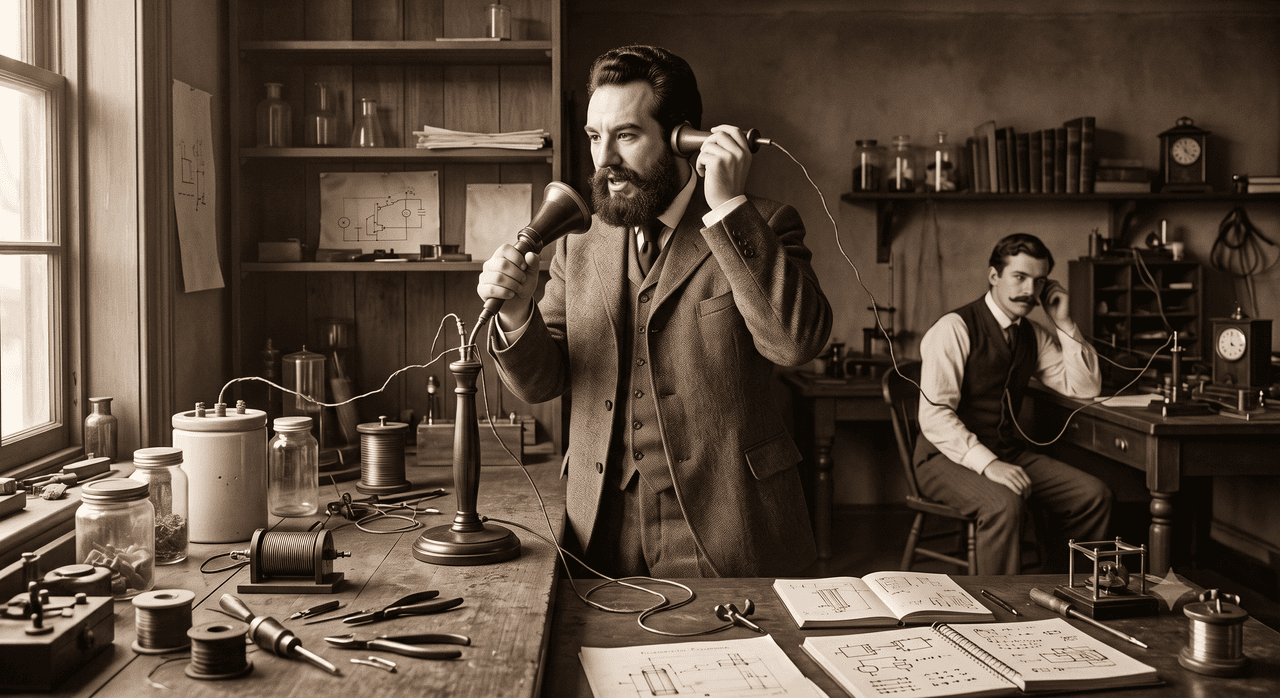




Graham Bell
Alexander Graham Bell was a highly significant inventor and scientist, born in 1847 in Edinburgh, Scotland, who dedicated his life to unraveling the mysteries of sound and enabling human communication. Bell changed the course of world history by inventing the telephone, which allowed people to hear each other’s voices over long distances. He died in 1922.
Childhood and Family
Alexander Graham Bell grew up in a family deeply fascinated by sound and speech. His father and grandfather were teachers of elocution. His mother was deaf. Her inability to hear sparked a profound curiosity in Alexander and his siblings about sound. At the age of just twelve, he made his first invention: a practical machine to separate wheat husks easily for a grain mill. Throughout his childhood, he conducted experiments on sound and vibration in laboratory-like areas at home.
School Years and Studies
During his school years in Scotland and England, Bell began to contemplate how sound could be transmitted over wires. While studying independently, he also taught music and sound-related lessons. He later moved to the United States, where he taught deaf children and helped them learn to speak. These efforts strengthened his belief in the possibility of transmitting sound via electric current.
The Invention That Gave Humanity Voice: The Telephone
Graham Bell, together with his assistant Thomas Watson, worked tirelessly day and night to transmit sound over wires. On March 10, 1876, the moment that changed human history arrived. Bell spoke into the device he had built to his assistant: "Mr. Watson, come here, I want to see you!" This sentence became the first intelligible human voice ever transmitted over a wire, heralding the birth of the telephone.
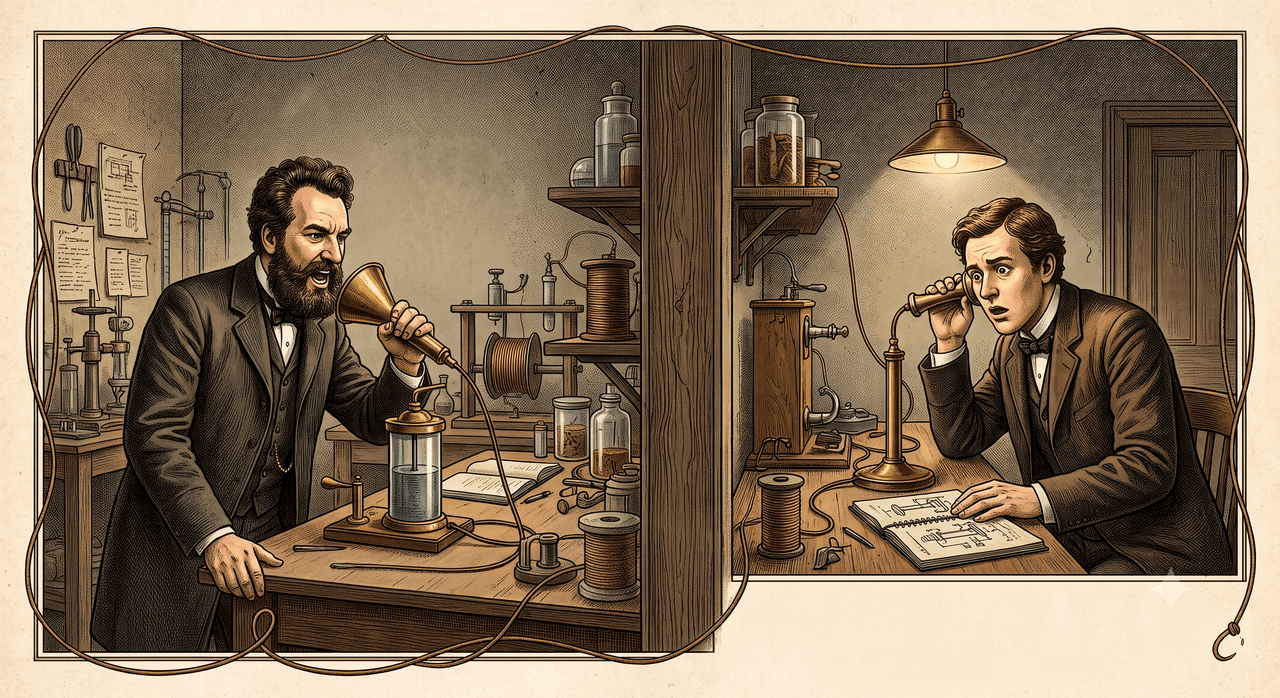
Graham Bell test yaparken. (Yapay zeka ile oluşturulmuştur.)
His Beliefs
He believed that science and technology should exist to make life easier for people and remove barriers between them. He held that communication was the greatest force bringing people closer together. Even after inventing the telephone, he often said that what brought him the greatest joy was helping deaf individuals and illuminating their world.
His Work Style
Graham Bell was an exceptionally curious, observant, and determined researcher. He designed instruments by studying sounds in nature and the structure of the human ear. When an idea failed, he did not give up; instead, he filled his notebooks with thousands of new sketches, repeatedly testing until he achieved his goal.
Some of His Inventions and Works
- Telephone: A revolutionary invention that enabled sound to be transmitted over long distances via wires using electric current.
- Photophone: A device that transmitted sound via beams of light instead of wires, laying the foundation for modern fiber-optic technology.
- Hearing Education Methods: He developed teaching techniques that enabled deaf individuals to learn lip reading and speech.
- Advanced Aviation and Marine Vehicle Designs: In the later years of his life, he conducted research on aviation and marine vessels, designing large kites and submarine-like vehicles.
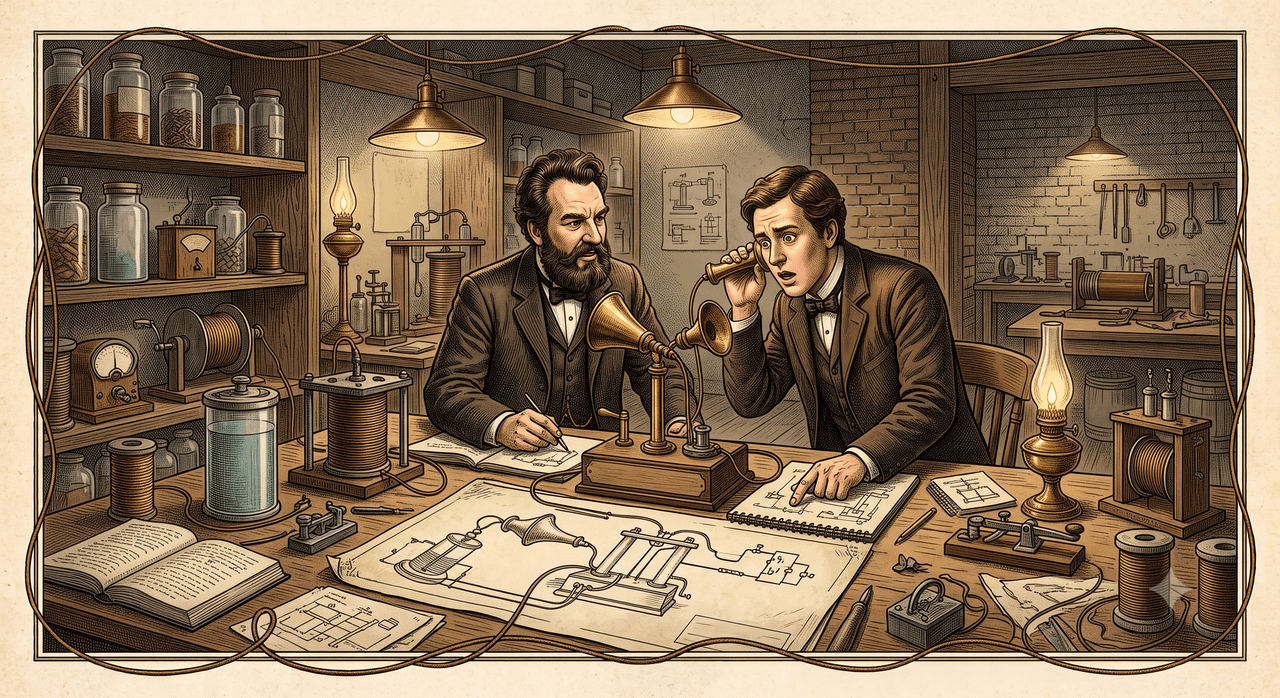
Graham Bell çalışırken. (Yapay zeka ile oluşturulmuştur.)
Later Years
Throughout his life, he never ceased seeking discovery and striving to benefit humanity. He supported the founding of the National Geographic Society to advance science. He passed away on August 2, 1922, at his home in Canada. In his honor, all telephones across North America were silenced for a brief period as a mark of respect.
Final Words
Alexander Graham Bell reminds us: "When one door closes, another opens; but we often look so long and so regretfully upon the closed door that we do not see the one which has opened for us." His determined life stands as the finest proof that curiosity and perseverance can change the world.