


Date of birth | 1847-02-11 | ||||||||
|---|---|---|---|---|---|---|---|---|---|
Date of death | 1931-10-18 | ||||||||
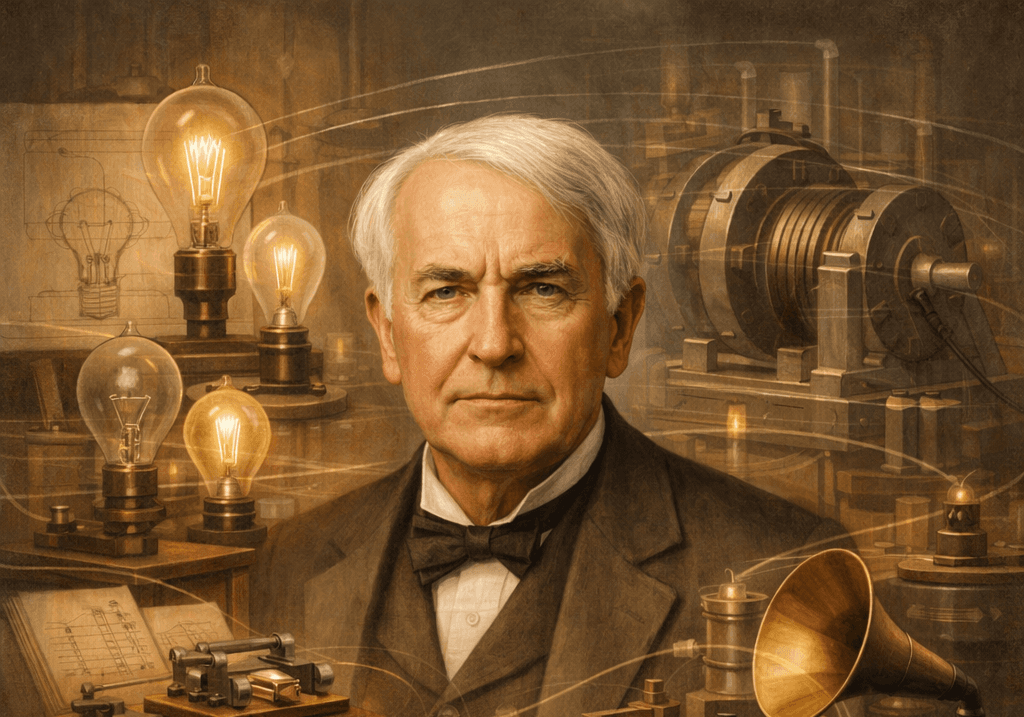
Thomas Alva Edison (11 February 1847 – 18 October 1931) was an American inventor and businessman who lived in the early 20th century. He developed important devices in fields such as electric power generation, mass communication, sound recording and filmmaking. His inventions, including the phonograph, the first motion picture camera and an early version of the light bulb, had a profound impact on the modern industrialized world.
Edison was born in Milan, Ohio, and was the youngest of seven children. When he was seven, his family moved to Port Huron, Michigan. His formal education was short; after being removed from school due to dyslexia, he was educated at home by his mother, who was a teacher. As a curious child, Edison acquired extensive knowledge in physics and chemistry through self-study.
A childhood illness led to hearing problems, which gradually worsened into significant hearing loss. This condition allowed him to focus more intensely on his work and reduced distractions from the outside world.
At the age of 12, Edison began selling newspapers and fruit on a train running between Port Huron and Detroit. Driven by his love of chemistry, he converted part of the train into a laboratory; however, he was fired after a accident. He later worked as a telegraph operator, gaining practical experience in electric and telegraph technologies. In 1874, he established a research laboratory and soon became the owner of the most advanced industrial research facility of his time. He gained fame in 1877 with the invention of the phonograph. He also built the first electric power station and held over 1,000 patents. He founded the company General Electric, which held a monopoly on electricity distribution in America.
Edison died on 18 October 1931 at his home in New Jersey at the age of 84 due to complications from diabetes. His legacy continues through the countless inventions and initiatives that laid the foundations of modern technology. Today, Edison’s creations are still in use across many fields, from electricity to media.
Edison quickly gained fame when he focused his career on invention. Some of his most important inventions include:

The Invention of the Phonograph
The Invention of the Light Bulb

Menlo Park Research Laboratory, New Jersey
Edison held 1,093 patents in his name, making him one of the most prolific inventors in history. His companies continue to exist today under the name General Electric (GE).

General Electric
Edison married Mary Stilwell in 1871, with whom he had three children. After Mary’s death, he married Mina Miller in 1886, and they had three more children. He was widely known for his extraordinary work ethic throughout his life and famously said, “Genius is one percent inspiration and ninety-nine percent perspiration,” to describe his lifestyle.
Behind the Scenes at Edison at Work, https://www.thehenryford.org/explore/inside/edison-at-work/
Fonograf ve Silindir Tarihi, https://www.eskiplaklar.com/fonograf
Who Invented the Light Bulb?, https://science.howstuffworks.com/innovation/famous-inventors/who-invented-light-bulb.htm

Date of birth | 1847-02-11 | ||||||||
|---|---|---|---|---|---|---|---|---|---|
Date of death | 1931-10-18 | ||||||||
Birth and Education
Career and Inventions
Death
Inventive Career
Patents and Achievements
Personal Life