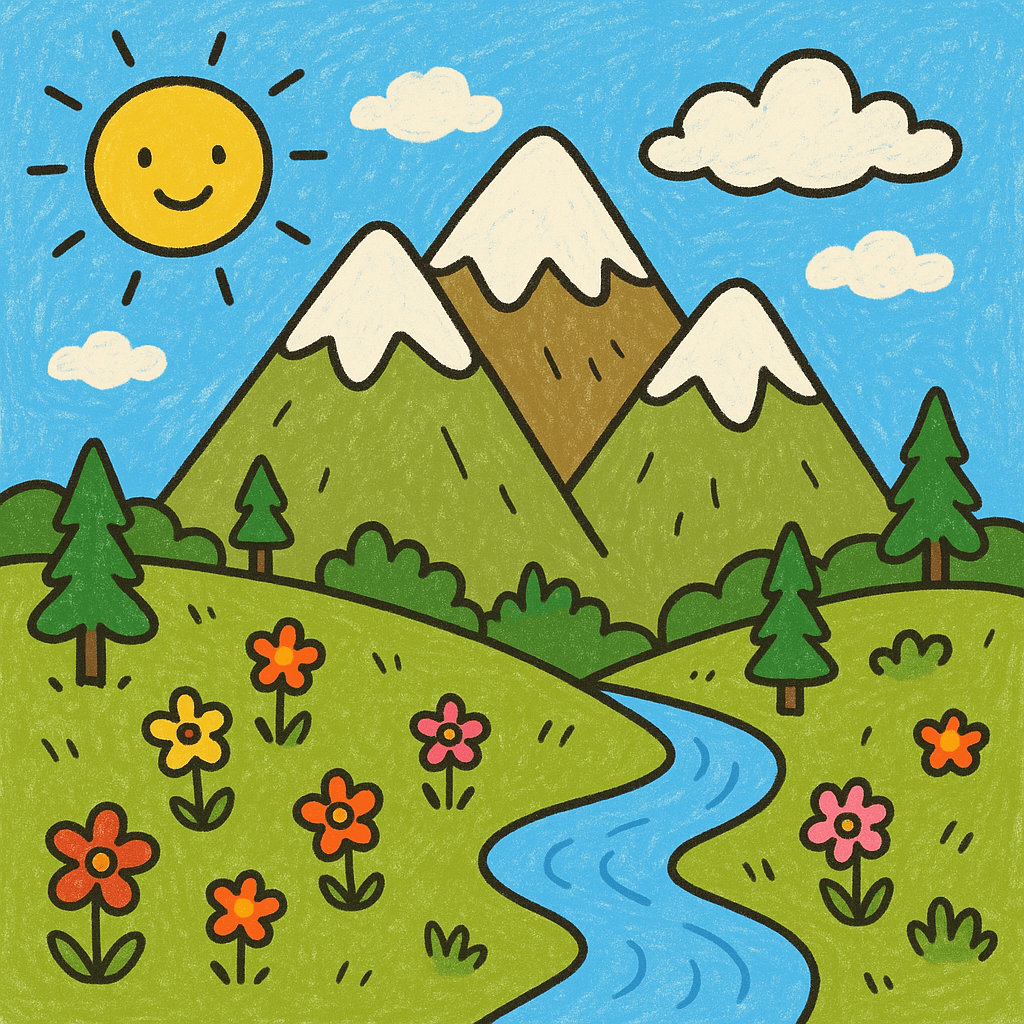




How Are Mountains Formed?
Our planet has a structure that is constantly moving and changing. The mountains we see on Earth’s surface, with their high peaks and summits, are the result of these movements. Mountains are not merely ornaments of nature; they are also extremely important structures that influence climate, water resources, and the lives of living organisms.
The Foundation of Mountain Formation
The Earth’s crust is composed of large sections called “plates.” These plates lie side by side like pieces of a puzzle, but they are never stationary. They move slowly and continuously. Mountains can form when plates collide with each other or move apart.
Understanding the collision of tectonic plates is crucial to understanding mountain formation. When two plates are pushed toward each other, the crust folds and rises upward. It is this uplift that results in the formation of vast mountain ranges.

(Generated by artificial intelligence)
Types of Mountains:
Fold Mountains – “Bent Mountains”
When plates collide, the Earth’s crust bends and folds, creating long mountain ranges. For example, the Himalayas, which contain the highest mountains on Earth, formed in this way.
Volcanic Mountains – “Mountains Born of Fire”
Sometimes magma (molten rock) from beneath the Earth’s surface rises upward. When this magma cools and solidifies, it forms volcanic mountains. Examples in Türkiye include Erciyes, Hasan Dağı, and Nemrut.
Horst and Graben Mountains – “Mountains Raised by Faulting”
In some areas, the Earth’s crust fractures. While some faulted blocks rise upward, others sink downward. The uplifted blocks form horst mountains, while the sunken blocks create graben valleys. The Aydın Mountains in the Aegean Region are an example of this type of mountain.

(Generated by artificial intelligence)
How Do Mountains Affect Our Lives?
Mountains do more than provide beautiful scenery. They are also the source of water resources. Snow and rainwater filter through mountains to feed streams and rivers. Mountains alter wind patterns and influence climate. Moreover, many animal and plant species live in mountain regions. For humans, mountains have become both natural habitats and centers of tourism.