



How Do Day and Night Occur?
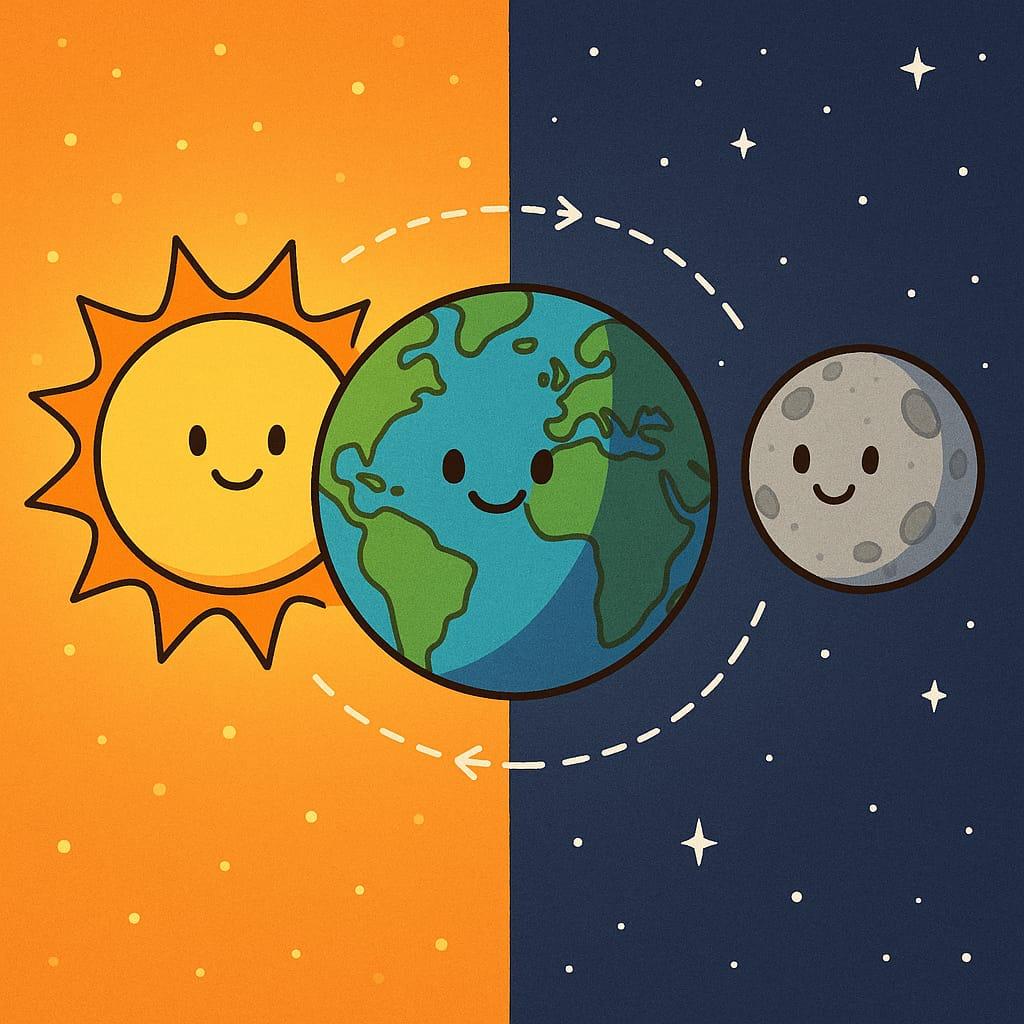
Day and night occur due to Earth’s rotation around its own axis. Because of this rotation, some regions of Earth are exposed to the Sun while others remain in darkness. This natural phenomenon repeats every day.

Visual explaining the formation of day and night. (Generated by artificial intelligence.)
Earth Is Continuously Rotating
Earth rotates from west to east, around its own axis. This rotation takes 24 hours. During this period, every region on Earth is sequentially exposed to sunlight and then enters darkness.
Why Does Day Occur?
When a region faces the Sun, it experiences daytime. The Sun becomes visible in the sky and emits light. The atmosphere brightens and temperatures rise. Living organisms are generally active during the day.
Why Does Night Occur?
As Earth rotates, a region moves away from the Sun and enters darkness, creating night. Sunlight becomes invisible, the air cools, and stars appear in the sky.
Does the Sun Move?
No. In fact, the Sun is stationary. The apparent rising of the Sun in the east and setting in the west is caused by Earth’s rotation. It is not the Sun that moves, but Earth.

Visual explaining the formation of day and night. (Generated by artificial intelligence.)
How Are Morning, Noon, and Evening Formed?
- Morning: The Sun rises above the horizon; its light is soft.
- Noon: The Sun reaches its highest point in the sky. This is the brightest time of the day.
- Evening: As the Sun slowly sets, the sky takes on orange, pink, and purple hues.
Is It Day Everywhere at the Same Time?
No. Earth is spherical and not all regions receive sunlight simultaneously. For example, while it is morning in one country, it may be night in another.
Why Do Day and Night Durations Vary?
Earth’s axis is tilted. This tilt, combined with Earth’s orbit around the Sun, creates the seasons. Depending on the season, days may be longer or nights may be longer.
Is the Situation Different at the Equator and the Poles?
Yes.
- Around the Equator day and night durations remain very close to each other throughout the year.
- In polar regions there can be extended periods of daylight in summer and extended periods of darkness in winter.
What Is Seen When Looking From the Sky?
From space, half of Earth appears illuminated while the other half is dark. As Earth rotates, these illuminated and dark areas continuously shift.